





When the 2025 World Series ended, Clayton Kershaw didn’t even realize it. His storybook career ended in storybook fashion, but from the Toronto visitor’s bullpen, Kershaw had to ask, “Are you sure?” His third World Series title put the stamp on a Hall of Fame career, and three rings outweigh the playoff struggles he was remembered so fondly for.
After an 18-year career, Kershaw will go out as a champion. His 2025 season will go down as a way to remember his greatness: he clawed his way to a 3.36 ERA in 112.1 innings as the third-softest throwing starter in baseball this year. Kershaw’s mastery of pitching defies everything the modern fan thinks they know about the game.
In an era where pitching has transformed more than ever, Kershaw was as stable as they come. Pitching trends came and went, injuries spiked, and starters threw less than they ever have per game. But when #22 for the Los Angeles Dodgers took the mound, everything else faded away. It did not matter how healthy he was, and it did not matter what his fastball velocity reached: Kershaw was a competitor who would succeed in any circumstance.
The accolades speak for themselves, with enough to cement a place in the inner circle of the Hall of Fame and an argument for one of the best pitchers of all time. Kershaw’s 18-year career ends with a career 2.53 ERA in 2,855 innings. Since 1920, no pitcher has had a lower career ERA than Kershaw with at least 1,000 innings pitched. Looking at ERA-, which accounts for league context and park factors (100 is average & lower is better), Kershaw’s 65 ERA- is the best of any pitcher since recorded play began in 1871 (min. 1,000 innings). He had only one season with an ERA over four, an injury-shortened 2024, compared to three seasons with an ERA under two.
He reached 3,000 strikeouts earlier this year, ultimately landing at 20th all-time in career strikeouts with 3,052. His 79.0 fWAR ranks 21st among pitchers, but only Pedro Martínez ranks above him with fewer innings, and the other twenty pitchers have all thrown at least 700 more innings.
In our starting pitcher round-ups, where Nick reviews every starter’s performance from the previous day, Kershaw adopted the TATIAGA nickname: The Ace That is Always Gonna Ace. The Aces Gonna Ace status for any pitcher is significant—a dominant outing is expected—but that was always Kershaw. This article is an ode to TATIAGA, exploring how Clayton Kershaw became a legend and why his greatness endured for nearly two decades.
Prospect Years
The Dodgers selected Kershaw seventh overall in the 2006 draft out of Highland Park, Texas, making him the first high-school pitcher off the board that year. High school pitchers are the riskiest demographic among drafted players, yet Kershaw left little doubt after his pro debut. In 37 rookie ball innings that year, Kershaw had a 1.95 ERA with a 37.5% strikeout rate. He was off to the races.
As he dominated the minor leagues in 2007, the scouting reports suggested greatness, but they don’t exactly line up with the pitcher we saw dominate MLB hitters for nearly two decades. Baseball America’s 2007 scouting report looks like this:
The Dodgers handled Kershaw carefully in 2006 after drafting him seventh overall, then took the gloves off this year. After he blew away MWL hitters, they jumped him to Double-A and he had little trouble against much older hitters. Of course, it’s easy to succeed with two legitimate swing-and-miss pitches. Kershaw had the best fastball in the league, a 93-95 mph buzzsaw, as well as one of the best curveballs. No minor league lefty can match his power stuff. His changeup could give him a third plus pitch, though he had little need for it until he got to Double-A. He has a clean delivery and mound presence well beyond his years, and he just needs to refine his command to complete the package. “He was by far the highest-ceiling minor league arm I saw all year. The second-best was Clay Buchholz,” a National League scout said. “Kershaw could end up winning Cy Young Awards. Not many young guys do what he does.”
The scouting report highlights the exceptional fastball and jaw-dropping curveball as the two primary offerings, with the changeup as a potential third. The dominant two-pitch combo was enough to overpower minor league hitters, but such a small arsenal would prove detrimental against better competition. Kershaw cruised through Single-A and got a taste of Double-A before the end of the season, quickly putting the 19-year-old on MLB radar.
In 2008, Kershaw came out dominating Double-A hitters, posting a 2.28 ERA in 43.1 innings. Baseball America’s scouting report pegged the curveball as a 70-grade pitch on the 20-80 scale and graded the changeup as a solid pitch with plus potential.
By mid-May, the Dodgers made the call for Kershaw to get the promotion straight to the big leagues, skipping Triple-A.
The Early Years
Kershaw debuted on May 25, 2008, in Los Angeles, where he faced off against the (soon-to-be arch-nemesis) St. Louis Cardinals. The 20-year-old donned number 54 on his back for his first major league game, and it was as eclectic as a pitcher’s debut can be. Leadoff hitter Skip Schumaker fouled off four straight pitches before Kershaw retired him.
Kershaw’s 95 mph fastball may seem like the standard today, but it was four MPH harder than the average lefty fastball. After getting the first one out of the way, he walked Brian Barton on four straight pitches and gave up a double to Albert Pujols. It was 1-0 very quickly. Thankfully, Kershaw struck out Ryan Ludwick and Troy Glaus to end the inning, and he ended up cruising through six innings with seven strikeouts and only two earned runs. In his debut, Kershaw threw 65% fastballs and an equal amount of changeups and curveballs.
Despite the curveball’s mesmerizing shape, it wasn’t a pitch Kershaw could go to frequently. He kept throwing the changeup as a third offering, but it wasn’t working. After eight starts, he had a 4.42 ERA with ERA estimators to match. He was struggling to throw strikes or miss bats, with a 5.2% K-BB% driven by a 14.0% walk rate. Kershaw was briefly demoted in July.
After returning three weeks later, the underlying skills began to come together. Although the 4.17 ERA and 3.96 FIP were marginal upgrades, his K-BB% had improved to a more reasonable 13.1%.

(Writer note: Kershaw debuting in 2008, when the pitch-tracking era began, was very helpful)
As the debut adrenaline wore off and he couldn’t just overpower hitters to strike them out, Kershaw struggled to adapt until after his demotion. He started to move away from the changeup and embrace the curveball more, leading to more strikeouts. By September, Kershaw was throwing the changeup just 2.4% of the time. While the standard mantra for young pitchers is to develop the changeup, it just wasn’t working for him. Kershaw’s rookie year ended with a 4.26 ERA in 107.2 innings. It wouldn’t be for 16 years that his ERA would start with a four again.
He made the Dodgers’ playoff roster, but played a minimal relief role: he threw 1.2 innings in Game 2 of the NLCS and 0.1 innings in Game 4. His Game 2 appearance was while the Dodgers were already losing, and he gave up a run in Game 4 that ultimately did not matter.
As far back as modern baseball analysis goes, evaluating pitching prospects, especially high school ones, is incredibly difficult. The saying there is no such thing as a pitching prospect, or TINSTAAP, traces back to a 2003 Baseball Prospectus Article by Joe Sheehan, which attributes the acronym to Baseball Prospectus Founder Gary Huckabay from the late ’90s. It references the volatility of young arms, whether it be injury risk or ability. It can be “easy” for a raw potential pitcher to overpower minor league hitters, but the skills required to beat the best-of-the-best are significantly more.
Kershaw came up as one of the top pitching prospects in baseball, and he had two pitches that could succeed at the big league level. The problem was that the changeup was still lacking, and he had nothing else to fall back on.
2009 started on a similar footing: over 10 starts, he posted a 4.34 ERA, 4.06 FIP, and a 9.9 K-BB%. The Dodgers could stomach a slow start—they had a 34-15 record—but the leash is only so long.
In his eleventh start of the year, Kershaw made a change. He nixed the changeup entirely and threw 12 sliders: a completely new pitch. The slider came in with mid-80s velocity and a sharp, but traditional, shape. Deploying it equally to lefties and righties, it only found the zone 25% of the time, but it was a new tool.
As he gained confidence in the slider, the results started coming. He was missing more bats, and the performance came along with it. He used the slider 8.8% of the time in June, and its usage rose each month. By September, the slider’s 15.7% usage was more than the curveball’s. It had become pitch number two in just half a season.
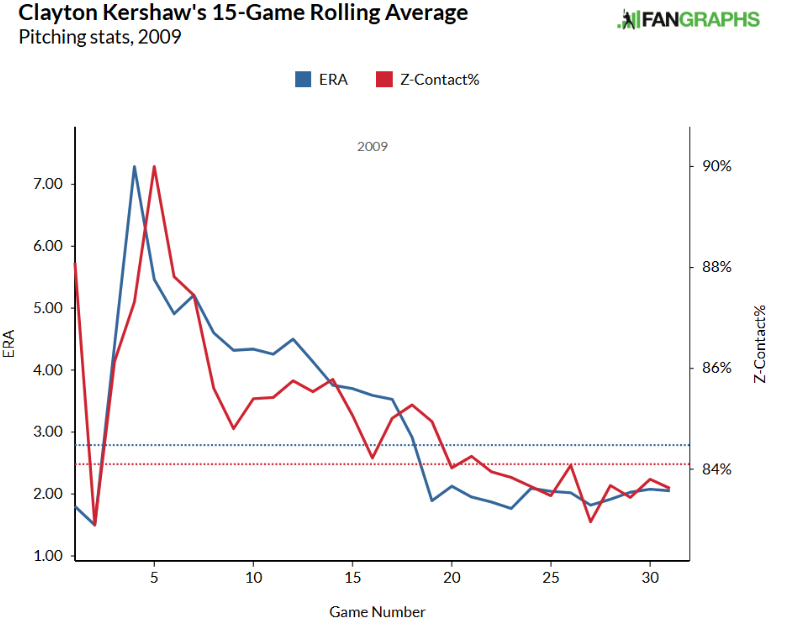
Since implementing the slider, Kershaw’s sophomore slump was no longer. Kershaw established the inner third of the plate with his fastball, the slider nestled underneath it. The pitch would jam hitters who could put a bat on it or breeze under a swing geared for the fastball. In 115 innings, he posted a 2.03 ERA, 2.60 FIP, and 15.1% K-BB%. He was still walking too many hitters, but he found his path to making big league hitters miss. His final season ERA ended at 2.79, which began a streak of 10 consecutive seasons with an ERA under 3.00.
The elite performance down the stretch earned Kershaw a spot in the playoff rotation. His first playoff start came in Game 2 of the NLDS, where he went 6.2 innings and gave up two earned runs. Kershaw exited the game losing 2-1, but Mark Loretta’s walkoff single gave the Dodgers the win. His second start, in Game 1 of the NLCS against the Philadelphia Phillies, was a glimpse into the future heartbreak. Up 1-0 in the fifth, Kershaw unraveled. He gave up five runs, with a three-run home run by Carlos Ruiz being the dagger. The Dodgers were ultimately eliminated in five games.
Going into 2010, Kershaw started putting something special together. With a full offseason of preparation on the slider, he was ready to annihilate major league hitters. He threw the slider 20.2% of the time, and it neutralized hitters to a .107 average and 43.9% whiff rate. He maintained his strikeout rate gains from the year before, but also started to see control improvements. His first-pitch strike percentage increased five points from the two years before, and his walk rate dipped below ten percent for the first time.
Not only were Kershaw’s pure skills improving, but his outings were also lasting longer. In 2009, Kershaw went seven innings or deeper eight times. In 2010, it was 15 outings. Kershaw’s first complete game shutout came in September, when he silenced the San Francisco Giants. His maturity from flashy prospect to dominant ace was happening in front of everyone’s eyes. He eclipsed 200 innings for the first time and maintained a 2.91 ERA. While he was viewed as a top pitcher in the league, he was still a tier below the Félix Hernándezes and Justin Verlanders of the world.
Utter Dominance
Coming off back-to-back strong years, Kershaw earned the nod to start Opening Day in 2011. Now 23 years old, he was leading the Dodgers’ pitching staff into the season. While you may look back at the stat sheet and see how dominant this year was, that wasn’t entirely the case for Kershaw.
Through his first 14 starts, which took him into mid-June, Kershaw held a 3.44 ERA. He gave up more than three earned runs in five different starts. The underlying metrics had taken a step up: his K-BB% was near 20% and FIP was under 3.00, but the results weren’t there. Then Kershaw became the pitcher we know.
His next 19 starts culminated in a 1.52 ERA across 141 innings. It began with back-to-back complete games with 11 strikeouts in each. He pitched into the seventh in all but two starts, as his walk rate was only 4.8%. He was challenging hitters in the zone, and they couldn’t do anything.
He earned his first All-Star Game nod in 2011, but the tear he ended the year on brought much more. Kershaw won his first Cy Young Award with a pitching Triple Crown – wins, ERA, and strikeouts — a feat only done three times since 2000 before Kershaw (and Verlander in the same year). Kershaw also led the National League in WHIP with his first figure under 1.00. He had become an Ace.
The next six seasons would be a blur of domination. Kershaw’s average season looked like what a good pitcher could barely even dream of:
Kershaw’s second Cy Young came in 2013 and retained the award in 2014: back-to-back seasons with a sub-2.00 ERA. He had 50 starts with ten strikeouts or more – only Max Scherzer and Chris Sale had more.
While his curveball carried the weight for who the public knew as Kershaw the Ace, any worried hitter knew that was often the least of their concerns. His slider obliterated anyone who dared to touch it. It might not have been as aesthetically pleasing as the curveball that froze hitters, but a weapon doesn’t need to be attractive to do damage. The results spoke for themselves.
During each consecutive year of this stretch, Kershaw’s slider held a whiff rate above 40%, a figure that is 80th percentile or better depending on the year. But for how much he threw the slider, its consistency was essentially in a tier of its own. 2014’s 45.5% whiff rate on the slider is in elite company. In the pitch-tracking era, only three pitchers have had a season with more sliders than Kershaw with a higher whiff rate: Spencer Strider, Patrick Corbin, and Robbie Ray. Kershaw’s curveball never had a higher whiff rate than the slider.
As the years went on, Kershaw fell in love with the slider and used it to diminish his fastball usage. It helped prevent damage from waning velocity, and it became a guessing game. In 2017, he threw 46.6% fastballs — the first time less than half of his pitches were fastballs — and the slider usage was at 34.7%.
The pure accomplishments achieved in this stretch are a sight to behold. The consistency and ruthlessness of prime Kershaw are hard to believe. When he signed a seven-year, $215M contract ahead of the 2014 season, it was the biggest contract by average annual value ($30.7M) for a pitcher ever. It was then backed up by an MVP season and a 1.77 ERA in 2014, and by 300 strikeouts in 2015 (in one of the best Cy Young races in recent memory). While he made only 21 starts in 2016 (and didn’t qualify for the ERA title), his 1.69 ERA was one of the best per-inning seasons in recent memory; his 42 ERA- is the best since Pedro Martínez in 2000.
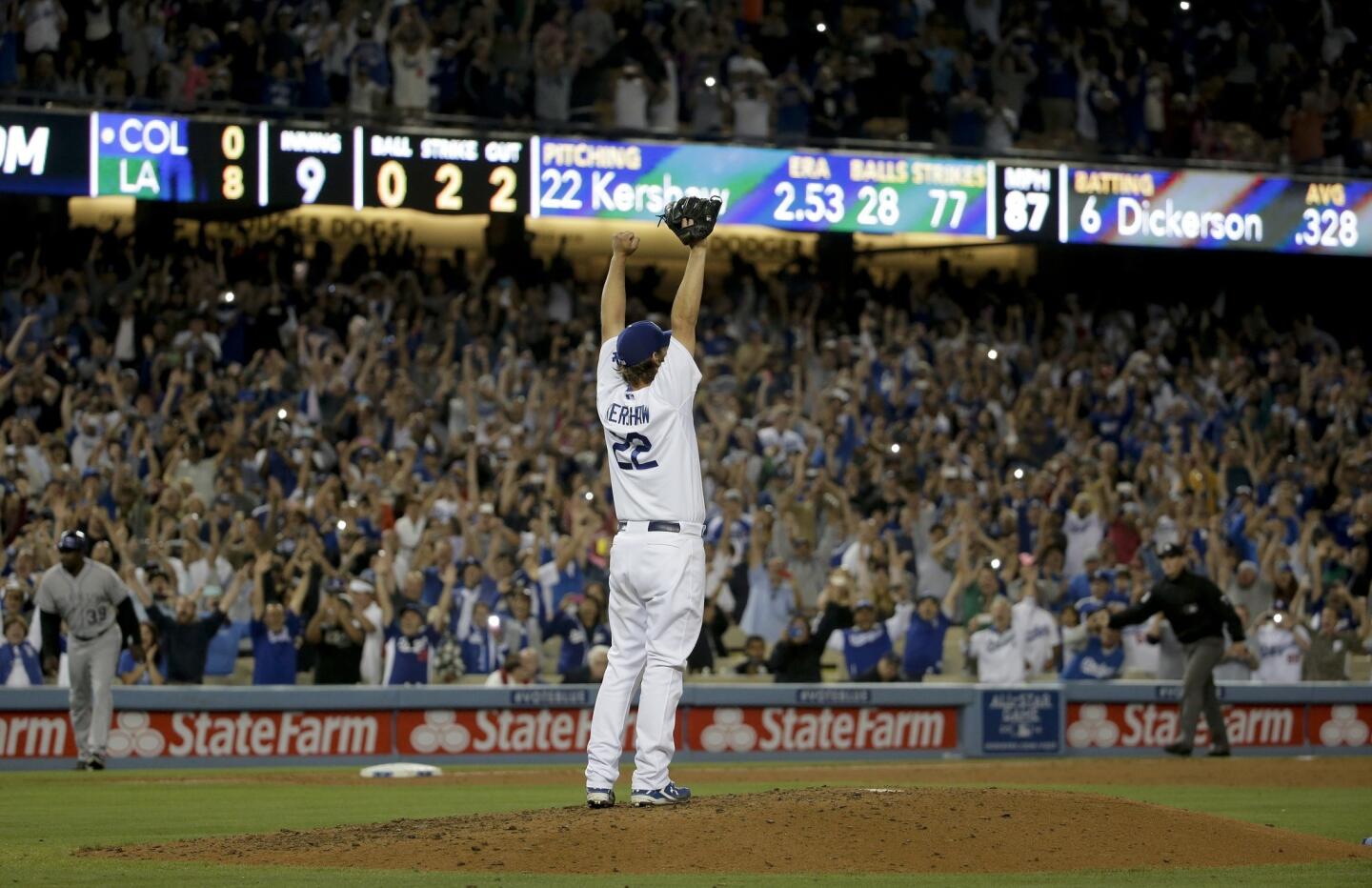
He got his no-hitter, which, in Kershaw fashion, was an all-timer. He struck out 15, with the only blemish being an error. It was as dominant as any no-hitter can be, just inches from perfection. And it wasn’t luck that got him that night in Los Angeles, but the full culmination of everything he was capable of. Kershaw spent his entire career lifting his hands above his head before every pitch, but the most iconic shot came after his 107th pitch, when he delivered greatness.
Courtesy: Chris Carlson / Associated Press
The success was undeniable, but it came at a high cost. Kershaw’s playoff resume didn’t match his regular-season one, and health quickly became a limiting factor.
His time as an Ace began with two years at home in October, and his proving ground started in 2013 as the presumptive Cy Young winner. The 2013 playoffs started with signature moments: he hurled seven innings of one-run ball with 12 strikeouts in Game 1 of the NLDS, and backed that up with six shutout innings in clinching Game 4. That doesn’t usually show up in memories of early Kershaw postseason moments. Game 2 of the NLCS was a pitchers’ duel that saw the Dodgers lose 1-0 on an unearned run. Kershaw had thrown six shutout innings outside of a passed ball and a sacrifice fly, putting his ERA at 0.47 through three postseason starts.
And then Game 6 of the NLCS happened. In a win-or-go-home setting, Kershaw got shelled for seven earned runs against the St. Louis Cardinals. In the moment when the Dodgers needed him most in his young career, he fell flat.
Kershaw looked to exact revenge in the 2014 NLDS, as the Cardinals and Dodgers lined up again. Two pitches into Game 1, and the Dodgers were down 1-0. It seemed cataclysmic, but Kershaw cooled off and had a 6-2 lead going into the seventh inning. Then, it actually became cataclysmic. The Cardinals put up eight runs, driven by Matt Carpenter’s bases-clearing double to take a 7-6 lead. The train had derailed again.
In Game 4, Kershaw, once again, had an opportunity. Down 2-1 in the series, the Dodgers turned to Kershaw on short rest. He was cruising through six innings: one hit, no runs, nine strikeouts, and a 2-0 lead. It was his moment, until it wasn’t. The seventh inning started with a groundball single that hit off the glove of a diving Dee Strange-Gordon at second base. It continued with a weak line drive single that nicked Hanley Ramírez’s glove. It could just as easily have been two outs, no one on. Matt Adams came to the plate, a career 51 wRC+ hitter vs. LHP at that point, and delivered the crushing blow to Kershaw.
The following years continued to be just one step short. Even the good performances couldn’t get over the hump. Game 1 of the 2015 NLDS saw Kershaw strike out 11 Mets but give up three runs and get outdueled by Jacob deGrom. His electric start in Game 4 got the Dodgers to Game 5, but it gets washed over as the Mets won the series. He continued to have ups and downs in the 2016 playoffs, but coming up short in Game 7 of the NLCS is what’s remembered most. Even when the Dodgers reached the World Series in 2017, the performances only mattered until they didn’t. Kershaw was electric in Game 1—seven innings, one run, 11 strikeouts—but he struggled in a Game 5 that ultimately ended up out of his hands. For as much as he was in control during a 162-game season, he struggled to find a groove in October.
The other cost that started to eat at Kershaw was health. Although he had made one Injury List stint in 2014 for an elbow strain, he was relatively healthy for a workhorse pitcher. But starting in 2016, a streak of consecutive years with an IL stint began. From his bicep to his shoulder to his back, it started to pile up. More and more time was missed, but on the field, it didn’t matter. Kershaw was at his full capabilities during the regular season when healthy. There was just a large postseason demon, and the health scares started to suggest he might be running out of time.
The Later Years
For a preeminent pitcher playing for a preeminent organization, there was an immense amount of pressure on Kershaw to get something out of the postseason. All the accolades in the world, but not the most important one: a World Series trophy.
The 2018 season saw multiple IL stints due to various injuries, and it was the first time since 2010 that he was not an All-Star or received Cy Young votes. That didn’t stop Kershaw from posting: he still had a 2.73 ERA. However, the peripherals took a significant step back from the elite. His strikeout rate dropped six percent, going from around 30% to 23%. Still above league average, but not in standout fashion.
Kershaw’s raw ability was starting to fade — his fastball dropped two ticks — but that wasn’t going to prevent him from being the pitcher he was. Instead, he turned to his slider more than his fastball. The 90.8 mph fastball and 88.1 mph slider became almost indistinguishable from one another, while the curveball could still freeze hitters.
The 2018 World Series, a second consecutive appearance for the Dodgers, felt like yet another back-breaking blow. Kershaw lost Game 1 and the title-deciding Game 5. The cool air seemed to be his kryptonite, as even the trips deep into October only broke him down more.
In 2019, Kershaw broke his Opening Day start streak, which felt emblematic of where he was at the time. There was still a good pitcher in the #22 Dodger jersey, but it seemed harder to get to consistently. His ERA rose above 3.00 for the first time since his rookie year. 2019 also brought a brutal gut punch in the playoffs: coming out of the bullpen, Kershaw conceded back-to-back home runs in Game 5 of the NLDS. It continued to slip away.
The 2020 season was anything but normal, but that worked in Kershaw’s favor. Reality flipped upside down, and so was Kershaw’s trajectory. He dominated the 2020 regular season to the tune of a 2.16 ERA in 58.1 innings (a full 2020 season), but then didn’t stop in the postseason.
He almost singlehandedly eliminated the Milwaukee Brewers in the Wild Card Round. His eight shutout innings, 13-strikeout game was arguably one of the best postseason starts of his career, even if the energy around the game didn’t match the stakes.
He survived a start against the San Diego Padres in the NLDS, but it set him up to get a pivotal NLCS Game 4 start against the Braves. Tied 1-1 in the sixth inning, in a series where the Dodgers trailed 2-1, Kershaw gave up three straight hits as the game fell out of the Dodgers’ grasp. He had seemingly let them down once again. But for all the times they came up short, the Dodgers repaid the favor. They won games five, six, and seven to send the Dodgers to the World Series for the third time in four years.
Game 1 was electric from Kershaw, as he outdueled future teammate Tyler Glasnow. The World Series was hosted in his hometown ballpark in the Dallas area, giving it an odd home-away-from-home vibe. Up 2-1 in the series, this is where Kershaw had crumbled so many times before. Not this time, though. It wasn’t quintessential Kershaw, but it didn’t need to be. He gave up two runs in 5.2 innings in Game 4, while the bullpen held the win intact to put the Dodgers in the driver’s seat for a World Series title. His sixth strikeout of the game marked postseason strikeout 207, which was the most in history at the time. It was a record-breaking display of patience that marked the culmination of years of postseason frustration, even as he leaned on his teammates to close it out.
Two days later, Kershaw celebrated from the bullpen as he finally won his World Series. The weight had been lifted from his shoulders.
Having locked down a near inner-circle Hall of Fame career, the subsequent years only enhanced it. His skills continued to fade, yet that didn’t impact his ability to pitch. His fastball velocity dropped below 90 mph more frequently, but his sheer drive and execution kept the ERA down. Right when people expected the end to be near, he proved he’s the best of his generation.
His 2021 ERA ballooned to 3.55, and health limited him to 121.2 innings. So, naturally, Kershaw turned around to throw to a 2.28 ERA in 126.1 innings in 2022 and a 2.46 ERA in 2023. His ages 34 and 35 seasons got All-Star nods, not because of who he used to be as a player, but because he was an Ace who was always going to be an Ace. The TATIAGA nickname coined in 2016 was for the consistency at the top of the game, but it rang more true at the end of his career.
Kershaw was limited to just 30 innings in 2024, which seemed like the end. He still experienced a second World Series-winning moment, one that was simply the Dodgers organization paying him back for all his years of service. However, Kershaw wanted just one more year. The injuries kept him down, but not out.
At 37 years old, Kershaw’s 2025 is a storybook ending. Despite his body failing him the year before and his raw ability depleting, Kershaw pitched his way when he stepped on the mound. It didn’t matter that the strikeout rate dropped below the league average, something he hadn’t done outside of the injury-shortened 2024. It didn’t matter what the radar gun said. His 3.36 ERA was a testament to Kershaw’s full embodiment of being a pitcher.
Being a classic pitcher also came with the accolades that so few (if any) future pitchers will earn. Having already picked up his 200th win in 2023, Kershaw earned his 3000th strikeout in July 2025.
A tight slider in a perfect location is Clayton Kershaw.
For as mean as the game had been to Kershaw at his peak, it was indeed forgiving down the stretch. So many greats don’t get to nail all of the achievements and send-offs as intended, but the universe was kind to #22.
Outside of a sacrificial appearance in the 2025 NLDS (that we don’t need ever to look back on), Kershaw made one real appearance in the Dodgers’ 2025 World Series run. Tied 5-5 in the bottom of the 12th inning, Kershaw came in to preserve the tie score. Just the thought of playoff Kershaw with runners on base can send a shiver down someone’s spine. We all know how it’s gone for so many years. And yet the universe aligned, for Kershaw’s eighth pitch (seven of which were sliders) to Nathan Lukes, to be dribbled softly up the line for a groundout that preserved the game ahead of an 18th inning walkoff.
Regardless of the inning count for Kershaw, he earned this title. If not for his 2.1 innings in the playoffs, but for the 18 seasons of brilliance that Dodgers fans are unlikely to see again.
The Legacy
Kershaw finished his career as a three-time World Series champion, three-time Cy Young award winner, and 11-time All-Star. The 2.53 career ERA is as unbelievable as it looks. His 3,052 strikeouts rank 20th all-time, but he’s only the fourth left-handed pitcher to do it, behind Steve Carlton, Randy Johnson, and CC Sabathia. Only two other pitchers have 3000 strikeouts with just one team: Walter Johnson and Bob Gibson.
Clayton Kershaw’s story is one of both the classic great pitcher and a modern one. His modern adaptability set him up for long-term success, but the early-career workload and dominance align more with an older generation of pitchers. For as much as the postseason plagued Kershaw, it was all done right in the end. It can be easy to pick nits at an inner-circle Hall of Famer, but Kershaw’s results down the stretch defy the modern understanding of baseball and only prove his worthiness as an all-time great.
We won’t see another like #22 on the Dodgers, but we’ll all wish we did.
Stay tuned for the second article about Kershaw, Almost Perfect, a deep dive into one of Kershaw’s best starts.
