





On the surface, not much about Andrew Abbott stands out. He’s undersized as pitchers go, he doesn’t throw very hard, and his stuff isn’t that aesthetically pleasing. You might be thinking there’s more under the hood about his pitches that make them better. You’d be right, but his stuff doesn’t do enough to explain how he’s the owner of the 4th-best ERA among qualified pitchers. His 2.41 narrowly trails Skubal’s 2.35 and Sánchez’s 2.36, all of whom are behind Skenes’ absurd 2.13.
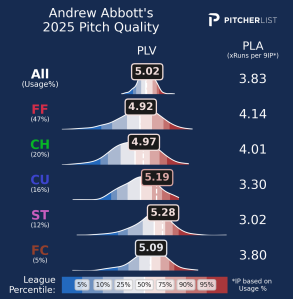
A picture is painted of a pitcher who should be a bit above average. That is not what Abbott has been this year. PLV accounts for command as well, which we’ll get into a bit later. First, let’s dig into what he throws to get a better idea of what he’s working with.
What He Offers
Abbott’s 4-seam is… not bad? It’s playing like it’s good, which is something. In terms of pure stuff, this seems like it should be an exceptionally hittable fastball. Below average velocity, generic release point, a shape that is doubly generic, both in that it’s around the average for all pitchers, and that it’s about what would be expected given his release. Despite this, it runs above-average called strike rates, average whiff and SwStr rates, and above-average batted ball results. Abbott’s crossfire delivery is likely helping at least somewhat, especially as a left-handed pitcher; moving the way he does tends to make it more difficult for batters to read his pitches as well. So, despite the generic release point, his delivery helps his stuff play up a bit. His motion is not the heavy lifter in this equation, but it’s worth mentioning.
What Abbott’s changeup lacks in pure stuff, it makes up for with deception. It spins on a similar axis as his 4-seam with the same spin efficiency and with higher than average spin for a changeup. He also maintains his delivery better than most pitchers across their fastballs and changeups; he doesn’t drop his arm slot much at all to throw this pitch. So while it doesn’t hit any elite marks for shape or separation, its 6” of horizontal and IVB difference from the 4-seam and 8 mph gap are more than enough when paired with its trickery.
I’ll cover his curveball and sweeper together because they’re very similar pitches. They both come in the low 80s, and they both have about 10” of sweep. One rises a few inches, the other drops a few. The sweeper is his main secondary against lefties, but switches to a background role against righties. The curve is his third-most-used pitch against either handedness. They’re both perfectly fine in terms of stuff.
He’s also debuted a cutter this year as something to use against right-handed hitters. As with most cutters, the movement is less important than the execution. He’s drilling this pitch in on their hands, which is good. He doesn’t always hit his spots, and when it’s been left in the zone, it’s been hit hard, which is bad. It’s a fine addition as long as he doesn’t use it too much and can avoid too many mistakes.
A Game of Keep-Away
I’ve alluded to it a few times now, and you’ve probably figured out that the way he’s succeeding is more to do with the execution of his pitches than the quality of their stuff. It’s the way he’s executing that’s unique, though. One last thing before we get into what he’s doing well, let’s quickly go over the downside of what he’s doing.
This should not inspire confidence in Abbott being able to maintain his performance. A pitcher who isn’t getting strikeouts while having extreme fly ball rates is usually not doing well. Especially not with Cincinnati as his home park, which generally makes it exponentially worse. Thankfully, these negatives are somewhat mitigated by Abbott’s technique this year. His secret is that he’s filling the outer half of the zone against all hitters to make it harder for hitters to pull the ball. Abbott leads all qualified pitchers with a 31.0% opposite-field contact rate this season. While he does still allow more pulled contact in the air than you might like, this is the nature of who he is as a pitcher. He will always allow a lot of flyballs. Getting them to pull as few of those fly balls as he can, or making it so that pulling the ball means hitting it less optimally, is how he can manage this.
Abbott’s overall 55.3% oLoc% is the 5th highest among all starters this year, and that number includes his cutter, which he almost exclusively throws inside. He lives on the outer half, and it’s harder to turn around and pull a ball that the hitter has to reach the barrel further out to get to.
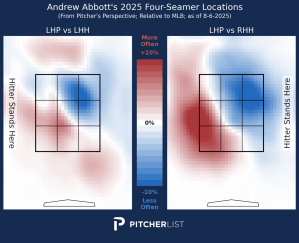
You don’t see it quite as much against the lefties, as he uses his fastball a bit all over against them, but is more focused on setting up the sweeper. Against righties though, the massive red splotch in the lower left corner is from him living on the far side of the zone, keeping it out of the wheelhouse. Hitting the ball hard the other way is difficult, especially in a league that is now so geared toward pulling it. Should he run into a lineup of slap hitters, he might be in trouble, but I also don’t expect him to take the DeLorean back to 1985 any time soon.
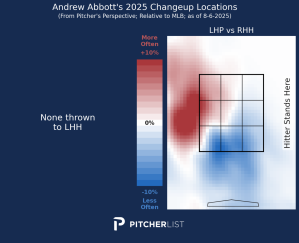
This is the baseball equivalent of the rice and ground beef diet. It’s basic and repetitive, but it gets the job done. Keep your changeup away from hitters, and they won’t hit it. Not to mention, this is a perfect spot to be throwing his changeup, considering where he lives with his fastball. The tunnelling he creates here is immaculate.
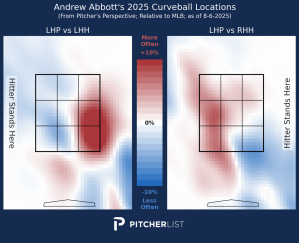
Oh, look at that, more pitches on the outer half. Unsurprisingly, hitting backdoor curves against opposite-handed hitters helps you rack up called strikes, 25.4% of all of his curves to righties this season, for the record. Hitting the far side of the zone against same-handed hitters with the curve will garner you fewer called strikes, 10.8% in this case, but he racks up whiffs, chases, and bad contact without issue.
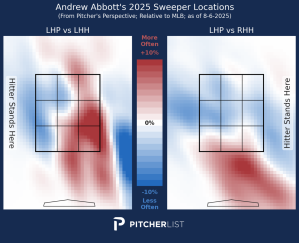
Here, we see more sweepers thrown to the outer half to same-handed hitters, where they belong. Interestingly, he throws this pitch below the zone against righties instead of the curveball. Logic would dictate that he should throw the pitch that moves down more below the zone, and the pitch that slightly fights gravity at the bottom, for more chases and called strikes, respectively. I would assume the reason he doesn’t is that the sweeper is easier to get under than the curve is, and would thus be more open to dangerous contact when left down in the zone, even if he were spotting it where he was throwing the curve.
The Outlook
His stuff is a bit different from last season. He raised his arm slot slightly this season, while also getting less extension, and it caused very slight changes to his pitch movement. His sweeper breaks a couple of inches less than it did last year, and his changeup added a little depth. More notably, his working outside as often as he does is a newer development for him.
I’m convinced this is why his fastball is playing better this year. The new strategy is working wonders for him. He turned one of his bigger weaknesses into a strength. It’s strange to see a 4-seam be such an effective pitch as it pertains to its ability to induce non-threatening batted balls. It’s not even coming from an exorbitantly high pop-up rate. It being in the 67th percentile for that metric is honestly lower than I expected it would be. Hitters are putting it in the air, it’s just that it usually finds an outfielder’s glove after lazily drifting its way out there.
He shuffled his usage around a bit going into this season, but the modification consists mostly of throwing fewer sweepers to righties, and letting the changeup do the work there. Realistically, I’m not sure what more there is to change, how he can grow. He could stand to take some pressure off his fastball and throw it less, but it’s working so well right now, why bother? This strategy probably won’t be as effective as it is now forever, even beyond the regression I expect to come due to him playing a bit above his peripheral stats right now.
Even with that being the case, should hitters adjust and start hitting those low fastballs, he can just start elevating above the zone again, or throwing more changeups. It’s rare for me to look at a pitcher and think that they’re entirely optimized, but Abbott’s doing about all he can. I suppose he could spend next offseason learning a gyro breaker to give him another out pitch against righties, but that would be icing on an already well-made cake. Really, all he needs to do right now is continue to sharpen his command and be ready to adjust as needed. For now, he can just keep on cruising as the league’s premier keep-away artist.
