





Aroldis Chapman has long been one of the most electrifying pitchers in all of Major League Baseball. For almost a decade and a half, his trademark triple-digit fastball has defined dominance on the mound, while his ability to maintain that velocity deep into his 15-year career, especially in today’s injury environment, is truly astonishing. What is even more impressive is that Chapman has turned in one of the best performances as a closer this season, posting a 1.14 ERA over 55.1 innings pitched as of the writing of this article, and will likely accumulate 30 saves for the ninth time in his career. While Chapman’s sustained above-average velocity has been a contributing factor to his success this season, he has also cut his walk rate in half (from 14.7% in 2024 to 6.9% in 2025), further improving his overall level of production. This article will take a look at the subtle changes that Chapman made to his arsenal this season, as well as examine his improved location ability, which has allowed him to have a dominant 2025 season.
Over the past two seasons, Chapman’s profile has been relatively volatile, combining high strikeout rates and high walk rates, allowing him to both dominate opposing hitters while also being vulnerable to blown saves by allowing runners on base. Last season, Chapman produced a 37.0% strikeout rate, 14.7% walk rate, and 3.79 ERA with 14 saves over 61.2 innings pitched for the Pittsburgh Pirates. As mentioned earlier, Chapman has dramatically lowered his walk rate this season, while also increasing his strikeout rate, resulting in a 39.7% strikeout rate, 6.9% walk rate, and 1.14 ERA with 29 saves over 55.1 innings pitched so far this season. While Chapman’s improvement in zone rate from 51.6% in 2024 to 54.8% in 2025 has played a role in his decline in walk rate, Chapman has also been locating his pitches in more optimal locations to generate sub-optimal outcomes from opposing hitters.

The tables above depict Chapman’s location plots during the 2024 and 2025 seasons. In my opinion, the primary difference that can be observed between these two seasons is the improvement in Chapman’s four-seam fastball location. In 2024, Chapman tended to locate the pitch right down the heart of the plate, while so far this season, he has been locating the pitch up in the zone more frequently. While Chapman’s high velocity and above-average “stuff” allow him the ability to still throw pitches down the middle and generate swing-and-miss, frequently locating his four-seam fastball down the middle left Chapman vulnerable to damage, and this change in location has lowered opponents’ xwOBA on his four-seam fastball from .399 in 2024 to .310 in 2025, and their observed wOBA on the four-seam fastball from .413 in 2024 to .244 in 2025. This improvement in location is also backed up by FanGraphs’ Location+ model, with the four-seamer improving from a 117 Location+ in 2024 to a 140 Location+ in 2025.
While Chapman’s four-seamer has received the highest location grades by the Location+ model, Chapman has also displayed excellent location ability with his sinker this season, with the pitch receiving a 118 Location+ grade in 2025. Possessing a sinker with a more traditional “two-seam fastball” shape (possessing more arm-side run compared to the four-seamer, as opposed to more sink), Chapman locates his sinker consistently up-and-away to right-handed hitters and up-and-in to left-handed hitters. Consistently locating the sinker in these locations have allowed for Chapman to generate sub-optimal contact, as opposing hitters have only been able to “square up” these pitches 14.4% of the time this season, by far the lowest in Major League Baseball this season among players with at least 200 sinkers thrown (Hunter Brown is in 2nd with a 17.8% squared-up rate against his sinker).
How was Chapman able to so effectively improve his command ability this season? Reportedly, Chapman has placed more of a focus on precise pitch locations this season after Connor Wong began selecting “inside fastball” on his PitchCom this season. Assuming this is accurate, this development is particularly interesting because it runs counter to the trend of pitchers throwing to central targets, which has become more common in recent seasons. Commanding a baseball is very difficult, with the average miss distance of a pitch at the Major League level being around 12.5 inches, leading many pitchers to aim at a central target in the zone, letting their natural miss carry the pitch to a given location. Chapman’s current approach has been an antithesis to this trend; however, it appears to have allowed him to effectively lower his walk rate and improve his overall level of production this season.
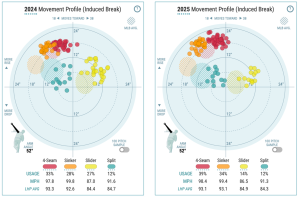
In addition to his improvement in location ability, Chapman has also made subtle adjustments to his pitch shapes this season, which has also been a contributing factor to his improved level of production in 2025. The tables above depict Chapman’s movement plots during the 2024 and 2025 seasons. As shown by these plots, Chapman has increased the amount of induced vertical break on both his fastballs (the four-seamer and sinker) by around 1.5 inches this season, while maintaining the same arm angle of 52 degrees.
In my opinion, this indicates that there has been a change in either Chapman’s grip or finger pressure that has allowed for the shapes of these pitches to add over an inch of induced vertical break each. Seam orientation data is not publicly available, and images of Chapman’s fastball grips from 2024 and 2025 show no noticeable differences. While the exact cause of this adjustment is a bit of a mystery, it’s clear there has been a concerted effort to refine the shape of these offerings, which have allowed them to be more effective at generating swing-and-miss this season. Chapman’s four-seam whiff rate has increased from 25.9% in 2024 to 30.1% in 2025, while his sinker whiff rate has increased from 33.1% in 2024 to 37.7% so far this season.
Aroldis Chapman has had an excellent bounce-back season in 2025, which has resulted in him signing a contract extension with the Boston Red Sox at the end of August. While Chapman has been utterly dominant in terms of on-field performance, he has been the beneficiary of some “positive luck” so far this season, currently allowing a career-low .189 BABIP while possessing an above-average 88.4% LOB%. Despite these favorable peripherals, ERA estimators still evaluate Chapman as one of the best relief pitchers in all of Major League Baseball this season, with a 1.68 FIP and a 1.92 SIERA.
Chapman’s resurgence in 2025 can be largely attributed to an improvement in location ability, as well as subtle tweaks to his fastball shapes, which have allowed him to generate more swing-and-miss since joining the Red Sox bullpen. While some minor regression is likely given his peripheral stats, Chapman’s improved arsenal gives Boston a late-inning weapon that will be valuable entering the Postseason. By pairing his elite velocity with improved command and subtle shape adjustments, Chapman has shown that even the smallest adjustments can have massive results.
Statistics as of the end of play on September 10th, 2025.
Photo by Icon Sports Wire | By Carlos Leano
