





A successful return from shoulder surgery at the Major League level is never an easy task. Not only is there an increased risk of re-injury in the future, but pitchers typically lose a couple ticks of velocity upon their return, lowering the quality of their pitches, which in turn can lead to decreased levels of production post-injury. Given these factors, a level of curiosity was present regarding how well Brandon Woodruff would adapt upon his return from shoulder surgery this season, as he has relied heavily on the quality of his four-seam fastball to generate production throughout his Major League career. Despite these concerns, Woodruff has been dominant to begin his 2025 season, producing a 31.7% K-BB and 2.22 ERA over his first 5 starts of the season. This article will take a look at the factors driving Woodruff’s success this season, the changes he has made to his arsenal and approach to stave off velocity regression, and whether he will be able to maintain this level of production throughout the remainder of the season.
Since becoming a full-time member of the Milwaukee Brewers starting rotation in 2019, Woodruff has been one of the best starting pitchers in the National League, consistently producing ERAs around 3.00 or below, and K-BB’s greater than 23%. During his last season prior to injury in 2023, Woodruff was in the middle of another excellent season as a starting pitcher, producing a 29.2% strikeout rate, 5.9% walk rate, and 2.28 ERA over 67.0 innings pitched before injuring his shoulder towards the end of the season. So far this season, Woodruff has picked up where he left off in 2023, currently producing a 35.6% strikeout rate, 3.8% walk rate, and 2.22 ERA over his first 28.1 innings pitched of the season.
As mentioned earlier, Woodruff’s excellent start to the 2025 season, particularly the increase in strikeout rate, has been surprising given the typical decline in production that occurs once a pitcher loses a tick or two of velocity, especially for a pitcher who has relied so much on velocity like Woodruff has in the past. While the average velocity of his four-seam fastball has declined compared to its average velocity pre-injury (95.8 MPH in 2023 to 93.2 MPH in 2025), Woodruff has made a couple of notable adjustments to his arsenal that have allowed him to stave off this velocity regression this season.
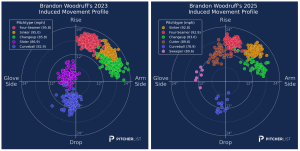
The movement plots above depict Woodruff’s arsenal over his past two seasons. Besides the decline in velocity, the most notable change to his arsenal has been the addition of a cutter to his pitch mix. Throwing multiple fastballs has been a common trend across Major League Baseball over the past couple seasons, as having the ability to throw different types of fastballs forces the opposing hitter to make a more difficult decision regarding which pitch is being utilized, introducing the possibility of the hitter anticipating the wrong fastball and allowing these pitches to “play up” in terms of generating swing-and-miss and sub-optimal contact. Possessing multiple fastballs also allows pitchers to utilize their “best” fastball to the appropriate handedness, as sinkers and cutters perform best when they are moving towards the batter (sinkers to same-handedness hitters, cutters to opposite-handed hitters), staying off the “sweet spot” of the barrel and inducing sub-optimal contact.
With the anticipated velocity regression on his four-seam fastball, Woodruff was the ideal candidate to add a cutter to his arsenal to improve his fastball performance and stave off any potential decline in production. Since introducing the pitch into his arsenal, Woodruff has utilized the offering to both right and left-handed hitters, with a 17.3% usage rate against right-handed hitters and an 11.9% usage rate against left-handed hitters.
Given the across-the-board reduction in velocity this season, pitch quality models, which evaluate pitches solely on their velocity, spin, and movement characteristics, each believe that the quality of Woodruff’s arsenal has significantly declined since 2023. FanGraphs’ Stuff+ has Woodruff declining from a 108 in 2023 to a 96 in 2025, aStuff+ has him declining from a 105 to a 97, while StuffBot (which evaluates pitches on a 20-80 scale) believes that the quality of Woodruff’s “stuff” has declined from a 54 in 2023 to a 42 in 2025.
Each model grades the cutter as a below-average offering; however, the intent of adding the cutter to his arsenal is not for the pitch to grade favorably in pitch quality models. Rather, the intent is to add a pitch that is complementary to the other pitches in his arsenal. This ties into the concept of arsenal effects, which suggest that certain pitches, such as cutters, can provide value by elevating other pitches in a pitcher’s arsenal, rather than just being effective in a vacuum. While the cutter has generated rather average results in isolation this season, with a 9.1% whiff rate, .257 wOBA, and .277 xwOBA, the addition of the cutter has made Woodruff’s four-seamer more effective, with the pitch’s whiff rate increasing from 31.1% in 2023 to 34.3% in 2025.
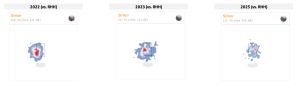
Another notable adjustment that Woodruff has made this season has been the locations of his sinker, particularly when utilized against right-handed hitters. Throughout his career, Woodruff has displayed an above-average ability to command the baseball, which allows him more opportunities to locate his pitches in ideal locations to opposing hitters. As shown by the heat maps above, Woodruff has historically located his sinkers inside to right-handed hitters, placing these pitches in ideal locations to generate sub-optimal contact, as the pitch’s movement towards the hitters causes the hitter to make contact away from the “sweet spot” of the barrel.
So far this season, Woodruff has moved the average location of his sinker towards the outer-third of the plate, instead locating the pitch in an area of the zone ideal for generating called strikes to opposing hitters. Backdoor sinkers are ideal pitches to utilize to generate called strikes, as these pitches appear to be out of the strike zone at release, and pitchers with above-average command, such as Woodruff, can effectively utilize this offering to get ahead in counts. With his new intent with the offering, Woodruff’s called strike rate on his sinker to right-handed hitters has skyrocketed from 13.5% in 2023 to 35.4% in 2025, with the CSW% increasing from 18.1% in 2023 to 41.5% so far this season.
Woodruff heavily relies on the sinker when he is behind in the count (2-0, 2-1, 3-0, 3-1) to right-handed hitters, utilzing the pitch 70% of the time in these count states, however, he changes his intent with the pitch when he is behind, instead locating the offering on the inner-third of the plate. Woodruff’s above-average ability to command the baseball allows him to utilize his offerings in optimal locations more frequently, and his adjustment to utilize the sinker as both a called strike weapon and sub-optimal contact inducer has made the pitch a more versatile offering, and has played a major role in his success this season.
Woodruff has made some impressive adjustments to his arsenal and approach that have allowed him to maintain his pre-injury level of production so far this season; however, his peripheral metrics indicate that some negative regression may occur in the near future. First, Woodruff is currently running a .158 BABIP, which will certainly regress closer to the league average over the final two months of the season. Milwaukee’s excellent defense should allow Woodruff to maintain a BABIP that is slightly lower than league-average, and I expect him to run a BABIP closer to his career average of .273 over the remainder of the season. Second, Woodruff’s ground ball rate is currently 19.4%, which is extraordinarily low, and I expect he will allow more ground balls over the remainder of the season. A low ground ball rate and low BABIP go hand-in-hand with each other, as fly balls run lower BABIPs than ground balls, and both of these values should regress closer to his career average over the remainder of the season. Third, Woodruff has also gotten extremely “lucky” with runners left on base, with a 100% (!) left-on-base percentage so far this season, which will certainly regress in the near future, resulting in more runs allowed.
Brandon Woodruff has mixed up his pitch mix and approach after returning from injury, and so far, these adjustments have paid off. While he is due for some negative regression in the near future, the addition of the cutter and revamped usage of the sinker have allowed him to stave off a regression in his average velocity, and it appears that he will continue to produce above-average strikeout and walk rates (barring injury) for the foreseeable future. Projection systems are mixed on Woodruff’s outlook for the rest of the season, with THE BAT projecting a 4.17 ERA, OOPSY projecting a 3.91 ERA, and ZiPS projecting a 3.49 ERA for Woodruff over the remainder of the season. I’m inclined to lean towards ZiPS’s prognostication and ballpark Woodruff for a near-3.50 ERA over the remainder of the season, as it appears that he will be able to maintain a high K-BB% while experiencing some batted ball regression over his next few starts. Even if the surface numbers normalize, Woodruff’s underlying approach changes suggest his post-injury version is built to last. Woodruff may not have the same Cy Young Award upside that he possessed pre-injury; however, Milwaukee can feel confident that Woodruff can still be an integral part of their starting rotation as they seek to make a deep Postseason run this October.
Statistics as of the end of play on August 2nd, 2025.
Photo courtesy of Icon Sportswire | Adapted by Aaron Polcare (@abeardoesart on Bluesky and X)
