





On January 14th, the Miami Marlins traded starting pitcher Ryan Weathers to the New York Yankees in exchange for minor leaguers Brendan Jones, Dillon Lewis, Dylan Jasso, and Juan Matheus.
The Yankees, entering 2026 with multiple injuries to their starting rotation, added the talented Weathers to an organization chock full of young pitching talent still a year or two from making an impact in the Majors. The Marlins, looking to clear rotation space for top prospects Thomas White and Robby Snelling, were able to bolster infield and outfield depth at various levels after adding top prospect Owen Caissie and two others in a prior trade with the Chicago Cubs for Edward Cabrera.
Both teams were able to strengthen points of organizational weakness while retaining their top-shelf talent. Still, I believe adjustments can be made with the Yankees that could elevate Weathers to the potential the Padres saw back in 2018, who drafted him seventh overall out of high school. Also, despite the highest-ranked player acquired by the Marlins, per MLB Pipeline, being Jones at just 15th in the Yankees org, I would expect a lot more long-term from the four minor leaguers.
Yankees get:
Weathers, 26, pitched in just eight games in 2025, tossing 38.1 innings with a 3.99 ERA and 4.60 FIP. While a career-best 22.3% strikeout rate still falls below expectations, there are certain adjustments Weathers is expected to make with the Yankees’ pitching staff to elevate his performance.
One is the addition/more frequent use of a developed two-seam – this change was even mentioned by Weathers in his introductory press conference. Weathers threw his sinker 4% of the time in 2025 despite it grading out fairly well, and bumping its usage against lefties seems inevitable.
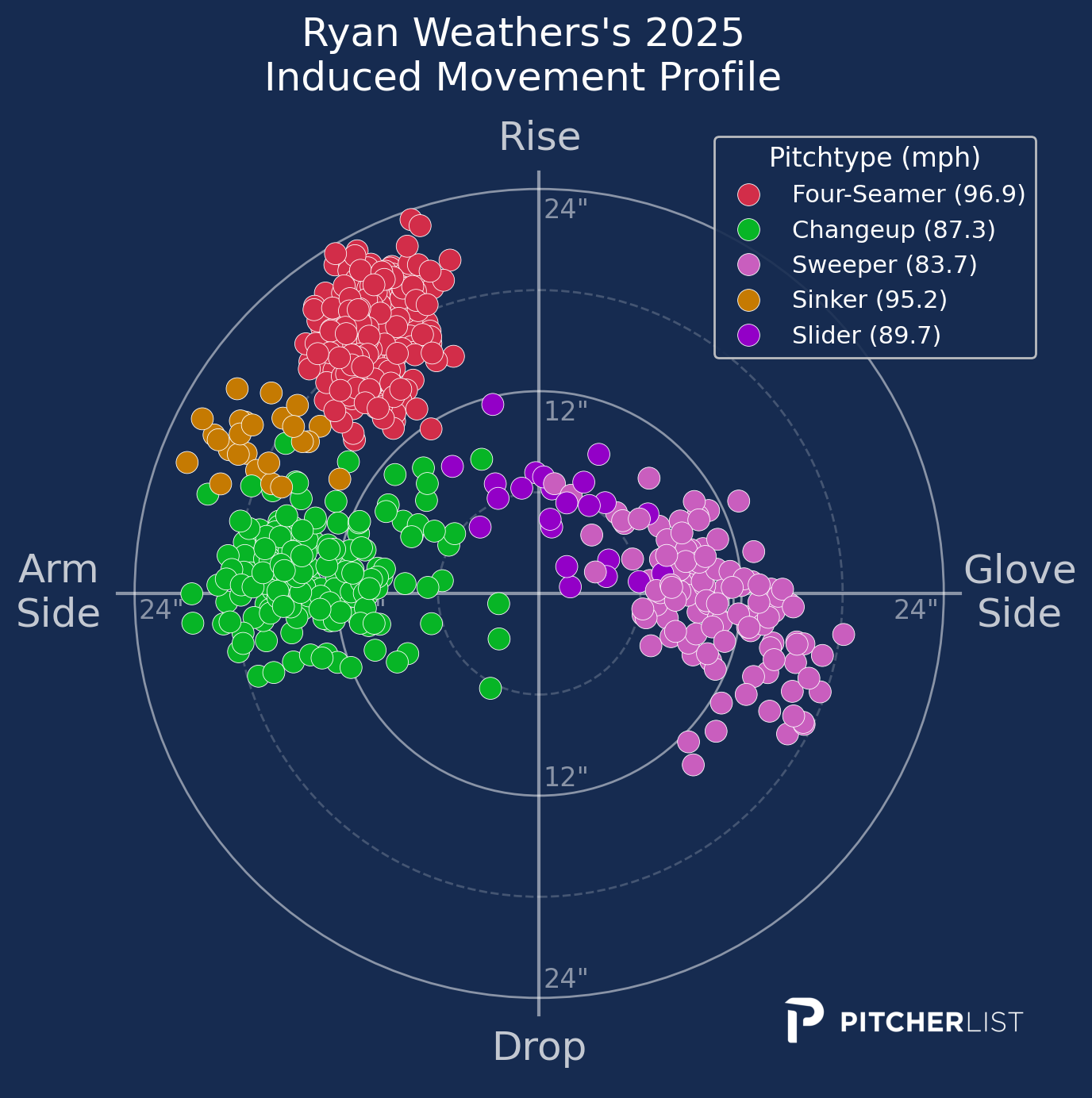
Weathers threw his changeup ~30% of the time overall and 18% of the time against lefties. These same lefties crushed his four-seam, which he used 45% of the time against them, while allowing a brutal .364 AVG and 1.182 SLG on the pitch. Cutting his four-seam and changeup usage in exchange for more sinkers against lefties should help induce softer contact and more ground balls.
This is a formula we’ve seen repeated by other Yankee lefties, such as Carlos Rodón, who added a wicked one-seam sinker in 2025 as a bridge to his now-lethal changeup. We could even see Weathers switch to this type of sinker, which would add a couple more inches of depth to an already solid two-seam shape.
Another possible change would be adding a couple inches of depth to his bullet slider, further separating it from his sweeper. Keeping a hard breaking ball shape would be great for handling righties and maintaining a sharp up-down profile alongside his strong four-seam, while his sinker/sweeper can offer a tricky east-west profile against lefties.
Regardless, Weathers taking the next step in the majors will come down to his health. He should enter the season in the rotation, and presently considers his health as “feeling better than [it] has in ‘a year and a half.’” The Yankees retain him for all three years of his arbitration, and believe in his talent enough to have parted ways with four promising prospects in exchange.
Marlins get:
Jones, 23, is an outfield prospect with excellent defense and base-running potential, currently expected to begin 2026 in AA. Jones hit .245 with a 126 wRC+ over two levels in 2025, posting an elite 14.9% walk rate and 20 doubles as a patient hitter with a decent hit tool.
The Marlins will hope to see his hitting continue to develop, along with some pull-side power, despite his smaller 5’10” frame. Most of Jones’s upside derives from his 51 stolen bases and strong range in center field.
Jones’s ceiling looks similar to that of Brett Gardner, a reliable outfielder who patrolled the Yankees’ center field and eventually left field for over a decade. The Marlins will look to develop his hitting further while Jones tackles the upper minors in 2026.
Lewis, 22, ranks similarly to Jones as a high-upside outfield prospect with a few flaws to work through. Lewis was one of the most potent power-speed threats in the lower minors last season, finishing in A+ with 22 homers and 26 stolen bases overall. This was accompanied by one of the premier batted ball profiles in the minor leagues, driven by elite exit velocities and solid pulled-fly-ball rates.
The flaws appear in his quantity of contact, as Lewis posted a 23.5% strikeout rate and 73.2% contact rate overall. While his patience improved in A+ (10.8% walk rate), Lewis’s long-term success likely hinges on his ability to make consistent contact.
Regardless, the power is real. Likely suited for a corner outfield spot long-term, a major league comp of his upside could be Adolis García, a somewhat volatile profile elevated by raw power translating to extra base hits.
Jasso, 23, is a patient corner infield prospect who spent 2025 in AA with the Somerset Patriots. Jasso hit 13 home runs with a 115 wRC+ while netting six triples over 127 games.
Unfortunately, Jasso also ran a career-worst 10.2% swinging-strike rate and 76.7% contact rate, opting for decent power numbers while losing some of his patient approach. The Marlins will look to further unlock Jasso’s power in 2026 as he likely starts the season in AA.
Matheus, 21, could have the highest upside out of all four prospects dealt. Finishing 2025 in A+, Matheus hit just three home runs overall, yet posted a 115 wRC+ and 40 stolen bases. Matheus also netted 32 doubles and ran an excellent 12.3% walk rate to just a 18.5% strikeout rate.
Matheus consistently pulled hard contact, limited whiffs (20.5% in A ball), and retained a patient approach as a young switch hitter in the lower minors. While his defensive upside is more of an unknown, his positional versatility brings intrigue.
Despite a smaller 5’10”, 155-pound frame, Matheus seems to have unlocked a solid hit tool with decent exit velocities overall. Long-term, Matheus could project as more of a utility player, but his many strong tools present a solid floor as he likely enters 2026 with the Marlins’ A+ affiliate.
