





When Carlos Correa and Julio Rodríguez are at their best, they’re among the most productive offensive players in Major League Baseball; however, for much of the first half of the season, both players have fallen short of the usual levels of offensive production. With the second half of the season about to begin, a return to their prior levels of offensive production could have a major impact on their respective teams’ fortunes over the remainder of the season. This article will take a look at slow starts to the season for Correa and Rodríguez, and seek to identify the adjustments these two players will need to make to their offensive approaches to get back on track in the second half of the season.
Coming off a season in which he produced a 155 wRC+ over 367 plate appearances in 86 games, the Minnesota Twins had high expectations for Carlos Correa entering the 2025 season, hoping that he could produce all-star level production at the shortstop position with a full, healthy season. While Correa has largely stayed healthy this season (minus a recent ankle sprain), his offensive production has not come close to matching his projected preseason output.
Over 322 plate appearances this season, Correa is currently producing a 93 wRC+, well short of his preseason projections. Steamer projected Correa for a 127 wRC+, THE BAT X (which includes Statcast batted ball data) projected Correa for a 123 wRC+, while OOPSY (which includes bat speed data) projected Correa for a 134 wRC+ this season. While each projection system believes that Correa will have a better second half of the season offensively, they have each lowered his projected total level of offensive production, indicating that Correa is more above-average with the bat rather than one of the best offensive shortstops in all of Major League Baseball.
The table above depicts Correa’s Process+ metrics from the 2024 and 2025 seasons. Process+ evaluates how well a hitter executes the aspects of hitting they have the most control over (swing decisions, contact ability, and batted ball quality), relative to the quality of pitches faced. As shown by the table above, Correa has experienced a notable decline in his swing decision ability, with his Decision+ grade decreasing from 98 to 89, and his power ability, with his Power+ grade decreasing from 106 to 94, while his contact ability has remained relatively constant.
Correa’s decline in swing decision ability can be explained by his increased tendency to chase pitches out of the zone so far this season. Compared to last season, Correa’s chase rate has increased from 25.5% to 31.6% and his overall swing rate has increased from 44.6% to 47.7%. In my opinion, there are two potential reasons as to why Correa has displayed a regression in swing decision ability so far this season. First, since his overall swing rate has increased by ~3%, I wonder if Correa is “pressing” at the plate, feeling the need to swing more often in an attempt to generate more offensive production. “Pressing” (an increased swing rate) typically occurs when a young player makes their debut at the Major League level, since they feel a pressing need to contribute value immediately; however, it can also occur when a player is in a slump, as they try to “swing their way out of it”. Given the fact that Correa is currently displaying the highest Swing% of his career, it is possible that he is becoming too aggressive with his swing decisions at the plate.
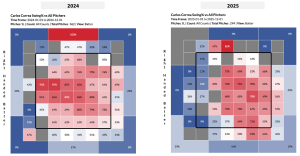
Correa has also displayed an increased vulnerability against sliders so far this season, which has also contributed to his decline in swing decision ability. As shown by the heat maps above, Correa has been swinging more frequently at sliders outside of the zone this season, particularly low-and-away, contributing to a 40.4% whiff rate against sliders in 2025, compared to a 25.0% whiff rate in 2024. Is Correa having a more difficult time tracking sliders this season, or is this a byproduct of Correa “pressing” at the plate? It is nearly impossible to tell from this chair; however, it is imperative that Correa improve his swing decision ability against sliders moving forward this season, as it is easy to envision opposing pitchers utilizing the offering more to Correa over the second half of the season than their current 17.5% usage rate.
In addition to his regressed swing decision ability, Correa has also displayed a decline in power output so far this season. As shown by the table above, Correa’s ISO has declined from .207 in 2024 to .125 in 2025, and his Barrel% has declined from 9.1% to 6.2%. While Correa’s ability to hit the ball hard has remained intact, with his EV50 only slightly declining from 102.5 in 2024 to 102.2 in 2025, this decline in power output can largely be attributed to an increased tendency to hit the ball on the ground that Correa has displayed this season, with his air rate declining from 55.7% in 2024 to 51.5% in 2025.
At first, this decrease in air rate was a bit surprising to me because Correa has increased both his swing path tilt and attack angle compared to last season, which would typically indicate that he’s hitting more balls in the air. I wonder if this decline in quality ball flight is a result of Correa’s increased tendency to chase, as more of the balls he’s making contact with are located out of the zone, which typically results in a lower quality of contact. On pitches located in the zone this season, Correa has maintained the same average launch angle of 9 degrees as he did in 2024, indicating that perhaps he could improve his barrel rate by improving his plate discipline, although he is has experienced a decline in in-zone barrel rate in 2025 as well (11.8% in 2024, 7.8% in 2025).
Overall, I believe that regaining his prior level of swing decision ability, particularly against sliders, will be an imperative point of focus for Correa in order to improve his level of offensive production over the remainder of the season. Swing decision ability typically improves with age, which leads me to believe that this will be a correctable issue for Correa, rather than an indication that he is firmly on the wrong side of the aging curve. That being said, I am not so confident that this weakness will be corrected in-season, although modern technology such as Trajekt could help him track sliders better in the batting cage, and I would take the under on his projected output over the remainder of the season.
Over the course of his young career, Julio Rodríguez has been one of the most electrifying players in all of Major League Baseball. His combination of plus defense at a premium position and power production has turned him into one of the brightest stars in the game and the Seattle Mariners‘ franchise cornerstone. While the Mariners are currently in the hunt for a spot in the Postseason courtesy of outstanding offensive performances from Cal Raleigh, J.P. Crawford, and Randy Arozarena, Rodríguez has underperformed projections to begin the 2025 season, and a turnaround in his offensive production could be a major boost for the Mariners’ lineup over the remainder of the season.
Over 431 plate appearances this season, Rodríguez is currently producing a 110 wRC+, short of his preseason projections. Steamer projected Rodríguez for a 137 wRC+, THE BAT X projected Rodríguez for a 135 wRC+, while OOPSY projected Rodríguez for a 145 wRC+ this season. Rodríguez has been on a heater during the stretch of games leading up to the All-Star break, hitting a home run in each of his last three games, and the projection systems are confident that this stretch could be the beginning of a bounce-back second half for Rodríguez.
The table above depicts Rodríguez’s Process+ metrics from the 2024 and 2025 seasons. Rodríguez has increased his swing decision ability so far this season, with his Decision+ grade increasing from 82 to 98, while his contact and power abilities have each taken a step back in the first half of the 2025 season. Rodríguez contiuues to swing the bat a lot, with a 55.7% swing rate comfortably above league-average, however, Rodríguez has made a slight improvement to his chase rate (from 36% in 2024 to 35.1% in 2025, still well above league-average) and his tendency to swing early in counts has likely contributed to a decrease in his strikeout rate from 25.4% in 2024 to 21.6% in 2025.
Similar to Correa, Rodríguez has hit the ball on the ground more frequently in 2025, with his Air% declining from 55.4% to 49.7%, which has contributed to his barrel rate declining from 10.2% in 2024 to 7.9% so far this season. In addition, his pull air rate has declined from 16.2% in 2024 to 12.9% in 2025, further displaying Rodríguez’s regression in his ability to hit batted balls at optimal profiles for power production. As shown by the table above, Rodríguez’s average intercept point has gotten progressively deeper over the past couple of seasons, which has likely been a contributing factor in his increased tendency to hit the ball on the ground. A contact/intercept point that is closer to the pitcher is more likely to result in a fly ball upon contact, as these pitches are contacted with during the upward part of the swing, causing the ball to be hit in the air with a greater probability of power production. With a deeper intercept point closer to his center of mass, Rodríguez’s average attack angle has decreased from 8 degrees in 2024 to 7 degrees in 2025, resulting in more ground ball contact as the bat is meeting the incoming pitch at a flatter angle. Moving his contact point closer to the pitcher to hit the ball in the air more frequently will likely be a focus for Rodríguez during the second half of the season, in turn improving his level of offensive production.
As Patrick wrote in his article about him a few weeks ago, Rodríguez continues to display some of the best bat speed in Major League Baseball, with an average bat speed of 75.8 MPH over 750 competitive swings this season. Given its year-to-year stability and ability to become reliable quickly, bat speed is one of the best predictive metrics for offensive production among publically available metrics, and this ability to swing the bat fast provides Rodríguez with a solid floor of power production that he can rely on to comfortably provide him with 20-25 home runs a season, even in years where he struggles with bat-to-ball and swing decision ability. Some might note that Rodríguez’s bat speed has consistently declined over the past three seasons, however, intercept point affects the bat speed of a given swing (swings with a contact point closer to the pitcher have more time to accelerate), and I believe that this decline is more indicative of his changing point of contact, rather than a decline in raw bat speed ability.
Now four seasons into his career, Rodríguez has settled into the high bat speed, high chase, high swing-and-miss archetype of player, which, while volatile at times, can produce some MVP-level peak seasons, especially when combined with the premium defensive value that Rodríguez provides in center field. Overall, I believe that Rodríguez will be able to improve his level of offensive production over the final two and half months of the season, and I would not be surprised if he ran close to a 130 wRC+ over the remainder of the season, as his elite bat speed is still intact, and it appears that moving his intercept point would be a straightfoward remedy to his newfound tendency of hitting the ball on the ground. Given his bat speed and recent improvements in swing decisions, Rodríguez has a strong foundation to build on. If he’s able to move his contact point slightly towards the pitcher and elevate the ball more consistently, I wouldn’t be surprised to see a major offensive uptick from Rodríguez in the second half of the season.
Statistics as of the end of play on July 13th, 2025.
Photos by Icon Sports Wire | By Carlos Leano
