





Well. That was ugly. Davis Martin had picked up a lot of helium as this season has gone on, and that last start felt like a popping of the balloon. He was never going to hold that mid-2 ERA he was sporting forever; that’s not who he is. Assuming that that was who he was now would’ve been foolishness, though I didn’t expect the regression to the mean to yank him back so violently.
Start after start passed, and while the doubts of “He can’t actually be this good” persisted, he continued to have successful outings until that one in the Bronx. He had the second-best ERA among qualified AL starters in mid-June. Sure, he was on a heater, but there must have been something going on under the surface. With the skills that saw him there being less than apparent on watch, there’s no way he’d been performing this well entirely by accident.
The trouble with arsenal synergy and how a pitch mix plays off of itself is that it can’t be quantified with absolute certainty. So, the bad news is that we don’t have a way to definitively say beyond a shadow of a doubt how much this aspect of his game is carrying him. The good news is that we can make some educated guesses based on what we do know and evaluate his pitches individually to make our own judgment.
The Arsenal
Martin’s “primary” pitch, if you can even call it that, given it’s one of six and he throws it just 26% of the time, is his 4-seam fastball. Put delicately, and speaking purely in terms of its raw stuff, it is not particularly good. With a generic release point and lackluster movement, this thing is mostly asking to get crushed in a vacuum. The one thing it does have is that he cuts it pretty hard, getting a good amount of disparity between movement and spin direction. We’ll get into why that’s important later.
Next is his other fastball. Martin’s sinker is also uninteresting in its shape, but that’s less of a problem with this pitch type. It possesses slightly better-than-average depth and attains it with a substantial amount of seam-shifted wake. Provided he keeps it low, it should do its job of inducing non-threatening batted balls.
Martin’s changeup is a weird pitch, as we’ll get into. It has tremendous depth both in a vacuum and relative to his other pitches. 13.6” of vertical separation is excellent, though he throws it oddly hard, just 3.8 mph slower than his fastball. His slider is his best pitch, full stop. Not only does it have good stuff as a tight gyro breaker in the mid-to-high 80s, but he commands it exceptionally well to boot. We’ll go into that in more detail in the next section.
Martin’s cutter is my least favorite pitch he throws, but its stuff is theoretically fine. His slurvy curveball is a solid pitch, with a good mix of power, depth, and sweep. It fills a bit of an odd role in his arsenal as he uses his gyro slider as his breaker against righties, and this one against lefties, but it seems like it’s designed to work in tandem with the cutter and 4-seam.
His Best Traits
I mentioned a bit ago that he locates his slider “exceptionally well”. I might have been underselling it.
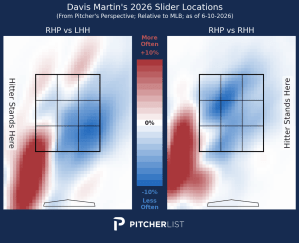
That’s money, doesn’t get much better than that. He buries this thing down and to the glove side about as well as anyone. I hesitate to go this far, but potentially the best word for it is deGrom-esque. It’s a half-rung down from there, maybe. That, in tandem with his other pitches and strategy, is how you run a chase rate over 50% on an individual offering, among other impressive numbers.
That’ll play. You know what else will play? Having the highest flailed swing rate of any gyro slider in righty-righty matchups. He has the best rate on gyro sliders for all situations, period, but even eliminating the skew against other pitchers who throw theirs against lefties more regularly by putting everyone into the same situation he usually throws his in, he comes out on top. It’s not close either, 70% of all righty-righty swings on his slider, the next best rate in these matchups is deGrom’s 65%. Hitters just cannot get their bats to this pitch.
His changeup behaves very strangely, but it’s been working for him. I need to take a more in-depth look at how kick changes have fared across the league, but it seems like every time I see one, it gets fewer whiffs than I’d expect considering their movement. Martin’s is potentially the most extreme of these, as it plays more like a hybrid pitch than a true offspeed.
He fills the zone with this pitch compared to the average changeup, and hitters beat it into the ground. I think if he landed it lower with more consistency, we’d see the whiff rate rise. It’s probably too firm to run elite whiff rates, but there’s room for a pitch that acts as a sinker/offspeed hybrid. He’s gotten into a bit of trouble when he’s left it up in the zone, but this pitch seems to have the potential to do a bit of everything for him. His locations on this pitch are just as odd as how it’s performed, though.
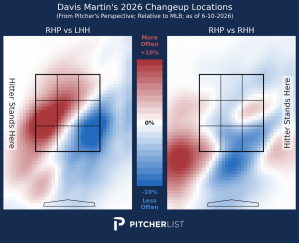
Yeah, I don’t know what that’s about. He’s throwing it on the wrong side of the plate. While a 12.1% called strike rate is above average, it’s not enough to warrant trying to throw his changeup like this. These locations are probably a big part of why its average miss distance is the fifth-lowest among offspeed pitches. The interesting thing is that he’s still getting above-average chase rates despite the odd locations. I’d love to see what it could be with slightly improved command; the potential is there for it to be a pitch that could put away hitters both with ground balls and strikeouts.
The other pitch of his that I’m fond of is his curve. I mentioned earlier that it’s decent from a stuff perspective, but he happens to do well spotting this low and to the glove side just like his slider.
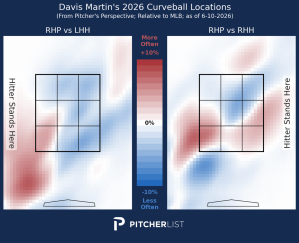
There’s nuance to this, of course, throwing sweepers back foot to opposite-handed hitters doesn’t tend to be quite as effective as gyro sliders. However, paired with high fastballs and cutters, it starts to come more into focus. Another funny thing I found when I was researching this article is that Martin’s changeup and curveball actually have a great spin mirror, with near-opposite spin directions and very similar active spin percentages. This pitch may be further aiding the tandem rather than working more with the 4-seam alone. I’m getting ahead of myself, though; that’s more of a topic for the next section.
A Brief Explainer of How His Pitches Work Together
The main benefit of throwing a large number of pitches is that hitters can’t reliably guess what’s coming next. They have to be prepared for a wider variety of looks, keeping them on their toes. Furthermore, when you have pitches that work especially well in tandem with each other, either in pairs or trios, or sometimes more in exceptional cases, hitters have to account for that as well.
Let’s look at some of how his pitches interact with each other. First, as a general rule, we can give him credit for repeating his release well across all of his pitches. He drops his arm ever so slightly for his changeup, but the whole range of averages fits within a 4° band and a 2” by 2” box. We’ll start with his 4-seam, as it features prominently against both righties and lefties. Looking at it next to his sinker, they come out of his hand about the same. With essentially identical spin directions and rates, and very similar active spin%, they then diverge via seam-shifted wake. This gives them 6.4” of IVB separation and 8.9” of HB separation. This allows them to play off each other well, with a good mix of deception and differences in movement.
His 4-seam and changeup play off of each other in a way very similar to his sinker. The slider pairs with the 4-seam the way most gyro breakers do with fastballs. The more interesting grouping is his 4-seam, cutter, and curve, which need to be spoken about together, as the cutter acts as a bridge for the 4-seam and curve in velocity and movement. Pitches on opposite ends of the movement spectrum work well together given the massive disparity in their paths to the plate, but they aren’t always the most deceptive, especially if they aren’t creating a significant spin mirror.
This is where the bridge pitch comes in, as it sits between two pitches on the spectrum, helping to disguise the others by providing a pitch that messes with the hitter’s ability to identify the pitch early by giving them something that travels in between the extremes. They don’t have to be perfectly in the middle, and ironically, Martin actually has a pitch that does sit nearer to there that he doesn’t use as the bridge.
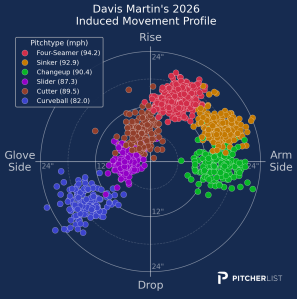
While he could choose to use his slider as a bridge, it would necessitate different locations. In addition to the downgrade there, it would kill some of the effectiveness of his best offering, as bridge pitches tend to take on a bit of extra damage in their role. Building off of the subject of bridge pitches and his curveball, one thing I found odd about Martin is that he uses his breaking balls a bit backward. Generally, sweepier breaking balls are best used against same-handed hitters, and gyro sliders the opposite. Furthermore, in Martin’s case, his sinker and curveball have almost perfectly mirrored movement, if not spin characteristics.
However, I think the way he pitches is a personal preference for him. For one, his cutter would be vertically off the middle as a bridge between the sinker and curve. Probably more importantly, throwing his curve consistently to righties might break what’s already working so well with his slider against them. Not to mention the potential that his changeup is also working with the curve, as mentioned earlier. I do think there’s room for him to use his slider against lefties more often, though.
Why This Matters
Davis Martin does not have great stuff. There is no getting around this judgment; his fastballs are mediocre. His changeup and slider are good but not outstanding in a vacuum. His cutter isn’t much on its own, and his curveball is about average for what it is. In addition to that, despite what his better-than-average walk rate could mislead you into thinking, he has fairly average command. The slider is the exception there; he locates that brilliantly. The curve is a bit better than average in that regard, too. Everything else is pedestrian.
This is why he needs a deep mix of pitches that can help support each other. While some pitchers are blessed with the aptitude for throwing five high-quality pitches and add an extra one or two on top of that just because they can, not all of them are afforded such gifts. A Skenes, Martin is not. He relies on his ability to keep hitters guessing and off balance by throwing a bit of everything and never letting himself become predictable. He’s far from the first to do this, of course. Logic would dictate that most guys who throw six or more pitches are doing so because they would be worse off throwing fewer.
Let’s be clear, Martin’s early-season success was exaggerated, but not a pure fluke. His pitch mix is a highly synergistic blend of offerings that play above their stuff grades because of how they work with each other. It takes his below-average fastballs and makes them adequate, his good slider becomes excellent, and so forth. He has intelligently built a profile that makes him an MLB-caliber starter, a decent one even. No small feat given what he’s working with in the modern stuff-driven game. Martin may never be an ace, but he’s carved a rotation arm out of the stone he was given to work with, and that’s worth celebrating and learning from to apply to other pitchers.
