





This is a weird limbo week in the middle of the season. It’s not quite the All-Star break, and a few weeks out from the trade deadline. It leaves me without an easy idea for an intro paragraph. I could use this space to welcome back Brandon Woodruff to a Major League mound for the first time in two years. He looked good while striking out eight Marlins over six innings. Or I could bemoan my own naiveté for getting even the slightest bit optimistic about my Pirates following a six game winning streak, including shutting out the Cards for an entire series; only to see the Buccos themselves get shutout for their next three game set in Seattle. Maybe we don’t even need introductory paragraphs any more. Perhaps we’ve evolved beyond that and are ready to get to the…
Fallers
Gavin Sheets, First Base and Outfield, San Diego Padres – 26% Rostered
Sheets is having a much better time in San Diego than he ever did in Chicago. The 29 year old has been a solid performer for deeper leagues this season as he’s batting .261 with 13 homers and 49 RBI. However, his big May (.275 average with eight dingers and 22 RBI) is doing most of the work propping up his season line. Sheets hit just two homers in June, and has opened July batting just .217 with no counting stats to speak of.
Sheets checks in with an above average barrel rate, an average exit velocity over 91 MPH and a hard hit rate over 51%. He also strikes out just over 20% of the time, and whiffs at a perfectly average MLB rate (24.1%). He doesn’t walk a ton and does chase a bit more than we’d like, but this isn’t a profile where you would expect prolonged slumps.
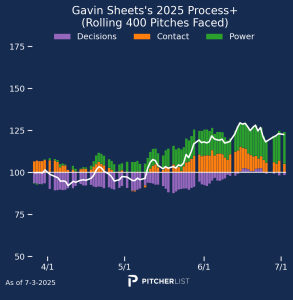
In fact, Sheets’ process chart looks more like player breaking out than slumping. I’m definitely willing to write off his recent performance as just a bit of a rough stretch, but I would expect him to look a lot more like the player he was in April and June; a .260-ish hitter with 3-4 dingers and 12-15 RBI monthly, instead of the two dinger per week hitter he was in May.
Ryan McMahon, Third Base, Colorado Rockies – 28% Rostered
McMahon is on pace to produce his sixth consecutive 20 homer season (not counting 2020 because we never count 2020). But he is also carrying his lowest average and OPS since his rookie year way back in 2018. Like Sheets, McMahon had a huge May, slashing .289/.389/.500 with four homers. In fact, he carried that hot bat with him for most of June, belting six homers over the first three weeks of the month. He also had a .349 BABIP in May and a .320 BABIP in June.
But his luck has seemingly run out and McMahon has slumped badly since June 20th, collecting just 7 hits and a single run driven in over these last few weeks. His July line stands at .130/.200/.174 with a .214 BABIP. McMahon also has a strong hard hit rate just under 50%, a barrel rate over 12% and a truly excellent exit velocity at 93.7 MPH which sits in the league’s top 5%. But, his nearly 36% whiff rate and 32% K rates do point to prolonged slumps and heaters being the norm.
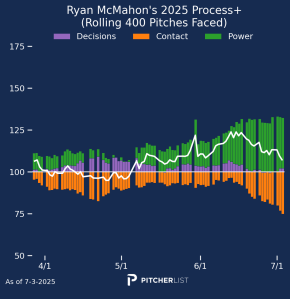
Much like Sheets, McMahon’s process chart looks mostly good. The recent downturn is apparent. His contact rate is bad, and his K and whiff rates are worse than his career norms, but we know he’s a streaky hitter with strikeout issues.
He’s also been mentioned as a possible trade deadline mover, so I’ll bother pointing out that he has an .800 OPS at Coors and a .593 OPS on the road. That’s scary at first, but players usually don’t suffer much moving out of Colorado because they no longer have to adjust to a major change in air density and all that comes with it every other week. If he gets moved, he will by default end up in a higher scoring lineup. Despite his recent slump, I think McMahon makes an intriguing target in both real life and fantasy baseball.
Wilmer Flores, First Base, San Francisco Giants – 24% Rostered
Flores notched an .863 OPS with 23 dingers in just 126 games back in 2023, so it didn’t come completely out of nowhere when he was sitting at seven homers and a whopping 28 RBI at the end of April. He had just a .237 BABIP back then, so it didn’t appear to be all luck. Wilmer’s run production tailed off in a bit May, as he hit three dingers with 18 RBI, but he complimented that with a .278 average. He really nosedived in June, slashing just .221/.330/.312 with just one homer and nine RBI.
Wilmer’s underlying rates might make you wonder where that production came from to begin with. He’s got one of the slowest bats in the league, and his hard hit rate and exit velocity are similarly unimpressive, sitting in the league’s bottom 2%. He does have well above average whiff and K rates, but that’s a plate setter profile, not a middle of the order run producer.
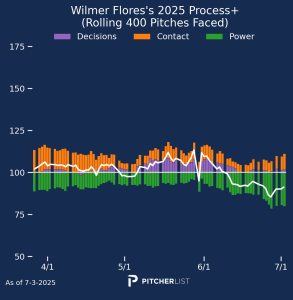
Unlike the two guys we looked at already this week, Wilmer’s process chart does not show signs that he’s coming out of a slump. To the contrary, he’s been trending downward since the start of June. I just don’t see any reason to expect a turnaround here, and the Giants would do well to get Devers up to speed at first base, or hit the trade market again.
Risers
Joey Ortiz, Third Base and Short Stop, Milwaukee Brewers – 8% Rostered
Oritz appeared here as a faller all the way back in week 1, so it’s extra great to see him back half a season later. It took a while, as Ortiz posted a .484 OPS in April and a .489 OPS in May, but the Brewer’s patience paid off, as Ortiz slashed .277/.326/.422 with three homers and four steals in June.
Ortiz offers a similar profile as Flores, but with more speed. He has very strong whiff and K rates in the mid 16% range, but a weak batted ball profile. Despite above average bat speed, Ortiz clocks in with just an 86.2 MPH exit velocity, a barrel rate under 4% and just a 34.3% hard hit rate. He also hits pop-ups at nearly twice the MLB average, and that’s the worst type of contact a hitter can make.
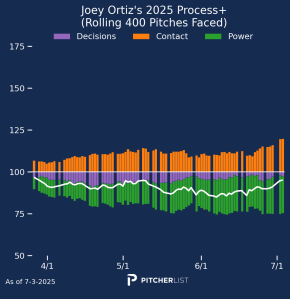
His big chart is starting to trend up a bit at the recent end there, but his power output and decision quality remain below that average line. His nice June also comes with a .294 BABIP, so some good batted ball luck was involved.
I don’t think Ortiz will have that 20/20 season that some of us were hoping for after he went 11/11 as a rookie last year, but I have some tentative optimism that he could be a useful asset in deep leagues down the stretch. He already has one homer in July and he has good bat speed and contact metrics. A 15/20 season isn’t entirely out of the question.
Ernie Clement, The Entire Infield, Toronto Blue Jays – 36% Rostered
Clement just polished off a month of June in which he slashed .354/.398/.455. He slugged just one homer and drove in only five runs, but rode that nearly 40% on base mark to 20 runs scored on the month. He had a .366 BABIP, but that isn’t even much higher that his actual batting average for the month.
Like Flores, Clement is a hitter prioritizing contact over power. He’s got a very slow bat and makes consistent contact with whiff and K rates both in the league’s top 10%. He’s also got quick feet, but is just 3/6 on the base paths this year. His process chart is exactly what you would expect, having just looked at a similar hitter.
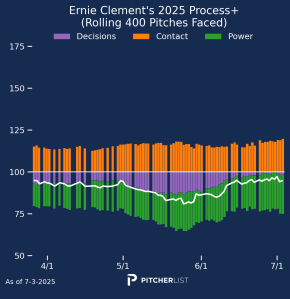
He is, in fact, very good at getting his bat on the ball. But with hard hit rates, barrel rates and exit velocities all in the league’s bottom 10%, he doesn’t make very hard contact. He also doesn’t walk enough to warrant hitting higher in the lineup consistently, and bounces around the order.
Still, I think Clement is worth rostering for his batting average contributions and position eligibility alone. Those are extremely valuable features in deeper leagues where we find ourselves rostering a lot of slump prone big swinging, oft whiffing sluggers. If he does move into the top third consistently (and he has hit there some) he could be an absolute batting average/run scoring gold mine down the stretch.
Ramón Laureano, Outfield, Baltimore Orioles – 12% Rostered
Laureano got off a slow start, posting a .188 average and .653 OPS in April, and he missed some time in late May and early June, but there really isn’t much excuse for his roster percentage to be this low. The 30 year old batted .348 with a 1.054 OPS in May and .312 with a .945 OPS in June. He launched seven round trippers, stole a couple bases, drove in 21 runs and scored 28 in 36 games over those two months. Sure he had a BABIP over .400 during that same span, but he’s been too good to be sitting on the wire in 88% of leagues.
Laureano doesn’t have great exit velocity at 88.3 MPH, but he does have well above average hard hit and barrel rates. He’s disciplined when it comes to chasing pitches out of the zone, but whiffs an unhealthy 28% and strikes out a ton with a 28% K rate. If he carried his current .851 OPS through the remainder of the year, it would be his best mark since 2019. Laureano hit 24 bombs in just 123 games that year (also a career high).
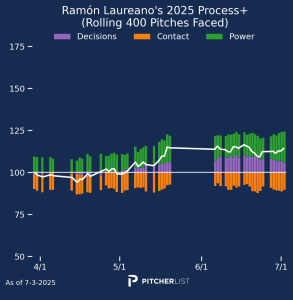
Now that’s a process chart I like to see. Laureano made clear gains in decision quality and power output before his injury in May and has maintained that level of production since he returned to action. He does have team options in ’26 and ’27, but the Orioles are well out of contention and in need of pitchers, so Laureano could be a deadline trade candidate. If he does get dealt, it would also certainly improve his offensive context. If you have a need in your outfield, I strongly recommend checking in on Laureano while people seem to be overlooking him.
That’s all for this week! Thanks as always for reading, and good luck out there deep leaguers!
