





We as baseball fans like to hold ourselves in high esteem for loving a sport as strange and whimsical as this one. I think we might be looking for a way to pat ourselves on the back.
Sure, this game takes its twists and turns, motored by its variance and telling tales of small sample sizes. But the nonsensical nature of the micro is generally washed out in the macro. If a hitter can check two out of the three boxes for power, contact, and decisions, he’s a star. If a pitcher can throw enough strikes without too many of them being punished, there’s a pretty good shot that he’ll be valuable, too.
It’s the getting there that’s the fun part.
After 13 disastrous innings last year, Atlanta Braves pitching prospect Didier Fuentes had the fastball that got him to the Show and little to show for it. A year and a role change later, and Fuentes’s fastball is helping him strike out 28% of batters in an increasingly important late-inning role. Fuentes’ secondaries tell the story of his development, but it’s his primary offering that creates the upside he’s been flirting with.
Not-So-Dead Zone
The name of the game is throwing strikes. And when your fastball is returning strikes at a 65% rate, it makes sense to continue leaning on it. Fuentes has done just that in 2026, pounding the zone with a four-seamer thrown 69% of the time, without sacrificing potency.
In fact, Fuentes’s fastball is one of the best in the sport. Exploding from his 6-foot frame, Fuentes has velocity and extension on his side (both 84th percentile for relievers), helping the pitch play up through perceived velocity. He doesn’t, however, have the kind of movement profile to write home about.
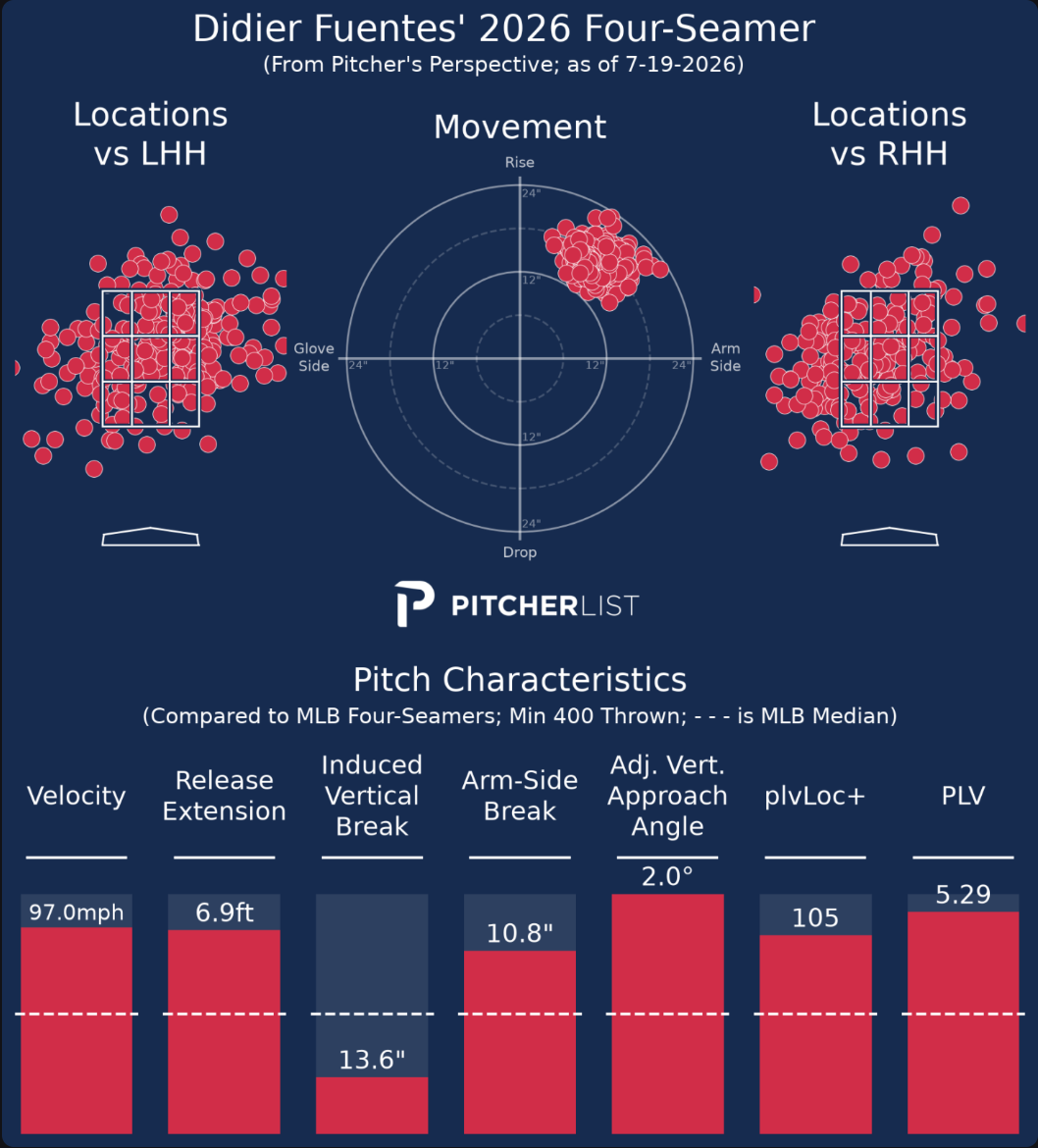
At 10.8 inches of iHB and 13.6 inches of iVB, it’s easy to lose him in a Savant-style movement plot. We’ve seen plenty of fireballers fly up to the league only to get shelled when their dead-zone fastballs get hit harder than they’re thrown. Fuentes has avoided this fate because of some quirky biomechanics.
Fuentes is a true pronator, boasting almost entirely active backspin on his four-seamer. While its spin rate is in the bottom decile, getting behind it so efficiently keeps it “true” and prevents additional iVB leakage. As such, the most important metric in Fuentes’s game is his fastball’s height-adjusted vertical approach angle (HAVAA). Vertical approach angle is simply the angle at which the pitch crosses the plate. You can imagine Jacob deGrom’s fastball having that de facto rise to it as hitters repeatedly swing under it. Conversely, a soft-tosser like Sonny Gray has to be careful putting his fastball in the zone, as a steeper VAA plays more like a prototypical sinker; that is, potentially sinking into barrels. Adjusting for height just ensures higher pitches (inherently closer to 0°) don’t claim stolen valor.
His heater, at 2.0 HAVAA, is in the 98th percentile.
We can attribute this to a handful of factors. Fuentes’s release point is lower than most because of his short stature, and he’s exaggerating this effect by pitching from a lower arm angle (24°, 5° lower than last season). Yet, he’s throwing hard and releasing the ball closer to the plate, which combines with his active spin to defy gravity. Physics can only affect a pitch for as long as it’s in the air. Shorten the distance and time to the plate; mitigate gravity’s impact.
Unsurprisingly, the results have been impressive, both in terms of impressing everyone’s models and getting guys out. By PLV, Fuentes’s four-seamer is a 94th-percentile pitch, and its Quality Pitch rate (56.9%) ranks in the 95th percentile. It’s harder to throw a “bad” pitch with good stuff, and Fuentes is commanding his heater well. His fastball’s Stuff+ and Location+ have each jumped six points from his debut season, and its plvLoc+ (105) is significantly above average.
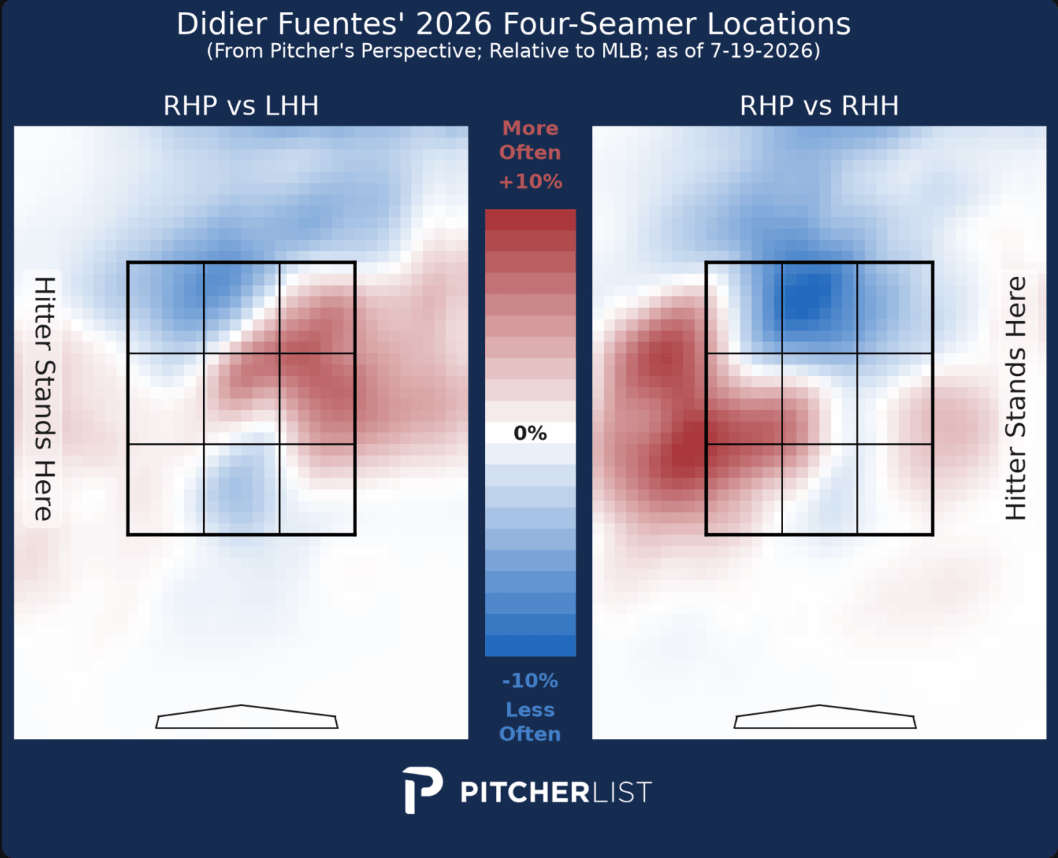
Notably, he’s keeping the fastball away to both sides of the plate, which I suspect is playing into his strong contact suppression, especially with renewed synergy with his secondaries. He’s currently running a strong .273 wOBA and .324 xwoBACON on the four-seamer while slightly underperforming his expected average and BABIP. He’s limited barrels at an average rate and, by virtue of his locations, limited pulled fly balls. His Pull AIR%, at 9.6%, is almost half of last year’s rate and one of the better marks in baseball. In turn, the xSLG on his fastball has dropped from .668 in 2025 to .343 in triple the innings this season.
There’s no telling whether his 95th-percentile HR/FB% will hold. History suggests it won’t. But when it bounces back, the Atlanta faithful can feel confident that Fuentes’s floor is still higher than the average reliever because of this pitch.
Making Sense of His Slider
It always comes down to the arsenal.
We can quibble over whether command is real, or sticky, or a matter of miss distance vs. optimal locations. A more fruitful endeavor might be pushing it to the background to prioritize stuff—specifically how it allows pitchers to attack hitters in new ways.
In Fuentes’s short stint last season, he struck out 10% of the lefties he faced while surrendering a .503 wOBA. Against righties, those numbers improved to 23.1% and .473, respectively. He was completely ineffective, but showed little recourse against opposite-handed hitters. At least against the righties, punching out guys provided some light at the end of the tunnel. This season, the script has been flipped. It goes without saying that his 2.50 ERA, 2.16 FIP, and 20.7% K-BB% are emblematic of a new pitcher, but his platoon splits changed, too.
Fuentes has struck out a third of the left-handed hitters he’s faced in 2026, compared to just 21.3% of righties. His platoon splits have thus shrunk, giving the Braves more leeway to play the leverage game with him, rather than matchups.
He has more answers for lefties now because of the biggest year-over-year change in his arsenal. He dropped a sweeper that had done little for him in 2025 and traded it for a slider, ultimately lopping off four inches of glove-side break and vertical drop. The shorter, tighter breaking ball, thrown 3 mph harder, has been a game changer, despite not being a standout pitch.
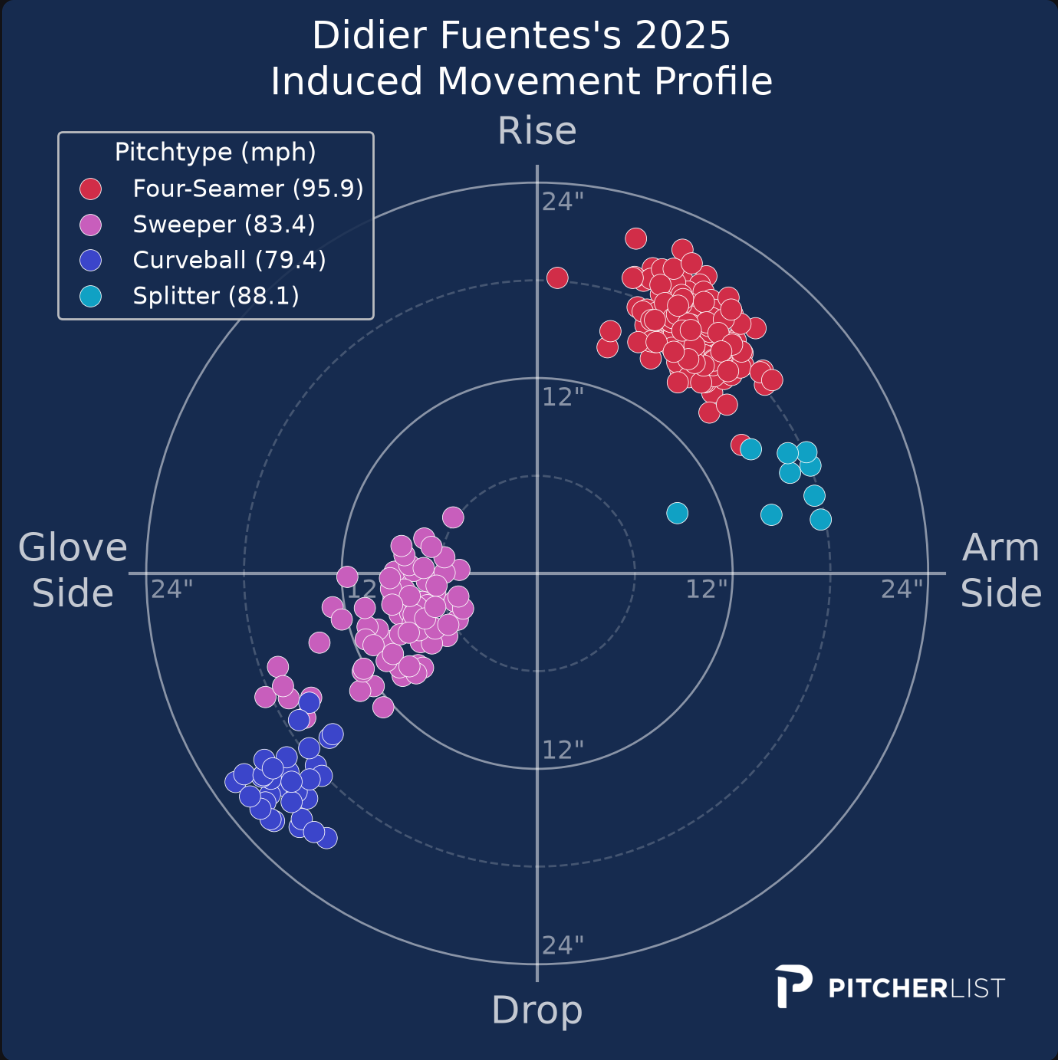
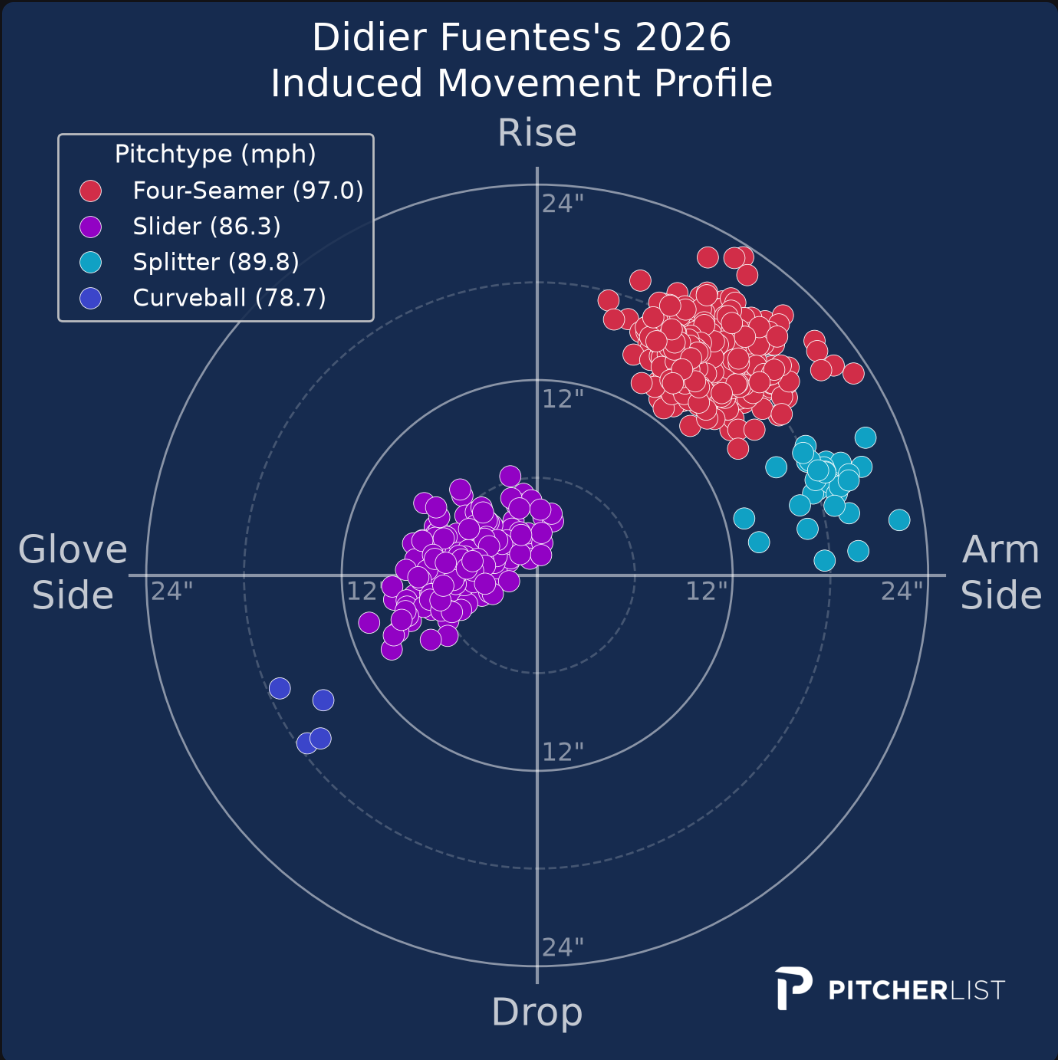
Sweepers are notoriously dangerous to opposite-handed hitters happy to recognize loopier movement coming towards the barrel. It’s easier to recognize and easier to punish.
At least in theory.
Lefties didn’t do much of anything with Fuentes’s secondaries last season. They just pummeled his fastball. Fuentes allowed three total bases on 51 non-fastballs to opposite-handed hitters last year. On 75 fastballs, they generated 21 bases. It was open season on a fastball that wasn’t quite as strong as it is in 2026, and being able to spit on the easily recognizable curveball and sweeper—thrown a combined 37.3% of the time—put him behind the eight ball.
This season, Fuentes is upping the dosage of fastballs while leaning on a slider and splitter to lefties. On paper, that seems far easier to tunnel, and their collective struggles confirm he made the right call.
Again, neither offering is particularly dangerous. The slider and splitter have below-average PLVs of 4.93 and 4.47, respectively. As a pronator, the breakers don’t come easily, and his delivery and arm slot leave him prone to inconsistent control. Even so, hitters don’t know what to do with them; he is yet to give up a barrel on a secondary pitch this season. That uncertainty makes his fastball all the more difficult to deal with. It gets on batters quickly and has a shape that defies the expectations of its arm angle. Paired with secondaries thrown harder and located better than last season, Fuentes’s strikeouts are hardly surprising.
Throwing a sweeper last season was likely an attempt at maximizing his utility against right-handed hitters. With that said, he hasn’t given much potency back to his same-handed counterparts. Throwing sliders to the same spot has sacrificed some CSW% but picked up additional swings out of the zone and whiffs within it. The slider still pairs fairly well with the heater thrown primarily to the glove side, and its sparing usage retains some surprise factor. His slider ranks 30th among all qualified pitches in average miss distance (6.1 inches). Against right-handed hitters, that mark jumps to 7.5 inches.
What’s Next for Fuentes?
It’s awfully easy to see the vision for a player when everything’s going right. Keep throwing the fastball, keep them off-balance with the slider, sprinkle in a few splitters to lefties… profit. But adjustments are coming, and there is some risk in throwing a fastball 70% of the time.
That four-seamer raises Fuentes’s floor. Guys with fastballs this good, located even decently well, stick around for a while. The ceiling that comes with it is obvious, too, as the Braves are witnessing. I think Atlanta is comfortable with his current state of affairs against left-handed hitters. However, he’s currently throwing his fastball 72% of the time to righties. Barring some poor batted-ball luck or a stretch of bad command, I’d expect the next bit of turbulence to come from same-handed hitters putting the fastball in play.
One potential solution is to experiment with a sinker.
Physically, Fuentes’s strengths make this sensible. He’s a pronator who wins with velocity and extension, and whose fastball already gets more arm-side run than about 80% of the league. If there’s an ideal candidate to add another arm-side heater, it probably looks a lot like Fuentes.
The benefits, theoretically, would be threefold. First, he’d lessen the load on a four-seamer that is phenomenal, but isn’t necessarily returning elite plate discipline metrics. Any extra hesitation works in his favor, and in adding a sinker, he could more easily access the arm-side part of the plate. Just 22.8% of his fastballs have been inside to right-handed hitters this season (18th percentile). It’s also only generating chases at a league-average rate. Giving himself another option to limit barrels and induce weak contact could do him well, and there might be some in-zone takes for the four-seamer derived from the threat of 95 mph in on the hands.
Lastly, additional arm-side run would create horizontal separation from his slider. When Fuentes pivoted from the sweeper, he sacrificed glove-side movement and, arguably, some upside out of the zone. That was the right choice. But what if he can stretch hitters horizontally without the woes of a pronator’s weak sweeper?
Fuentes has one plus pitch to his name. Fleshing out an arsenal around it, rather than optimizing for the right-handed matchups he was likely to find, has put him back on the trajectory his prospect rankings suggested. There’s a closer in here, even if Atlanta doesn’t need one just yet, and the next 30-or-so of his innings should reflect that. Fuentes has the juice, pedigree, and results to see increasing leverage down the stretch. With the current version of his arsenal, I like the odds of him making good on that assignment.
Moving forward, the Braves are set to make some decisions about their fireballer. The longer his good results last, the more likely there will be talks about returning him to the first inning, instead of the ninth. Without a third option to righties, I’m not sure that’s a more fertile environment for his development. Even with it, I’d be cautious about messing with a pitcher doing the best work of his young career.
In either event, it’s excellent news that Fuentes is in these conversations, and while his fastball might make him special, it’s the secondaries that have made him playable in 2026. With more ways to find strikes and more reasons to expect non-fastballs, it makes plenty of sense that Fuentes’s four-seamer finally looks this good.
Photo by Rich von Biberstein, Jeff Robinson | Adapted by Parker McDonald (@CarbonFoxGFX on Twitter/X)
