





When a hitter has a higher barrel rate paired with a lower hard-hit rate, I am generally a tad skeptical of what their true power is. Conversely, hitters with consistently high hard-hit rates but lower barrel rates can underachieve their raw power due to poor angles and not lifting the ball enough. See Yandy Diaz and a more pronounced example in Ke’Bryan Hayes. But do the former bucket of hitters with fringy exit velocities but optimal launch angles maintain their production levels over time? Let’s dive in.
For this exercise, we’ll be looking at hitters since Statcast data became available in 2015. For gauging production, we will look at their wOBA in the season during and the season after. A sample size of 250 PA was selected as the cutoff in each season, except 2020, where 150 was chosen, to cast a decently side net while also eliminating some of the noise in small samples. However, we will also dig into a few specific examples of interesting players who just missed that threshold.
The hard-hit and barrel rates have increased almost every year of the Statcast era, as hitting the ball hard is more important than ever and almost a prerequisite for being a big league hitter, unless you can provide value by making contact and playing defense. I took hitters with an above-average barrel rate with a below-average hard-hit rate in their respective seasons. And since there is a good amount of hitters barely skimping by in each category, we’ll also look at a more arbitrary designation of “high barrel rate, low hard-hit rate”. For that, we can choose 10% as the mark for barrel rate, and 37% as the cutoff point for hard-hit rate, which is the average hard-hit rate in the Statcast era.

Of the 194 hitters in the initial sample, the average barrel rate was 8.67% and the average hard-hit rate was 34.5%. However, 56 hitters in the cohort weren’t able to attain enough plate appearances in the next year to qualify, whether that is due to injury or poor performance. Now that crew of hitters is generally worse, but it does include 2020 AL Rookie of the Year Kyle Lewis, 2019 Kris Bryant, and 2024 Royce Lewis, to name a few, so there are still a few quality seasons.
In the following season, 83 of the remaining hitters (60%) saw their barrel rate decline after previously posting above-average barrel numbers with below-average hard-hit rates. Interestingly, just 36 hitters (26%) experienced a drop in hard-hit rate. Still, the decline in overall production was clear, with 92 hitters (67%) posting a lower wOBA in the next season.
The average year-to-year change in wOBA was a drop of 12.7 points and a standard deviation of 0.0448, suggesting a moderate amount of variation with some hitters regressing and some not. After running a t-test on this decline, we can say that it was statistically significant with a p-value of 0.0023, and more often than not, hitters with this profile tend to come back to earth.
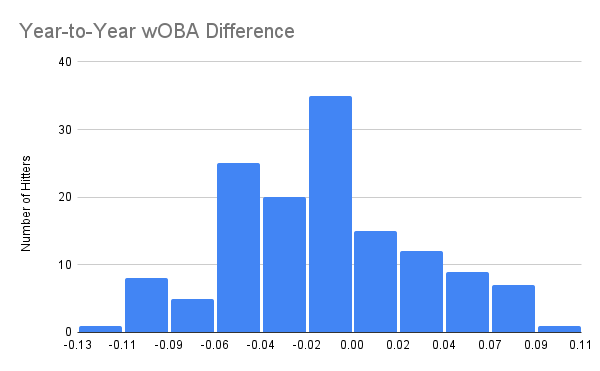
Narrowing down to the more prolific barrelers, it’s a far more select group of hitters with only 20. And again, seven of them did not attain enough plate appearances in the following year for one reason or the other, most commonly due to poor performance. For the remaining 13 hitters, 11 of them had a worse wOBA, and nine had a worse barrel rate.
It just seems like a somewhat fragile combination that often runs out of steam after some time. It is usually hitters with average to below-average raw power. Chas McCormick is another example of this sort of fragility, as he had this combination in his breakout 2023 campaign and got real draft capital in fantasy drafts the next season. He ultimately lost his starting role as these skills fell back.
That leads us to look at some interesting hitters who fit this criteria last season and so far this season. Some young hitters who fit this mold and in 2024 and have struggled (or injured) in 2025 include Connor Norby, Edouard Julien, Zack Gelof, JJ Bleday, and Tyler Fitzgerald.
In addition, two young lefty bats who met the criteria in 2024 but lagged in the plate appearance department are Addison Barger and Ben Rice. Both Rice and Barger have absolutely mashed this season and hit the ball really hard. Context is vital in every situation, and you could certainly have seen some positive aspects in each of their profiles going into their breakout years in 2025. Both of them own a hard-hit rate over 50% this season and some of the best contact quality in baseball.
Of the original group of hitters, Barger and Rice are two of only four hitters to have a 50% hard-hit rate in the following season, along with Joey Votto and Gregory Polanco.
There are 17 hitters with an above-average barrel rate and a below-average hard-hit rate so far in 2025 of varying talent levels.
Lastly, I wanted to include the hitters with the most seasons with this combination for those curious.
Ultimately, there are a few takeaways we can have here. Barrel rate is an incredibly powerful stat for identifying power, but a lack of consistent hard contact can be a red flag for certain hitters. It is a positive trait that they can lift all at the right angles and find power that way, but it just may not be as sustainable. Now, this shouldn’t be a hard and fast rule for all hitters, as understanding the context and nuances of the situation is important.
