





There is no greater persuader than potential. And in 2019, there were few pitching prospects with as much of it as Dustin May.
Popping stuff models before it was cool, May flirted with triple digits, with turbo sinkers to boot. He threw frisbee sliders, flashed a changeup, and boasted a movement profile destined to go viral every fifth day.
Then this sport, as it so often does, took its toll.
After pitching to a 2.57 ERA in the shortened 2020 season and appearing in seven playoff games, May’s first full season in Dodger Blue loomed but never happened. Tommy John surgery ended his 2021 campaign after five starts. He returned late in 2022, and by May of 2023, Tommy John called again. He lost all of 2024, suffering a life-threatening esophageal tear in the process.
May’s 2025 was never guaranteed, and a sport defined by failure wasn’t kind to an ailing arm throwing 5 mph slower than his peak. He struggled to the tune of a well-deserved 4.96 ERA before being traded to Boston at the deadline and unceremoniously ushered into free agency.
But May was finally healthy, having left 50 innings in the dust for the first time in his career. That proof of concept, with this kind of pedigree, was always going to get another chance. It came from the St. Louis Cardinals, who have gotten a 3.16 FIP and 2.5 fWAR through 20 starts. Another year removed from surgery, May looks much more like the tantalizing talent that captivated Chavez Ravine, and his ability to forge new ground while getting back to his old self should land him a long-term home this offseason.
Fast(ball) Track to Effectiveness
This might be the healthiest version of May that we’ve seen since his debut. Performance aside, this is evidenced by increased velocity and a change in arm angle.
May’s four-seamer is up 1.5 mph, and both the sinker and cutter are up two ticks. There’s simply more juice in this profile than there was this time last year, with downstream effects on his pitch shapes. His cutter has traded drop for glove-side movement to become a legitimate weapon against left-handed hitters. His four-seamer, meanwhile, has done its best to escape the dead zone. It dipped into the nightmare range of 11.6″ of induced horizontal break (iHB) and 11.9″ of induced vertical break (iVB) before returning to the 10″ by 14″ shape that has held for the rest of his career.
The latter, in turn, has generated a personal-best CSW% (29.7%) while improving on contact (xwoBACON down from .362 to .282). Stuff+ and PLV remain relatively unimpressed. However, the pitch is both more effective than last season and more cohesive with the rest of his arsenal.
May has long been a member of the three-headed fastball brigade. This season, he’s getting the most out of the approach by embracing seam-shifted wake, tailoring his pitches to platoon splits, and getting back to the 45-grade command that made his stuff competitive. His locations are best illustrated by the growth in his cutter, which is finding success with a Location+ jump from 91 to 110 in 2026. By plvLoc+, it improved from 99 to 107.
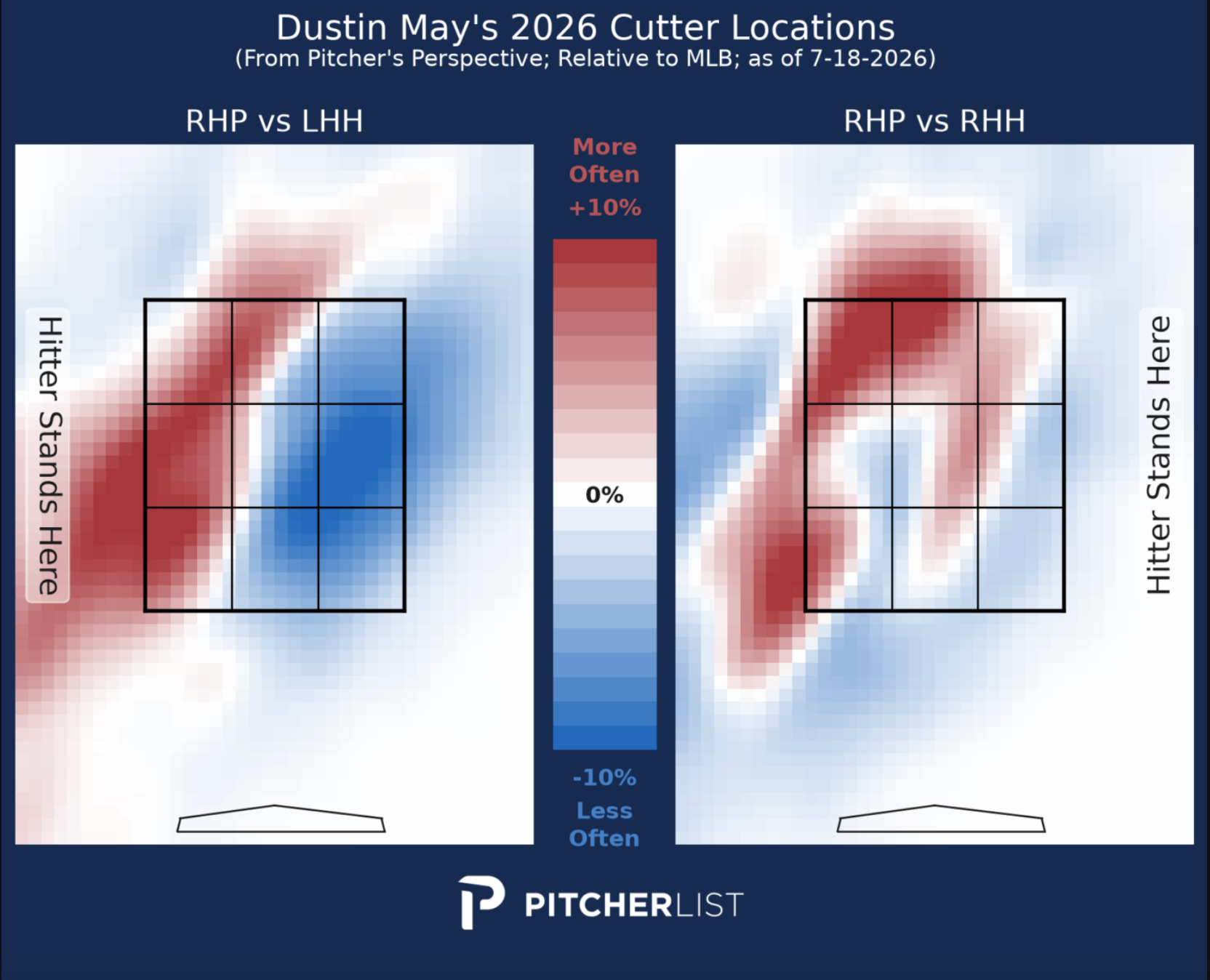
Last season, May threw his sweeper more often than any other pitch to both sides of the plate. He also featured his sinker more frequently than the four-seamer and cutter, contrary to modern pitching nomenclature. He’s fallen in line this year, all but dropping the sinker to lefties while throwing every other non-sweeper more. He’s getting away with enough four-seamers to set up the cutter, and throwing fewer sweepers has added some punch as an out pitch. Meanwhile, he’s still throwing fastballs at a 75% clip to right-handed hitters, leading with that hard-right turn and offering the others enough to keep guys off-balance.
Finding his prior four-seamer has also helped separate it from its two-seam counterpart. He’s acquiring that movement without sacrificing spin-based deception.
Take a look at his spin-based and observed movement charts. It’s good enough that May is getting 60 “minutes” of deviation on his sinker and cutter (the most of his career). But he’s achieving that while keeping their spin-based movement—which hitters are tapping into—constricted. There is a 45-minute difference between his cutter and sinker, with the four-seamer predictably between them. By observed movement, though, hitters have to cover 2 hours and 45 minutes worth of break, from 1.2 inches of glove-side movement to a foot and a half of arm-ride run.
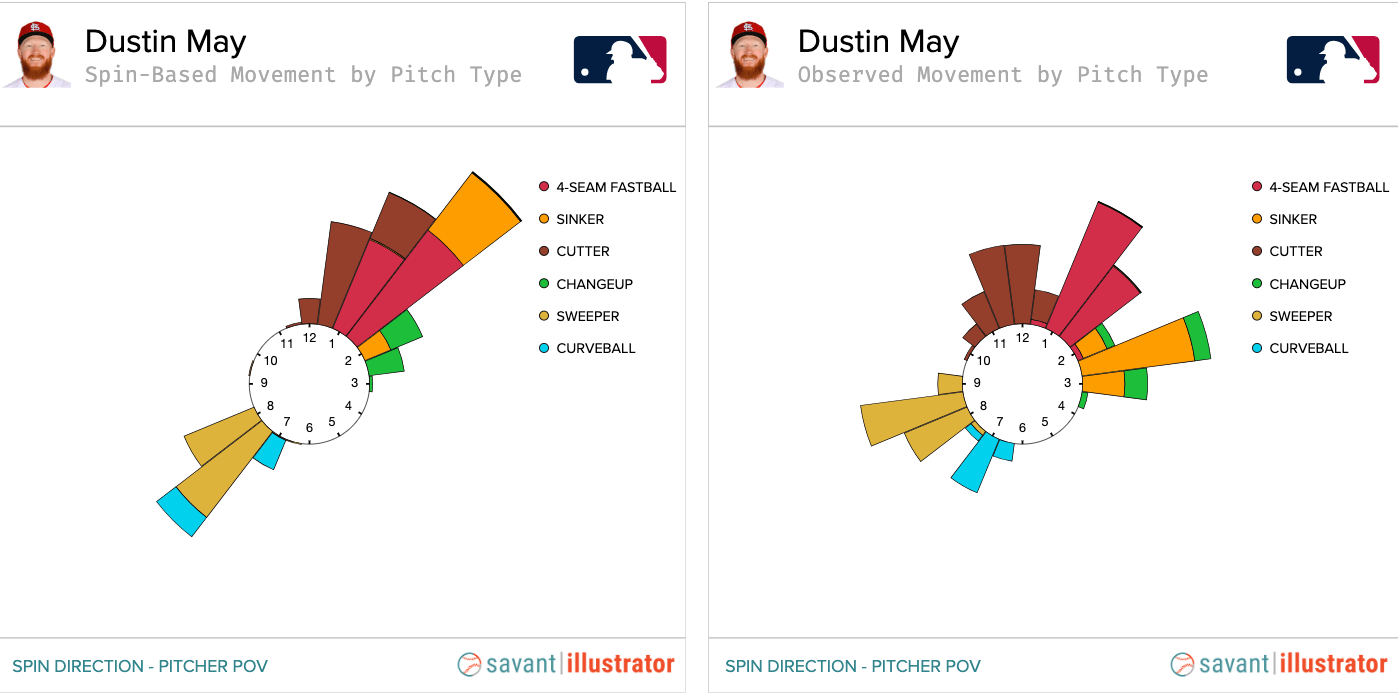
Forcing hitters into that bind, along with a more vertical four-seamer than last season, has made good on his heater-heavy approach. It also probably wouldn’t be sustainable without the higher arm angle that eluded him in 2025.
I can’t speak to whether May’s dropped arm angle, from 30° to 21°, was an adjustment gone awry or a medical necessity. But his velocity, shapes, and command all improved when it got back up to 33° this year. He also struggled in his abbreviated 2022 stint with a 24° arm angle, 8° lower than his pre-TJ self. Anecdotally, it tracks that being further removed from rehab would add some level of comfort to his mechanics. Being able to adopt more of a north-south approach is quite the side effect.
The Evolution of May’s Breakers
I don’t fault May for leaning on his sweeper more than any pitch last season. It was the first time a non-fastball had headlined his repertoire, and to some extent it was a matter of survival. His fastball was incapable of finding strikes like even a 40-grade pitch, and it seemed his sinker was still stuck in recovery. The process wasn’t terrible, either. Stuff+ or PLV said the sweeper was his best offering.
It’s just a risky way to live, arguably untenable without a real fastball to play off of it. Hard contact was always coming, and in 2026, the pitch regressed to its platoon-based norms on batted balls. Left-handed hitters have generated a .497 xwoBACON against it, a 221-point increase from last year.
Fortunately for St. Louis, May’s abnormal splits have held their ground on plate discipline. Throwing it 17% of the time to opposite-handed hitters, instead of 38%, has retained its potency and mitigated the potential for damage. Interestingly enough, it has remained an excellent out pitch to them, getting whiffs inside with the occasional letter-high called strike.
The Cardinals have also coaxed a curveball out of May. Depending on where you look, this is the first time May has thrown one. We don’t see it that way.
In 2023, we picked up his only breaking pitch as a curve, rather than a slider or sweeper. This may have been a result of two pitches merging and messing with some models, and May located it more like a sweeper. Averaging 86.3 mph with 92nd-percentile glove-side movement and just -4.8″ of iVB, it certainly pushed the needle of what a curve could be.
Naming May’s old breaker isn’t nearly as important as acknowledging that his new curve is meaningfully different. That curve has seemingly evolved into two pitches: the sweeper with a similar movement pattern and a curve with far more drop. Like his changeup, it isn’t commanded very well, and they are sparingly used (about 10% each to lefties). Still, it’s a new weapon and additional insulation for his softer stuff against left-handed hitters. It also happens to play better with this version of his fastball.
Subsequently, May doesn’t have to thrust his sweeper into the teeth of the platoon advantage quite as often as before, and he doesn’t have to attack the problem with a fastball. Both his sweeper and sinker are being used 20% less than last year, having been replaced by four-seamers, cutters, curveballs, and changeups. Two of those pitches didn’t really exist a season ago. None of them have to be elite for this strategy to work.
Welcome to the Next Chapter
As nice as it would be to cite a mid-3.00s ERA as proof of May’s newfound success, we’ll have to stick to the peripherals. His 4.59-ERA campaign is better represented by his 3.39 xERA, 3.16 FIP, and 3.86 xFIP. He’s underperforming his xBABIP by 42 points and his xwOBA by another 24.
May isn’t the ace his prospect pedigree suggested. His elbow has all but ensured that won’t be the case. But he isn’t the ill-fated future journeyman that last year showcased, either.
Healthy again, with back-to-back 100-inning seasons to his name, we’ve found the most complete version of Dustin May. His velocity is back where it needs to be to find success, even if the triple-digit fastballs never return. He looks comfortable again, and while one can theorize about his arm angle and other adjustments, it is borne out by the results.
Perhaps May had to sacrifice the upper limits of his stuff for a season’s worth of durability. In doing so, he’s squashed enough of the health concerns to land a legitimate multi-year deal in free agency—and maybe earn St. Louis real prospect capital in the process. The peripherals scream “mid-rotation starter” and the stuff makes him capable of starting games in October.
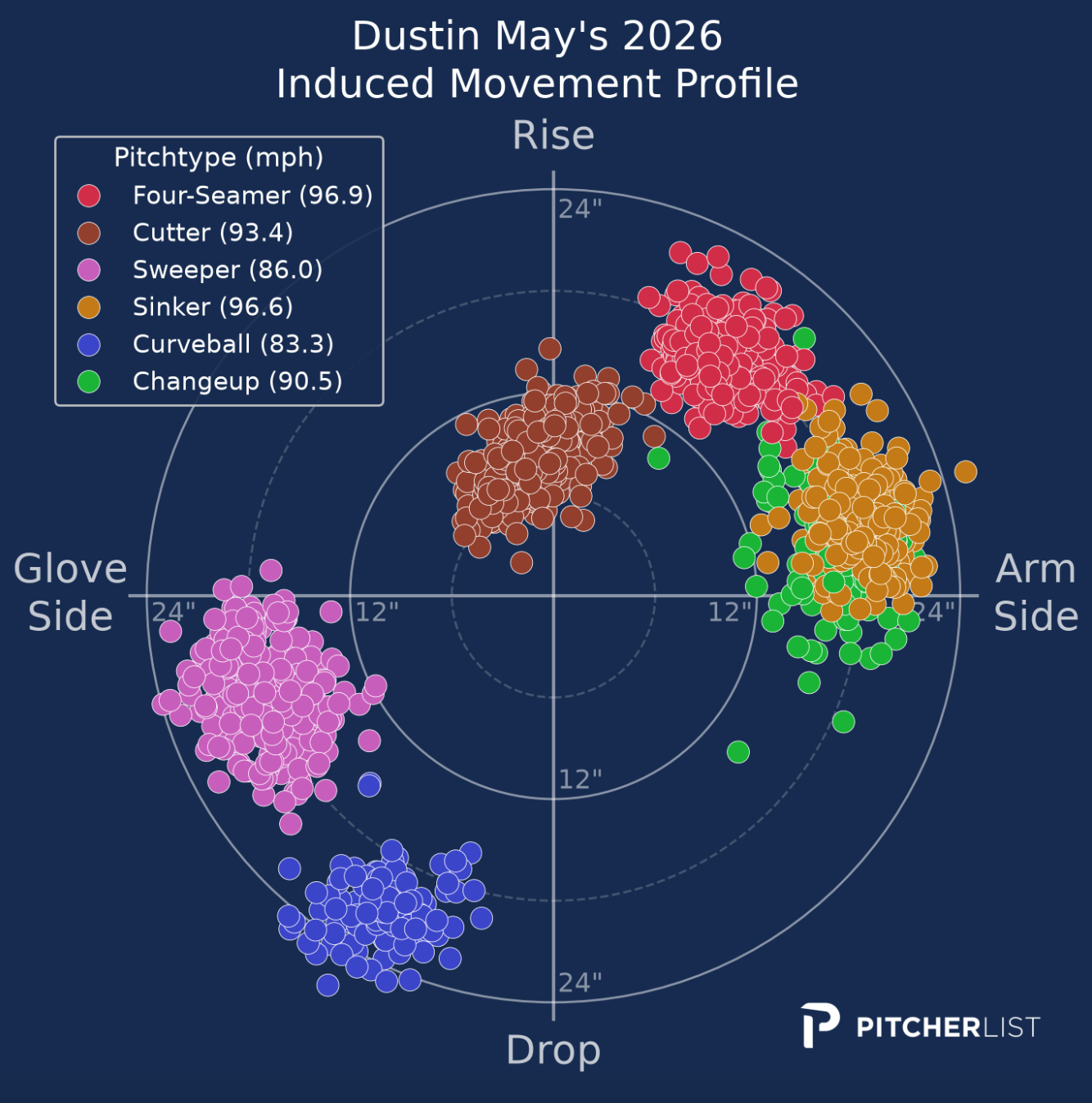
May has found the balance of stuff, usage, and deception with his fastballs to get the most out of each pitch without putting the four-seamer in harm’s way. Armed with a strike-getting sweeper, a change-of-pace curveball, and a changeup picking up excellent called strike rates in its (relative) infancy, he has never had more answers to the test.
His development isn’t necessarily finished, either, although I’m not counting on another command jump.
May’s sweeper and curve rank in the 99th and 98th percentile for spin, respectively. We know he has experience with multiple shapes, from his sweeper/curve hybrid to their current renditions, and his cutter gets some glove-side run at 93.4 mph. As one last attempt at damage suppression, might a more traditional slider be in the cards? Given the physical traits and track record of tinkering, I wouldn’t rule it out.
In either event, May looks poised for a deal similar to Sean Manaea’s three-year, $75 million from a couple of offseasons ago. Both had some latent injury risk and big contract years, the latter of which came from demonstrable adjustments on a new team.
May’s journey from Los Angeles to the operating room to Boston and St. Louis isn’t yet finished. By the end of the week, he might have another new home. But May’s performance looks sustainable, and his arsenal is living up to the highlights from nearly a decade ago. More than ever before, we can say that May is a legitimate starter in this league. After seven long years, that’s something to celebrate.
Photo inspired by Lawrence Iles/Icon Sportswire | Featured Image by Justin Redler (@reldernitsuj on Bsky/Twitter)
