





(Before we start, I want to quickly note that the idea for this came before Eovaldi’s move to the IL. Given that the injury is just triceps tightness, I’m not that concerned about it.)
Nathan Eovaldi has had a strange MLB career. Everything about his profile as a pitcher has seemed to contradict itself over the years. It’s easy to forget now that he’s 35 years old and in his 14th MLB season, but there was a time when Eovaldi was the hardest-throwing starter in the league. Putting it into better context, he’s one of just eight starting pitchers since 2008 to throw a pitch 102 mph even once. Oddly, Eovaldi has pretty consistently held a lower-than-average walk rate despite his impressive velocity. He’s also never been a big strikeout guy. This comes even though he’s always had a good splitter, and his primary fastball has never been a sinker.
Further compounding on the oddness of Eovaldi’s career, he didn’t really find his groove in the majors until he was 30 years old, more than 900 innings into his big league career. He had always shown flashes of brilliance but hadn’t put together much more than the occasional league-average season. Something happened in 2020, though. Coming off of an injury-riddled season in 2019 that saw him moved to the bullpen, he looked like a different guy in the shortened pandemic season. He changed further going into 2021, revamping his arsenal and shuffling around his pitch usage. Considering he made his first All-Star Game and finished fourth in AL Cy Young voting, he had done something right. Since then, he’s largely been a reliable above-average starter.
No more ruminating on the past now, we have enough context for who he used to be. As mentioned, Eovaldi is 35 now. Unsurprisingly, he doesn’t pump high-90s heat by hitters anymore. The drop-off going into this season from the previous was a bit surprising, though. After averaging 95.4 mph with his 4-seam last year, he’s down to 94.1 this season. That’s a sharp and concerning decline. Surely he’s struggling to adjust to the velo loss, right? His fastball shape isn’t that great; falling to league-average velocity is definitely a sign of the end. It has to be. What do you mean he was off to by far the best start of his career?
How to Cope with Velocity Loss
Eovaldi got ahead of the curve on what I consider to be a plague upon the league. Pitchers are frequently far too reliant on fastballs that don’t warrant the workload they see. In general, I think most pitchers should throw fewer fastballs. It’s never quite that easy, unfortunately. Something has to fill the gap left behind by those fastballs that aren’t getting thrown. To be entirely honest, I wouldn’t have guessed Eovaldi would do this quite the way he did.
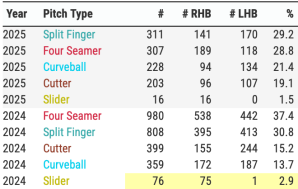
(Image courtesy of BaseballSavant)
Eovaldi’s best pitch from a stuff perspective is pretty comfortably his splitter. Following that, it’s probably the slider he basically never throws. Those are what I would have assumed he would be working into the mix more. Instead, those stayed static while his curveball and cutter moved into the spot left behind by his diminished fastball usage. I don’t fully understand why his curveball is working as well as it has. Maybe I’m too critical of pitches with mediocre stuff, but it boggles my mind that a breaking ball could succeed to this extent with just deception and command in today’s game. What he’s done this season with it is a massive win for baseball fans who miss old-school pitching. A curveball coming in at 76.0 mph, from a low release, with just -8.1” iVB and 9.4” HB should not be putting up numbers like this.
No. Absolutely not. I refuse to believe this pitch is one of the best curveballs in the league this season. I’ve been critical of BaseballSavant’s pitch run value stat in the past… but it has it as the very best curve in the game right now, and I don’t think I can fault it for that, given how its competition has performed. PLV has this pitch labelled as a league-average curveball. This is about what I would expect from a well-used curve that lacks in shape metrics. That is not how it has played out.
The other pitch that has stepped up to carry weight this season has been his incredibly weird cutter. It’s not every day you see a pitcher throw a cutter with the same amount of iVB as his 4-seam, but that’s what Eovaldi has done this year.
I’m not sure I’ve ever seen anything quite like this. It’s almost like a sinker-cutter mix, just at different angles and with more rise. The oddness of these two pitches and how they play off of each other is probably part of how he’s racked up called strikes with them this year. He loves to drop the cutter just off the zone on the glove side. This pairs very well with the front-door 4-seamers he throws to lefties that function like sinkers there due to all of the arm-side run he gets on them.
We see more of this sort of proto-sinker-cutter mix in how his fastball has been hit this season. Both this year and last, Eovaldi’s 4-seamer has produced a higher than 50% ground ball rate on contact, which is exceptional for a 4-seam, and right in line with what you would expect from a sinker.
Despite its shape falling approximately into the dead zone for Eovaldi’s slot and release, he hasn’t suffered the usual pitfalls that pitchers with dead-zone 4-seamers have to deal with. It’s honestly easier to think of this pitch more as a running 2-seamer than a 4-seamer, even though that’s technically not what it is.
A Small Reality Check for the Future
Now, I do have to be the bearer of a bit of bad news. Eovaldi has seen quite a bit of batted-ball luck this year. That’s not the point of this article, but I would be remiss if I didn’t mention it. Specifically, his cutter has been hit hard when he leaves it in bad spots, and he’s largely gotten away with it. As Eno Sarris pointed out recently, there’s never been a better time to be a contact manager, as this year’s baseballs have had more drag than any other year we have data for. The ball is flying less far than it normally would. On top of this, only a third of the barrels Eovaldi has given up have been pulled.
I probably don’t need to tell you he’s not magically a sub-2 ERA pitcher now. He’s definitely had some good fortune. But with that said, it’s astonishing that he’s managed to put up the numbers he has amid a sudden loss of velocity on his fastball. Its numbers haven’t deteriorated at all, and while you might expect that more from a contact-managing fastball like his rather than a pure bat-misser, dropping from the mid-to-high 90s to league average is a substantial hit. Yet, it hasn’t fazed him at all. He just toned back the usage and let his other pitches do the work. His underlying metrics are superior to last season’s. This is not how the aging curve is supposed to work for pitchers.
A Brief Rant on What We Can Learn from Eovaldi’s Evolution
There’s a lesson to be taken here for any pitcher with an underperforming fastball, be it one that used to be good and is no longer, or one that’s always been an obstacle to success. The best thing you can do to make up for having a questionable fastball is to do what you would do with any other struggling pitch: Throw it less. Focus on your secondaries, and find ways to shield your fastball with the rest of your arsenal.
Not everyone can have an arsenal exactly like Eovaldi’s, he’s a somewhat unique pitcher in how his stuff operates. There are almost certainly avenues to achieve the same effect for most pitchers, though. Eovaldi’s command is good, but it’s not elite. The same can be said of his stuff, while it’s a bit strange, I wouldn’t say it’s world-class. What he is managing to do this season with the tools he’s been afforded at this point in his career is the most special thing about him as a ballplayer right now. He has maximized his skillset by pitching intelligently. He leans into the things that make him who he is as a pitcher and uses them to his advantage. With the data available to pitchers now, there are fewer and fewer excuses for a lack of optimization in an arsenal and usage. Eovaldi has, at least for now, cracked one of the codes to survive a loss in velocity. This is surely not the only way to do it, however. In the meantime, though, we can hope that other pitchers learn from Eovaldi’s successes, regardless of how similar a situation they find themselves in.
