





After not throwing a major league pitch last year, Eric Lauer’s 2.82 ERA in 83 innings this year is a remarkable turnaround for the 30-year-old. Even more impressively, Lauer has an 18.4% K-BB%, which ranks 19th out of the 116 pitchers with at least 80 innings. Not only is the top-line ERA productive, but the strikeout and walk totals suggest the success is earned.
Last year looked like a career-ending track: he spent 2024 throwing 75 innings in AAA for the Padres and Astros, posting an ERA over 5.00. Lauer also briefly went to the KBO, where he had seven starts with a 4.93 ERA. The Blue Jays’ veteran-heavy rotation has him following behind the likes of four well-established arms, yet Lauer’s 2.59 ERA is significantly better than the next closest starter, Kevin Gausman (3.85).
Lauer has something that his other four rotation-mates don’t have: the ability to throw with his left hand. Is it all that simple? Yes and no.
Left-handed starting pitchers are fading away at the major league level.

Just 26.4% of pitches have been thrown by left-handed pitchers in the first five innings of a game this year, which would be the lowest total in the pitch-tracking era. Lefty starting pitchers have performed significantly better than righty starting pitchers this year, too.
There are fewer lefties than ever, and they’re pitching better than ever. Well, is it because lefties are easier to hit, so the bar to clear as a big league lefty is higher? Or are there simply fewer lefties, and being one raises the floor? The full answer might come in a later research article (future me will have the answer).
However, in Eric Lauer’s case, it’s a mix of both. Lauer is executing almost perfectly on his secondary pitches, while getting as lucky as can be on the fastball.
Oh, Is Throwing a Fastball Supposed to be Difficult?
Lauer throws a below-average fastball by almost all metrics. At 91.6 mph, it gets 15 inches of iVB and 9 inches of run: average movement at poor velocity. The release doesn’t help either; he gets only 6.1 ft. of extension and a 0.5 height-adjusted VAA. Both figures are around the 13th percentile, respectively.
Despite the astoundingly poor metrics, Lauer throws the pitch 45% of the time to lefties and righties alike. He seemingly has good reason to, as the results back up the usage.
| SwStr% | CS% | Zone% | Chase% | ICR | Str-ICR | AVG | BABIP | Hit Luck |
|---|---|---|---|---|---|---|---|---|
| 11.1% | 16.7% | 54.5% | 32.0% | 37.0% | 58.2% | 0.195 | 0.239 | -11 |
He’s had significant BABIP and hit luck, but there’s enough else to make the case that the fastball is performing well. The -11 hit luck is 96th percentile, which is impressive since hit luck is a cumulative stat. Following that, the low average and BABIP show that batted balls are finding gloves more than they probably should.
Conversely, a 37.0% ICR is 81st percentile, so he is limiting hard contact, and the fastball gets enough strikes otherwise to limit baserunners. As for the plate discipline stats, his CSW% is average, but he gets a significant amount of chases.
Usually, a bad fastball might do one or the other: limit hard contact or miss bats. Lauer is doing both and benefiting from immense batted ball luck. What might be driving this production is the location, which is just perfect enough to make it all work.
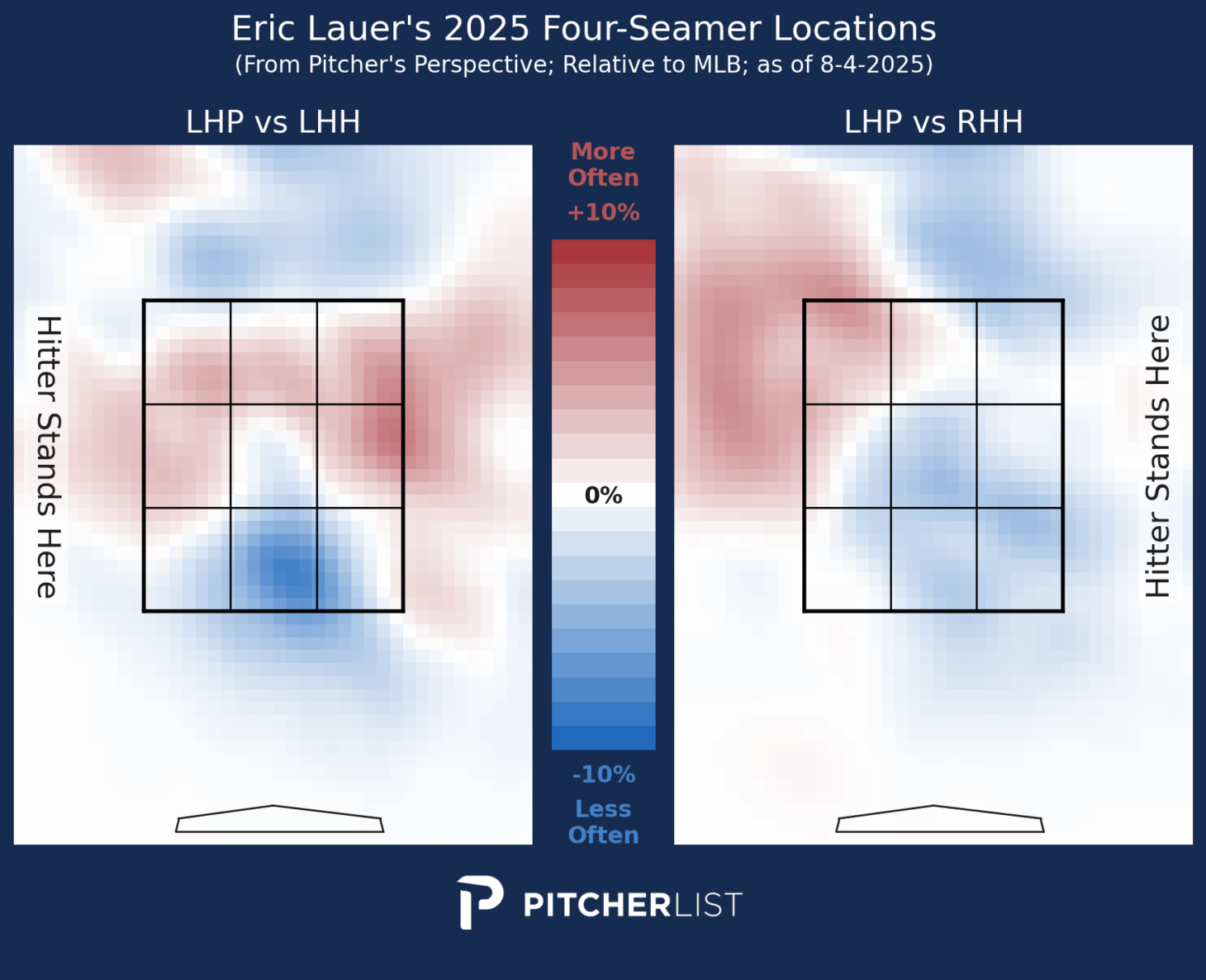
While there isn’t a truly dominant location, he elevates the pitch 56.1% of the time. With a 0.5 height-adjusted VAA, it is absolutely not a pitch that should be elevated. However, with good location away to both-handed hitters, he’s able to generate opposite-field flyballs. These batted balls do not have the same impact as pulled flyballs, which have the best wOBACON of any batted ball type & location.
The whiffs come primarily from the same spot as the batted balls. His whiff rate vs. righties is an above-average 21.9%, while lefties only whiff 15.6%. 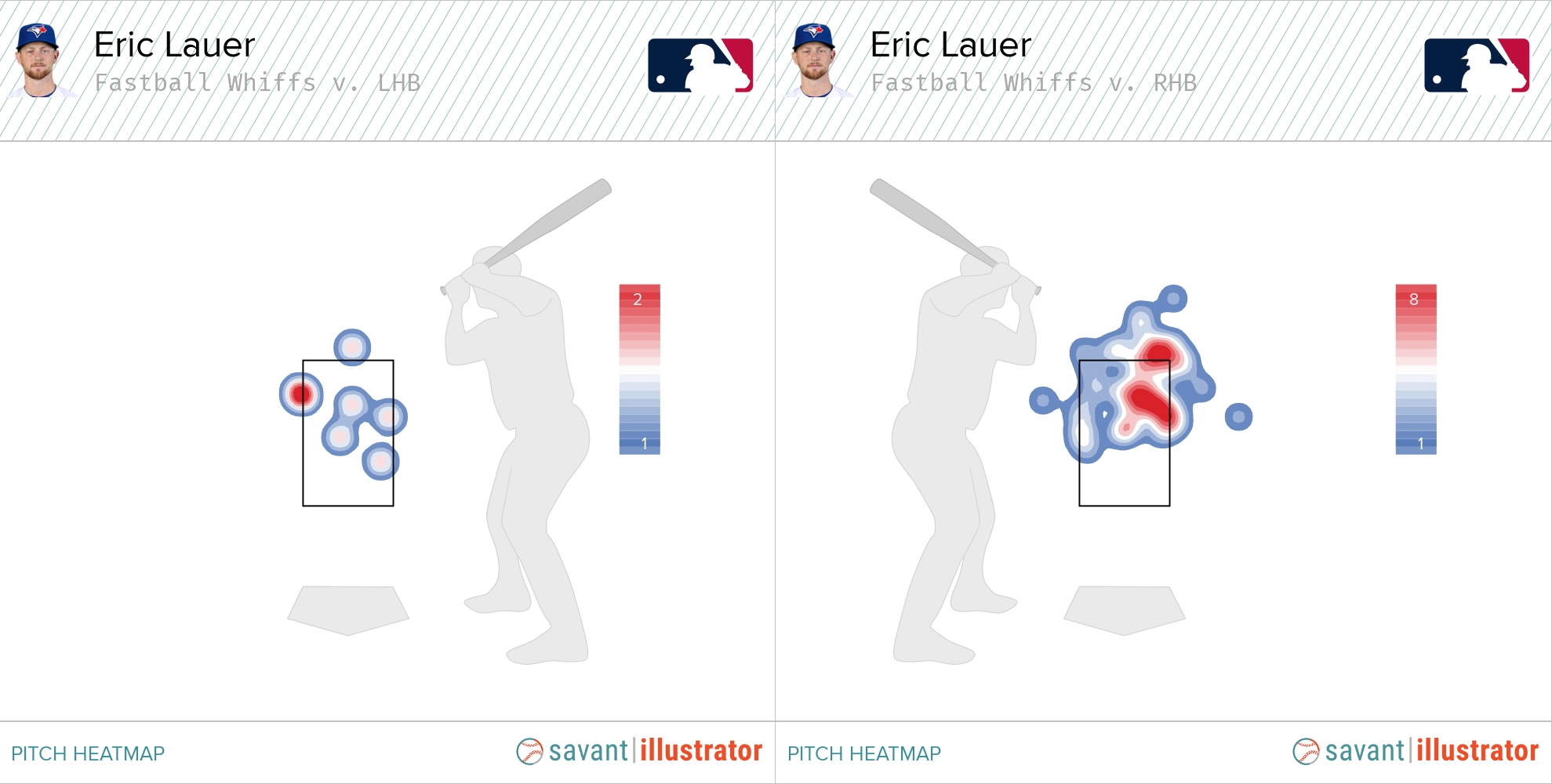
There’s a fair amount of in-zone whiffs from Lauer, an astonishing development from him. With the poor metrics, there’s reason to believe that hitters are just dying to hit the fastball that they overswing. Hitters swing at the pitch 54.0% of the time (86th percentile), whiffing an average amount but fouling the pitch off 25.9% of the time, which is in the 89th percentile. With a ton of foul balls, this allows Lauer to get to the rest of his arsenal consistently.
An Unusually Located Cutter
Lauer’s cutter is his main secondary pitch to all hitters, which he throws at 86.5 mph. With the lower velocity, there’s a decent amount of drop to the pitch. He gets an extra inch of cut against righties compared to lefties, which is likely due to location.
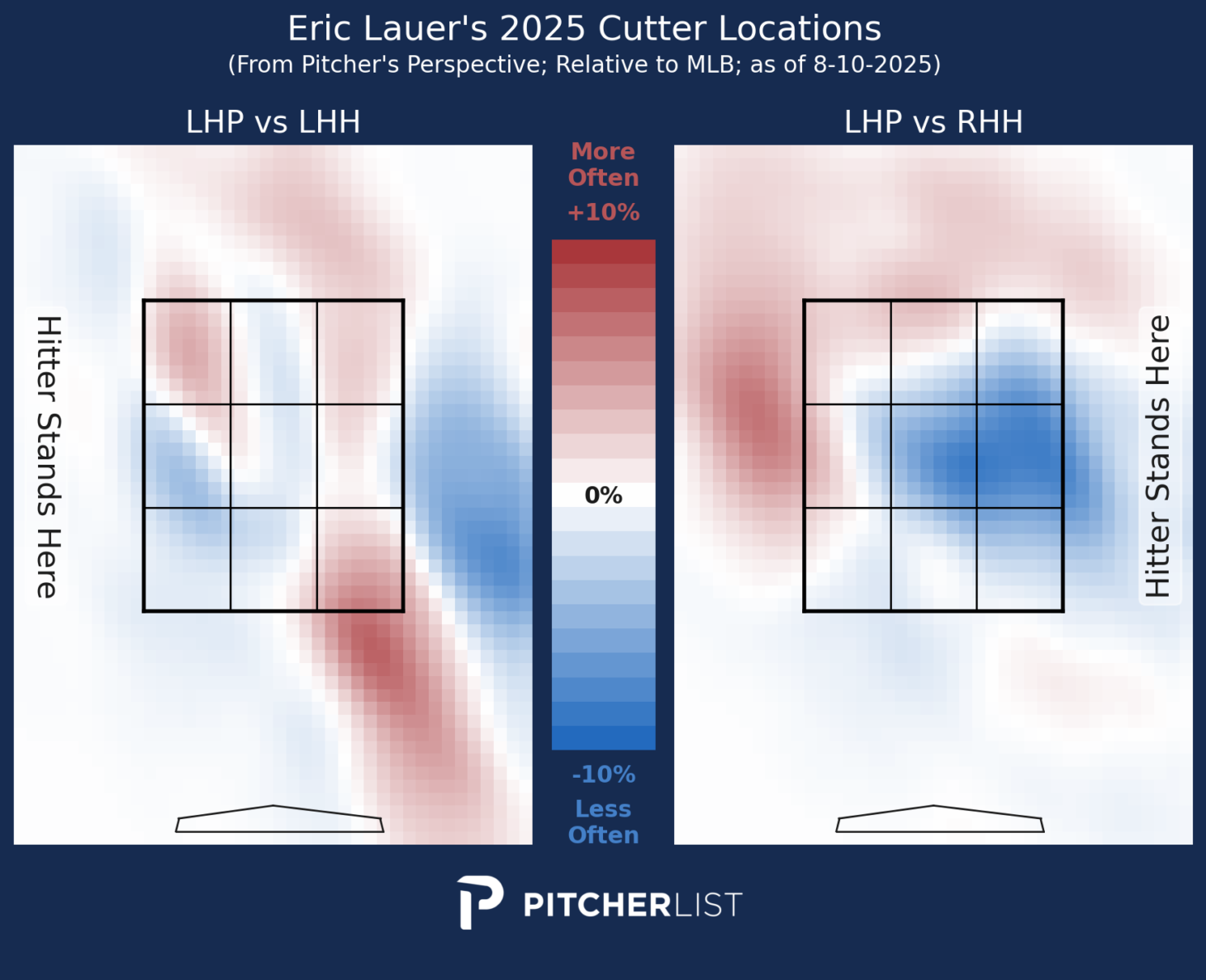
He generally utilizes the pitch as armside, looking to steal called strikes on the outside corner to righties or inside to lefties. With a left-handed batter right in line to the inside cutter, that’s the likely culprit for the lower horizontal movement. Lefties also have to deal with him burying the cutter, akin to normal slider usage.
The cutter has been downright dominant against righties: 35.3% CSW% and a .109 average against. It has a -5 hit luck, 81st percentile for the pitch, and the 39.3% ICR is only slightly better than league-average. So while there’s some luck, it’s not driving the pitch’s success.
Most of the whiffs against the cutter come as hitters think it’s coming back into the zone, generating a weak swing at a difficult pitch to hit. It is the putaway pitch against righties; a 26.5% putaway rate is 10% above the league average.
He also possesses the ability to bury the cutter inside to righties, like how most pitchers throw cutters to opposite-handed hitters, but it’s infrequent.
As for lefties, he throws it in three different spots of the zone, making it challenging for hitters to get a grasp on it. Lauer has a 29.5% CSW%, driven by a strong called strike rate. He does give up more hard contact against lefties: a 52.6% ICR and .350 average against are poor, but it induces fewer swings than most cutters. It doesn’t have the same putaway numbers against lefties, which is left to the curveball.
The cutter is the only pitch in his arsenal that has above-average Stuff+ and Location+ grades, coming in at 103 and 107, respectively.
Pristine Curveball Execution
Lauer’s curveball is what brings the cutter and fastball together. Living up and away with the two fastballs allows him to go down-and-away or down-and-middle with the curveball.

His curveball is a slow curve, coming in at a leisurely 75.2 mph. The movement profile is nothing special on the pitch, but the command is. He dominates the zone with the curveball, making sure his misses are in the zone rather than not.
The result is a 121 Location+, tied for first in curveball location among starters with at least 80 innings.
It gets an average amount of whiffs, but the 51.4% zone rate results in a lot of strikes. This pairs nicely with his usage: he throws 45.9% of his curveballs early in the count, where hitters are less aggressive.
When hitters are ready for the pitch, they do hit it. It has a .279 average and .333 wOBA against. It doesn’t get hit hard, though; a 32.1% ICR is above league average.
Like the fastball and cutter, Lauer’s curveball is a CSW% demon. Against righties, it has a 37.3% CSW%, with a 27.3% called strike rate doing most of the heavy lifting. Against lefties, it has a gaudy 42.4% CSW% with exceptional whiff and called strike rates.
While it’s not frequently a 2-strike pitch, Lauer can deploy it sparingly to lefties to get a strikeout. It has a 50% putaway rate on eight pitches thrown in 2-strike counts.
He locates the pitch well and keeps it out of trouble, which has resulted in the metrics loving the pitch’s production so far.
The Periphery Pitches
He has two other offerings: the slider and changeup. Both have under 10% usage, making them expendable tools that aren’t a necessity.
The slider has a gyro shape that Lauer deploys primarily in two-strike counts to righties and as a strike pitch to lefties. It has the same amount of horizontal break as the cutter, making it an optimal tunneling pitch.
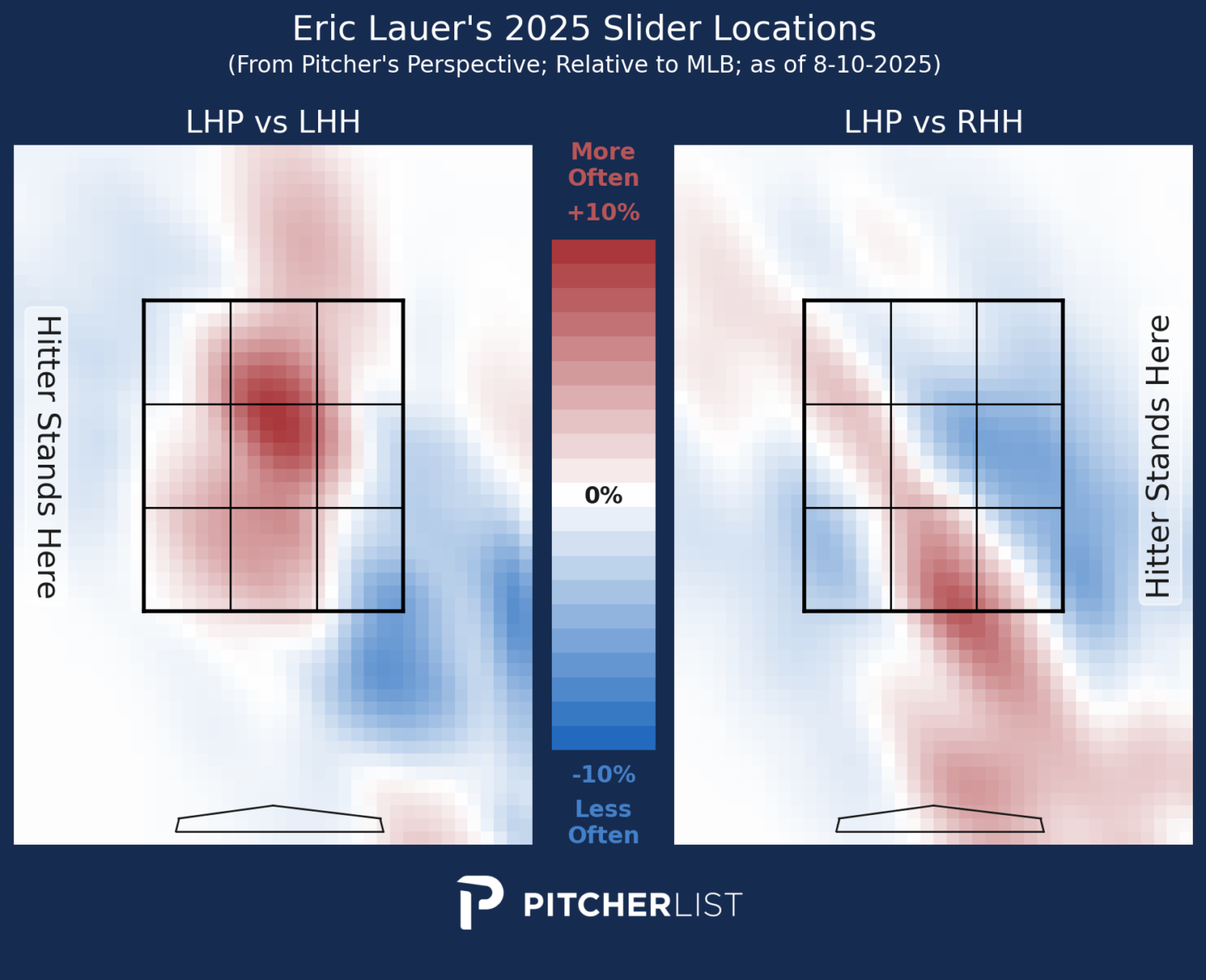
It works well off the up-and-in cutter location to lefties, but it gets a home on the complete opposite side of home plate against righties. This is the most stark example of why Lauer is pitching so well: he has a game plan with all of his pitches all around the zone, and he’s executing it to perfection.
Unsurprisingly, the pitch gets a lot more called strikes against lefties compared to righties, but he makes up for it in whiffs.
As for the changeup, he only throws it to right-handed hitters, and it’s a very poor pitch. It has just a 23.1% zone rate, and hitters don’t chase it out of the zone either. When they swing in the zone, it has a 68.8% ICR and a .375 average against.
One Last Trick: Is It a Deceptive Delivery?
I didn’t notice this at first, but the great Pitcher List writer Jack Foley pointed this out to me: Lauer hides the ball just about better than anyone, despite a very short 6.0 ft. of extension.
He has otherworldly scap retraction that allows him to have the ball behind his head until really late into the release. It results in the ball having to go behind his head at the last second, which makes it harder for the hitter to pick up.
I believe this is what brings it all together. Lauer is pitching lights out, with a clear plan for all of his pitches, and has an advantage as a left-handed pitcher. He’s putting unassuming shapes in unusual locations, but those shapes in those locations are not ones that hitters see very frequently. Add a delivery that makes it hard to track the ball, and Lauer is doing just enough to excel right now.
Lauer’s success has been fun to watch, but its sustainability is very simple: are hitters letting him get ahead in the count with fastballs and curveballs? When he’s pitching well, these two pitches allow him to get to the cutter and slider that are commanded well enough to be lethal. I wouldn’t be surprised if more appearances against playoff teams eventually mean the book gets out on him, but it seems to be stable. A 25.0% strikeout rate and 6.6% walk rate tell the story of the season for Lauer.
