





Spring training games have now been underway for a little less than a week, and that means the excitement of baseball being back on televisions during the daytime, endless stats to pore over at the end of each night, and countless storylines to keep an eye on.
Some of the most interesting spring stories have to do with a handful of jobs that are still up for grabs. While most players show up to spring knowing what their role will be with their club to begin the year and are simply looking to get back into the swing of things, a handful of others show up fighting for their starting role on the team. For these players, every at-bat or inning pitched becomes magnified, as we, along with their respective clubs, try to figure out if they will become a valuable real-life and fantasy starter, or simply a reserve who we can remove from our radar.
As you settle back into your stat-checking spring training routine, these are the most important position battles to be keeping an eye on in the National League.
(Note: Konnor Griffin is technically “fighting” for a position to open the season at shortstop in Pittsburgh, but the 19-year-old’s ownership of that position is an inevitability at this point. The question of whether or not he will first start on Day 1 or Day 31 is one to keep an eye on, but the job will be his to lose.)
Cincinnati Reds – Chase Burns vs. Rhett Lowder
The Cincinnati Reds have a decision to make for their final starting rotation spot, with two former first-round picks out of Wake Forest University contending for the job.
2025 Stats (43 IP): 0-3 | 4.57 ERA | 1.31 WHIP | 67 K
After being drafted second overall in 2024, Burns made his MLB debut last season and averaged an electric 98.7 mph on the four-seamer with a wipe-out slider to boot–but he struggled to maintain success beyond his first two starts as batters quickly adjusted to a mainly two-pitch mix.
Despite the flashy stuff and massive strikeout rate (67 strikeouts in only 43.1 IP, a 35.6% K rate that would have ranked him 11th overall in the league if he had enough innings to qualify), Burns had a mediocre 4.57 ERA and 1.32 WHIP. The stuff is clearly there, though, and adding a legitimate third pitch in the changeup is what will really take Burns to the next level of consistent ace.
The star of the show is obviously the heater, but the CSW% on that slider is very impressive in its own right.
There is also some underlying data to suggest that Burns was unlucky in the amount of damage that he gave up last season. Batters were able to hit a respectable .250 against that elite four-seamer, but that included a highly-inflated .386 BABIP (anything above .330 is considered extremely unlucky, and Burns easily surpassed that mark). The slider faced similarly bad luck, with a .333 BABIP. The actual average against that pitch was only .203, indicating that when Burns’ luck reverts to the mean, batters will struggle to scrape their collective average above .200 against the slide piece.
The changeup was not used as a very serious pitch last season, and Burns himself has admitted that it was the focus of his offseason. He was excited to showcase the pitch in his spring debut, and though we will need to wait for more data, early indications are that his changeup is already a more refined and effective pitch than it was last season.
That aforementioned spring debut contained mixed results—although Burns did not allow a hit through two innings of scoreless work, he threw less than half of his pitches for strikes (15/32) and gave up three walks while racking up only two strikeouts. He won’t be judged too harshly on those results alone, but his command will obviously have to improve throughout the spring if the Reds are to feel confident inserting him into their regular season rotation.
2024 Stats (30.2 IP): 2-2 | 1.17 ERA | 1.27 WHIP | 22 K
A former first-round pick in his own right (No. 7 overall in 2023), Lowder showed that he could navigate big-league lineups in his 2024 debut with the Reds. He was only given a brief look over six starts that season, but he managed to impress with a 1.17 ERA and a quality four-pitch mix. His entire 2025 season was derailed by forearm and oblique injuries, and now that Lowder is fully healthy, it will be interesting to see what type of spring he puts together.
He does not have the overpowering arsenal that Burns does, but Lowder’s overall PLV of 4.91 is still pretty respectable, especially given that his four-seamer graded so poorly in 2024 and dragged the rest of his arsenal down quite a bit.
Ironically, Lowder’s job this spring is the exact opposite of Burns — his off-speed stuff is already there, he just now has to show that he has a legitimate enough four-seamer to keep hitters honest and remain competitive throughout at-bats.
Similar to Burns, Lowder had a mixed spring debut, racking up four strikeouts across two innings while also allowing one earned run, two hits, and one walk. The four strikeouts are intriguing, though, given that Lowder’s strikeout rate in 2024 was only 17.2%, less than half that of Burns. If Lowder can push that number even into the mid-20’s, then he is a very interesting arm to continue to watch.
Fantasy Relevance: Burns will likely be taken in the early-middle rounds of most drafts, as he is the name most people are familiar with by now on the shortlist of candidates who could be the next great ace. If you are in a dynasty or keeper league, then he is certainly worth the investment even earlier. Even in a non-keeper league, he is likely worth the pick, as he could be ready to take the leap to ace-level status by this summer. Lowder, on the other hand, will likely be forgotten about by most drafters and will be someone to watch out for as an early-season free agent. He has an intriguing underlying foundation and could even make for a fantasy-relevant long reliever if given the opportunity.
New York Mets – Brett Baty vs. Carson Benge
There is a hole in right field in Queens after the Mets decided to move Juan Soto to the opposite corner. This was looking to be a tight battle through the end of spring, but a recent tweak to Baty’s hamstring could give Benge the path to now take the job and run with it.
2025 Stats (432 PA): .254 AVG | .313 OBP | .435 SLG | 18 HR | 50 RBI | 53 R | 8 SB
There were questions entering 2025 if Baty even still had a role with the Mets, and he went on to put together a solid campaign and by far his best season yet with the club. He finished the year with 18 home runs and eight stolen bases in uneven playing time, while also compiling a very respectable 111 wRC+ and seven defensive runs saved between 2B and 3B. He still has elite bat speed (86th percentile) and barreled the ball at a greater rate than 80% of his fellow big leaguers. His ‘100 Plate Appearances Rolling xwOBA’ chart was especially impressive to end the season, staying firmly above league-average for the majority of the stretch.
Baty’s Process+ rolling average chart confirms that he unlocked a new, far more effective approach at the plate last season.
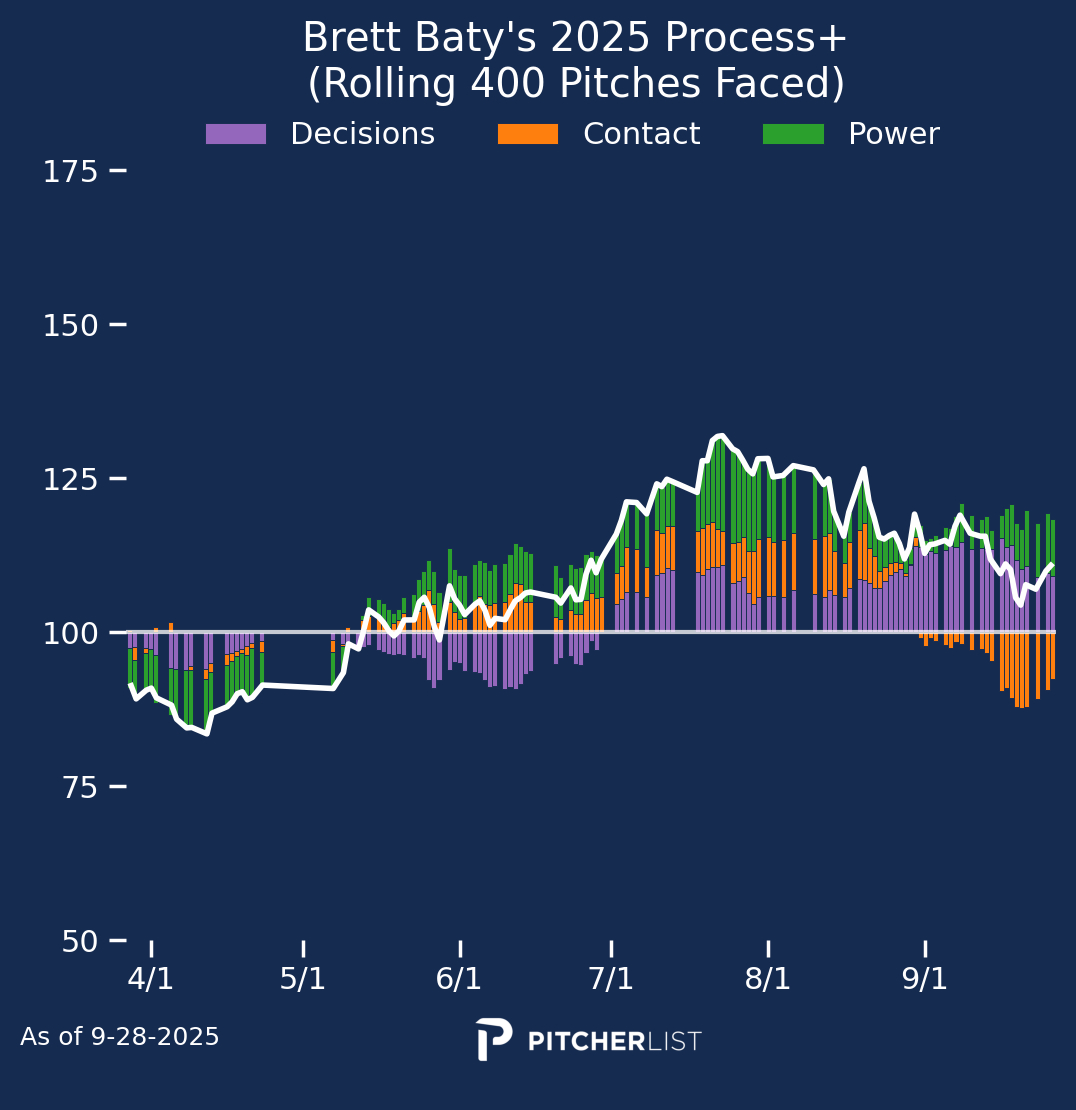
We can see that he opened the year with a month-long stretch of poor at-bats amid concerns that he was still the same underwhelming player that Mets fans had become frustrated with in his first few years with the club. All three metrics (power, contact, and decision-making) were dragging him downwards, instead of upwards. However, at the beginning of May, he began to unlock a power and contact combination that started a consistent trend upwards—a trend that continued through an impressive peak in July that brought his Process+ above the coveted 125 mark. Even his decision-making turned positive at the beginning of that month, and remained so through the rest of the season. The fact that Baty was able to consistently maintain this new and improved approach for a four-month stretch bodes very well for the type of player he could be in 2026.
The biggest issue for Baty is that he has a weak arm and has never previously played the outfield.
The Mets as an organization have come to really like Baty, however, and are confident that he can make the adjustment. The hamstring issue is not being talked about as anything serious, so while it does dampen Baty’s chances of being in right field on Opening Day, he has put himself in the good graces of the team in enough of a way to deserve a chance once he is fully healthy again. Don’t fully write off Baty just yet.
2025 Stats *Minor Leagues (519 PA): .281 AVG | .385 OBP | .472 SLG | 15 HR | 73 RBI | 87 R | 22 SB
The 23-year old was drafted 19th overall in 2024 out of Oklahoma St., and is currently the No. 16 prospect in MLB. Benge has a smooth and powerful swing, but he struggled quite a bit in 24 games at the AAA level last season, with a woeful .178/.272/.311 line. However, at 32 games at the AA level, he crushed it, hitting .317 with eight HRs, 23 RBI, and 28 runs. Mets fans are hoping he can eventually tap into that version of himself at the major league level.
Benge is much more of a natural OF than Baty, who is learning a new position—Benge was an OF throughout college, and although he featured in center, he is familiar with the corner positions. Benge also has much greater arm strength than Baty, indicating he already has a major leg up on the defensive side of the field. All he has to do is keep himself from being a liability at the plate to cement his spot in the everyday lineup.
Fantasy Relevance: Both Baty and Benge profile as under-the-radar power/speed combinations. The upside of Benge is higher, but Baty has been on an upward trajectory since last season, and it will be interesting to see if he can continue to improve this season if given the playing time. Baty will likely go undrafted if he is still dealing with the hamstring tweak, but is worth keeping an eye on in the early weeks of the regular season. Benge, on the other hand, is worth a late-round stash given the potential upside.
Los Angeles Dodgers – Hyeseong Kim vs. Alex Freeland
This particular battle opened up due to Tommy Edman’s off-season ankle surgery, creating a gap at second base that the Dodgers will need to fill for an unknown period of time to begin the season.
2025 Stats (161 PA): .280 AVG | .314 OBP | .385 SLG | 3 HR | 17 RBI | 19 R | 13 SB
The 27-year-old Korean utility man proved himself to be a quality contact hitter in limited playing time last season. Kim slashed .280/.314/.385 in 161 at-bats and also stole 13 bases, showcasing the speed that gave him the nickname “The Comet” while playing in the KBO in his native Korea. He is able to play multiple positions around the diamond, allowing the Dodgers to keep him in the lineup upon Edman’s return if he has proven his value by then.
2025 Stats (97 PA): .190 AVG | .292 OBP | .310 SLG | 2 HR | 6 RBI | 10 R | 1 SB
Taken in the third round of the 2022 draft out of Central Florida University, Freeland has maintained a spot on the Top 100 MLB prospect list over the past several years. Dodgers fans are hoping that 2026 is the year that Freeland turns that pedigree into proven success at the big-league level after struggling during his cup of coffee with the club last season. His spring is certainly one to watch, as there wasn’t much encouraging data across Freeland’s 97 big-league at-bats last season, but that doesn’t mean we should write him off just yet.
Fantasy Relevance: Neither player was particularly relevant last season in the sporadic playing time they were given, but neither should be written off heading into this season. Kim now has his first season of MLB baseball under his belt, oftentimes the hardest for players coming from overseas, and a full off-season with the organization to make any necessary adjustments. Freeland, on the other hand, is still only 24-years-old and is counted on to be a part of the next wave of young talent for the Dodgers. While neither player is currently a recommended pick in standard format drafts, they both have the potential to put up relevant numbers if given the job. Freeland still has room to develop as a player, but Kim especially could become valuable in points leagues as a “free” source of consistent points off of waivers.
