





Another year, another round of “Is Gavin Williams for real?” questions after every start. He looked good last year, but there were reasons to question his success. He had a 12.8 K-BB% as a direct result of falling short of his strikeout potential and running the highest walk rate of any starter who pitched more than 60 innings. His peripherals were near universally worse than his results. He had one stretch all season in which he went three consecutive games with fewer than three walks, and games with four and five bookended it.
Far be it from me to judge a pitcher by his walk rate. I’ve iterated dozens of times now that I generally don’t care if a pitcher walks a few more hitters than average, but that patience has a limit. That limit finds itself shrinking when a pitcher isn’t getting strikeouts at an elite clip or consistent weak contact. I never trusted Williams last year. It didn’t matter that he finished with a 3.04 ERA and seemed to flourish more as the season went on. The inconsistencies in his process and faults in his statistical profile were too much to take his numbers at face value.
That said, since the day he was drafted, we’ve all expected big things from him. His stuff has long made us wonder what he could be if he ever put everything else together. Even in a baseball environment that sees new prospects with elite stuff come up every week, we’ve remained patient with Williams, hoping for him to reach his potential. This season, he’s changed up his style for the better.
In-n-Out, Up-n-Down
Walk rates are tricky things. They aren’t always the product of bad control/command, and they can be heavily influenced by strategy. Williams’ spike in free passes to first last season can be largely attributed to an inability to make hitters chase pitches out of the zone at desirable rates. I believe he had an epiphany this offseason. “Why not throw the more difficult-to-hit pitches in the zone, and the less difficult ones out of it?” This thought is displayed prominently in his individual pitch numbers this season as opposed to the previous. Rather than one giant headache-inducing table, let’s break this strategy shift down pitch by pitch.
This here is the biggest catalyst for Williams’ prosperity this season. It’s why I believe in him now more than I ever have. He is throwing his fastball less, and it’s playing up. This isn’t as simple as just a lower zone rate, though. He is spotting this pitch beautifully this year.
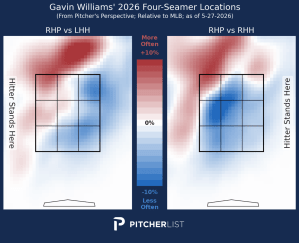
He is locating 4-seamers above the zone with spectacular regularity. I didn’t know he had this in him, to be quite honest. His 4-seam pitch maps from previous seasons weren’t nearly as inspiring. He’s always had the capacity to fill the upper half of the zone with fastballs, but only in the worst season of his career did he show any aptitude for locating well above the zone. He’s throwing higher with this pitch in general, a 68.3% hiLoc% compared to last season’s 55.8%. Just 9.0% of his 4-seamers have been in the bottom third of the zone or lower, which is a touch below half of the league average rate.
A good sweeper, even a poorly-spotted one, is difficult to hit. Zoning them frequently is generally a sound decision. Williams has opted to do just that this season, and he’s locating them well on top of that. He’s done a good job of keeping them low in the zone, and when he’s out of the zone, he’s still pelting the low glove-side edge for chases.
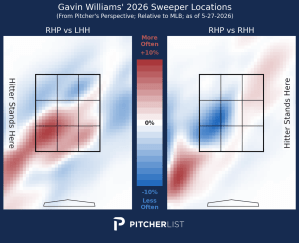
He’s done a great job with this pitch this season. It’s standing up well to increased, more demanding usage. It has maintained its ~44% whiff rate, including a bump in z-Whiff%.
Don’t be fooled by the drop in whiff rate; things are going swimmingly for his curveball this season. Its strike rate has soared to 67.6%, with career best marks in both CS% and SwStr%. His ability to land a pitch with this much power and movement in the bottom of the zone so often as he has has been impressive. This pitch does occasionally leak upward toward the middle of the zone, and he’s paid for that a couple of times, but it’s a net gain.
This one’s weird. The numbers are absurd; that’s a 98th percentile CS% and CSW%. 94th percentile Str%, 96th percentile zone rate, and he’s even getting some whiffs and chases out of the zone. The stats look great, but he’s using this pitch in a way I would describe as dangerously novel.
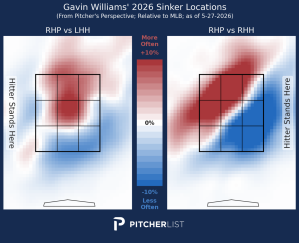
Yeah. We should talk about that. This isn’t zoning for the sake of it; rhyme and reason do exist in this chart, I promise. Look at this one compared to the 4-seam, and it starts to make a bit more sense. Remember when Giolito took the league by storm seven years ago with his daring high changeups that fell into the zone, confusing the poor hitters who thought they were laying off a high fastball? The same concept is at play here.
Williams uses both fastballs against both handednesses of hitters, slanted toward platoon preference. The high sinkers play off of and set up the 4-seam against righties, and do the same for cutters against lefties. The downside here is obvious, of course. Throwing sinkers in the upper half of the zone is a risky location for them. Sinkers are the easiest pitch there is to make contact with, and throwing them up where it’s more likely that a batter can get under them is usually inadvisable. The batted ball numbers on this pitch have been… peculiar, to say the least.
This can be explained, but I think it’s just a very odd set of occurrences rather than something sustainable. You may be wondering how the xStats can look that good when the hard-hit, barrel, and ICR numbers are so dismal. That would be because the xStats here at PL are spray-angle adjusted. If you were to go and look at the individual instances of hard contact and well-hit fly balls that have come off of Williams’ sinker, you’d notice that nearly all of them have been hit to either center or the opposite field. That is why this pitch has an HR/FB% of zero. Every time it’s well struck, it isn’t quite hit well enough to do damage. He’s gotten more strikeouts with the sinker than he’s allowed hits off of it.
Surely some of this is luck. I can chalk some of it up to the deception of how his fastballs and cutters play off of each other; that’s a plus for him. Nevertheless, I will not be giving him full credit for these specific results even if they align with what was expected based on how they were hit. How long this works for him is anyone’s guess. I wasn’t expecting to have this much to say about his fourth pitch when I chose to write about him, but it was too odd not to dive into, especially given how much success has come for him from it.
His cutter has been relegated to the back of his arsenal after being his third pitch against both righties and lefties last season. It is now almost entirely a platoon offering, contributing 13% of his kitchen sink approach to lefties. The modifications don’t stop there. Like his fastballs, he is also elevating this pitch far more often than he used to, a spike from 32.2% to 62.5% hiLoc%. The smaller sample here of just under 100 pitches makes it tougher to be certain of the quality of this change, but the early results are promising. It’s not a stretch to presume that the cutters are tunneling well with his fastballs and creating pitch identification nightmares for hitters, allowing all three pitches to play above their stuff quality. That could explain the boost in called strikes and CSW%.
A Quick Arsenal Rundown
As mentioned earlier, Williams has always had a tantalizing pitch mix, but it’s not necessarily in the way you might expect.
Williams’ 4-seam fastball is… average at best? The whiff rate this season really is a product of strategy more than the quality of the pitch itself. He throws it hard, but its movement falls into the dead zone for its release, which is compounded by said release being around the average height. Throwing it in the mid-high 90s helps, but there’s a reason this pitch has given him trouble in the past, and why it’s so great that he’s reduced both the total usage as well as letting it fall out of favor when he’s desperate for a strike. It has dropped from 50.2% to 30.4% of his pitches in 2-0, 3-0, and 3-1 counts this year.
His sweeper is awesome. 87 mph pitches that regularly break more than a foot to the glove side do not grow on trees, especially not for starters. Bradish and Kirby are the only starters with comparable breakers that sweep more than Williams’ does. As such, this pitch is difficult to get the bat on, let alone hit well. It’s the best pitch he throws, and it’s not close either.
His curveball similarly has a strong mix of velocity and movement. It’s not quite an elite pitch, but it’s easily above average. Furthermore, it fits nicely into his arsenal, creating a strong spin mirror with his 4-seam, at near opposite spin directions with similar spin activity.
Like his other fastball, his sinker suffers from generic movement that has kept it from being an elite pitch in the past. He doesn’t create a ton of SSW, and it has slightly below-average depth both in terms of movement and angle. On its own, it mostly just has velocity going for it. However, within the context of his arsenal, it has a role. While it doesn’t have a huge movement gap from his 4-seam or even his cutter, as we see with some other pitchers, it does enough to separate and cause problems for hitters. Look no further than how his fastballs have performed this season and recall how he’s using them in tandem.
His cutter is weird. The old one he was using in 2024 was more normal, but the one we’ve seen since last season isn’t consistently crossing the horizontal neutral line, leading to a cutter that doesn’t “cut” per se, rather it breaks ever so slightly arm-side. This is usually not a good thing. However, with cutters being so arsenal and usage-dependent, he’s found a role for this pitch. It doesn’t matter that it doesn’t cut to the glove side because he’s not usually trying to saw off lefties inside with it. He’s dropping it into the top of the zone like his sinker to set up high fastballs and low breakers. It functions as a bridge pitch that can get him called strikes, though its mediocre movement will get it tagged on occasion. I’m perfectly fine with this being his fifth pitch.
It’s All Coming Together
When I was planning this article out, I considered omitting my usual breakdown of a pitcher’s arsenal. It was as I was doing the research for it that I realized how relevant it is for Williams. His new plan of attack perfectly suits him by optimizing which pitches are in the most danger, and setting himself up for the knockout punches he wasn’t landing earlier in his career.
His fastballs have never been quite as good as people believed them to be, but it doesn’t matter anymore because he’s put them in the best position to succeed we’ve seen from him thus far. He’s leaning on how his pitches play off of each other in tight situations, and otherwise being aggressive with his breaking balls to avoid those situations. It’s generally not helpful to tell a pitcher to “throw his best pitches more often” as they would if it made sense for them to do, but that’s exactly what we’re seeing from Williams.
If I could do anything with his arsenal, I’d love to see him try his hand at an offspeed pitch again. He never trusted his old changeup enough to throw it consistently. That was for the best; the pitch didn’t do him any good, but that doesn’t mean he should give up on throwing one altogether. I should be clear, this isn’t a necessary thing. He’s always been a reverse splits guy, so a changeup isn’t at the forefront of his needs. I’m just of the opinion that most pitchers should have one.
The biggest thing to keep an eye on for him is the performance and location of his fastballs. Throwing the chest-high 4-seamers is one thing, but if his sinker starts to get pieced up, adjustments might be necessary. Should the sinkers (and cutters) start to drop in the zone, it could hurt the chase rate on 4-seamers above the zone. I don’t think the strategy would fully fall apart, but we might see him revert a bit and trade lower strike rates for lower barrel rates. It’s a game of adjustments, and Gavin made a good one this offseason. I’m excited to see how it continues to play out.
(Stats up to date through 5/27)
Adapted by Kurt Wasemiller (@kurt_player02 on Instagram & Threads
@kuwasemiller.bksy.social on BlueSky)
