





By all accounts, George Kirby is having a great start to the season. His 2.84 ERA ranks best in the Seattle rotation, 1.16 WHIP is 65th percentile among starters, and he’s pitched into the sixth inning in all but one of his starts. After a disappointing and injury-plagued 2025, there were a lot of questions about who he was going to be this season — he’s seemingly answered them on the surface.
Under the hood, however, Kirby looks unrecognizable. As someone once known for potentially all-time great command, the common trope was that Kirby needed to sacrifice some of that strike-throwing in order to earn more strikeouts. He made that transition last year, striking out 26.1% of batters (23.3% career figure) and walking 5.5% (3.1% career figure), despite overall underwhelming results. This year, his strikeout rate is just 19.1%, a career low, and his 5.9% walk rate is a career high. Across the board, this looks like a different guy.
| Split | ERA | FIP | WHIP | K% | BB% | CSW% | ICR | GB% | Stuff+ |
|---|---|---|---|---|---|---|---|---|---|
| First Four Seasons | 3.58 | 3.25 | 1.11 | 23.9% | 3.6% | 26.9% | 37.5% | 43.6% | 101 |
| 2026 | 2.84 | 3.26 | 1.16 | 19.1% | 6.2% | 25.1% | 27.3% | 58.5% | 100 |
Usually, this combination of changes screams regression. His FIP is equal to his career norms, and, more often than not, you can point to a guy doing just the right things with the same skillset.
For Kirby, this is anything but the case. Without any dramatic changes to the arsenal, the biggest question is whether this new profile is sustainable.
Righties Are… Confusing?
In an early sample, Kirby has become a reverse splits pitcher of sorts — Kirby has a better K-BB% against right-handed hitters and a worse wOBA against. On the surface, there haven’t been any significant changes to the arsenal or the usage. He’s throwing the four-seam fastball, sinker, and sweeper all around 30% of the time, with the only change being a 3% tradeoff of sinker usage for changeup usage.
Since 2024, Kirby has leaned into the high fastball approach, which has been taken to new heights (literally) this season. The sinker has maintained its 53.4% HiLoc% (91st percentile), and the four-seam fastball was bumped 9.9% to 81.7% (95th percentile). His average fastball height ranks 3rd among pitchers with at least 100 pitches to righties. Hitters know he’s going to go upstairs, and they’re swinging away. The four-seam has a 100th percentile chase rate with a 98th percentile swing rate.
The four-seam fastball’s shape isn’t great for whiffs up in the zone — 11.9 inches of induced vertical break and a 0.7 height-adjusted vertical approach angle are both well below average — and hitters are trying to capitalize on that at an extreme level.
The result is a solid 36.4% Ideal Contact Rate for Kirby, 3% lower than last year, but a .276 average and .344 wOBA are significant steps back from career norms. The four-seam fastball has seen an absurd 28.8% increase in groundball rate, despite it being located higher than ever. That barely makes sense: higher pitches should lead to more flyballs, right?
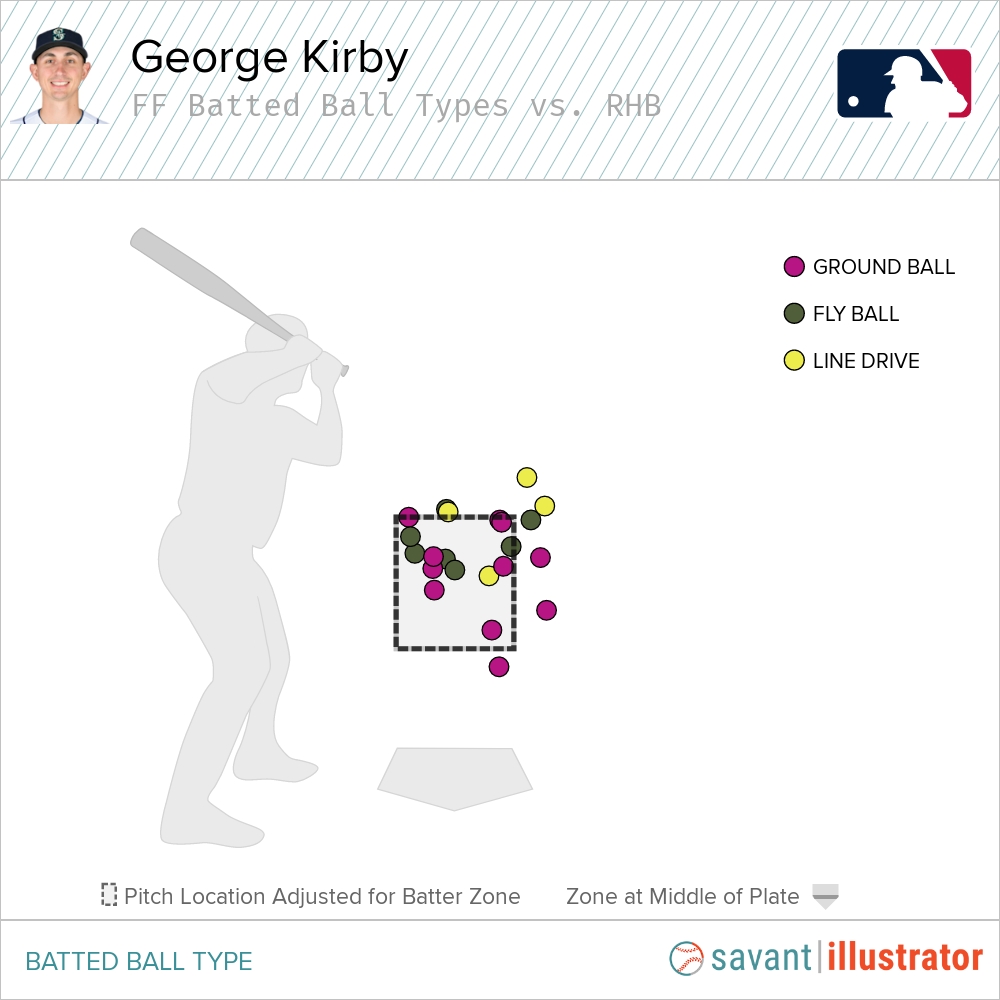
The majority of high pitches that have turned into groundballs are ones that were located lower than probably anticipated. However, I believe this shows that everyone is swinging expecting a higher fastball, and these are located “low” relative to expectations. And everyone is so prepared for something high in the zone that this is an overcorrection. A 61.5% chase rate on a fastball with decent usage is ridiculous. On the other side, some hitters are trying to be patient and get a fastball in the zone, knowing they won’t go upstairs. Even though there’s an increase in groundball rate and lower ICR, exit velocity on flyballs has increased from 88 mph to 97.6.
The sinker’s changes are less perplexing: he’s now throwing the pitch up-and-away now and some of those pitches are leaking into the middle third of the plate. The rate of sinkers in the middle third is up 8%, and here is a heatmap of swings on the sinker:
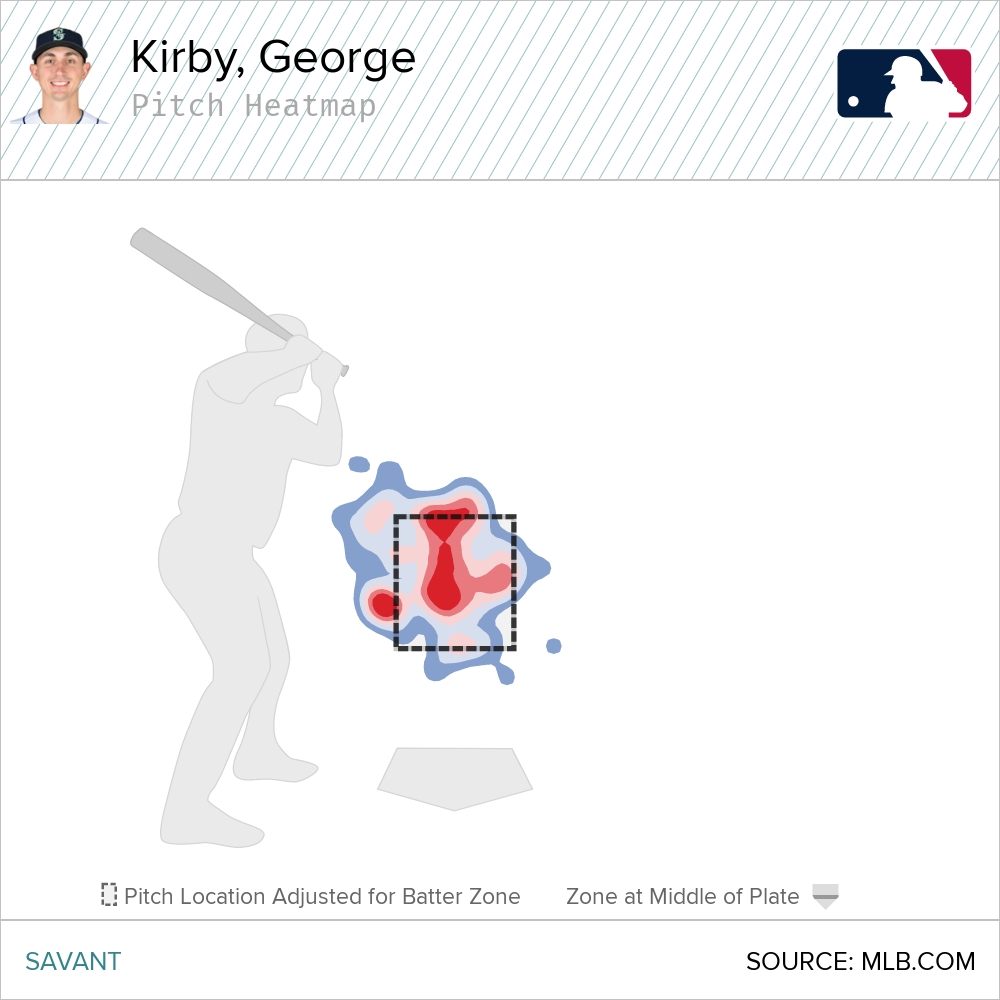
This looks much worse than it has been for Kirby: a .353 BABIP is driven by 2nd percentile Hit Luck. The ICR on the pitch is down and there isn’t anything out of the ordinary suggesting anything other than classic BABIP shenanigans. His change to throwing the sinker as a backdoor pitch has removed some of the whiff potential, and it’s getting punished unfairly when it’s put in play.
Both the fastball and sinker have seen significant declines in zone rate, but are matched by increases in swing rates. However, Kirby still needs something to make up for that, as his 2.8% walk rate against righties is as good as ever. The sweeper is being thrown more in the zone, which has also resulted in more damage against it. It’s a .276 average against, but it’s only been singles so far. The sweeper has also crept up a bit in location, with more pitches “hanging” than ever before. That hasn’t really been the source of the hits — it’s more dinks and dunks on pitches that didn’t quite miss the bat.
Kirby is doing everything to lean into being a contact-suppressing pitcher: throwing pitches that hitters know they can hit but not do damage on and finding new ways to get strikes. The problem for Kirby is that his comfort zone is now in places where he used to get whiffs. A fastball up isn’t going to have the same effect when he’s living there with a pitch not good enough to miss bats on its own. The putaway rate has dropped from 29.1% to 16.7%, an almost comical fall off.
I believe Kirby is comfortable with these tradeoffs against right-handed hitters, even if it doesn’t produce higher strikeout rates. If the plan of attack is to rely on pitches out of the zone, it’s going to work out okay.
Broader Changes Against Lefties
As mentioned earlier, Kirby is reverse splits-ish — left-handed hitters are hitting just .196 with a .250 wOBA, but a 10.1% K-BB% is a 8.5% decrease from last year. Kirby has seen a similar drop in strikeouts like against righties, but it’s a two percent increase in walk rate to lefties, now at 9.2%.
Even though his walk rate against lefties was 7.0% last year, this feels unprecedented. The pitch mix has changed here, with mixed results.
The fastball usage has increased, its HiLoc% has decreased 5% (still a high 72.2% figure), and the groundball rate has increased 13.5%. It’s a similar story to righties that there’s a ton of groundballs on pitches up in the zone, but a 19.4% ICR is unsustainably low. Clearly, there’s a strategy to induce these groundballs against all hitters, but it might be not last as long against lefties.
Additionally, he’s changed his sinker usage, cutting 10% and making it a front door only pitch. The sinker command has been impeccable, as he’s yet to throw one middle-middle. While preventing hard contact, it docked a significant amount of zone rate off the pitch, giving him another less reliable avenue for called strikes. Especially when the sweeper is the main breaking pitch to an opposite-handed hitter, that can be a tough predicament.
That hasn’t been the case for Kirby though. His sweeper has been electric here, with the rare increase in SwStr% paired with more weak contact. The sweeper isn’t necessarily his immediate strikeout pitch. Most of the gains have come earlier in the count or in deeper two-strike counts. It’s a product of everything else, where the deeper arsenal allows it to have more success.
This also plays with the curveball, which has seen the biggest step back of any pitch. The curveball lost 13.4% of its SwStr%, dropping it from an elite whiff pitch to below average. The whiffs have fallen off both in zone and out of zone. The pitch has crept diverted in location: a 10% increase in the middle third and a slight increase in the waste area. The pure stuff of the pitch has shifted slightly, which might be working in tandem for small enough changes to cause regression. The curveball has lost almost a tick of velocity and added two inches of drop, leading to a seven-point decrease in Stuff+.
Between the two breaking pitches, their usage has been all over the place. In 0-2 counts, the two are used together 21.3% of the time. Last year, that figure was 59.1%. While their usage shows up later in 2-strike counts, Kirby is turning to fastballs that aren’t putting away hitters.
In looking for other secondaries, Kirby has also turned to the changeup. He adopted it last year after throwing mostly splitters to start his big league career, and this year it’s become more of a factor. It’s been relatively average all things considered, but he’s improved the locations enough that it doesn’t need to be anything special.
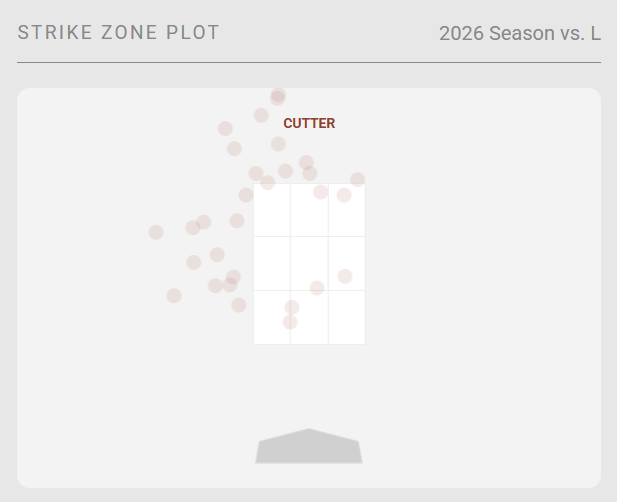
The cutter has also made an infrequent appearance, just to keep hitters really off balance. It’s been a pitch that’s being located up off the fastball or in off the sinker, and the pitch chart shows the pristine command he has of it.
Kirby’s approach to lefties is to rely on the fastball first and everything else can be a mixed bag. The tradeoff he’s making for weak contact isn’t one that allows him to still overpower hitters like he can to righties. It’s putting him deeper in counts and situations where he isn’t able to get a swing and miss.
Kirby’s command is still impeccable, it’s just exemplified in a new way. Working for weak contact will play well with his arsenal, but not as well as it probably has so far. The extreme attack plan by hitters to get as much out of the zone as possible, given this much weak contact, doesn’t seem as sustainable as we’d like. He still has the whiffs in there, it’s just how can it be deployed. As always with Kirby, he can dial it up how he wants, but there’s no reason to stop what’s working early despite a lower ceiling.
