





Matt Wallner has done nothing but hit in his opportunities in the major leagues with a career 136 wRC+ in 871 plate appearances. This season, he’s hitting .211/.323/.478 (128 wRC+ with 16 gomers in 291 plate appearances. He’s one of only two hitters with an above-average wRC+ with a batting average below .220 (Sean Murphy is the other). The lefty slugger mostly operated as a strong-side platoon in the corner outfield and has shown a prolific power and patience combo. That combo does, however, come with plenty of swing and miss.
Debuting in 2022, Wallner is on track to surpass 300 plate appearances in the majors for the first time in 2025. After missing some time at the start of the season with a hamstring injury, the Twins have exposed Wallner to more left-handed pitching. He has 166 total career plate appearances against lefties, and 58 have come in 2025. It’s a small sample, but he’s striking out just 24.1% of the time against lefties and has actually been more productive against them than righties in 2025 (128 wRC+ vs. 119). He’s already matched his home run total from all of his previous seasons with three against them this year.
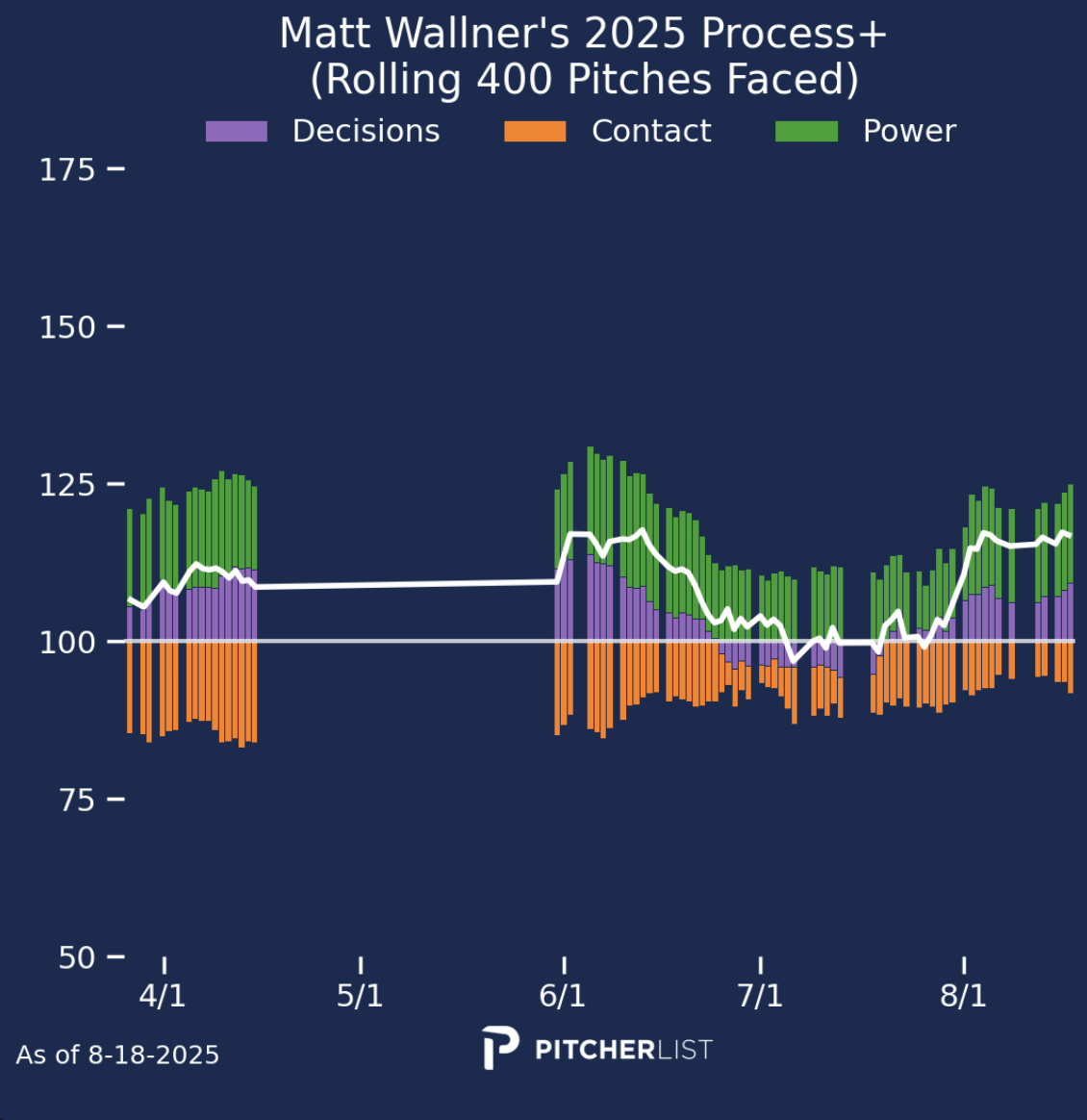
The 27-year-old has exciting tools and is seeing nearly every playing time. Is he more than just a platoon bat? Let’s dive into his profile and what makes him an exciting player to think about.
Balancing Tradeoffs
Wallner has elite bat speed at 76.5 MPH, which right off the bat makes him someone to pay attention to. He has an ideal swing path with the ability to lift the ball more often than not and access his elite raw power. Then, it’s easily clear to see what can hold him back with his strikeout issues and limitations against same-handed pitching. His 73.4% Zone Contact% is the fourth lowest, and his 17.3% swinging strike rate is the third highest in the majors (min. 250 PA). Since debuting in 2022, his 72.7% Zone Contact% ranks 346 out of 347 hitters (min. 800 PA). That is only higher than the infamous Joey Gallo, who is a natural comparison for Wallner.
However, the things he does really well could make his subpar contact ability matter less. He’s always had sound plate discipline and swing decisions during his time, a career 10.9% and up to 12.7% this year. But he’s shown the ideal balance between hunting your pitch and being aggressive while also recognizing balls and strikes. Among hitters with high walk rates (10% or higher), he has the sixth-highest swing rate this season (49.2%) behind Jeff McNeil, Kyle Stowers, Bryce Harper, Cal Raleigh, and Corey Seager.
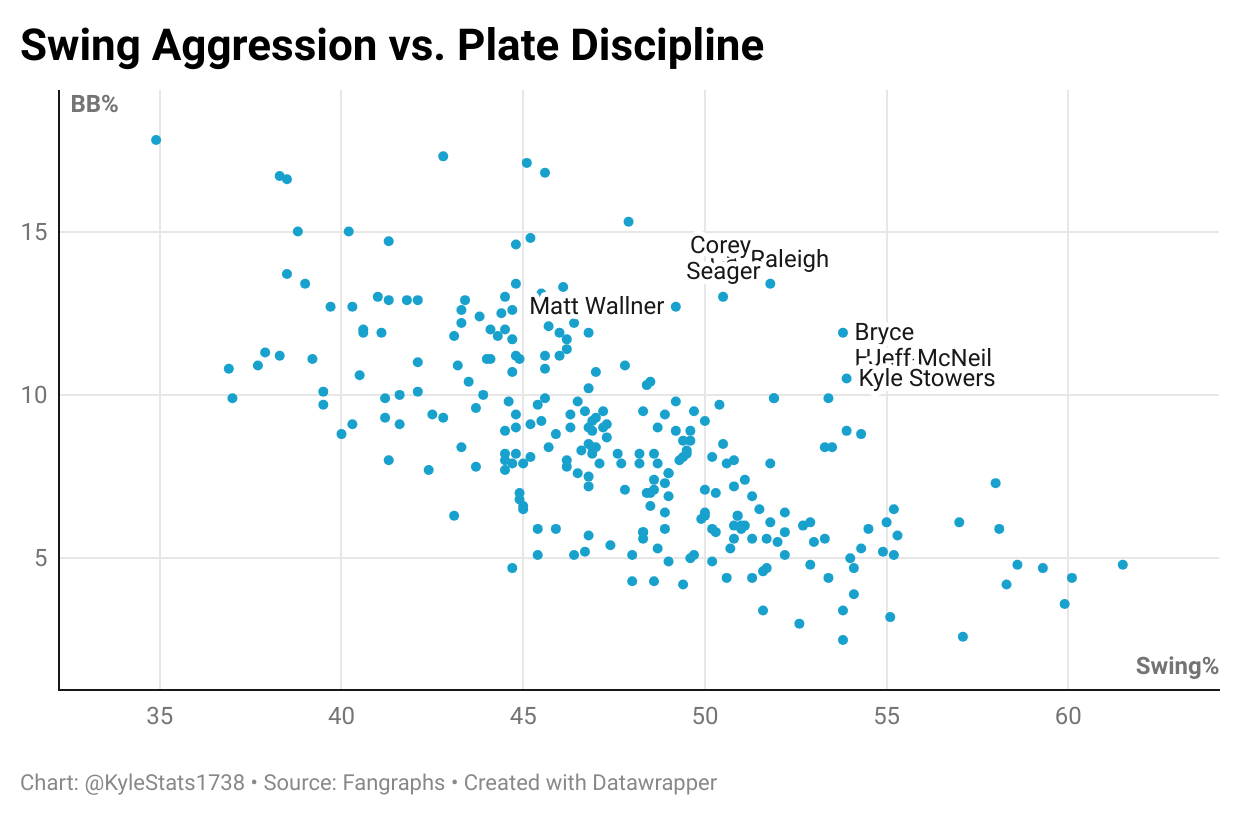
Wallner is not overly passive at the plate as some hitters might be. This is a fairly strong indication of which collection of hitters recognize balls and strikes versus the ones who are extremely passive.
Kyle Stowers is another name that comes to mind for a comparison. They are both 27 years old and have dealt with swing and miss problems. Stowers is still whiffing a lot in his breakout 2025 season (16.1% swinging strike rate), but his quality of contact has been absurd, and he’s boosted his walk rate to keep the OBP high.
Both lefties have premium bat speed, but they differ slightly in their swing metrics. Stowers is more compact at a 6.7-foot swing length, whereas Wallner is a bit more elongated at 7.4 feet. Interestingly, Wallner has flattened his swing path tilt a bit this season, going from 34 and 32 degrees in the two seasons prior down to 28 in 2025. Stowers has maintained a more scoopy style of swing with a 35-degree tilt.
Stowers dealt with similar growing pains in Baltimore, as he was consistently blocked from consistent playing time and exposure to same-handed pitching. With the trade to Miami, he’s been freed for everyday opportunity and has been one of the best hitters in baseball. He still hasn’t killed lefties, but has been near average while destroying righties. Just being passable against the same hand is often the recipe for left-handed hitters like Stowers and Wallner.
Wallner is among a cohort of 20 hitters to be above-average or better marks in all of PitcherList’s hitting metrics except for contact ability. These hitters rate positively when it comes to hitting for power and making sound swing decisions in and out of the zone, but their hit tool holds them back a tad. A few notable hitters included with Wallner in this group are Max Muncy, Pete Alonso, Matt Olson, Teoscar Hernandez, and Spencer Torkelson.
Next Steps
Wallner has a good foundation as a hitter with mega raw power, the ability to lift and pull the ball, and quality swing decisions. His pulled fly ball rate is near the highest in the league. He’s made incremental improvements against lefties this season, but an area he’s still been hurt by is his performance against breaking balls.
Since his debut, he hasn’t ranked higher than the 21st percentile in whiff rate against secondary pitches. Breaking balls, especially, have been an area of weakness for the slugger. He hit only .175 on breaking balls last season and .210 the season before. He combined for seven homers in that span, whereas in 2025, he’s hitting .278 with six homers and a .563 SLG. By run value, which considers strike-throwing, limiting hits, and minimizing damage, his two best pitches are his slider and sweeper, both with a positive six.
His overall numbers are down from past seasons when he posted back-to-back seasons with a 140 wRC+ or better. After posting BABIPs of .328 in 2023 and .389 last year, with a career average of .318, he’s seen that number tumble to .247 this season. There’s been a shift in his batted ball profile with fewer line drives and more infield pop-ups. His pull rate is maxed out at 54.2%, and is the fifth highest in the league (min. 250 PA). With a fly ball rate near 50% and a pull rate north of 50%, a lower BABIP is likely to come with that combo.
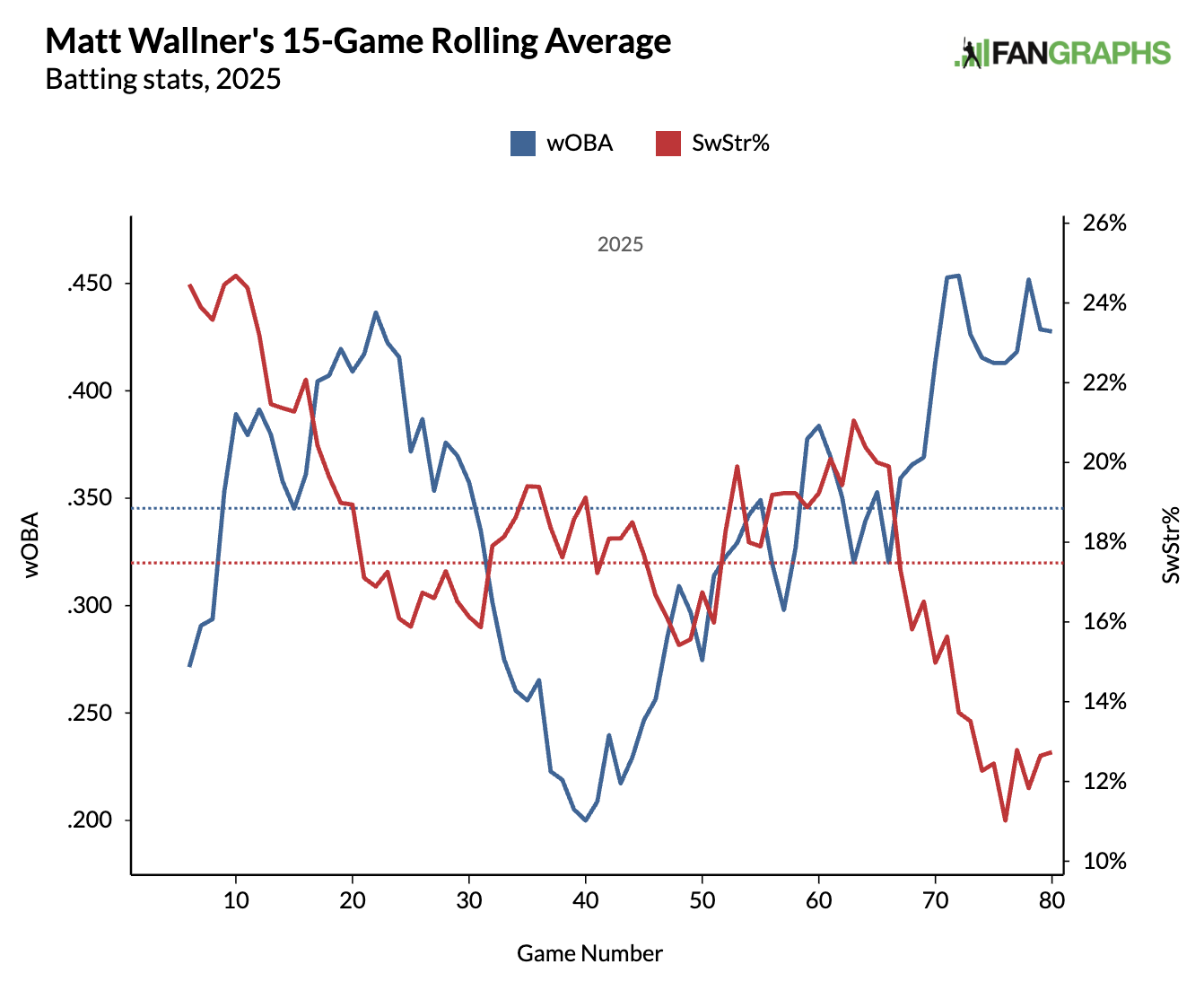
Since the start of July, he’s producing like a top 25 hitter with a .224/.354/.517 (143 wRC+) line to go with nine homers in 130 plate appearances. He’s made this a theme so far in his young career, raising his performance in the second half of the season. He has a career 121 wRC+ in the first half compared to 143 in the second. The contact quality is again upper echelon during this stretch with a 15.7% barrel rate and 45.7% hard-hit rate, and he’s managed to bring the whiffs down and be just under 30% for the strikeout rate. That will play with his power and ability to get on base.
The defensive numbers have been consistently below average throughout his big league tenure, so the value will be heavily predicated on his bat. He profiles similarly to Max Muncy with his elite blend of power and plate discipline. The progression against lefties this year is a positive sign that he will continue to get a fair amount of run against them.
Matt Wallner ties the game with a 452-foot BOMB 💣 pic.twitter.com/9Izm7ZpPDz
— MLB (@MLB) July 27, 2025
It’s a beautiful lefty swing that launches balls to the moon when he gets a hold of one. Despite the low contact rate and the BABIP cratering this season, he’s still been 21% better than the league average hitter. Wallner is delivering on his extended opportunity and has the upside to be a league-winner down the stretch, which would set him up quite favorably come draft season next year.
