





New York Mets left fielder Juan Soto is not the game’s best hitter by batting average, home runs, or wRC+. But the essence of what it means to be a hitter, to duel with the pitcher 60 feet and six inches away, to control the strike zone, to create mistakes and capitalize on them. That is where Soto is king.
Subsequently, it was unsettling to see Soto collapse in the batter’s box on Sunday against the Pittsburgh Pirates. I thought he tripped or, worse, hurt himself, while striking out. I braced for impact and took solace in the only emotion from the replay being second-hand embarrassment.
Mason Montgomery undressed Soto. It’s something he’s uniquely capable of doing. And after the improvements he flashed in his first two outings of the season, the Pirates should expect to see Montgomery put many more batters to shame in 2026.
Soto.exe Has Stopped Working
No hitter strikes out with much grace, but it was particularly jarring to see Soto take such an ugly swing. It was certainly an outlier result, and one I’m comfortable saying won’t happen again. Even so, Montgomery dictated the terms of engagement here, and a closer look at his at-bat shows how Soto’s stumble was a manifestation of incredible stuff.
Pitch 1: 98.5-mph 4-seam fastball, middle-middle. Soto is geared up for a fastball, gets a pitch he can drive, and is a little late, fouling it off behind him.
Pitch 2: 98.8-mph 4-seam fastball, middle-low. Montgomery tries to beat him again, but Soto is more on time, despite the velo bump, hitting another foul ball.
Pitch 3: 99.3-mph 4-seam fastball, up and in. Soto doesn’t get beaten three times in a row. He gets his hands through early, pulls a 110-mph foul ball, and tells Montgomery that he better throw a breaking ball next.
Pitch 4: 89.1-mph curveball, spiked in the dirt. Montgomery obliged, but with an uncompetitive offering.
Pitch 5: 89.1-mph slider, out of the zone low and away. At 1-2, Montgomery is going by the book with a chase-worthy slider. It wasn’t great, and Soto unsurprisingly did not budge.
Pitch 6: 88.2-mph curveball, spiked in the dirt. Montgomery didn’t have much feel for his curve, and this one didn’t start high enough to tempt Soto.
Pitch 7: 89.3-mph slider, middle-up. This was the most important pitch of the plate appearance. Soto looks fastball, subtly rocks back at the spin, and fires late to fight off a high slider. He survives, but finally has to worry about a called strike on a breaking ball.
Pitch 8: 99.5-mph fastball, well above the zone. Soto triggers later than on the previous fastballs. In a part check swing, part evasive maneuver, Soto’s torque creates a black hole in the batter’s box. Cartoon slipping noises ensue, and he is defeated.
After four suboptimal breaking balls, everybody in the building knew the fastball was coming. Montgomery wasn’t going down without his best pitch, and Soto had already shown he was willing to punish a high heater. He wasn’t close on this one, and we can chalk that up to three factors: the threat of Montgomery landing another breaking ball, the tunnel he creates, and the 19 inches of induced vertical break helping the fastball defy gravity.
With the help of Baseball Savant, we can see the impacts of Montgomery’s elite iVB, along with how well that final fastball tunneled with the previous slider. From Soto’s vantage point, it doesn’t look like a heater that’s ending at eye-level, and the only other pitch playing into calculus there was the breaking ball that began above the zone.
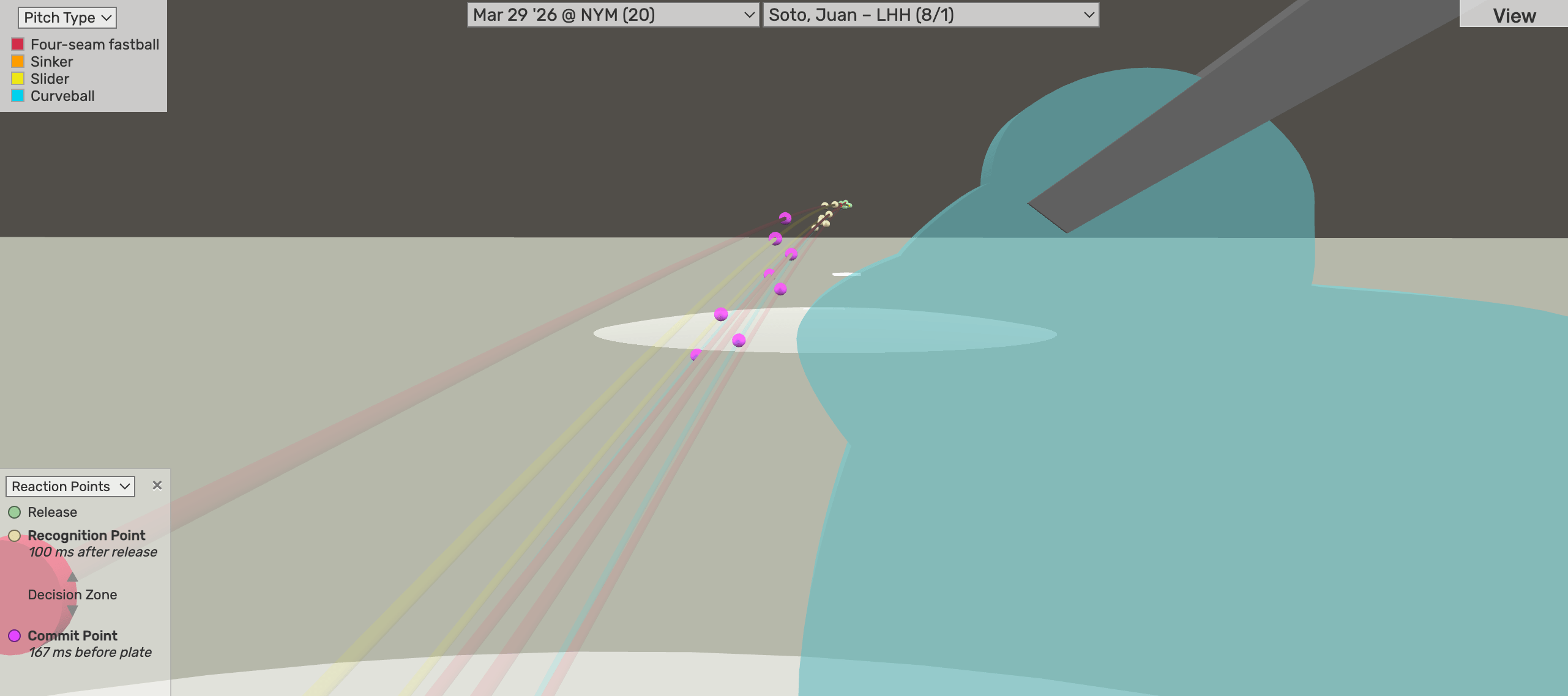
Likewise, Montgomery’s profile is defined by outlier velocity, and that extends to his not-so-soft stuff. Intuitively, high breaking balls are a dangerous way to live, but when they are coming in with fastball-like velocities, they aren’t exactly “hanging,” changing the math on Montgomery’s arsenal.
Montgomery’s Curve Is Here To Stay
Neither of the curves Montgomery threw to Soto was all that compelling, but their prevalence is encouraging. He didn’t have one at all with the Tampa Bay Rays, and throwing it 29% of the time through two outings suggests this isn’t a spring training project leaking into late March. Montgomery is trying to find another out pitch, and it might unlock additional upside.
So far, the results haven’t been overly impressive, albeit in a ridiculously small sample. On 18 pitches, the curve has generated a 38th-percentile PLV (4.79). It’s earning whiffs, but hasn’t hit the zone enough (22.1%) to find called strikes. None of that is surprising. Command has never been Montgomery’s friend, meaning he must build his game around mitigating that deficiency. In other words, it’s chase velocity or die trying, and as he looks to become more than a middle reliever, Montgomery has to find ways for his incredible fastball to continue exceeding expectations.
More high breaking balls may pave part of that path. I’m wary of suggesting any improvements for Montgomery based on command; it feels safe to assume that banking on an uptick in Zone%, much less any precision, is ambitious. Still, Montgomery’s velocity buys him some breathing room.
Last season, there were 2,299 sliders thrown in the upper third of the strike zone at or above 88 mph. The generated a 23.9% whiff rate, a .209 average, and a .259 wOBA. The element of surprise helps, but it makes sense that these results are slightly better than sliders below that threshold (22.3% whiff rate, .233 average, .282 wOBA). Interestingly enough, the rare hard, high curve fared well, too. The 61 pitches thrown over 86 mph found a .121 wOBA, compared to .261 wOBA on the nearly 3,300-pitch sample size below 86 mph.
Through two outings, Montgomery is averaging 86.9 mph on his curve, which also impacts its shape. At 1.2 inches of glove-side break and -10.6 inches of iVB, it’s fairly similar to Toronto Blue Jays reliever Brendon Little’s offering. In 2025, Little’s primary pitch generated an above-average PLV (4.96) with a plvLoc+ of 93, so it can be effective without being spotted — good news for Pittsburgh’s lefty.
Wherever it’s located, the presence of a curveball helps Montgomery. A new pitch is one more thing for hitters to worry about. It’s also an off-ramp for when his feel for the slider goes sideways. Retaining potency out of the zone should keep hitters off the fastball when the slider betrays him. Similarly, Montgomery’s release points allow him to stay deceptive while throwing the curve.
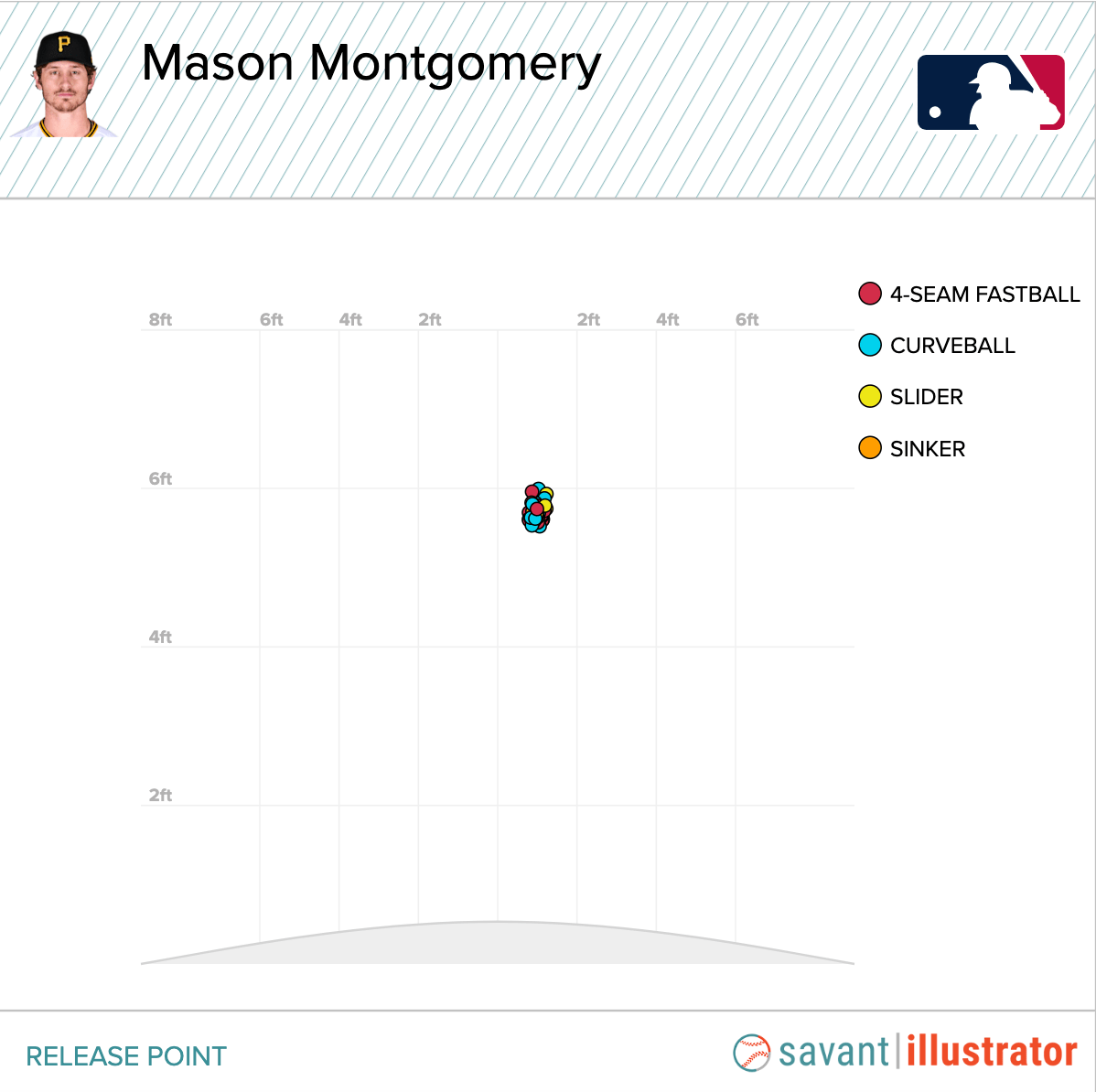
Many curveballs stand out on a chart of release points, poking out above the rest of one’s arsenal. That isn’t the case for Montgomery, which falls in line with its increased velocity and tighter movement. Montgomery has also showcased more over-the-top mechanics in 2026, raising his arm angle from 52 degrees to 61. His fastball follows suit, operating with a spin-based movement of 11:30, compared to 11:15 last year. Paired with a curveball lacking horizontal movement (think 5:45 on a clock), Montgomery’s game is more vertical than ever before.
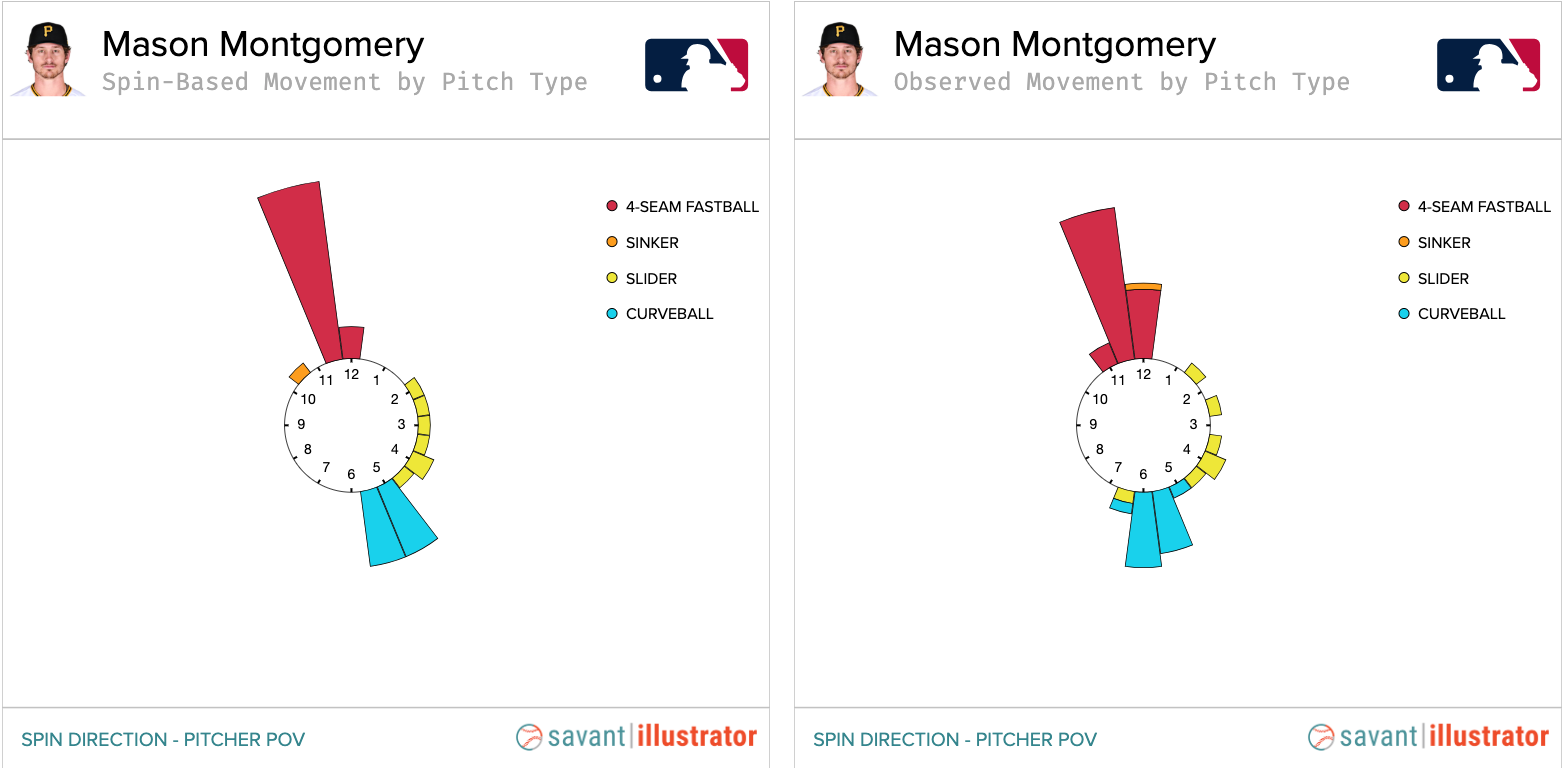
There’s a chance this opens the door to patching another hole in Montgomery’s profile: accessing the arm side of the plate. He’s never been one to pepper lefties inside with fastballs, posting a first-percentile aLoc% on the heater last year. Getting more over the top lends itself to less horizontal momentum, and if he’s opting for more curveballs, he doesn’t need to spend as many pitches setting up glove-side sliders. In a right-tailed outcome, this mechanical change would have a tangible effect on his command. It’s not worth relying on that development, but approaching 30% arm-side fastballs is a step in the right direction.
Armed with elite vertical movement on his fastball, this shift feels more conducive to success. As a pupil of Tampa Bay’s “throw it down the middle” approach to pitching, any gain in zone rate should amplify the effects of his stuff, and a third pitch should limit chances for batters to punish a get-me-over slider.
Ultimately, Montgomery will always toe the line between elite stuff and scary command. Ascending into a true high-leverage arm will require improvement in the softer factors of his game, and through two rocky outings, it seems like Pittsburgh is pointing its fireballer in the right direction.
