





Mookie Betts always wanted to play shortstop. He wanted to even before the Boston Red Sox drafted him out of high school nearly 15 years ago. Growing up in Nashville, Tenn., Betts even imagined himself someday playing shortstop for the New York Yankees. He wanted to be like Derek Jeter. It just never worked out that way.
Until he turned 32 years old, that is, 12 seasons into a major-league career mostly spent as a right fielder, where he already had built Hall of Fame credentials. With the World Series getting underway, Betts now gives the Los Angeles Dodgers a Gold Glove finalist playing shortstop.
Among all of the rare and previously unprecedented achievements happening in Major League Baseball in 2025, notably performances by Cal Raleigh, Aaron Judge and Shohei Ohtani, the most remarkable individual success story bound to go down as legendary could be Betts transforming himself into one of the best defensive shortstops in the league. And it came a point in his career when twilight is typically starting to gleam for nearly everyone else. Betts moving from the outfield to shortstop, and being this good, had never happened before in the sport’s history.
Betts deserves the credit for improving, but it’s also taken a village to make it happen.
Dodgers coach Chris Woodward, who played all over the field in 18 professional seasons and 12 in the majors, including more than a thousand games at shortstop, told Pitcher List that Betts is breaking new ground among those who have changed defensive positions.
“A lot of people asked me in the beginning of the season,” Woodward said. “And I said that playing shortstop is as close to impossible as there is in this game, coming from the outfield for a whole career, basically.
That said, Woodward continued: “Just knowing him, if you spend any time around him, let alone every day working with him, I’m not surprised. I’ve seen this guy exceed every expectation, probably, in his life.”
Betts certainly wasn’t just any outfielder coming in from the pasture. He was a six-time Gold Glove winner in right field for the Red Sox and Dodgers, with the most recent award coming in 2022. And, no matter that he stands listed at just 5-foot-9, a much bigger athletic reputation preceded him. Betts is famous for having bowled multiple 300 games. He can dunk a basketball. He has described pickleball as his “jam.”
After being asked what has been different about playing shortstop this season, Betts said it was getting a chance to work on it for an entire offseason for the first time since he was 18 or 19 years old. Rather than the switch being an on-the-fly, in-season urgency like before, the Dodgers this time could give Betts enough notice to make a real commitment to playing the position correctly. Enough for someone like Betts, anyway.
“I put in a lot of work this offseason,” Betts said. “I didn’t know if I could excel at it or not. I wasn’t really concerned if I could or if I couldn’t. I was more concerned with just making sure I understood what I was doing, that I understood how to attack the task at hand.”
Betts’ defense at short in 2025 hasn’t been simply passable, functional, or just good enough. It’s been great. Betts tied for first among all shortstops with 17 total runs saved at Fielding Bible. Other defensive metrics vary (sometimes frustratingly so for analysts), but Betts finished third overall at Baseball Reference among all players at any position in defensive WAR. He finished eighth overall at Statcast among shortstops in outs above average.
Checking the SABR Defensive Index, relevant because it’s an analytic component used to account for 25% of the Gold Glove voting process, Betts ranked third among National League shortstops through Aug. 10, the most recent day results were published. Expanding to both leagues, Betts’ in-season SDI number was the same as that of Kansas City Royals star Bobby Witt, who won the AL Gold Glove in 2024. This season’s final rankings figure to be released once Rawlings announces the winners on MLB Network on Nov. 2. But it’s safe to say that Betts finished strong, because he’s among the top three NL vote-getters, alongside Nick Allen and Masyn Winn. Winn, the St. Louis Cardinals‘ young star, probably should be considered the favorite to win based on the stats — although 30 major-league managers and coaching staffs make the final call. Betts simply being nominated indicates how far he’s come in a short period of time.
Teammates say they are not surprised, but they do appear to be impressed.
“I think we all knew Mookie could do it,” left-hander Clayton Kershaw said. “But, yeah, maybe to the level that he is, because he’s been one of the better ones in the game. We all knew that he could play shortstop and, you know, survive and be good. But I guess we should never underestimate when he puts his mind to something.”
Betts came into 2025 having logged 81 career games at short in the majors, most of it coming in 2023 and 2024, amid respective injuries to Gavin Lux and Miguel Rojas. The Dodgers had other players to fill in at short in that span, guys like Enrique Hernández, Chris Taylor and Tommy Edman, but it was not ideal for the team’s defense to keep the door revolving at short. Until this season, Betts’ own play at short graded as mixed, going by defensive metrics and to the eye, probably because he was doing it mostly with effort and athleticism. He just hadn’t trained at short enough — a part of becoming great at something that can be quite boring while you’re doing it, Kershaw noted.
“He works so hard, takes so many ground balls and, yeah, turning himself into a great shortstop, a lot of it is boring work,” Kershaw said. “Repetitive baseball is pretty boring in general, just because you do it every day. It’s a lot of tedious stuff, but Mookie does what he has to do.”
Rojas, who lends a hand in training Betts at short even though doing so has been bound to reduce his own playing time, said it was just a matter of time until his teammate improved. Especially with a full offseason to train and gain confidence.
“It’s really hard to play shortstop, because shortstop is a premium position,” said Rojas, who has logged nearly 1,000 MLB games there. “It’s not like any other position where you can actually be there on the fly, and that’s why so many players kind of are tentative for moving there.”
Known for his positional flexibility, Hernández recalled feeling game to switch to shortstop in 2023, when he played for the Red Sox, after Xander Bogaerts had left the previous December in free agency. The move also came amid the World Baseball Classic, in which Hernández also played center field for Puerto Rico. Boston’s initial uncertainty in how to replace Bogaerts, along with the WBC interrupting the typical spring training routine, made Hernández’s move tougher than he anticipated.
“I went into the season and I struggled mightily,” Hernández said. “So it’s definitely not that easy.”
The Red Sox ended up replacing Hernández at short and, later that season, traded him to the Dodgers. Betts is a cut above the typical player, Hernández said.
“When he’s in right field, he’s the best defender on the team, and he’s at short this year, and he’s the best defender on the team,” Hernández said. “So, like I said, there’s nothing that Mookie Betts does on the field that surprises me anymore. He’s good at everything he does.”
Rojas said that a mental hump probably was the biggest barrier for Betts to get over.
“I think the mindset was a thing that changed a little bit more other than anything else, because his ability to play defense is always going to be there,” Rojas said. “He’s going to catch the ball, he’s going to throw it. So for me, it’s been impressive, for sure, that he changed from being kind-of average or below-average to one of the best in the league.”
Betts has credited Rojas with being effective in emphasizing to him the multiple arm slots a shortstop needs to deliver the ball around different points of the infield. Throwing the ball has been among the actions where Betts has improved the most, but not the only one.
“There’s just always something to work on,” Woodward said. “Even if it’s 115 degrees on the field like it was today (in late June), he puts his attention to detail to work. He never misses a day. We’re at the point where we try to keep things fun, but he’s always trying to sharpen his knife. His footwork right now is good. He’s always trying to get off the ball a little faster.”
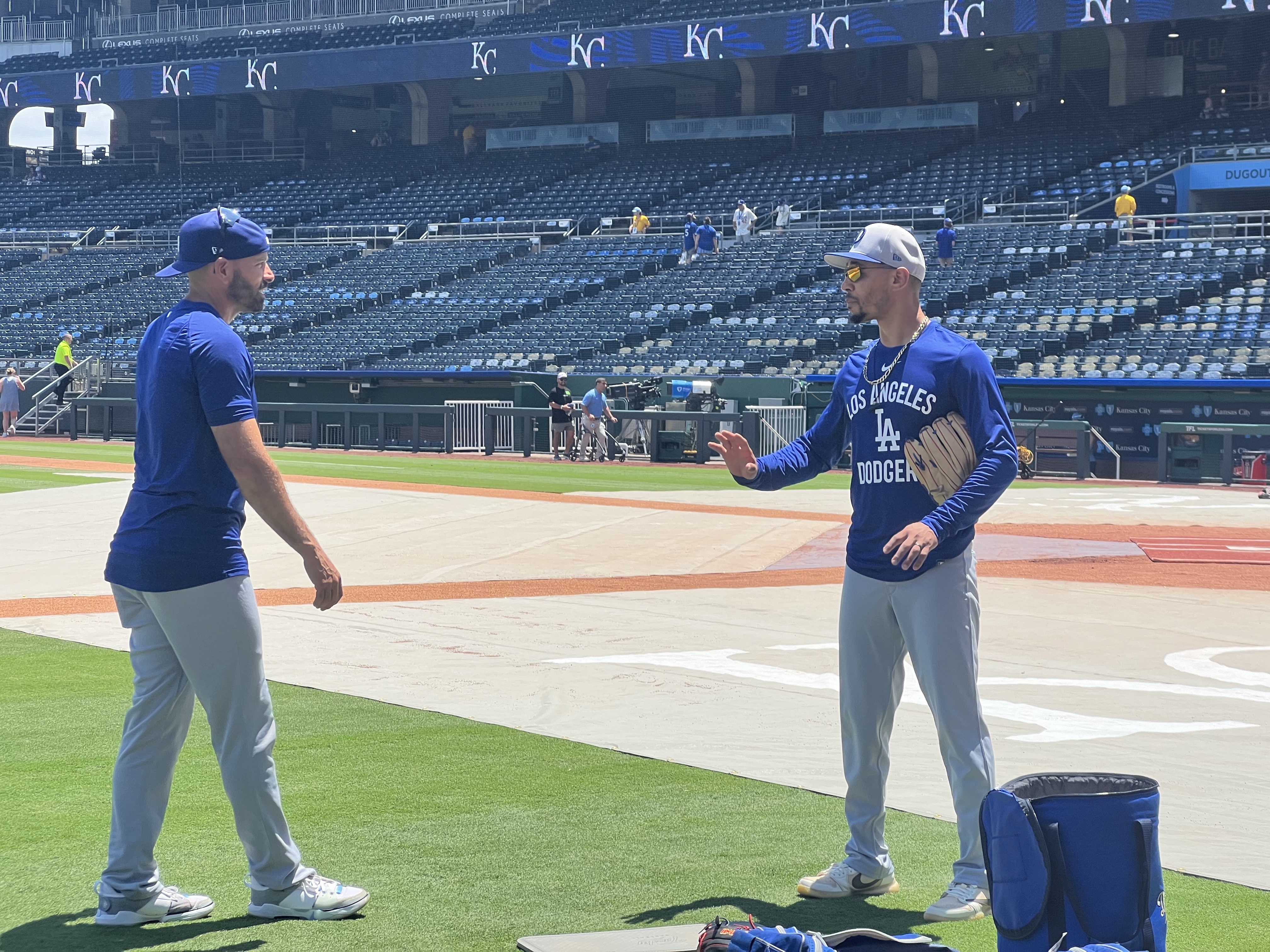
Photo by David Brown
Woodward said he could not pin down a moment or a game when Betts crossed the rubicon and become a strong defender at short. He just remembers that it happened.
“I don’t know exactly what day, but there definitely was a day, yeah, where I feel like all the technique was there,” Woodward said. “It just hadn’t smoothed out. The clay was molded. We just needed the final smoothing to make it look right to the to the eye.”
Dodgers manager Dave Roberts said the moment might have come in late May.
“I don’t remember a specific game or play, but I know there was a moment when finally I realized that he looked like a major-league shortstop,” Roberts said.
Woodward has heard Roberts mention the moment before. He remembered it, too.
“Dave looked over at me during the game after Mookie had made a play, and it was smooth,” Woodward said. “The arm stroke was smooth, the footwork and everything, and it was kind of a tough play. And he made it look really easy. And that’s always my thing with them: ‘We’re going to make every play look easy to do with the proper technique.’ It looks easy, but is it really? No, it’s difficult. And he did that, and I remember saying or thinking that he looks like a shortstop.”
Betts’ impact on defense reached another level in the NL Wild Card Series against the Philadelphia Phillies, when the Dodgers cut down a rally with the help of a wheel play, an old-school defensive maneuver that Betts himself called for. Betts credited Rojas afterward for planting the seed of a new “learned behavior” earlier in the season.
As progress is said to go with other things, Betts improvement at short hasn’t been linear or constant, pulling back from the bigger arc of the transition.
“I remember telling him, he had some moments where he was kind of — I wouldn’t say, doubting himself — but he wasn’t sure if it was all going to sync up,” Woodward said. “And I just told him: ‘You’re going to be standing out there when we win the World Series, and I promise you that, but we have to make sure we keep doing the work. So we keep working on it.’ ”
Betts said he actually did lack confidence about moving to short, and he certainly lacked comfort, during spring training in ’24. The Dodgers had planned for Lux to play short a year removed from his ACL tear, but he couldn’t handle it, so they moved him to second base. Betts switched positions with him.
“I went through it last year, and it did not feel good for me trying to switch in the middle of spring training,” Betts said.
The position-switch controversy early in ’25 the Red Sox endured with a former teammate, slugger Rafael Devers, reminded Betts of his own limitations. While he didn’t want to cast himself in another Red Sox soap opera, Betts said he could identify closely with Devers, whom Boston traded to the San Francisco Giants in mid-June after he refused to move to first base once spring training had started.
“I definitely do,” Betts said. “I don’t mean this in a boastful, or whatever, way. But not everybody is the same as me. He would be switching in the middle of the season, so the chance of him being successful, I mean, all the odds are stacked against him. Not everybody can do this kind of thing. Not everybody grew up playing everywhere, so they may not be as comfortable making a switch, especially at this time. I understand where he’s coming from. I’m not trying to get in the middle of none of that. But I understand.”
Devers eventually relented and played 29 games for the Giants at first base, getting defensive results that ranged from not bad to pretty good, depending on where you looked.
Betts probably wasn’t aware that his move to shortstop got a nudge forward from a place he did not realize. Seattle Mariners coach Perry Hill has something to do with Betts’ new success, in a six-degrees-of-Perry sort of way. Widely renowned as the top defensive guru in the sport, Hill has never coached Betts, and has seen only glimpses of his move to shortstop, including a late-season series against the Dodgers. But he knows Rojas well, having coached him and other infielders with the Miami Marlins previously.
Betts always had the latent talent to play short, Hill observed, but he also had help from an instructive teammate who knows what he’s doing better than most.
“Miggy is a consummate team player,” Hill said of Rojas. “He wants everybody to be as good as they possibly can be. He’s a very fundamentally sound infielder, and so I’m sure that he’s helped Mookie in several different ways.”
This is how the process works, Hill said, in the form of a city-planning metaphor:
“You start by building a basic foundation. And then you can be yourself after that. If something goes wrong, or if you have a problem … you know, players can go into fielding slumps just like hitting slumps. But then you go back to the foundation that you laid, and then that’ll calm it down and get you back on track.
“Look at any major city’s skyline. You got all shapes, colors and sizes of buildings, but they also have one thing in common: They have the clay, they have the rebar, they have the cement. They all have that same foundation.”
And speaking of slumps: Betts came through the worst hitting slump of his career during the first four months of 2025. Betts traveled with the Dodgers to Tokyo in March for a season-opening series against the Chicago Cubs, but was sent home early with an illness that prompted a 25-pound weight loss. Betts was back playing by the end of the month when the regular-season restarted, but he suspects that the illness, which doctors never did identify, had something to do with his poor start at the plate.
Betts otherwise was at a loss to explain why his offensive slash line had plummeted to .231/.302/.355 in early August through his first 103 games.
“I was so sick early on that I feel like it may play a little part,” Betts said. “Maybe I started trying too hard. And I was so underweight, and I tried to get back too fast. I created some bad habits, and I think once I had created those bad habits, you look up at the scoreboard and you’re not doing well, and then you try and make it all up in one game, and just becomes a spiral effect at that point.”
Betts found the slump odd because of his concurrent success on defense. Nobody was hitting him up with complaints about how things were going at shortstop in the first half. But he did field questions tinged with concern about his ability to play shortstop every day and still be the hitter he was before 2025. Everyone came up to Betts and said things like: “You know, Mookie, nobody in MLB history has ever done this before. Are you sure playing short isn’t too stressful?”
“I don’t worry about that,” Betts said. “You know, those are things that have nothing to do with what God has kind of put in front of me.
“But hopefully I can figure out how to hit again.”
Betts did figure it out in the home stretch, posting a .317/.376/.516 line over his final 47 appearances. Betts also conceded that he experienced a reckoning related to how hard it was to play shortstop every day in the major leagues when compared to his former spot in the outfield. He wasn’t picking daisies out there like a toddler in tee ball, at least not literally, but it felt something like that. Even for a player who had six Gold Gloves playing in right.
“It’s not that I wasn’t locked in during games playing right field,” Betts said. “But you could definitely space out, especially, like, when Kershaw is up there striking guys out. Sometimes, there really is nothing to do. You definitely have time to think about what you’re having for dinner, or whatever it is going through your mind. When playing short, you don’t have that kind of time when you’re in there.”
Playing short every day does come with consequences.
“Every day I find myself a little more mentally exhausted. But I think it’s going be more of a positive thing.”
Betts presumably could have been a great shortstop years ago, even all along, but the Red Sox never explored it after the beginning of his pro career. Betts played short in high school, as scores of other major leaguers throughout history can say, and was drafted as a shortstop in the fifth round (172nd overall!) in June 2011. Betts and the Red Sox beat a midnight deadline Aug. 15 to sign a contract, otherwise he likely would have gone to play in college for Tennessee. The night Betts agreed to a contract, the bigger news was the signings of right-hander Matt Barnes and catcher Blake Swihart from the first round, along with left-hander Henry Owens and outfielder Jackie Bradley Jr. from the compensation round. Betts got a mention too, but the Red Sox didn’t really begin to understand what they might have until at least two years later.
Betts played shortstop in his first game as a pro, which came with Boston’s Florida Gulf Coast League rookie-ball team less than two weeks after he signed. Betts finished with two hits, he drove in a pair, he stole a base … and he made three errors at short. General manager Theo Epstein coincidentally resigned in October to become president of the Chicago Cubs.
Betts made 13 appearances at short for the Low Class A team in Lowell (Mass.) in 2012, his first full season as a pro. He was credited with making six errors in those games, and it was becoming clear the Red Sox were going to play him at second base. Not that it appeared to matter yet. Betts also hit zero home runs that season for Lowell, and wasn’t giving many signs that he was eventually going to perform like a Hall of Famer at any position.
Two years before drafting Betts, the Red Sox had signed Bogaerts as an international free agent. By the 2014 preseason, Bogaerts had become one of the top prospects in all of MLB as a shortstop, and Red Sox second baseman Dustin Pedroia was coming off his fourth All-Star Game appearance. It began to matter than Betts was blocked in the middle infield because he had started to figure things out in the minors. By 2014 he was on prospect lists, too, albeit in the second half of the top 100. The Red Sox started playing Betts in center field and in right at Double-A.
Ben Cherington runs the Pittsburgh Pirates today, but he had been second in command for the Red Sox when they drafted Betts. Cherington took over after Epstein resigned, and said Betts playing shortstop in the long run was not a topic he could remember ever coming up among the execs in Boston’s front office.
“What Mookie has done is remarkable. Obviously he’s showing us now that it should have been a topic,” Cherington told Pitcher List in an email. “His takeoff in the minor leagues happened so fast that we were thinking mostly about what position gave him the best chance to help the major league team the fastest.”
Echoing what Betts’ own Dodgers teammates said about him just needing time to train at short, Cherington said Betts’ dogged work ethic is what made the results we’re seeing possible. Cherington saw Betts perform his diligence firsthand.
“What I do recall clearly is that Mookie may have been the best practice player I’ve ever been around,” Cherington said. “He got more out of practice and made quicker adjustments than any player I’d been around.
“In that way, nothing he does is TRULY surprising. But still, nobody goes from playing right field to being a plus every day shortstop at 32 years old. Unless you are Mookie.”
Betts doesn’t look at his career positional timeline as some sort of missed opportunity. He remembers just being happy to be playing and getting a chance to move up the ladder. Betts imagining himself as the next Jeter was just a dream.
“I did want to play shortstop for the Yankees, or the Red Sox, or whatever, but those dreams are short lived, right?” Betts asked rhetorically. “Being picked in the fifth round probably plays a part in it, because you give your first- and second-round guys the looks. I mean, they deserve it.
“Where I’m from, bro, I didn’t expect anything. I was thankful for the opportunity. So the big leagues weren’t even, like, a real goal. It was cool, and you set lofty goals, right? But it wasn’t really real until it got real.”
Betts has gotten real good, real good at playing shortstop, in a way unlike anyone who came before.
