





2025 has been a year that Atlanta Braves fans will be eager to forget, as the team has performed well below expectations this season for a variety of reasons, from underperformance to injuries throughout the roster. Atlanta’s starting rotation has been especially hit hard this season, with pitchers such as Chris Sale, Spencer Schwellenbach, and AJ Smith-Shawver missing significant amounts of time, which, along with a regression in production from Spencer Strider, has opened up more opportunities for other pitchers on the roster to have a role in the starting rotation. One pitcher who has taken advantage of this opportunity has been Hurston Waldrep, who has done nothing but produce in his first 6 appearances at the Major League level in 2025, producing a 1.01 ERA over his first 35.2 innings pitched this season. This article will take a deeper look at Waldrep’s hot start to the season, analyze the changes that he has made to his arsenal since last season, and attempt to identify what role Waldrep belongs in with the Atlanta pitching staff for 2026 and beyond.
Drafted by the Atlanta Braves with the 24th overall pick of the 2023 Major League Baseball draft out of the University of Florida, Waldrep made a brief appearance at the Major League level last season to underwhelming results. In two games started, Waldrep produced a 16.71 (!) ERA, 8.3% strikeout rate, and 22.2% walk rate over 7.0 innings pitched, resulting in -0.4 fWAR. So far this season, Waldrep has turned his level of production around in a big way, resembling the promise he has held as a prospect, producing a 1.01 ERA, 23.9% strikeout rate, and 8.0% walk rate over 35.2 innings pitched this season, resulting in 1.0 fWAR. While ERA estimators such as FIP and SIERA indicate that Waldrep’s ERA is currently overperforming his peripherals (2.65 FIP, 3.80 SIERA), Waldrep has clearly made some adjustments to his arsenal and his approach that have allowed him to experience more success as a starting pitcher at the Major League level this season.
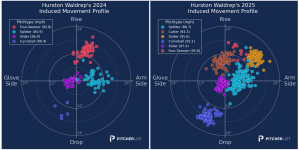
The movement plots above depict Waldrep’s arsenal over the past two seasons. Waldrep’s signature pitch throughout his amateur and professional career has been his splitter, a consistent swing-and-miss weapon with downward tumbling movement, generating ~2 inches of induced vertical break at 86.7 MPH and 739 RPM in 2025. Waldrep’s splitter generated a 40% whiff rate in a limited sample size (45 pitches) at the Major League level in 2024, and the pitch is currently generating a 45.7% whiff rate so far this season.
While having one swing-and-miss weapon in your arsenal is better than having zero swing-and-miss offerings, it is difficult to translate the high “stuff” quality of one pitch into on-field production without an effective arsenal of complementary pitches surrounding the standout offering to get ahead in counts and/or generate sub-optimal contact when needed. While the splitter is truly at least a 70-grade offering, Waldrep’s four-seam fastball that he displayed in 2024 was underwhelming due to its “dead zone” shape, as the pitch possessed a movement profile similar to a hitter’s expectation relative to his arm angle, and his lack of feel for locating his slider and curveball prevented these offerings from being effective in-game last season.
To improve the performance of his fastballs, Waldrep has scaled back his four-seam usage dramatically and added a cutter and sinker to his arsenal, fully embracing the “throw multiple fastballs” trend that the league has embraced in recent years. Possessing the ability to throw multiple fastballs allows a pitcher to mask a “dead zone” four-seam shape, since the opposing hitter must decipher which fastball a pitcher is using at any given time, introducing the possibility that the hitter anticipates the wrong fastball and produces either a whiff or sub-optimal contact. As a pitcher with a natural supination bias, Waldrep is well-suited to leverage seam effects to create these pitch shapes, and adding these offerings to his arsenal has allowed Waldrep to be more unpredictable when facing opposing hitters.
While Waldrep’s addition of multiple fastballs to his arsenal has been a frequently discussed adjustment that he has made, a more subtle tweak that he has made this season has been improving his slider shape. Last season, Waldrep’s slider possessed a true bullet shape, displaying 1.5 inches of induced vertical break and 1.7 inches of horizontal break at 87.0 MPH. This season, Waldrep’s slider has added more vertical drop, resembling a “downer” or “deathball” shape with 0.2 inches of vertical drop and 1.4 inches of horizontal break at 87.4 MPH. This slight adjustment in shape has contributed to an increase in the pitch’s effectiveness, as evidenced by the 3.2 RV/100 the offering has generated so far this season.
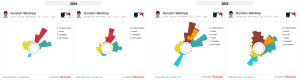
Downer sliders are typically more effective at generating swing-and-miss than traditional bullet slider shapes because the pitch displays unexpected movement relative to the hitter’s expectations. As shown by the tables above, Waldrep has clearly changed his grip and/or intent with his slider, with the pitch generating more seam-shifted wake this season to create more of a downer shape than the slider he possessed last season. While seam orientation data is not publicly available, the pitch’s increased axis differential indicates Waldrep is utilizing seam effects to generate this improved slider shape, and it would not be surprising if this revamped slider becomes an integral piece of Waldrep’s arsenal moving forward.
While the on-field results suggest that the changes Waldrep has made to his arsenal have been effective, pitch quality models, which measure the quality of each pitch based on velocity, spin, and movement characteristics, are mixed in their assessment of the adjustments Waldrep has made to his arsenal. Out of FanGraphs’ two pitch quality models, Stuff+ is more favorable in its assessment of Waldrep’s arsenal, improving his “stuff” grade from 101 in 2024 to 106 in 2025, while StuffBot is more bearish regarding his adjustments, declining his “stuff” grade from 55 in 2024 to 45 in 2025. Pitch quality models can sometimes have difficulty capturing the effectiveness of off-speed offerings, explaining the wide difference in grades on the splitter between the two models, while the discrepancy in the grade on the slider likely comes down to differences in how each model is constructed. I can’t speak to how each model is specifically constructed; however, this discrepancy highlights how pitch quality models can differ from each other and how important it is to analyze a given pitcher’s offerings within the context of their arsenal. Given how the multiple fastballs have allowed Waldrep to mask his “dead zone” four-seamer and how the slider has been able to generate whiffs this season, I firmly believe that these adjustments have been a positive development for Waldrep’s arsenal.
As mentioned earlier, Waldrep is currently overproducing his ERA estimators, and his peripheral metrics indicate that he is due for some regression in the future. While Waldrep’s current BABIP of .261 is not particularly extreme, he is currently running a 92.7% LOB and 3.4% HR/FB, values which are certainly going to regress over a full season, resulting in Waldrep allowing more runs than he is at the present moment. Projection systems at FanGraphs are quite bearish on Waldrep’s rest of season production, with each system projecting him for an ERA over 4 for the remainder of the season, largely due to the aforementioned regressions and a projected increase in walk rate, given the below-average command that Waldrep has displayed in the past (Waldrep is currently producing a 108 Location+ in 2025). I’m willing to take the under on these projections and bet that Waldrep can run a high-3 ERA over his final 4 starts of the season. Location ability can be variable start-to-start, and a 1.01 ERA is obviously unsustainable; however, the adjustments that Waldrep has made to his arsenal around his dominant splitter provide optimism that he can continue to outperform his projections over the remainder of the season.
In conclusion, Hurston Waldrep has made some notable adjustments to his pitch arsenal that I believe have improved his odds of staying in the starting rotation long-term. While some regression is inevitable, his combination of a dominant splitter, improved slider, and versatile fastball mix provides him with a stronger foundation to be a starting pitcher at the Major League level. If he can continue to avoid running into command troubles that he has experienced in the past, then Hurston Waldrep has the potential to become a fixture in the Atlanta Braves starting rotation for years to come.
Statistics as of the end of play on September 2nd, 2025.
Photo courtesy of Icon Sportswire | Adapted by Aaron Polcare (@abeardoesart on Bluesky and X)
