





Let’s make one thing abundantly clear: this is not a eulogy. Gerrit Cole absolutely still has the stuff; he just isn’t applying it correctly. This is not a case of an older pitcher coming back from a long-term injury with nothing left in the tank. While the problem beleaguering Cole is typically associated with younger pitchers, it also frequently affects pitchers in the same position he’s in now. He’s eight starts deep into a return year after missing 75% of the last two seasons due to elbow problems that eventually required Tommy John surgery to correct. This kind of uncharacteristic performance is to be expected, and writing him off now would be a mistake. It can take a while to get back into a groove after that much time away from pitching. Last year may have been his off-season, but this is not the fall-off for him.
A Tale of Two Coles
While some changes are to be expected in a pitcher’s career, I don’t think all of the things that are different with Cole compared to how he looked two years ago are intentional. Some of them surely are, but the negative ones look to be byproducts of his rust. Let’s break things down pitch by pitch to get an idea of how things aren’t the same.
The 4-Seam
Yes, despite rapidly approaching his 36th birthday and coming off of two years’ worth of elbow problems, Cole has returned with a 4-seam fastball that is just as strong as it was pre-injury. Unfortunately, it hasn’t played like the same quality of fastball. The good news is that it’s not difficult to ascertain why.
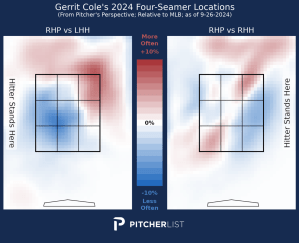
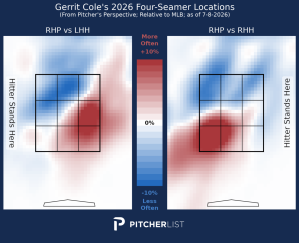
Yeah. That ain’t it. It’s not even just the obvious thing of throwing far more low 4-seams in place of high ones; they’re low and away as well.
Throwing 95 south in the zone would be great if they were sinkers that ran down and off the barrels. That is not the pitch he’s doing it with, and hitters are punishing him for it. His 4-seam doesn’t run enough to play well down there. The barrel rate on this pitch is the highest it’s ever been going back as far as the metric can be tracked (data from his first two seasons pre-Statcast doesn’t exist; Cole’s been around a while), and the whiff rate is the lowest it’s been since his days as a Pirate as well. The high zone rates are pushing the strike-based metrics up, but this pitch isn’t doing what he needs it to.
The Slider
Some time around when his elbow began to bother him, Cole started to lose feel for locating his slider. He reacted by throwing it less and supplemented it with a cutter that likely further reduced the slider’s effectiveness somewhat due to blending. The good news is that he seems to have no qualms about throwing the slider now. The cutter being gone entirely is something I’m treating as neutral news for now. The stuff quality has dropped marginally with the combination of a lower release and decreased depth, but it’s still around a 60-grade to me in that regard. The bad news is that he hasn’t yet regained his knack for locating it.
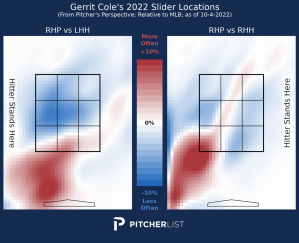
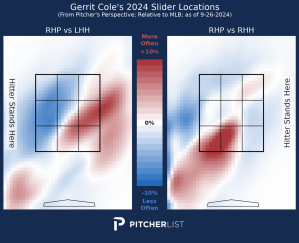
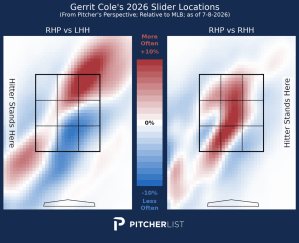
I don’t think this needs to be explained at great length. Put simply, his ability to locate this pitch down and to glove side has not bounced back yet, and that will put a damper on the performance of even great sliders. He’s had some bad luck with the balls in play off of this pitch, but he isn’t doing himself any favors with the locations of it.
The Changeup
Despite his long career as an ace, Cole never really developed a reliable changeup he trusted to use as anything more than a throw-in next to the rest of his arsenal. This is only the third time in his career that its usage has eclipsed 10% of his total pitches, but it’s become his go-to secondary against lefties this year. Whether this is for the best is yet to be decided, but I like the idea.
It’s not the most deceptive changeup ever, but it at least gets the job done in that regard. The spin sells the pitch well, but he doesn’t get significant bonuses for maintaining his arm path or its range of directional angles at release. In terms of stuff, it’s arguably the best iteration of his changeup to date, coming in with 8.5” of IVB separation and 10.6 mph of velocity separation. His execution of this pitch has been a bit odd.
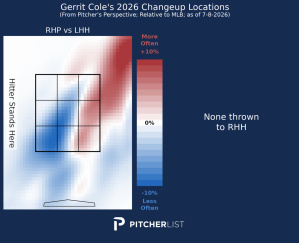
The heatmap is slightly exaggerating the issue of the high and outside changeups, though an odd number of them have slipped out early and landed up there. It hasn’t been a frequent enough issue to keep him from running an above-average chase rate with this pitch, at least. It’s a little bit funny; his average changeup location is only 3” lower than his average 4-seam location. For context, the leaguewide average is a 12” gap. I wouldn’t be surprised if the execution of those two pitches in tandem is what’s causing the changeup to run such a low whiff rate, far lower than would be expected given its stuff quality. It’s inducing weak contact and ground balls effectively in the meantime, but given the pitch’s shape, it seems unlikely that that’s the goal he’s trying to achieve with it.
The Curveball
This pitch became Cole’s most-used secondary in 2024 while he reduced slider usage, and to great success at that. The curve posted above-average metrics across the board, getting whiffs, called strikes, chases, and suboptimal contact alike. In the latest addition to a trend I’m sure you’re getting tired of at this point, his execution of this pitch is getting in the way of reaching those heights at present.
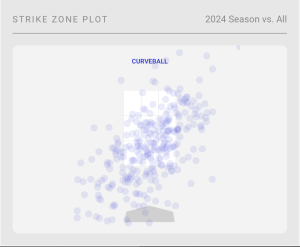
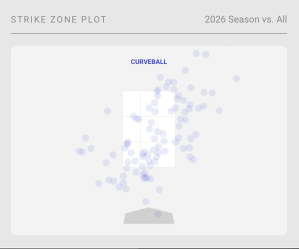
We’re using zone plots and tables this time because I think they get the point across better in this case. Cole’s old strategy with this pitch was to fill the bottom of the zone as often as he could and trust that the combination of power and strong two-plane movement would keep it out of trouble. Largely, that worked! This year, he’s doing some of that while also trying to catch called strikes against lefties by throwing it high and away from them. I think.
Honestly, I’m hoping that’s what’s happening because it would mean it’s intentional and thus easier to fix, and that his curveball isn’t just slipping out early by accident at an alarming rate. Most of the bubbles in that cluster have come in platoon matchups. The curves against righties being mostly kept down and to the glove side lend credence to the idea that this is an active choice by Cole.
The problem here is that he’s hanging the pitch too often, and it’s getting him in trouble for no real benefit. While the called strike rate is higher than it was in 2024, the overall strike rate has dropped because the SwStr% has cratered to a frankly pathetic 4.0%. Even in a small sample with an odd pitch map, it is unfathomable that his long-time, trustworthy secondary breaker has a whiff rate that would be below average for a sinker.
The Sinker
Speaking of sinkers, Cole’s has long been shelved since Houston told him it was holding him back. At the time, they were right. The high 4-seam was in vogue and what Cole always should’ve been doing anyway. In the first half of this decade, he threw just 46 sinkers, an average of 0.37 sinkers per start. In the downtime Cole had while recovering, the new meta has become throwing multiple fastballs. Even if a sinker doesn’t have great stuff, working it in with 4-seamers can help both pitches play up by keeping hitters honest. Cole’s has subpar stuff in a vacuum, but it fits into his arsenal nicely with about 6” of both IVB and HB separation from the 4-seam.
Alright, bad news time, say it with me now: “His execution of the pitch is holding it back.”
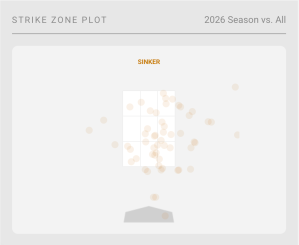
Don’t like that. It’s a small sample, too small for a heatmap, but it’s not hard to imagine where the big red splat would be. The called strikes he’s been getting with this pitch have not been worth the contact generated by clustering sinkers around that part of the zone. This is probably exacerbated by the locations of the 4-seam as well.
The Climb Back
You can’t say Cole isn’t going right after hitters; his strike-based metrics largely look good. His zone rate is the highest it’s been since 2018, and his walk rate is tied for the lowest it’s ever been. That said, he could be applying more pressure if he cleaned up his locations. Nobody’s perfect, and an immediate return to form is probably too much to expect from a pitcher with as much rust as Cole has accumulated over the last couple of seasons. He needs to defrost a bit more before we can really expect him to get back to normal.
There’s likely a bit of extra time to be tacked on, given he changed his delivery while he was away. He has a full over-the-head old school windup now, and he lowered his arm slot as well. Getting used to a change like that on top of the cobwebs that need to be shaken means giving him more than eight starts’ worth of patience. That said, we can still define what we want to see from him while we wait for it.
First and foremost, his 4-seam fastball needs to find its way back to where he used to throw it. The relatively few fastballs he’s thrown up there have been looking lonely at the top. Getting hitters chasing those pitches is how Cole made his career, and he should really get back to it. I think that would do wonders for his other pitches as well; his current pitch maps just aren’t cohesive at all. While his other offerings could all use their own version of fine-tuning, it might be moot if he doesn’t start elevating the heater.
The next most important thing after that would be reining in the slider and putting it down and to the glove side consistently like he used to. Getting that pitch and the fastball landing where they should be might be enough to get him back to his usual ace self. I think it speaks to how tangible that future is that he’s finding any success given how he’s been pitching. His stuff and abnormal attack are getting him by on called strikes and suppressing contact, but the whiffs are missing. They’re not gone forever; he just hasn’t found them yet. Against all odds, he still has everything he needs to succeed. He’s not far away from it either; all of the pieces are still there, they’re just not in the right places yet.
