





When you see the name Janson Junk, as a pitcher, your mind immediately goes to one place: Junkballer. There are a thousand different titles this article could have in relation to that — none of which are particularly good.
Junk has also been treated as his namesake by a variety of organizations: the Miami Marlins are his sixth Major League organization. He was traded from the Yankees to the Angels in the 2021 Andrew Heaney trade, then to the Brewers in the 2022 Hunter Renfroe trade, and then designated for assignment three times in 2024 by the Brewers, Astros, and Athletics. Junk signed a minor league deal with the Marlins in 2025, where he’s been since.
We’re not here to talk about Junk’s time being reduced, reused, and recycled (sorry!) as a professional pitcher. Junk’s start to 2026 has been more exciting than anything we’ve seen so far from him. Through three starts, the surface-level 4.32 ERA, 17.4% strikeout rate, and 5.8% walk rate might seem underwhelming in a small sample. It doesn’t scream breakout, but the rest of the profile under the hood does. After some tinkering last year, it looks like Junk is in a much better position to perform, and the surface-level stats will soon follow.
Setting the Table in 2025
Junk’s 2025 flies under the radar in the first place: his 4.17 ERA, 17.2% strikeout rate, and 2.9% walk rate in 110 innings are nothing to write home about for a fringe starting pitcher. However, his FIP was over a run better than his ERA, sitting at 3.14. Among pitchers with at least 80 innings starting (Junk had 23 relief innings), Junk’s FIP overperformance ranks 10th among 138 pitchers. In that top ten, only Junk and Jesus Luzardo had an ERA under 5.00. This points to him pitching respectably and getting unlucky, rather than some of the other names (Trevor Williams, Anthony Senzatela, Aaron Nola, etc.) that are pitching so poorly that FIP is just lessening the blow.
For Junk, his strikeout rate in his first extended season in the big leagues was consistent with the 18.0% in the 40 innings across four seasons prior. The exciting development was that his walk rate dropped by 5.4% from 2024, a tangible improvement in strike-throwing. His zone rate went from 47.5% to 51.2%, a 98th percentile figure.
Before the 2025 season, Junk, a longtime Driveline guy, tried out an experimental tool they developed — the intended zone tracker. According to Driveline, the tool works as follows:
“With the tool, a pitcher or coach uses a touch screen to move the visible crosshairs of their intended target, a digital catcher’s glove, on the interactive screen that is placed at home plate in a bullpen setting.
The location of the pitch, how close it was to its intended target, are automatically recorded in addition to the pitch’s spin, velocity, and expected run values.”
Junk saw significant command improvements, especially on his breaking pitches. It also allowed him to find confidence in his changeup, which he didn’t use in 2024.
Not only was the walk rate and FIP a shining light into what Junk was capable of, but PLV, Pitcher List’s pitch model that grades both stuff and location, put Junk in the 93rd percentile among all starting pitchers.
There were a variety of articles about the oddities of Junk ahead of this season, such as The Junk Box is Full of Mystery by Michael Rosen and Which Way is Janson Junk Going to Regress by Michael Baumann. All signs pointed to the fact that he was doing unique things, whether that was exceptionally poor batted ball luck or large variations in his arm angle. When a pitcher is doing unique things while holding skills like command, we’re intrigued.
The 2026 Upgrade
Having confidence in the command allowed Junk to do two things this year: improve his stuff and optimize his usage.
PLV loved his approach across the board, but Stuff+ only thought the locations were good. A 96 Stuff+ was below average with a bad fastball (92 Stuff+) and only one league-average pitch, a 100 Stuff+ slider. This year, the arsenal has ticked up to 106 Stuff+, with the fastball (103 Stuff+), slider (106 Stuff+), and changeup (114 Stuff+) all improving significantly. His 5.29 PLV is in the 94th percentile this year.
Starting with the fastball, it’s upgraded in almost every single way.
A velocity increase is always good, but creating a more vertical break from a lower arm slot is as good as it gets. The 1.5 height-adjusted VAA, which measures the angle where the pitch crosses the plate, accounting for location, ranks in the 94th percentile. Despite a slightly lower arm angle (from 53 to 49 degrees), Junk is generating more vertical movement on the pitch. This creates a tougher angle for hitters to square up the pitch, in theory, leading to more whiffs (more on this later).
The pitch has gotten better in terms of pure stuff, and he’s using it less this year, too. His 29.8% fastball usage overall is a nine percent decrease from last year. Among qualified starters this year who don’t also throw a sinker, no one uses their fastball less than Junk. Maybe he is a Junk-baller after all.
He peppers the zone with a 62.0% zone rate, utilizing the pitch mostly early in counts to righties and as a two-strike offering to lefties. The control of the fastball buoys the low walk rate.
Junk’s primary breaking pitch, the slider, also saw a stuff upgrade. It isn’t as comprehensive as the fastball, but it added two inches of drop. This is a theme across all of the secondaries — an increase in drop, which pairs well with a fastball that added vert. At a lower arm angle, this is even more surprising to hitters, who correlate lower arm angles with differences in horizontal movement, not vertical.
The slider is also a zone-heavy pitch that Junk uses early in the count. Against righties, it’s actually his primary pitch at 35.3%. Its zone rate currently sits at 58.5%, compared to the league average 43.4%.
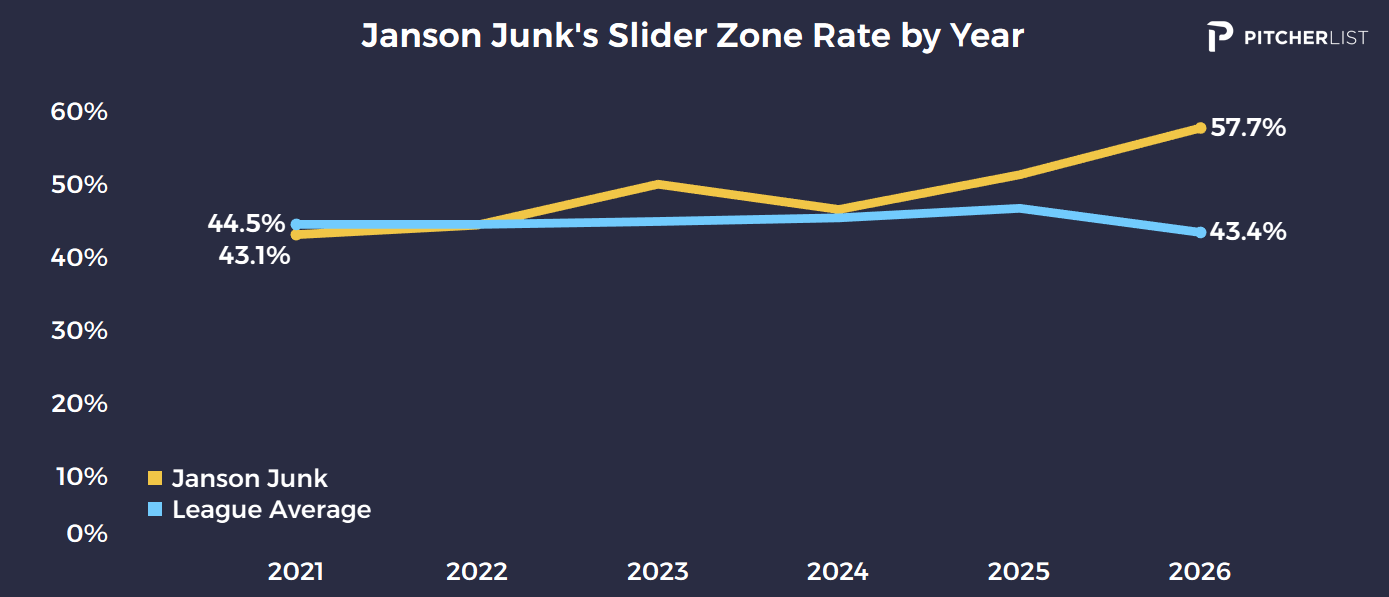
The sweeper follows a similar path as the slider: it added drop and is still a pitch that is focused around the zone more than most. The sweeper is predominantly a pitch to right-handed hitters, and Junk also uses it more than the fastball. It doesn’t stand out in a material way in terms of stuff, but it keeps hitters off balance when they have to deal with it compared to the slider. With their frequent competitiveness, neither pitch misses bats at an above-average rate.
Junk also has a breaking ball for lefties, deploying a curveball 13.4% of the time. It’s mostly an early in the count offering, leaving later counts for fastballs & changeups. He’s backed off of using it (5.8% decrease) from last year and it’s been hit hard every single year.
The last main offering that Junk has is that changeup, which is primarily a pitch for left-handed hitters. Its usage increased by 14.9% from last year to 28.2%, and its Stuff+ increased from 90 to 114. The pitch added two inches of horizontal run and lost almost five inches of drop. The changeup also lost two ticks of velocity, driving the change in drop, going from 88 mph to 86 mph.
The changeup is a pitch he hasn’t really ever had feel for, and this year’s version is just his best attempt at wrangling it. It still sails high with some consistency, but the new shape is promising enough that there’s much more room for success as he throws it more. The pitch already has more whiffs this year in 16 innings than it did in 110 last year.
While the changeup is getting more whiffs, this hasn’t materialized across the board: Junk’s 17.4% strikeout rate is equivalent to last year’s 17.2%. I just wrote about how all of the stuff looks better, and yet the results aren’t changing.
Where are the Whiffs?
After I spent too long (and failed) to come up with a creative pun in the title, the very generic “Janson Junk is Ready for a Breakout” felt fitting for who he currently is. All the ingredients are there for him to break out this year, but it’s not there yet.
This starts with locating his fastball up in the zone. The 1.5 HAVAA is perfect for locating the pitch up in the zone. However, his 36.4% HiLoc% is in just the fourth percentile.
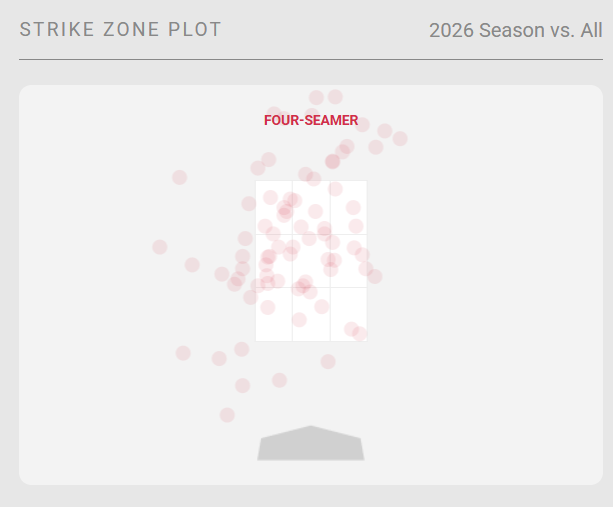
This is not where a pitch with these characteristics should be. Junk’s earned four whiffs on the pitch so far this year, three of which are up or above the zone.
Not only does that fastball location enable whiffs on the pitch itself, but it sets up the rest of the arsenal. He’s added drop to all his secondaries this year, which means that there has to be more vertical separation in order for everything to tunnel correctly.
Thanks to Fangraphs Labs, we can visualize how this looks. Based on the anchor pitch type and location, “each other pitch in the arsenal appears at the position it would arrive if aimed at the same initial point.”
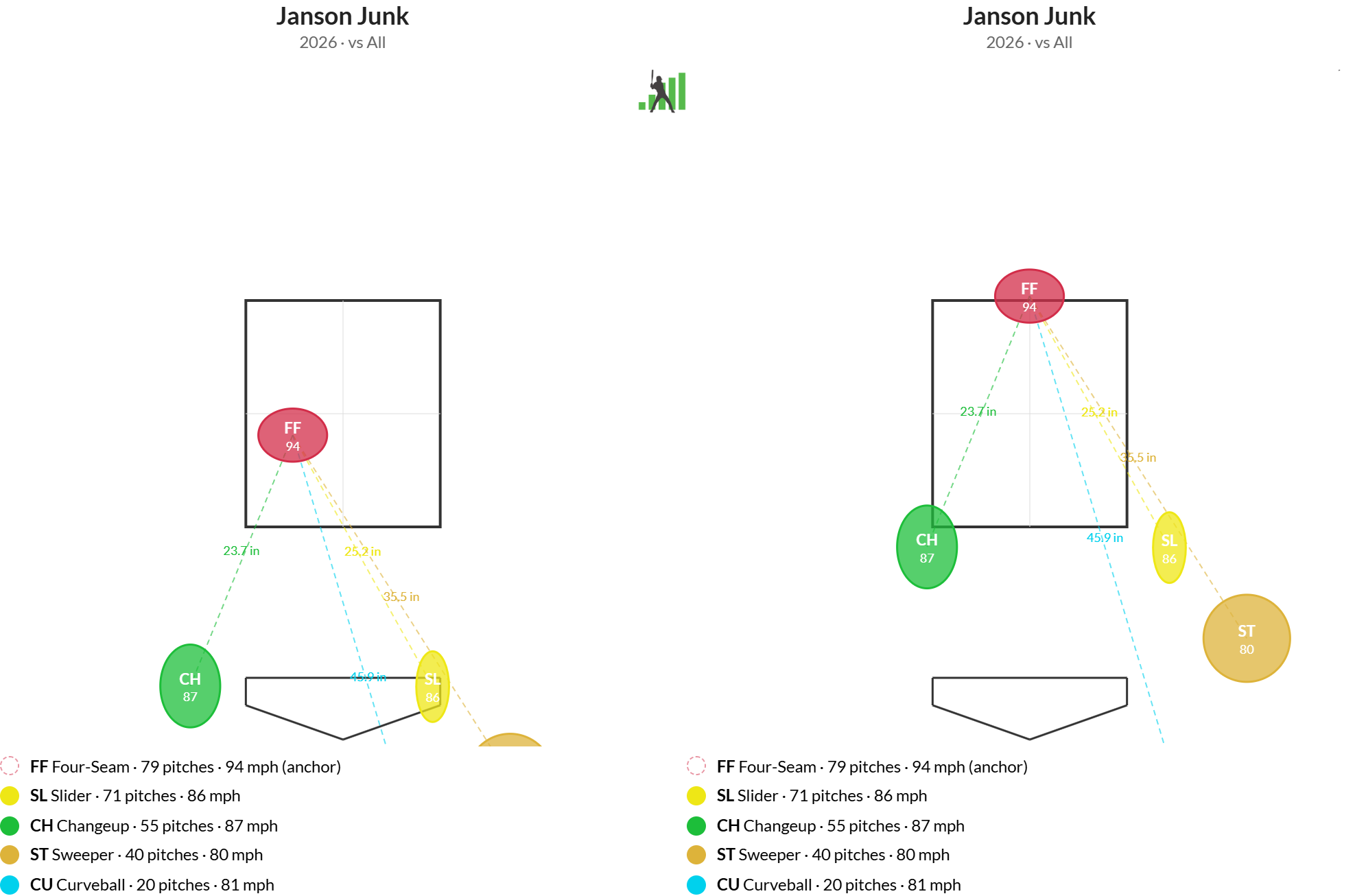 Just based on the fastball alone, it’s easy to see how much more competitive a slider, sweeper, and changeup all look if tunnelled from something up in the zone compared to where he currently locates the pitch. It would enable Junk to become even more deceptive with his wide mix.
Since Junk is slider and sweeper first to right-handed hitters, we can use the slider as the anchor pitch to still show that the fastball should be elevated.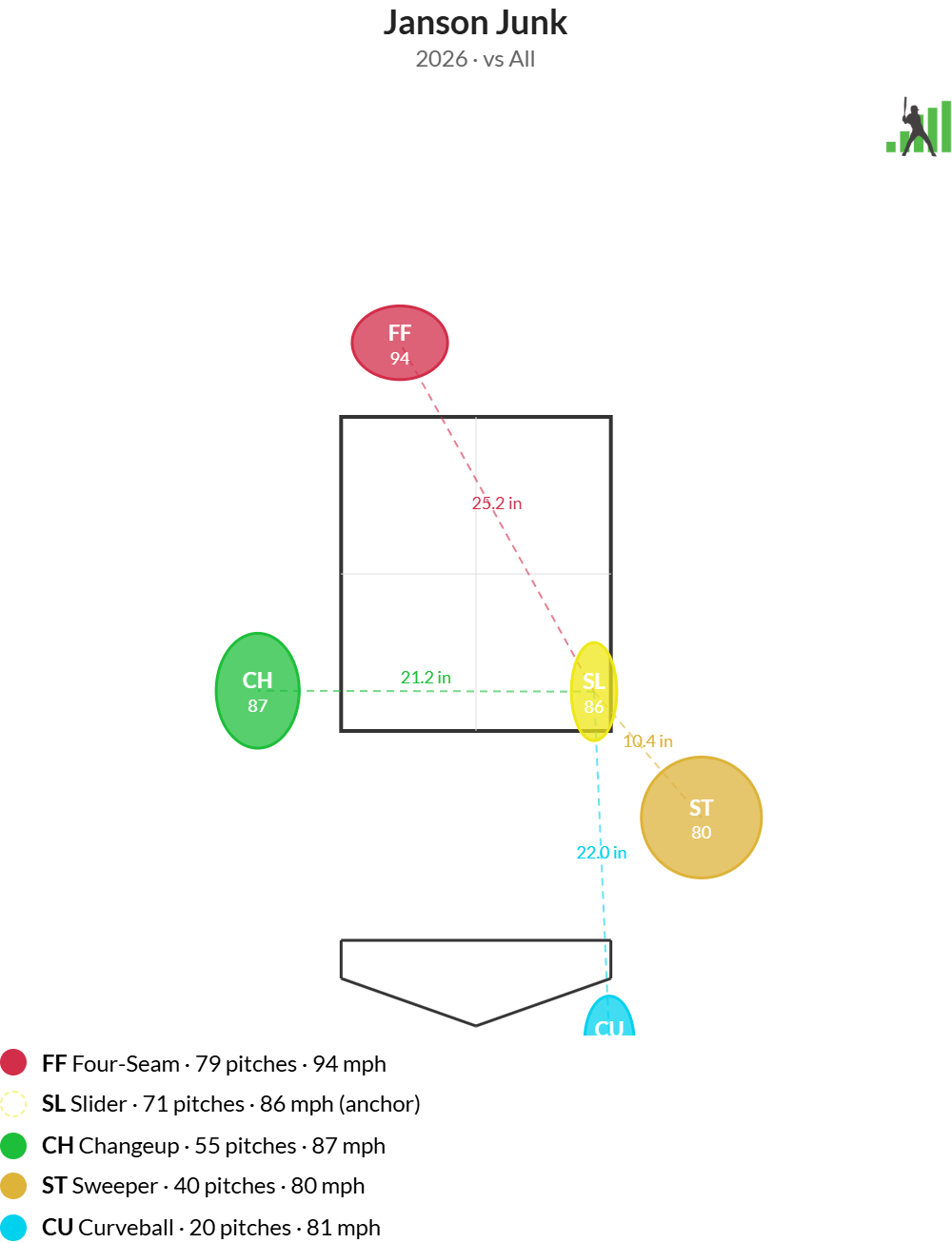 Hitters would then have to worry about a larger area of the strike zone, with pitches that have more separation than ever. Instead, they can focus on identifying spin with everything generally going to similar locations. All of his breaking pitches struggle to be effective in situations where they should miss bats.
These are pedestrian whiff rates and chase rates, but the slider’s 95th percentile foul rate is the first one that is a problem. When it’s getting swings that could turn into whiffs, hitters are making slight contact. Additionally, the slider and sweeper have exceptionally poor chase rates in two-strike counts and putaway rates, meaning they currently fail to generate strikeouts in the right situation.
The pitches are all better than that early-season performance. If Junk can find locations better suited for his fastball (and not have it sit 92.8 mph like his last start) and allow everything else to play off of it, it will work out for Junk. Having an anchor location on a lower-usage fastball will keep hitters off balance when they have to make swing decisions against secondaries.
Junk spent last year refining the command and spent this offseason refining the stuff. It’s now time for him to put it all together and show what a complete arsenal looks like.
