





The Cleveland Guardians have a habit of getting more than the sum of their parts. With a self-inflicted spending cap and an open wound in the bullpen, they’ll need to do so again to outperform their sub-.500 projections and make the playoffs.
Part of that equation is left-handed pitcher Joey Cantillo.
Cantillo exceeded expectations last season, posting a 3.21 ERA across 95.1 innings. Oscillating between the rotation and the bullpen, he pitched himself into Cleveland’s 2026 plans. Despite being a popular breakout pick, though, Cantillo’s profile is a mixed bag of cautionary flags and exciting traits.
Breaking Down Joey Cantillo’s Arsenal
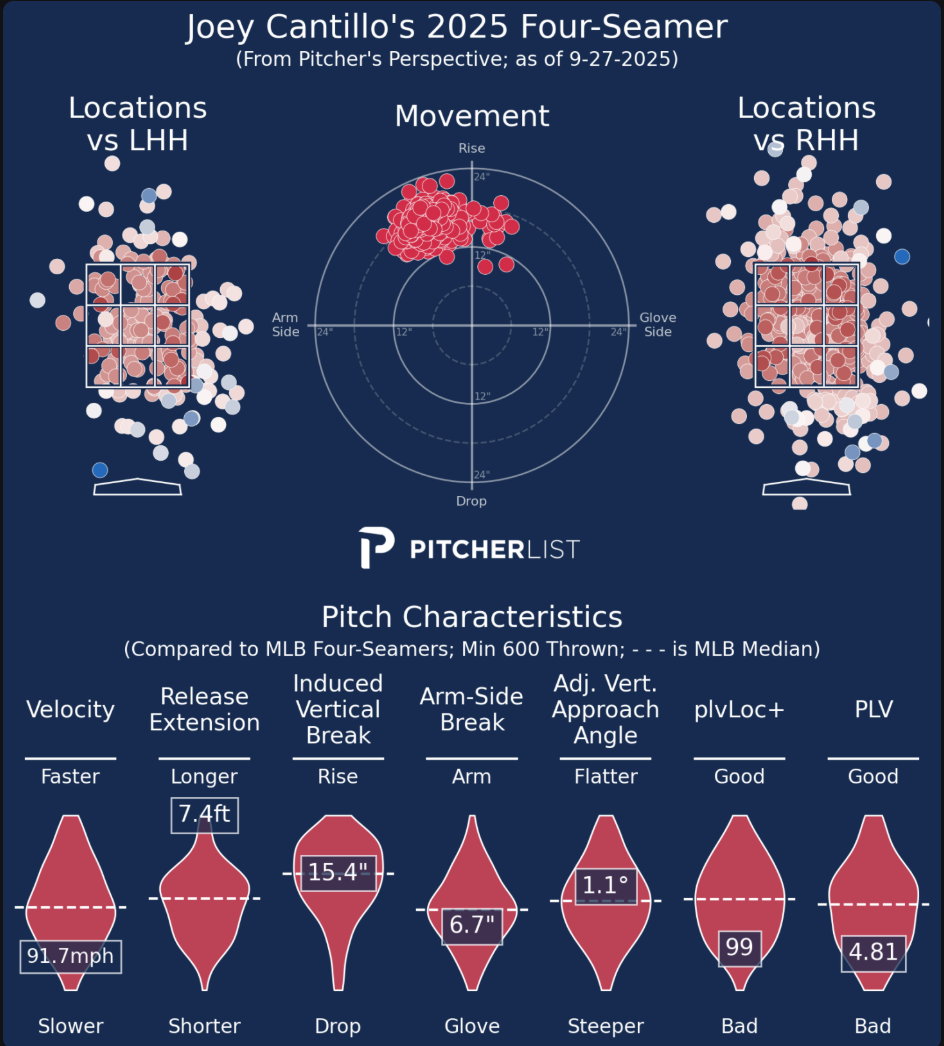
Cantillo is playing a different sport than his firebending peers. His game revolves around avoiding swings on his fastball, and for good reason. It’s a bad one, and thrown 42% of the time, it has the potential to wreck any outing.
His heater averages just 91.7 mph, showing little ability to generate swings outside the zone or whiffs inside of it. He struggles to suppress damage, too; its average exit velocity was 94.2 mph with an 11.5% barrel rate. And yet, the pitch’s 57.2% zone rate is an indictment of Cantillo’s willingness to challenge hitters, for better or worse.
No pitcher with at least 75 innings last season had a higher CSW% on pitches inside the zone than Cantillo. This is directly tied to his changeup, an elite offering that comes in at 78.2 mph with similar spin and release points to his fastball. As hitters hunt for extra bases, his changeup has kept them off balance while racking up whiffs.
In other words (Nick Pollack’s), Cantillo is a SWATCH, and one that needs an assortment of quality secondaries to consistently get outs. His curveball dutifully fits the bill. It’s free real estate early in counts and a ground ball machine later, underlined by an above-average zone rate that demonstrates a strong feel for the pitch.
Joey Cantillo, Nasty Changeups. 👌 pic.twitter.com/ao1CWcFYB4
— Rob Friedman (@PitchingNinja) April 10, 2025
His slider is another story. Without elite velocity, movement, or damage suppression, it’s little more than a wrinkle to keep left-handed hitters in check. If nothing else, it tunnels well with his fastball, playing into the kind of deception that Cantillo’s skill set demands.
At face value, this all makes a good bit of sense. His changeup was among the league’s best individual pitches, his curveball stole him extra strikes, and his slider did just enough to keep a questionable fastball from bruising his top-line numbers.
However, his fastball ran a BABIP 43 points lower than its expected counterpart. He’s also operating with a control-over-command approach—all of his pitches have above-average zone rates, but only his slider and curve had plvLoc+ grades over 100 in 2025. There’s work to be done to stave off regression, even if the ERA estimators aren’t overwhelmingly bearish.
Cantillo’s Adjustments Could Define His Ceiling
As he fights for a spot in the Guardians’ rotation, Cantillo has emerged as a popular breakout pick in 2026. I can’t quite get there. Without a serious alteration to his arsenal, it’s easy to see a 3.21 ERA, 3.55 FIP, and 97th-percentile CSW% being the best it gets for an arm lacking elite upside.
Your favorite projection system probably agrees. It’s no surprise that Cantillo’s small sample size is regressed heavily to the mean. But neither PLV, PECOTA, nor any projection on FanGraphs’ dashboard has him in line for an ERA below 3.65. Using PECOTA’s distribution, that mark would land somewhere between his 70th- and 80th-percentile outcomes. That’s totally acceptable for a back-end rotation option with intriguing stuff. It just isn’t an arm anyone is rushing to start in October.
Conversely, one player that came to mind while watching Cantillo was Jose Quintana. He’s made starts in three of the last four postseasons with similar traits. They share a short arm action, a changeup to neutralize righties, a platoon-neutral curve, and a lack of both velocity and spin. Their nuanced pitchability earned them opportunities, and in Quintana’s case, the command proved to be sustainable. Perhaps that kind of innings-eating ceiling lies ahead.
It would be easier if his pitch mix evolved like Quintana’s, whose poor fastball turned into a usable, if unremarkable, sinker. I don’t know if that’s too much to ask. Cantillo spoke to David Laurila about his proclivity for staying behind his fastball, giving it ride and, at times, cutting action. He also referenced hitting the mid-90s more consistently. If his velocity jumps, there’s a world in which his fastball returns the whiff and chase rates that have eluded him. At the very least, it’s something to monitor in spring training.
Otherwise, a sinker would open up the arm-side part of the plate and induce more ground balls. A cutter could also be used to threaten right-handed hitters inside. More importantly, either addition would lessen the reliance on his fastball, without the diminished returns of more secondary offerings.
Cantillo’s stuff plays well in the zone. Capitalizing on that upside (and his ability to throw strikes consistently) while limiting opportunities for serious damage is his endgame.
That likely won’t come in the form of a new slider. For all the feel he flashes with the changeup and curve, his feel for spin falls behind. With spin rates that rank in the 0th and third percentiles for his fastball and slider, respectively, adding a new pitch is no guarantee. (And it almost certainly won’t be a sweeper.)
Ultimately, Cantillo looks the part of a fringe-4.00-ERA starter with the in-zone whiff rates to elicit more upside. He clearly has a plan of attack to weaponize his changeup, and he locates the breaking stuff well enough to win. It’s no surprise his fastball gets so many called strikes (22.3%), but giving back any skill could turn takes into damage-inducing swings.
Cantillo’s margins are inherently thin, and as he hopes to break camp in Cleveland’s rotation, his ability to buy himself breathing room could be the difference between being a swingman and a mid-rotation starter. For the Guardians’ October aspirations, few developments are as important as Cantillo’s next step.
