





It hasn’t always been smooth for Kevin Gausman, the No. 4 pick in the 2012 draft. It took some time for the Colorado native to live up to his prospect cachet, and despite a few productive seasons in Baltimore and short stops in Atlanta and Cincinnati, Gausman didn’t really take off until arriving in San Francisco in 2020. After racking up 1.6 fWAR in 12 games (10 starts) in 2020, Gausman turned in a brilliant 2021 campaign, securing 4.8 fWAR behind a glittering 2.81 ERA, 1.04 WHIP and 4.54 K/BB ratio in 192.0 innings.
That landed him a massive five-year, $110 million contract with the Blue Jays in free agency, and Gausman kept the good times rolling with a 3.35 ERA and 1.24 WHIP in 174.2 innings. While those numbers were technically downgrades from 2021, Gausman was backed by a career-high 7.32 K/BB ratio and sported an FIP of 2.38, continuing his dominance with 5.5 fWAR. The 2023 season wasn’t much different, with Gausman riding a career-best 11.5 K/9 to his third straight season of Cy Young consideration as Toronto’s ace.
Gausman’s rise to prominence coincided with an increase in the use of his splitter. In the early stages of his career, Gausman leaned heavily on his fastball and splitter, mixing in the occasional slider or changeup to diversify his offerings, but turning to the split more frequently led to gaudy strikeout numbers and his establishment as a true top-line starter. That devastating splitter became his calling card. Hitters generally knew what to expect but could do nothing about it, flailing in anguish as pitch after pitch tumbled beneath the zone. The man himself literally showed you how to throw it, after all:
It was all working until it wasn’t.
A Tough 2024
Gausman was below his usual standards in 2024, pitching to a 3.83 ERA, 1.22 WHIP, a 2.81 K/BB ratio and an 8.1 K/9 mark that was his worst since 2018. Alarm bells sounded in spring training when Gausman dealt with right shoulder fatigue, and he stumbled to a 4.56 ERA through his first 22 starts of the season. He made just one start in spring training and didn’t hit 80 pitches until his fourth start — a threshold he failed to meet just four times in total across 2022 and 2023.
Although he was able to correct course to a certain extent over his final nine starts (a 2.22 ERA) en route to a reasonable 2.9 fWAR, it was unbecoming of the ace status bestowed upon him, and Gausman becoming a mere mortal had tremendous downstream effects on a team that struggled to cash in runs.
The most glaring driver of Gausman’s decline was a decrease in the effectiveness of his splitter.
First and foremost, while the velocity of Gausman’s splitter hasn’t changed a ton, hitters have become increasingly adept at turning around his best offering or laying off entirely. The xwOBA and Whiff% paint a troubling picture — the Whiff% on the splitter was Gausman’s career-low by over six percentage points — with things taking a turn in the last couple of seasons. Gausman has also seen a notable drop in the splitter’s ability to put hitters away in two-strike counts, while hitters have also managed to get under the pitch a little better over time.
The 2024 season was Gausman’s most concerning, which should come as no surprise given his performance in the first two-thirds of the schedule. When the dust settled, Gausman wasn’t terrible, but with his signature pitch looking a little more pedestrian, the battle was on. His ace in the hole wasn’t the sledgehammer it used to be.
It’s tempting to chalk this up to a drop in the, well, drop, of the pitch, but Gausman used it to tremendous effect in 2022 and 2023 despite a little less vertical movement en route to the plate. Maybe the book is simply out on one of the game’s best pitchers, what with so many seeking to replicate his arsenal and players more aware than ever of the splitter’s potential to wreak havoc. Baseball is a game of counters and adjustments, and the ecosystem around Gausman is giving batters tons of reps playing the splitter meta-game.
It also could be a matter of Gausman, largely a two-pitch pitcher, tipping his hand via a difference in arm angle — his average arm angle has dropped steadily from 41.4 degrees in 2021 to 36.1 degrees last year. It might be that shoulder problem chipping away at his effectiveness, or time simply catching up to a 34-year-old who has been a workhorse for four seasons running.
Perhaps the answer doesn’t lie in Gausman’s splitter itself, but rather in how the pitch mingles with the rest of his arsenal. The velocity on the splitter wouldn’t appear to be an explanation on its own, nor would the drop based on his track record, but what about compared to his most frequent pitch? Looking at the splitter compared to Gausman’s four-seam fastball, you can see the two slowly converging.
(For reference, the differentials here are calculated as the splitter minus the fastball; i.e., in 2024 his splitter was 8.0 mph slower than his fastball and in 2023 his splitter dropped 18.4 inches more than his fastball.)
There’s an increasingly dwindling speed gap and the splitter is no longer falling off the table as much as it used to, relatively speaking. On the flip side, we have seen Gausman start to crank up the horizontal break of the pitch. And that brings us to 2025.
A New Look (So Far)
In spring training, (a healthy, bulked-up) Gausman revealed that he would be unveiling a zippier new slider with “a little cutter action” to help him tangle with lefty batters. That’s a new wrinkle for a guy who has left the slider as a distant third-place in his collection, and he nearly cut the pitch entirely back in 2019, throwing just 30 sliders in 102.1 innings with the Reds.
He also mentioned that a spike in his sinker usage in 2024 was a result of less-than-satisfactory results with his fastball, and the numbers suggest that Gausman is back in love with the heater — he has thrown just one sinker all year long to this point.
Everything points to Gausman pounding fastballs and going all-in on working east-west, rather than north-south as he has in years past. As a result, Gausman’s splitter looks like nothing we’ve seen from him before. The pitch is generating more arm-side run than ever, and recent history suggests that this is entirely by design.
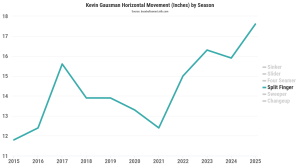
The new horizontal break hasn’t led to any major reversal in his fortunes, as you can see in the following table with the new splitter tacked onto the information we discussed above. Highlighted in red are the major problem areas, and it would seem that a new-look splitter isn’t helping him achieve results. The pitch is generating even fewer whiffs and baiting fewer two-strike hitters than ever.
Compared to his fastball, Gausman is seeing gains in vertical drop differential — up to 17.9 inches — as well as horizontal movement differential — 6.1 inches of arm-side run. It bears questioning, however, whether that added drop is being wasted as the fastball and splitter continue to diverge on the horizontal plane. Add in a slider that gets 2.0 inches of glove-side run, and Gausman is working with more of the plate horizontally than ever before. But with only three pitches, and each now sporting increasingly distinct movement across the plate, are hitters being fooled?
Gausman is generating slightly more whiffs, up to 24.6% this year on all pitches compared to 23.4% a season ago, but is also surrendering much harder contact. His exit velocity (90.7), hard-hit rate (45.5) and xSLG (.457) are all his worst of the statcast era.
It hasn’t prevented him from turning in vintage performances, with Gausman’s eight starts so far including an eight-inning, 10-K dazzler vs. Boston and six innings of one-hit, nine-strikeout ball against Cleveland, but Gausman’s lows are also lower than they’ve been before. There was a game against the Mets with no strikeouts in 5.1 innings, as well as a 2.2-inning dud against the Yankees that featured a ridiculous 53-pitch inning. While Gausman can make batters sweat across the entirety of the plate, those with discipline may also be having an easier time laying off his movement.
What Next?
Gausman’s splitter is most certainly different than it used to be. “Different” doesn’t automatically mean “better” or “worse,” but watching Gausman tinker with his bread and butter is like watching a leopard change its spots. To see it after 2024 that was a campaign most pitchers would kill for only underscores the intrigue. In some regards, the change feels like Gausman trying to outrun time or at least his reputation; he’s giving batters a new version of an old trick that wasn’t offering the same level of illusion.
Gausman’s results were slipping even before 2024’s roughest patches and this might be a preemptive strike. Changing his entire movement profile after a multi-year stretch as one of the sport’s very best hasn’t led to full-on rejuvenation to this point, but how this new splitter functions could very well define the final act of his career.
For the first time in a long time, we don’t know what Gausman has up his sleeve. We do in the big picture, of course — heavy fastballs and that splitter to put batters away, with sliders sprinkled in for fun — but the road to the destination is just a bit different. It’s clear how Gausman wants to go about his business, but the little flourishes that make the fine lines between mediocrity and stardom are new. It’s an ace reinventing himself on the margins to stay ahead in the struggle between Good and Great, and it will be fascinating to watch.
Photo by Icon Sports Wire | By Carlos Leano
