





Michael Wacha entered the 2020 season as half of the New York Mets‘ plan to replace Zack Wheeler. Wacha pitched to a 6.62 ERA, Wheeler was a down-ballot Cy Young candidate, and the Metsian trajectories seemed to be set. The next season furthered that notion, as Wacha remained on the wrong side of a 5.00 ERA and Wheeler led the country in innings and strikeouts.
Wheeler has obviously continued to blossom. But the vision Brodie Van Wagenen boasted about did, to an extent, come to fruition.
Wacha is about to finish his fifth consecutive season with an ERA beginning with a 3. He has become a stalwart for the Kansas City Royals and is one of the few bright spots on the AL Central’s most meager team. He’s made playoff starts for Kansas City, and he might make the next one, too. This is a success story for the Royals’ limited spending.
However, Wacha’s most consistent stretch hasn’t come without a series of adjustments, and his ability to tinker with the lesser parts of his arsenal has bought him time as a reliable starter. Life as a changeup-first soft-tosser isn’t always long, especially without a particularly high ceiling or strikeout rates to sacrifice. It’s worth considering how Wacha has earned the Kansas City faithful’s long-term confidence.
Taking the High Road
One of the bigger hurdles Wacha has to continuously clear is the ability to work around a modest four-seam fastball. Wacha’s fastball hasn’t finished the season averaging 94 mph since 2017; it has never posted a Stuff+ above 100. Even its most redeeming factor—the pitch’s 17+ inches of iVB—is dampened by the over-the-top arm slot.
There are a few ways to navigate this, such as limiting its usage with other types of fastballs or throwing more breaking balls early in counts. Wacha has chosen to change his spots.
The willingness to throw fastballs up in the zone (and up out of the zone) is significant. The zone rate has decreased, but an uptick in swings has helped return more strikes. Most notably, Wacha’s fastball O-Swing% has skyrocketed to a career-high 35.7%, 10 points greater than last season and a driving force in trading called strikes for whiffs.
Frankly, it’s an unintuitive adjustment, given his four-seamer’s specs. Bad fastballs get barreled up in the zone, especially when they don’t deviate from expectations and aren’t thrown very hard. Again, 87th-percentile iVB is nice to have, but adjusting for height brings it down to the fourth percentile, so the iVB is coming entirely from his arm slot.
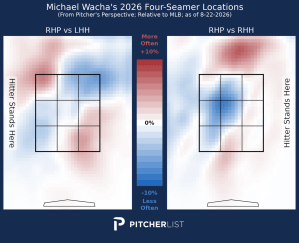
I would expect this pitch to get drilled. But it is performing better than last season by PLV, wOBA, and Stuff+, and on those pitches above the letters, it is exceeding expectations. He has already registered more whiffs—and a higher whiff rate—on high fastballs than each of the last four seasons. Its xSLGcon is much improved from last season, as is its wOBAcon (and to a lesser extent, its expected counterpart).
Given the spike in chase rates and damage suppression, it’s safe to say the change has been for the better, even if the reasons why are a little harder to identify. It’s still a true backspin fastball with usable velocity, so perhaps my priors were overindexing on shape. But many of Wacha’s whiffs are coming further above the zone than years past, and the shape of his whiffs is more emblematic of his 2023 campaign. Pitching for the San Diego Padres in 2023, Wacha registered a 22.4% strikeout rate and a 3.22 ERA, earning him the runway to make a home in Kansas City.
In 2026, this offering has generated a slight uptick in strikeouts (17.6% to 19.1%), with his chases preventing an increase in walks. Being homer-prone elsewhere has hurt his peripherals, but he’s only been burned over the fence once on a high fastball this year.
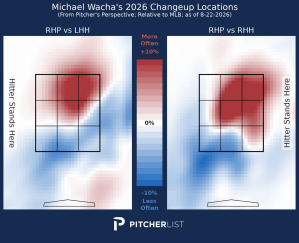
Wacha may also be helping other parts of his arsenal by anchoring his secondaries to a high fastball. Wacha’s changeup is unique in its movement variance. When tunneled with a high fastball, Wacha buys breathing room for changeups that stay above the lower third of the zone. Like his fastball, he is sporting an abnormally high hiLoc% (89th percentile) on his primary off-speed pitch. It’s still not getting hit very hard, and it is changing how he earns his strikes. A 2.7% bump in CSW% was made possible by more called strikes and more whiffs out of the zone, even if those chase pitches aren’t getting swings as often as last year.
I’d postulate that these heaters have also helped his curveball, which has seen a marked increase in called strikes. Interestingly enough, all of these gains have come against righties, where his CS% jumped from 7.0% to 25.8%. His ECS% has followed suit, from 9.3% last year to 33.8% in 2026, and his 2-Strike O-Swing% has nearly doubled. Wacha is still using it less than 10% of the time to like-handed hitters, but the fastball has made it an ancillary weapon, rather than a change-of-pace offering.
Movin’ On Over
Wacha has also made a bit of a mechanical adjustment in his age-34 season.
Wacha’s stuff is nearly identical to last season, and his arm angle is just 2° higher. Yet, his release points, across the board, are noticeably closer to third base than last year. Wacha has changed his place on the rubber, intentionally changing the geometry of his offerings.
The Royals let Wacha rediscover his slider after a few years of hibernation. As a true pronator, though, the pitch never generated anything close to a high spin rate, nor did it offer above-average horizontal break. It’s a true vertical slider, but sitting middle-away to right-handed hitters hadn’t borne much fruit. Still, he can comfortably blur the glove-side edge of the zone with regularity, and his command there has been fairly consistent. His slider’s 110 Location+ was impressive in 2025, and while that’s dropped to 102 in 2026, plvLoc+ (107) likes it more.
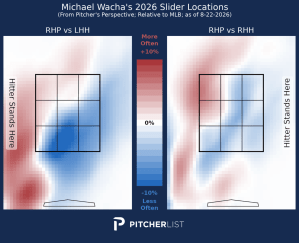
As such, the spots are likely to stay the same. If Wacha can make it appear like it has more horizontal break, there is room for his whiffs to grow. I think that is part of why he inched closer to the arm side of the rubber this summer.
Pitching from the third-base edge of the rubber has changed the horizontal approach angle of all of his pitches, and as they drift glove-side (a physical necessity if he is throwing the same pitches to the same spots from a more arm-side release point), they exaggerate the glove-side movement of his offerings.
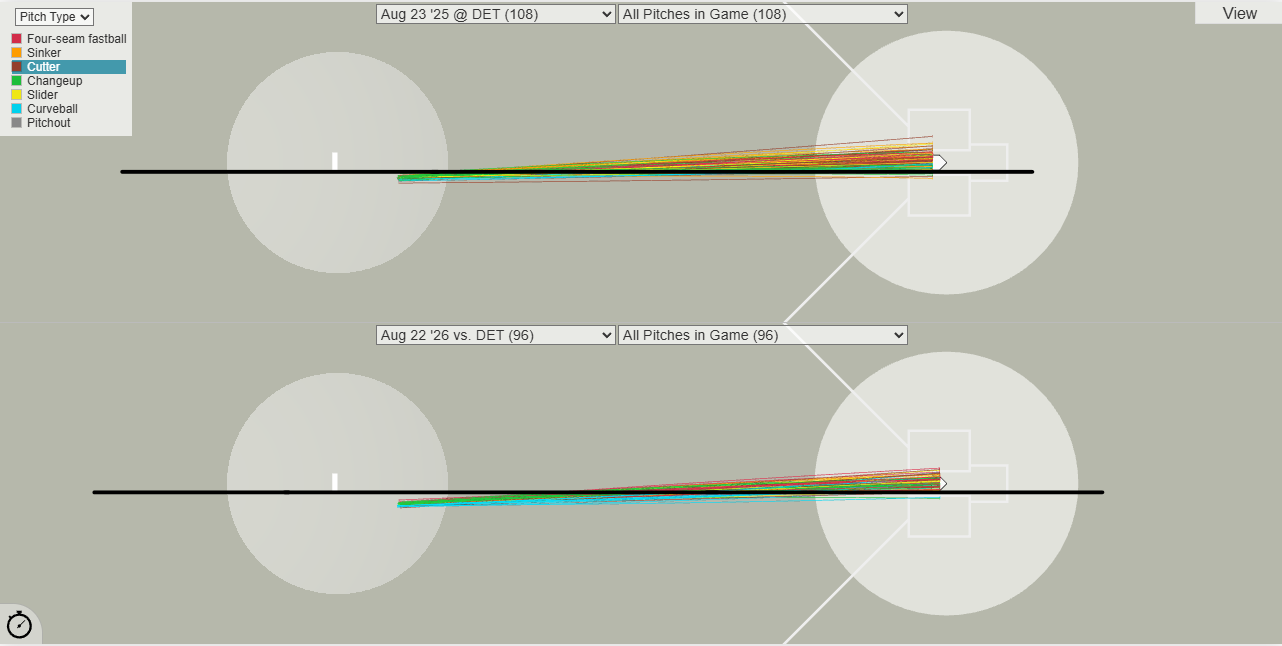
Take this graphic from Baseball Savant, using two games against the Detroit Tigers nearly one year apart, as an example. I drew a 0° line from the “bottom” of the rubber to help visualize this angle, but it might be more helpful to imagine the catcher at the backstop instead of home plate. If he were trying to catch Wacha’s pitches from 2026, we’d probably position him a little closer to the left-handed batter’s box, rather than directly behind the middle of the plate.
Even so, I would hesitate to suggest that Wacha made this significant of a change for a pitch he throws 10% of the time. He must like what it’s doing for the rest of his arsenal, whether it be for HAA, command, or something else entirely. It makes sense that his cutter would benefit as well, and more called strikes might showcase that, but the rest of his results haven’t been as conclusive.
As for the slider, two stats show that his newfound HAA is working. For one, the miss distance on the pitch (5.3 inches) ranks 55th of 242 sliders with at least 50 swings. A season ago, 3.2 inches of miss distance ranked 226th among 290 qualifiers.
Secondly, the pitch’s O-Contact% has dropped significantly, from 55.2% to 40%. Its contact metrics are average, and the CSW% is nearly identical to last season, but getting guys to come up empty outside the zone has come easier. It isn’t immediately clear whether these changes have tangibly made Wacha better—neither run value nor PLV would agree—but if it is playing into the success of other pitches, it’s worth the trouble.
One offering it likely hurts is his sinker, which lacks the outlier movement, velocity, or command to be a quality pitch. Flattening some of the (visual) movement with more glove-side HAA doesn’t make that any easier, and its movement profile is already dead-zoney. Throwing it more often to righties, and in similar spots to his four-seamer, makes it useful only in its presence to distract from the four-seamer.
While I am curious whether eschewing it for more cutters, changes, and breakers to right-handed hitters is on the table for next year, Wacha’s adjustments have insulated his age curve and given him the tools to deal with a subpar fastball. There is room for his expected stats to drive some regression, but Wacha is currently leading the American League in innings with an improved K-BB%. For Royals fans hoping to win a perpetually attainable AL Central, Wacha’s craftiness is a page out of Zack Greinke’s playbook, and it might give his arsenal enough punch to match their timeline.
