







Eric Longenhagen over at FanGraphs spotted some interesting fielding positions in the Arizona Fall League last week and did some digging, finding out that MLB is trialing a new system of outfielder positioning.
ICYMI: Major League Baseball is using the Arizona Fall League to pilot new rules restricting defender positioning both on the infield (with the bases empty) and, perhaps more notably, in the outfield.Here's Eric Longenhagen's report from last night:
— FanGraphs Baseball (@fangraphs.com) 2026-10-07T17:25:48.329Z
I would recommend reading Eric’s entire write-up, but the gist is that there are markings on the field indicating where infielders need to be at the beginning of any play when the bases are empty, and outfielders have to stick near in any situation. The status of the players vis-à-vis these markers is relayed to players and umpires via large LED screens, as seen in the Bsky thumbnail above. I’ll be attending First Pitch Arizona next month (along with several other Pitcher List luminaries!) so I am looking forward to seeing this system in person (assuming it’s still in use by then, things change in the AzFL in a hurry sometimes), but until then I have some thoughts.
The Good
Logenhagen notes that his league sources hope that the new rules will “create more base-hit action and have a positive impact on the game’s aesthetics.” This isn’t a particularly surprising or novel goal for the league office, and I don’t necessarily think it’s a bad one. In a vacuum to some extent the entire point of the central league bureaucracy is to try to do things that have a positive impact on the game’s aesthetics.
It’s no secret that the offensive environment in baseball has become extremely HR-oriented, and we see it in pretty much every single batting stat looking back even just to the turn of the century:
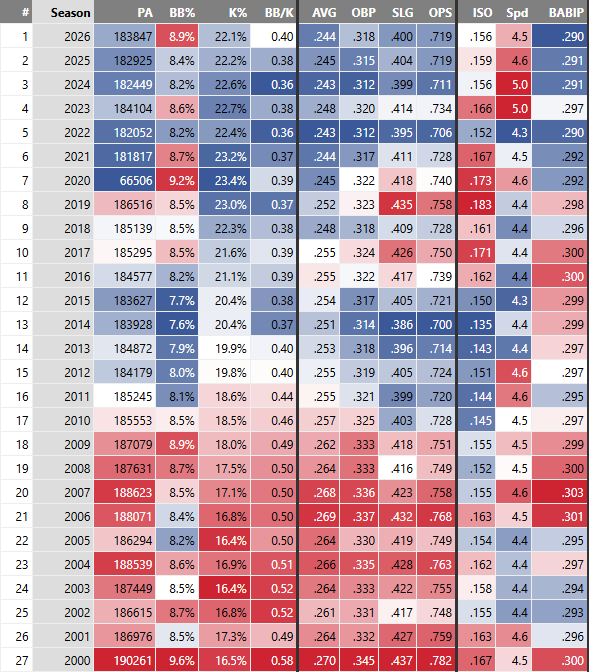
Just as an aside, I think it’s also very interesting to see what numbers haven’t changed much over 26 years.
I haven’t been quite so up in arms about the TTO style of play; I remember summing it up to Travis Sawchik at a signing event for The MVP Machine as “I like when my team strikes guys out and hits home runs,” but it is becoming very hard to argue that it’s really a satisfying thing to watch year in and year out. And what we’re seeing is the end result of the optimization of the game as it exists; even the worst-run teams are mostly rowing in the same direction as the top of the pack. To say that MLB shouldn’t care about these things or shouldn’t look at ways to tweak them doesn’t make sense to me given that the optimal team design is a result of rules set by the league. The fact that they see these things as issues and want to address them is a positive thing on balance, although obviously the specifics of those changes get considerably messier.
The Bad
We’ve seen an absolute flurry of rule changes in the last twenty-odd years. Between 1976 and 2008, MLB only adopted two new rules:
- Pitcher can’t throw at the batter
- Catchers must wear protective helmets while on defense.
Since 2008 there have been at least a dozen new rules added to the ledger, and that’s not counting the temporary ones added during the 2020 COVID season. The obvious comparison to the experimental AzFL rules are the Defensive Shift Limits that were first implemented in 2023 and then updated in 2025. We’re all pretty familiar with them at this point, and part of that is because they’re mostly simple: when the pitcher is on the rubber, two infielders must be on either side of second base, and none of them on the outfield grass. Easy, and not overly prescriptive. Also, crucially, the rule only affected a specific subset of plays, as the shift was almost exclusively deployed against left-handed batters (although within that subset, in 2021 the majority of pitches against LHBs happened with a shift in place.) With this new rule proposal, the specific player positioning would take place in the outfield for every pitch. It would also apply to infielders on every pitch without a baserunner, but the effect seems like it would be pretty negligible compared to the existing shift rules.
There is something fundamentally repellent about specifying exactly where a fielder has to stand when a pitch is being delivered, especially on a field like you see in baseball, which is somewhat famously unmarred by any lines within fair territory. The shift ban sidestepped this to an extent by splitting the infield in half but letting fielders stand wherever they want in those halves. We still see plenty of batters step in to the box with a middle infielder nearly behind second base, and I still see plenty of balls hit back up the middle turned into an easy out.
The system in use in Arizona, meanwhile, seems very specific in the positioning. Eric got to try the system out from the field and said “when I was on the field, it felt to me like three strides on either side of the painted hash mark was the margin for error.” That works out to probably around ten feet of wiggle room from the predetermined centerpoint of the starting location, which in the context of an entire MLB outfield is a rather small area. These restriction zones are likely to change, and I would imagine the hash mark center spot will also move, but one other thing about the current implementation of the outfield positioning is that it looks almost shockingly unnatural. You can see a photo of the positioning in the FanGraphs article, but the corner outfielders are markedly close to the foul lines, leaving pretty huge gaps between them and the center fielder who is lined up dead center (and a bit shallower than we usually see, although that’s not as immediately noticeable.)
For a change that is ostensibly aimed at improving the aesthetics of the game, it makes for a pretty jarring, if not outright ugly, visual. It also doesn’t seem like it necessarily provides for the outcomes that MLB would want to see, offensively:
As I write this, I am watching my second game with these restrictions, and I’ve noticed a few things. Bloop hits are tougher to come by, whereas well-hit balls in play have a better chance of getting over the outfielders’ heads. There are slices over the heads of corner outfielders that force them to flip their hips and change direction along with the ball in play, which is usually only a thing you see the center fielder forced to do. And the corner outfielders are positioned closer to the foul line, which means they have a shot to cut off sharply-hit grounders that would otherwise trickle into the corner, and hold the batter to a single.
Well-struck balls getting over the outfielders heads is obviously a positive outcome, but taking away bloops and extra-base hits down the lines feel like counter-productive results. Especially the latter as a ball down the line that barely stays fair always seems like one of the most dramatic things you see on a semi-regular basis. This is all pretty heavily dependent on the specific siting of the players, though, which is almost assuredly subject to change. But I think there’s a bigger issue at play with this new rule package.
The Ugly
MLB had a very obvious path forward for the penalties it would assess for pitch clock violations. Balls and strikes made perfect sense, and were obviously assignable to the party at fault for the violation. It’s also a pretty granular system as far as baseball goes. Yes, the game state changes depending on the count, but both players have opportunity and incentive to not let a violation be strike three or ball four. Prior to 2025 the shift ban worked in a similar manner, where a violation meant the batting team could accept the result of the play or have the hitter be awarded an automatic ball.
However, in 2025 MLB changed the rule such that “the batting team may accept the result of the play or the batter will be granted a free base (enabling any other runners to advance one base) if there is a violation and the violating player was the first to touch the ball in play.” We almost saw this come into play during the AL Wild Card series between Houston and Chicago when Jose Altuve made a play on a Sam Antonacci ground ball:
There was a lot of confusion over the review at the time, even among online baseball knowers, and I believe at some point on the broadcast (not in the embedded clip) they incorrectly said the outcomes were either out or an illegal pitch/dead ball. Turns out the potential outcomes were an out or Antonacci being awarded first. Maybe it’s just me, but I really don’t like those options. Antonacci was out by multiple steps, and Altuve didn’t have to make a particularly superhuman play to make that happen. And therein, for me at least, lies the rub.
There simply aren’t many layers of outcomes you can fiddle with to enforce a rule in baseball. There’s no clock, no yardage, et cetera like you have in a sport like football. This means that if MLB wants to make a rule violation more impactful than just incrementing one side of the count, the only other option is to change the outcome of a play that has already otherwise been completed. I guess the football equivalent for this type of violation would be encroachment or a false start, but if that infraction occurs, the play is blown dead; it’s not assessed only after the play is completed. If MLB wants to say that players cannot be out of position (however they define it now and going forward) they should simply not let a pitch be thrown until everybody is compliant. That, however, would run directly into their stated goal for more action and lower game times. As it stands, even if the review went against Houston in the WC game, Antonacci would have only gotten a single out of it. The current implementation of the new position rule is considerably more arbitrary:
Penalties for non-compliance are enforced by the field umpires, who can see the LED board from their vantage points. For infielders, non-compliance will only result in a violation if the out-of-place defender is the one who fielded the ball in play; where the runner is placed is then a matter of umpire discretion, though first base seems the most likely spot. In the event a play is made by an outfielder who is outside the allowed radius, how many bases a batter is awarded is again a matter of umpire discretion, similar to the way fan interference is assessed. For instance, if a center fielder is out of position and he robs the batter of a would-be gap double, the umpire can place the batter at second base.
This seems like a perfect recipe to make nobody happy with the outcome. Eric has already made the direct comparison to the decisions made in fan interference cases, so we don’t even have to imagine very far to see where this ends up. Just look at the Anthony Volpe game-tying-home-turned-RBI-double from the ALDS:
I think the eventual decision of an RBI double is reasonable given the specifics of the play, but it’s two outs in an elimination game; could Volpe have stretched it into a triple? Could Victor Mesa Jr. have caught the ball? In this case you end up with an outcome that mostly pleases nobody, and this is a play where there was clearly fan interference. Applying similar hypothetical outcomes to a play where a fielder cleanly plays a ball because he was potentially inches out of place seems like a recipe for widespread discontent among both fans and players.
But for the league, there isn’t much of option if they want to go down this route. An out-of-position fielder invalidating a play and adding a ball to the count doesn’t feel like it’s much “fairer” or more logical in the grand scheme of things, and that would really be the only way to minimize the infraction. I usually try to come up with some kind of solution to issues like this if I’m going to complain at some length about them, but I really can’t think of any here. The fundamentals of baseball seem at odds with MLB’s vision for how to juice offensive action, which seems to mean that they’re going to need to try to fundamentally change baseball to make it happen.
