





Speaking broadly, rookie pitchers are far from finished products. When one performs well immediately, it usually comes with a caveat that would mark them as volatile or otherwise prone to bad games, along with the good ones. This is normal, of course. Being a rookie is a learning experience; they aren’t supposed to have their game fully figured out yet. Most rookies who find themselves thriving are usually, at least to an extent, coasting on their stuff. Enter Parker Messick. Messick does have good stuff, but it’s hardly the entirety of what’s driving his success. The level of polish on his game for a pitcher with his lack of experience is astonishing. Let’s break down what makes him so special.
Control Freak
What does good command look like? It varies by pitch type, but there are generally accepted ideals for each one you want a pitcher to be aiming for. No one’s ever going to hit those every time, but when you check the zone plots, you want to see lots of pitches clustered around those areas.
This is where the fun begins. His changeup is a 65-grade pitch with plus command to boot.
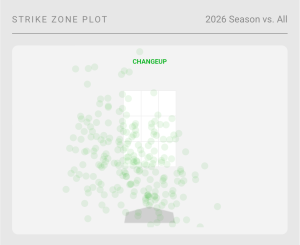
The ability to land a pitch outside of the zone in enticing locations is maybe the most valuable element of command for a pitcher to have. There are plenty of good pitchers who never achieve this echelon. Messick has it as a rookie. This is how a pitch with a 25.5% zone rate can run an 82nd percentile CSW%. It doesn’t matter that it’s rarely in the zone because it looks like it’s going to be in the zone often enough that hitters chase it nearly half (48.3%) of the time. This, combined with the stuff quality of his changeup, is why he gets a swinging strike on more than one out of every four times he throws it.
It feels weird to be doing his pitches out of order by usage, but I can’t wait any longer to talk about his cutter. I don’t care that it’s a new pitch for him, and I don’t care that he’s throwing it less than 10% of the time. Look at this zone plot.
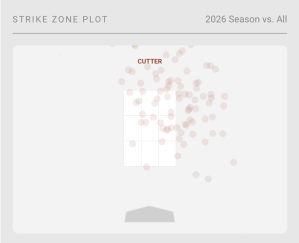
That is absurd. Again, this is a new pitch; he didn’t throw it a single time in the majors last season. He is already spotting it like a seasoned vet, jamming up righties inside on pitches they think are high four-seamers. The following is a very specific stat that I’m cherry-picking a bit to explain his ability here, so bear with me for a second. This is what the attack zones look like:
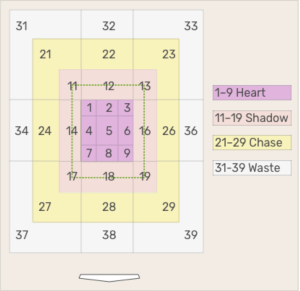
(Image courtesy of BaseballSavant)
Please note, this zone is mirrored from the plots shown previously due to the perspective. The ideal spot for cutters from a lefty to a righty trying to jam them inside would be in zones 11, 14, 17, and 24; the shadow zones and the middle-height chase zone on his glove side. However, the sections of the shadow zone that are over the plate are prone to having hitters turn on them and send them flying. So we’ll filter those out and leave it as those zones, but out of the strike zone. Messick is landing his cutter to righties in that area 26.7% of the time. That is the best in the league among any lefty who has thrown just 50 or more cutters to righties this season.
I understand that that is not a huge group of pitchers. Let’s mirror it so we can add in righties too, throwing glove-side cutters to lefties in zones 13, 16, 19, and 26, out of the strike zone, with the same minimum cutoff. After that, the leaderboard from a sample of 83 qualified pitchers who have thrown 50+ cutters to opposite-handed hitters looks as follows:
The guy who wasn’t throwing this pitch eight months ago is throwing it in the best location for platoon matchups at the third-highest rate of anyone in the majors. Neat. Now granted, not all of the pitchers in the sample are using their cutter with the intent of jamming those opposite-handed hitters when they throw it. However, I feel like it’s worth mentioning that the two guys above him, Gray and Leiter, have found more success with those pitches than any of the others in their arsenal thus far this season.
Ironically, Messick’s primary fastball is far from the pitch he commands best. We’ve reached the point in the article where we have to remark on the flaws in his command that exist in most pitchers. It’s not bad, but he does have a noticeable problem. The good news is that he’s elevating this pitch consistently. The bad news is that it leaks low and falls into the middle of the zone too often. It hasn’t burned him particularly badly yet, but it is the number one thing I want to see him fix. I can’t live with a middle-middle location rate (mmLoc%) higher than 10% on a four-seam. That worries me.
We can take a bit of solace in that he’s making this mistake more often against his fellow southpaws than he is in platoon matchups, but I don’t love the 9.4% he’s sitting at in those either. However, he’s elevating his four-seam at the league-average rate. He’s spotting it above the zone well, and drawing an above-average chase rate too. It’s not bad, it just needs some cleaning up.
I do love that the place his fastball generally lives in is a perfect setup for his other pitches. Excluding the curveball, his other pitches light up the heatmaps in the spots they’d land if they were tunnelling with his fastball’s usual spot. The sinkers are usually down and to the left, and the changeups are further down from there. The cutters are slightly to the right, the sliders down and to the right. The curveball sits at the bottom of the zone or down and to the glove side, both valid locations for them.
The last pitch we’re going to focus on his command of is his other fastball. It’s the only pitch where I have a neutral or lower opinion on what he’s doing with it. Oddly, it’s not a command problem so much as a strategic one. Messick’s sinker requires a different type of chart to really understand why what he’s doing with it is unique. The following is a location frequency plot, displaying how often a pitcher hits locations with specific pitches relative to the rest of the league.
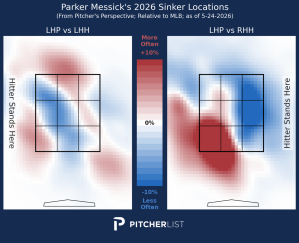
You see that big, angry red blotch in the lower left part of the righty map? That is him drilling that same spot at a rate way higher than the average pitcher right now. While I like how good he is at spotting it there, he’s had some substantial batted ball luck go his way on this pitch, and I’d like it if he’d cut back on the sinkers to righties in general. He can hammer arm-side sinkers to lefties all he wants, but as we’re about to get into, he’s got enough pitches going for him that he doesn’t need to run that risk against righties.
Substance And Flash
As much polish as he shows, it can only take him to a point. Luckily, Messick also has above-average stuff at his disposal, making his ability to locate it all the more valuable.
Messick’s four-seam is a solid foundational pitch. It’s not elite, but having average velocity with above-average shape for his release point is going to play. He also cuts it substantially. This pushes its movement direction higher, giving it more vertical and less horizontal, helping separate it further from his sinker and changeup.
This pitch, as well as his others, is further aided by the herky-jerky delivery that sees him hiding the ball behind his head at the end of his arm circle before firing from a high slot while getting deep into his legs, lowering his release point, and finishing as a flailing mess of arms and legs. It is beautifully hideous. I love it. Hitters probably don’t.
Messick’s changeup is the pitch he’s going to build his career on. I mentioned earlier that I thought it was a 65-grade pitch, and I stand by that. With 8 mph of velocity separation from his four-seam and a staggering 16.4” of induced vertical break (IVB) and 9.5” of horizontal break (HB) separation, this pitch evaporates from hitters’ view as it comes in. While he does drop his arm slightly to throw this pitch, it gets some points for spin deception. The baffling thing, considering everything else about this pitch, is that he throws it with a slightly tilted four-seam circle grip. He’s not kicking it. It’s not a splitter. We’ve seen those grips used to create mind-bending movement gaps at the cost of hitters sometimes being able to identify them more easily. Messick suffers no such problems.
Messick’s sinker is the kind that works because it fits into his arsenal more than it would on its own. In a vacuum, its shape isn’t great. However, it looks enough like the four-seam out of his hand, and it settles into its own range of movement with no blending with the four-seam or changeup.
His curveball is a slurvy breaker that comes in when he’s looking for a change of pace. He likes to land it in the zone for called strikes and has done so effectively to this point. As lefty slurves go, this one is fine. It’s nothing special, but it does its job.
His cutter, like most cutters, is arsenal-dependent. It can be difficult to tell whether or not a cutter is going to be deceptive based on its data alone, but his spins in a fashion that is closer to his four-seam than most other pitchers get. He also maintains his delivery to throw it. All this, combined with the velocity and movement gap it possesses, I like the odds of this pitch working for him, especially with his feel for placing it.
Lastly, he throws his slider almost exclusively to lefties, but I think he could stand to use it against righties as well, given its tight shape and power. The movement on this pitch can vary at times, occasionally blending with the cutter when he throws it harder and it gains positive IVB. But at its best, he can twirl it at 85 with little to no IVB, granting it excellent depth, and 5-9” of sweep.
Finishing Touches
It’s probably worth noting that Messick is already making well-informed changes. After aggressively filling the zone during his first stint in the majors last season and getting tagged a bit for his troubles, he’s eased back and is throwing his three main pitches in the zone noticeably less often.
Command is different from control. I don’t care if Messick is avoiding walks better than everyone else; I know he could do that if he really wanted to, but it wouldn’t be the best usage of his arsenal. It took him all of seven MLB starts across barely more than a month to grasp that. Throwing strikes for the sake of it isn’t really advisable in most cases. It’ll work at lower levels for future major leaguers with the stuff to beat the hitters there, but top level hitters are just too good for that. Since adjusting this year, Messick worked through 62 innings before giving up the same number of hits he did last season in 40.
Unlike most rookies, Messick doesn’t have a long way to go to reach his ceiling. That’s not because it’s lower than the others; he’s just advanced. Sure, he’s an older rookie, turning 26 during the next World Series, but he was drafted in 2022. He hasn’t been a pro that long. He’s in the same age range as Connor Prielipp and Brandon Sproat. He was always thought to be a high-floor, safe bet kind of prospect coming out of Florida State, given how scouts evaluated his pitchability. Considering his stuff has gotten markedly better since then, and the command may be even better than advertised, Cleveland might’ve built itself a new ace.
