





It feels like it’s been forever since top prospect Cade Cavalli was first called up to make his debut for the Nats. A fast-tracked college two-way player who made his MLB debut just two years after being drafted, there was a lot of hype surrounding him. When he made his debut, it was supposed to be one of the first things Nats fans could feel good about after trading away franchise superstar Juan Soto a few weeks earlier. Unfortunately, his debut went poorly, and he was almost immediately shut down with shoulder inflammation. The next time we saw Cavalli pitch in the majors, Soto had already suited up for the Padres 214 times. And also 157 times for the Yankees… And 112 games with the Mets too. He was gone for a while.
Just shy of three years (1080 days) passed between major league outings for Cavalli. After being shut down at the end of 2022, his 2023 ended before it could begin, as he hurt his elbow and got Tommy John surgery in spring training. When he started his rehab assignment midway through the 2024 season, he was still having issues with his arm and only made three appearances. After pitching just 8.1 innings in 2 years, the Nats chose to have him start 2025 in AAA, where he struggled until he was eventually called up in August.
He looked different upon his return. He had raised his arm slot and mixed up his usage by adding a sinker, and eschewed his slider in favor of a harder cutter. While he got BABIPed a bit in his first extended big-league look, there were some things that were eye-catching. Now in 2026, there’s even more to like. Despite some streakiness compiling together into a statistical overview that looks just slightly above average from most angles, there’s a lot to be excited about. Let’s break down the unique arsenal of pitches that drives his profile.
Smoke and Mirrors
Regrettably, we have to start on a slightly sour note. Cavalli’s 4-seamer is not great. He dropped his arm slot back down, but the change to his fastball was neutral. He cuts it significantly, but it doesn’t get particularly unique movement that can sometimes result from that. It checks in as below average in both vertical and horizontal movement from a generic release point. Its saving grace is that he typically works between 95-98 and can run it up to nearly 100, as well as the spin mirroring we’ll get into once we’ve talked about the rest of his pitches.
His curveball is ludicrous. Nobody in the league, relievers included, throws a curve with more movement at a harder velocity than Cavalli’s. With elite power and significant drop and horizontal movement, this is a devastator that is extraordinarily difficult for hitters to do anything with if they can make contact at all.
By stuff quality, his sinker is the superior fastball in his arsenal. While somewhat generic, it has a steep enough VAA to induce grounders regularly, and is well separated from his 4-seam.
Unsurprisingly, his sweeper is about as crazy as his curve is. It shares the same distinction of being the hardest-thrown sweeper with as much movement as his has. The pitch has a somewhat slurvy shape, with more depth than you’d expect from a sweeper. It occasionally blends with his curve a bit on the movement chart, but the way he uses these pitches prevents that from being an issue.
Cavalli’s changeup has a lot to like about it from a stuff perspective. It scores average marks from me across measurable deception, but the 8 mph velocity gap and 10” IVB separation from his 4-seam are both benchmarks I love to see met. It also gets a ton of horizontal fade by managing to get significant seam-shifted wake despite fairly high active spin percentage on an already relatively high-spin change. This thing just dives down and to the right.
Cavalli’s cutter is still something of a prospective offering, but there’s a good amount to like. He throws it very hard, only 3-4 mph slower than his fastballs. Given what his old slider looked like and how hard he throws this pitch, it’s not surprising that it doesn’t have a lot of depth. For what this pitch is, it gets enough separation from the 4-seam, and it’s usually over the horizontal neutral line to the glove side.
If you’ve read my articles or other pieces on the building of a pitch arsenal, you may have noticed something about Cavalli’s pitch mix from the table at the top of this section. He has mirrored all of his four main pitches exceptionally well. His 4-seam, curve, sinker, and sweeper are within an 11-minute range from perfectly mirroring spin direction, and within 9 percentage points on active spin percentage. This makes it nearly impossible to tell what Cavalli is throwing until you see it start to move. Due to the slightly larger gaps in direction and active spin percentage, his cutter and changeup do not quite fall into the same bubble, but they’re not far from it.
This is such an intelligent piece of pitch design, making use of Cavalli’s specific mechanical biases and aptitudes to create a really unique pitch mix. It is very rare to see this much mirroring across a whole arsenal. It does a lot for a pitcher to have their pitches be nearly unidentifiable by their spin characteristics, which is why spin mirroring is a coveted trait among pitch interactions on a smaller scale, usually just between 4-seam-curve and sinker-sweeper tandems. Cavalli accomplishes it with both in one, which is highly uncommon.
Plan and Execution
Cavalli’s pitch execution, like most pitchers, varies from pitch to pitch. Much like the stuff section, we’re going to start with a bit of negativity talking about his 4-seam.
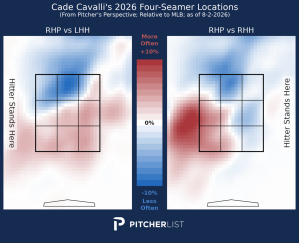
Given his 4-seamer’s stuff quality, I understand his hesitance to throw this pitch high. I don’t agree with it, but I understand the logic behind the conclusion. Unfortunately, the relatively lower rate of high 4-seamers hasn’t led to the avoidance of good contact it’s likely going for.
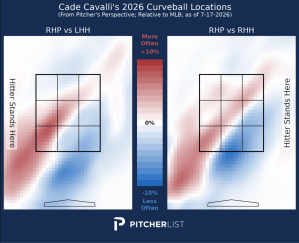
Cavalli’s plan with his curve is fairly clear from its heatmap. He’s trying to bury it down and away, and does so at a better-than-average rate, but it sometimes slips out a bit early and lands higher and further to the arm-side than intended. This is an acceptable exchange, especially with how good his curveball is. It’s not like hitters are going to be doing much with the ones he leaves in bad spots anyway. As long as this pitch is close enough to the zone to interest hitters, he’s golden. Anything after that is a bonus, so his command of this pitch being slightly better than average is a huge positive.
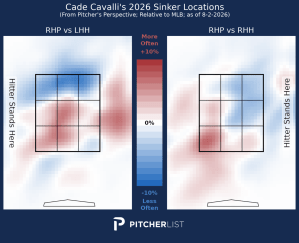
Mixed bag here. He keeps it down in the zone, pitching aggressively, and has even shown a knack for landing it backdoor to right-handed hitters. That said, it does slip higher around waist height more often than I’d like. This, combined with how his other pitches are thrown, is leading to a lack of called strikes for this pitch. My theory is that due to how he uses his 4-seam, and everything in his arsenal being low in the zone, hitters are more aggressive against pitches that have trajectories that start where his sinker usually does. This isn’t all bad, though, as we’re about to see.
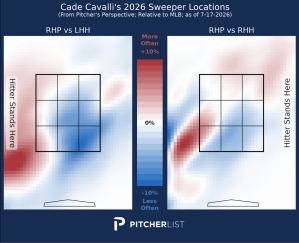
Yeah, that’ll play. And it does; this pitch checks in with above-average marks in nearly every metric. From swing-based to expected and actual contact results, it’s been great. This pitch is functioning better than anything else in his arsenal right now, and a lot of it has to do with how he uses it. You can ignore the left-handed hitter side of this chart; this pitch is mostly used in righty-righty matchups. He has a gift for landing this pitch just off the low glove-side corner, which is the perfect spot for it. It plays up further given how he fills the bottom of the zone with his sinker and drops the curve in similar spots to the sweeper. This is well reflected in its 25.6% PAR%.
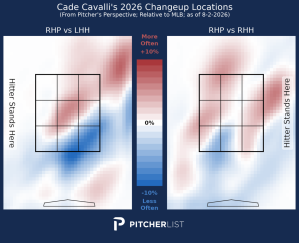
Take this chart with a grain of salt; this isn’t a big sample, but it’s enough to see that he isn’t commanding his changeup well right now. Far too often it leaks high, not getting out of the zone, and rarely finding itself below it. The ones off the side of the zone to his arm-side are good, but they’d be better if they were paired with high 4-seamers, which we’ve established isn’t happening as much as I’d like.
We’re skipping the cutter’s pitch heatmap; there’s nothing to be learned from it. It’s a small sample of a pitch that’s largely been scattered around. Ironically, this seems to be a pitch he likes throwing high, more so than the 4-seam at least. His general strategy seems to be zoning it against lefties, and throwing it above or off the glove side against righties. I like the usage against righties; I don’t get what he’s doing against lefties at all. It’s not really a bridge pitch, and he isn’t throwing his fastball high consistently enough to make the cutter being high that often make sense. Maybe I’m missing something; maybe the sample is just too small to do anything with.
Top of the Mountain
So with all of that in mind, why does he have a 2.43 ERA in his last 10 starts? Especially compared to the 4.03 he had in the first 16 of them? He’s throwing a little harder, but not by much, a tick on the breakers and half a tick on the fastballs. The only significant change I could find is that this is when he started throwing his cutter again. It wasn’t around at the start of the season, but late in June he reintroduced it, and that’s when he really started to take off. He’s been especially dominating righties ever since, and the main pitch it’s stolen usage from has been the sinker.
It’s likely that throwing fewer sinkers in the bottom half of the zone and replacing them with cutters out of it is a big part of what’s spiked his K% in that time, even if the cutters aren’t getting the whiffs themselves. It’s opening him up to more strikeouts via not having the ball put in play early on a misplaced sinker.
It seems like he’s figured out one half of the equation. With breakers like his, dominating right-handed hitters is exactly what he should be capable of. He’s lowered curveball usage to introduce the cutters against lefties too, and I don’t think I love that change, but it hasn’t caused any meaningful differences in those matchups yet.
Final Thoughts
I said earlier on that his overall statistical profile reads as a pitcher who is slightly above average. Then we broke down his pitch mix. Which, given the excellent breaking balls and mediocre fastballs, checks in as slightly above average. His overall pitch command seems to be, wait for it, slightly above average. Even with his recent stretch in mind, it would be fair to conclude that that’s an accurate descriptor of who he is as a pitcher. While we’re here, let’s talk a bit about what we should be looking for, and hoping he does, to improve against lefties.
First things first, I’d like to see fewer 4-seamers, and I’d like to see them located higher. While it’s a generic gyro-heavy 4-seam that isn’t particularly suited to whiffs, I think throwing it higher would help to set up his other pitches better. Considering where he’s throwing everything currently, he’d create better pitch tunnels by locating this pitch at the top of and above the zone. This could push his chase and called strike rates higher and help him take fuller advantage of his spin-mirrored arsenal.
Now, I mentioned that I think he’s throwing the 4-seam lower to try to keep hitters from being able to get under it too well. He is keeping an overall low pull air%, but the 4-seam is still being hit well. I wouldn’t expect this to improve with higher locations, which is why I suggest he throw it less often. This would be a simple proposition against righties; he already varies his mix well against them. Against lefties, the 4-seam and curve make up two-thirds of his pitches on the year. Everything else has 12% usage or less in those matchups, which makes requesting something to step up a bit of a taller ask.
I think the pitch tunneling would allow him to get away with some sinkers and sweepers to lefties to help fill the gap. I don’t know if I trust his cutter against lefties yet; I would need to see more of it. The biggest thing he could do for these matchups and in general would be improving his changeup command, but I’m not holding my breath on that. It definitely could happen, and I hope it does, but expecting it would be presumptuous.
I also believe raising the 4-seam would help his sinker better survive its current locations if he has trouble getting that pitch lower. Due to the depth of his breaking balls, keeping the sinker slightly higher could actually be advantageous toward getting chases on those pitches; the trouble is balancing that with the contact allowed by leaving the sinker higher. At present, his sinker is excelling at inducing grounders, but they’re frequently hard hit, meaning they get through more often than average. While he’s definitely earned some of those, he’s had some bad luck in this regard, and the Nats’ infield defense (except for Nuñez) has done him no favors either. Using it less in recent months has somewhat mitigated this issue, but this pitch has more to offer.
So what do we make of all of this? I think it’s probably fair to say that he isn’t quite as good as the 3.36 ERA he’s posted this year would suggest, but I don’t think he’s far from it, nor is it out of reach for him to be that good. Right now, he’s a mid-rotation starter who can get strikeouts but will likely have days where he leaves a few too many of his non-breaking balls in hittable spots and gets punished for it. That’s how most of his damage has come anyway; despite making up 40% of all of his pitches, his breakers make up just 13.9% of his XBHs allowed. For context, breaking balls make up 30% of all pitches thrown this year league-wide, and are responsible for 29.2% of all XBHs. Maybe he should throw more of those.
Regardless, there are likely to be at least some frustrating days ahead. Hot streak or not, he’s still got some flaws to buff out. He’s well-equipped to do so, but it remains to be seen if he can find an answer for lefties the way he did for righties. In between the occasional bad outings, however, there’s a pitcher who can absolutely mow down hitters in a way we haven’t seen him do since he was a prospect. Given this development and the overall intelligence behind the design of his mix, it seems likely that he’ll make more progress.
(Statistics up to date through August 18th, 2026)
