





As we look at risers and fallers in points leagues, the focus should not just be on how players are performing, but what their role is.
Are your hitters suddenly leading off or batting lower in the order than expected? Have they gotten an off-day, and is it because the manager put them in a platoon? Or did they get subbed out at the end of a game for defensive reasons?
As for pitchers, did they get pulled after just 70-80 pitches, or were they allowed to work deep into the game? And could anyone on the IL or in the minors threaten their rotation spot?
As volume is everything in points leagues, these are the questions you want to answer beyond just whether a player gets hot. So, given their role and their performance, who should you buy in on, and who should you leave alone?
Risers
Christian Walker
Walker was slumping a bit in May until last weekend’s outburst, but his .524 SLG on the month is now pretty close to April’s .547. He does only have one double, but that’s mainly because the balls are going over the fence instead of to the gaps (he’s got eight homers in 26 days).
With 30 bombs since last year’s All-Star Break, Walker actually leads all first basemen and is looking better than ever in his age-35 season. Simply put, he’s the Walker we expected to see last season. Better late than never.
Ernie Clement
I must admit, I don’t really understand how Ernie Clement is a .300 hitter.
How’s his bat speed? Second-percentile. Chase rate? Also second-percentile. And he barrels the ball an abysmal 2.2% of the time.
But what he does well, he does really well. Even as he swings at, well, everything, he hardly ever misses. He’s got a 96th-percentile Whiff rate and a 99th-percentile Strikeout rate. And though his Hard-Hit rate is fourth-percentile, his Squared-up % is 96th. Make that make sense!
Clement’s statcast page is so starkly red and blue that it could accurately portray the state of American politics. But regardless of how he does what he does, he manages to do it consistently—batting .286 in March, .305 in April, and .295 in May. But there is something new here…
What’s different now is there’s some power to go behind all the contact—he’s got three dingers in the last week after just one up to May 18. Will he get to double-digit home runs on the season, given his career high is twelve? Jury’s out on that, but if he keeps hitting like he has of late it’s an easy hurdle. Either way, he’s got a lot of value in a points league.
Casey Schmitt
Schmitt was a replacement-level hitter last season with a .706 OPS and twelve homers in 348 plate appearances, but this year he’s found another level. He’s raised his OPS by exactly 200 points while lowering his K-rate from 23.8% to 19.8%. He’s become a middle-of-the-order hitter (80% of his PA’s have been in the 3/4/5 slots), basically anchoring offense for the Giants. And now that Devers is back to being (mostly) Devers, Schmitt should have even more opportunities to drive in runs.
Like Ernie Clement above, Schmitt rarely sees a pitch he doesn’t want to swing at (17th-percentile Chase rate). He also draws minimal walks, but he makes good contact—and a sub-20% K-rate works well in points leagues for any slugger. And make no mistake, Schmitt’s become a bona fide slugger, as he’s pacing for over 35 homers on the season, a near-.300 Batting Average, and could drive in a hundred runs. Such production would make him a top-50 player.
Stephen Kolek
Stephen Kolek doesn’t strike a lot of hitters out. In fact, his K-rate’s dropped steadily over the last 3 seasons, from 18.5% (so, not very good to begin with!) to 14.3%.
What else has gone down? His ERA and WHIP, which are at 2.77 and 0.85 this season. As with Ernie Clement, there’s a bit of how is he doing this? to Kolek’s game, but he’s got great command and gets a lot of ground ball outs.
Fallers
Seiya Suzuki
Suzuki’s decision-making and overall process have dipped into the negative lately, and his power has also eroded. Over the past week, he’s got a single hit in his last 21 at-bats and is carrying a .178 OPS. He hasn’t fared so well in his last fifteen games, either, with a .111 average and .172 OBP.
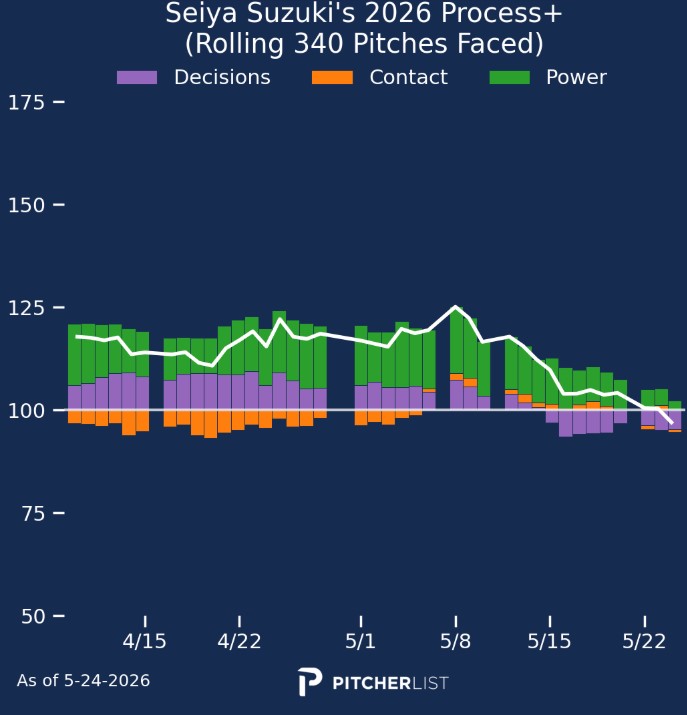
As Suzuki goes, apparently so do the Cubs, as they’re mired in a ten-game losing streak. Overall, the team is batting just .174 over their last thirteen games and are striking out almost ten times per game. A streaky group, they should turn it around eventually (and are one MLB’s best offenses when they do), but I’d be especially worried about Suzuki and here’s why.
Suzuki’s Average Exit Velocities have been historically consistent (91.4 mph in 2023, 91.7 in 2024, 91.3 in 2025), but this year he’s sitting at 88.4 mph, which is in the 34th-percentile. His Barrel rate has gone from an elite 16.6% to just 6.8% this season (I don’t have to tell you this, but that’s a huuuuge drop). So while his K-rate and Walk rate have stayed relatively consistent, he’s just not hitting the ball hard.
Trevor Rogers
How does a pitcher go from a 0.90 WHIP in one season to a 1.62 WHIP in the next? Or from a 1.81 ERA to a 6.96? Well, sometimes luck is a factor. Consider this: in 2025, Trevor Rogers had one of the worst Hard-Hit rates in the league, where 48.4% of batted balls against him were considered solid contact. He was actually third-percentile in the category. This year, his Hard-Hit rate is at 37.1% and in the sixtieth percentile.
Since pitchers make fewer appearances than hitters, luck is often more of a factor in their success. Looking at Rogers’ numbers last year, he got extremely lucky, with an xERA more than 1.5 runs above his actual.
However, his struggles this year go beyond luck. While his velocity looks the same, his K-rate has plummeted from 24.3% last year to just 17.9% this year, and it looks like the secondary pitches are to blame. His cutter had a .065 BAA last season; this one, it’s .400—and the pitch hasn’t resulted in a single strikeout. His change-up was also a money pitch with a .202 BAA, now it’s .339.
Unlike Stephen Kolek, Rogers approaches lefties and righties about the same, with slightly more change-ups to RHBs and a few more sinkers to LHBs. Given his PLV is identical to last year’s, the stuff doesn’t look any different, just when he’s using it. So Rogers needs to refine his approach somehow or another, because when the luck runs out, it can be a steep drop.
