





The perception of Ryan Pepiot’s 2025 depends on where you look. On the surface, a 3.55 ERA, 1.23 WHIP, and 20.0% strikeout rate is mostly underwhelming for the 27-year-old who posted a 3.60 ERA and 26.3% strikeout rate last year. Even though the ERA looks good, estimators all suggest Pepiot is getting very lucky to start the year. Looking through the box scores, there’s only one abysmal start. Pepiot has gone six innings in eight of his eleven starts and has only given up more than three earned runs once. This is the problem with the Quality Start stat: six innings and three earned runs are worth a 4.50 ERA.
Pepiot has the fourth-worst ERA among qualified starters with at least a 60% quality start rate. The two pitchers below him are also Rays; their current ballpark does not help their case, but it’s only the seventh-highest home run park factor. For Pepiot, his ERA estimators think the results have been kind, as he holds a 4.44 FIP and 4.17 SIERA.
This season has been a new look for Pepiot: he’s made the largest usage change across his four big league seasons. While he added a cutter & curveball upon coming to the Rays last year, this year has seen an eight percentage point drop in his fastball usage. His 42.6% fastball usage is his first time below 50%, a significant change.
The change has led to a step backward in some of his peripherals, but Pepiot still has the tools to succeed. Even after he twirled seven shutout innings in his best start of the year on Sunday, he only registered seven whiffs, and hitters had a 50% ICR.
Primed for Regression at First Glance
As mentioned above, Pepiot’s topline numbers show all sorts of steps backward. However, this is more because he’s working with a new pitch mix and ballpark that he might not be comfortable with.
Pepiot has seen his CSW% plummet and ICR increase, which means he isn’t getting strikes and is also giving up hard contact. He’s lost an equal amount in swinging strike rate and called strike rate, so the increase in zone rate is not directly affecting only called strike rate. The only place Pepiot has taken a step forward is in his walk rate, which is more of a given with his sharp increase in zone rate.
While it seems that Pepiot is trying to emphasize strike throwing, it has not been effective in the way it should. The Rays have publicly discussed that one of the core tenets of their pitching strategy is to get to two strikes as quickly as possible. In this article by Marc Topkin of the Tampa Bay Times, Pepiot talks about how hitters have been more aggressive early in the count, and that he wants to use their aggressiveness against them. His 30th percentile first pitch strike rate and 80th percentile zone rate become apparent as a conscious strategy decision.
Pepiot is getting more swings and more balls in 0-0 counts this year, but that isn’t amounting to whiffs. It seems straightforward that going out of the zone would lead to more whiffs, but it’s a different situation in a 0-0 count than any other. Hitters have significantly more power in their decision-making in 0-0 counts, and their ability to take more of these pitches shows that Pepiot has been unsuccessful in using hitters’ aggressiveness against themselves.
Specifically, Pepiot has been uncharacteristically locating his slider poorly in 0-0 counts compared to his overall pitch plot.
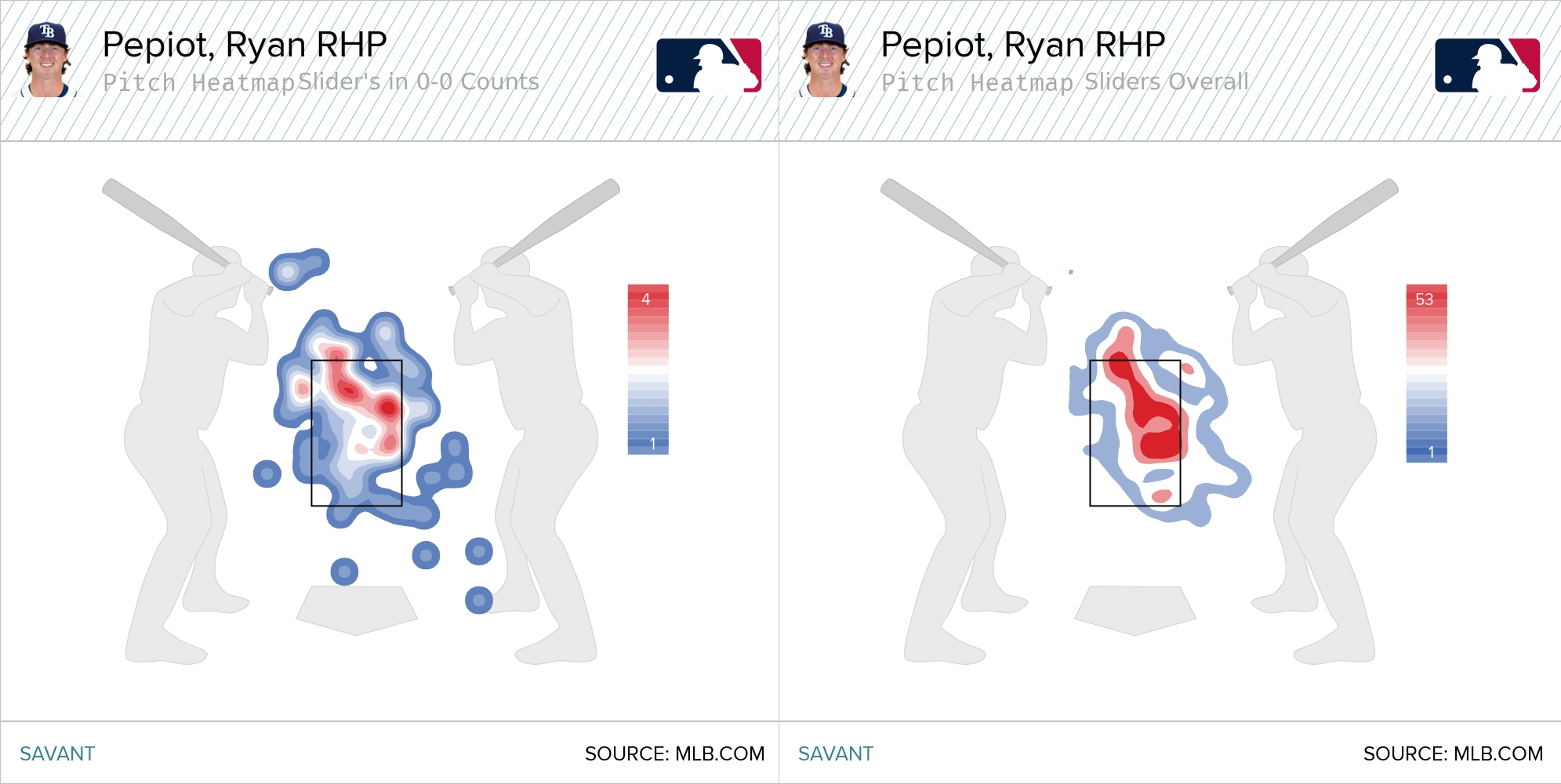
There are more sliders just off the plate up-and-arm-side in 0-0 counts, which is simply not an enticing pitch to a hitter in 0-0 counts. Even though it’s technically located in the shadow zone, his hard slider does not light up the eyes.
He can still capitalize on hitters’ aggressiveness on the first pitch; better locations are just needed.
Additionally, Pepiot has given up a few “minor league” home runs. He’s conceded three home runs with an xBA under .300, tied for the most in baseball with four other players. For example, this home run by Alex Bregman is out in two parks: George Steinbrenner Field and Yankee Stadium.
What the Arsenal Looks Like
Pepiot’s arsenal still looks good on paper: he has three pitches with a Stuff+ above 100, and his 107 Stuff+ overall ranks 13th among qualified starters. He’s effectively shut down left-handed hitters but struggled to deal with right-handed hitters, which is a big reason why the peripherals look poor. Left-handed hitters only have a .188 average & .290 wOBA compared to righties’ .292 average and .355 wOBA. With a riding fastball, a hard rising slider, and a changeup with a lot of drop, it makes sense that he does better against lefties.
Fastball
Pepiot throws his fastball at 95 mph with 18.4 inches of ride on average from a 5’9″ release, resulting in an above-average 1.2 height-adjusted VAA. His +2.6 ft/sec² vertical dead zone delta (per Alex Chamberlain’s Pitch Leaderboard) is in the 96th percentile. This pitch is perfectly suited for whiffs when located up in the zone.
Pepiot is elevating more than ever with the fastball but isn’t necessarily seeing the results that he should. His fastball has lost 11 percent in whiff rate year-over-year, going from an elite 31.6% to an average 20.9%. He needs the fastball whiffs for everything to come together. The vertical location has been good, but his horizontal location has transformed for the worse.
His fastballs are leaking into the middle of the plate against all hitters, and he is also throwing more glove-side fastballs than arm-side fastballs. Last year, Pepiot had a 39.8% difference between arm-side & glove-side fastballs vs. lefties and a -19.2% difference vs. righties. This year, it’s 13.6% vs. lefties and -22.6% vs. righties. His middle-horizontal fastballs have also increased by six percent across the board. The arm-side fastball is essential for creating tunnels with the rest of his arsenal, and the middle-horizontal fastballs lead to hits.
These locations are diminishing the stuff, as he’s actually improved his chase rate against lefties and maintained it against righties. With pitches in the zone, however, he’s conceded a 52.2% ICR, which is in the 21st percentile. His hit luck is also at +9, which is in the fourth percentile. By getting hit harder and getting exceptionally bad luck, the fastball has not been a great pitch this year.
Slider
Pepiot has a turbo slider at 89 mph that gets significant movement at high velocity. His slider also suffers from a similar issue: it leaks over the middle of the plate. Since Pepiot is falling behind more hitters in 0-0 counts, he could be overcompensating by throwing hittable pitches to work back into the count safely.
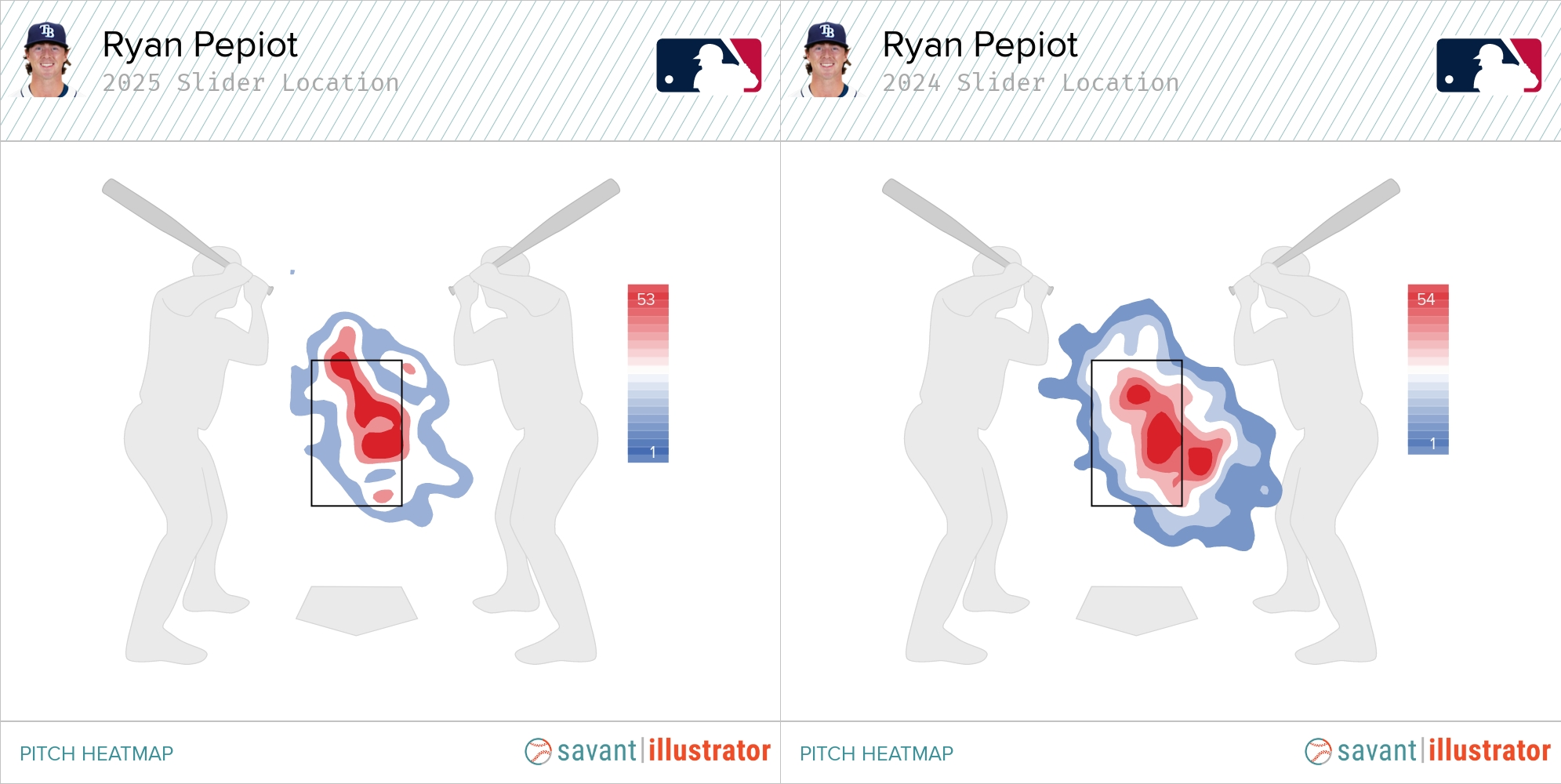
This year, his location heatmap has two significant differences: he’s missing that down-and-glove-side whiff location, and everything is up. Like the fastball again, he’s increased his chase rate on the slider, showing that he still can get whiffs on the pitch.
Pepiot has struggled against righties, and the slider location is a clear culprit. The pitch has a 37.5% hiLoc% against righties, one of the highest figures among starters. This means that even when it gets chased, it’s not in a place for a whiff. His out-of-zone contact rate on the slider went from 48.6% last year (league average) to an absurd 71.4%.
His last main offering, the changeup, has followed a similar fate to his other two primary pitches. Pepiot is now using the changeup in the zone, even if it is not necessarily built to do so. The pitch comes in at 85 mph with phenomenal drop, creating good separation with the fastball. However, the in-zone usage doesn’t come from well-executed locations. It’s in the middle of the zone vertically and uncharacteristically so.
The changeup needs to be kept down for it to succeed, especially against lefties. The swinging strike rate and called strike rate have dropped off this year because the pitch is not fooling hitters into falling below the zone. There’s more opportunity for hitters to recognize that it’s staying in the zone, which depreciates both parts of CSW%. Lefties have also cut their chase rate against the pitch, sapping it of its true power.
Against righties, Pepiot has maintained his chase and whiff rates because he still has one hot zone in a chase location.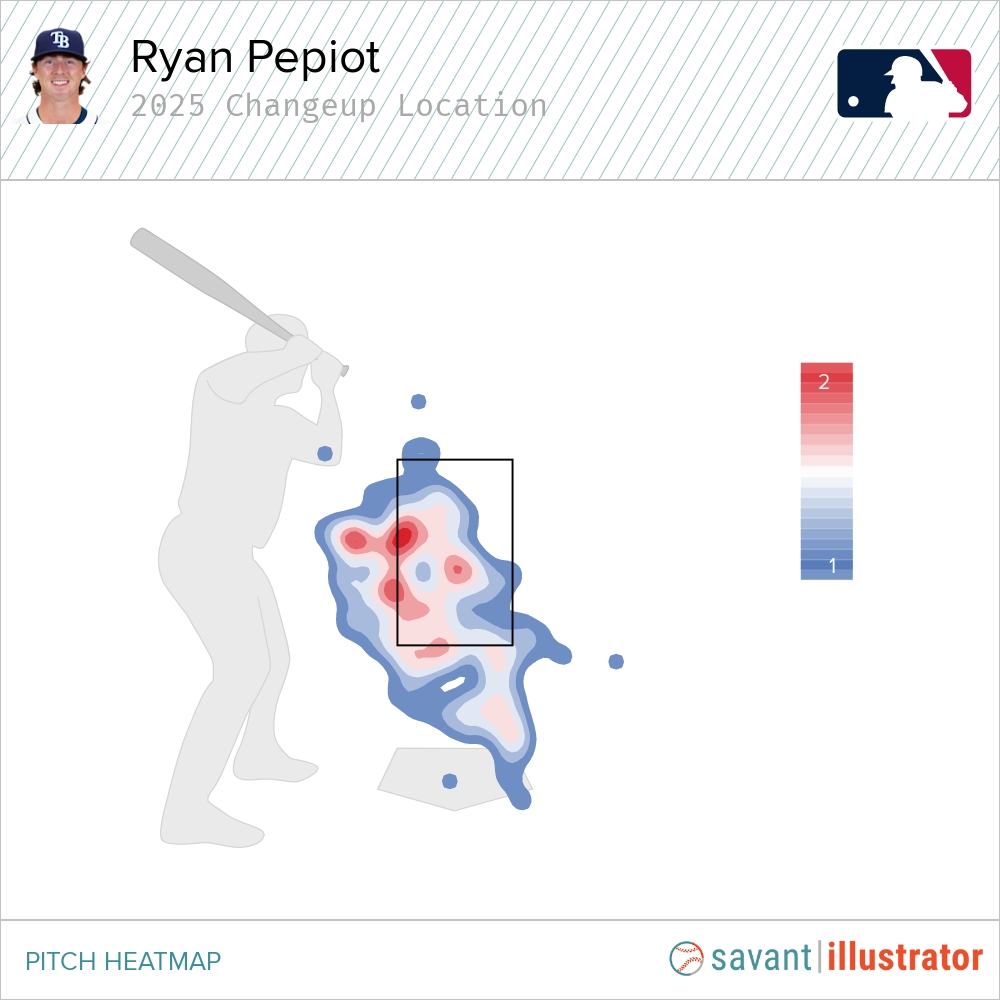
He goes down and away to righties with relative frequency, which still generates consistent whiffs. The middle horizontal location still results in more hard contact, regardless, and that’s reflected in a 47.2% ICR.
Cutter & Curveball
Pepiot also has the cutter and curveball, which are deployed situationally. The cutter is a quality bridge pitch with a significant rise akin to the slider. It has effectively neutralized lefties in results (.125 average), but it’s been located inconsistently and has given up an average amount of hard contact.
The curveball is a pure “show me” pitch, with 71.4% coming early in the count. The problem is that it has a poor 22.2% zone rate, and hitters are not chasing it. This results in a 22.2 CSW%, which emphasizes the low usage.
Going Forward
The pieces are clearly there for the promising right-hander, but the focus on generating weak contact is not working as intended. The only promising peripheral is the 7.3% walk rate, down 1.6% from last year. However, that’s come at an extreme decrease in strikeouts, putting him in limbo about what kind of pitcher he wants to be. Thankfully, he has a solid ERA already. There’s wiggle room to continue to change and find a sweet spot without his season stat totals being in jeopardy.
I’d like to see two things from Pepiot: one realistic and one aspirational.
First, Pepiot should go back to hunting strikeouts. His stuff is still good, and we’re seeing that he can get whiffs when he locates pitches in the right spot. However, that is not happening at the frequency that it should. The slider and changeup both need to be buried to hitters where they can’t touch them, while the fastball needs to return to the edges in order to maximize its rise.
Second, if Pepiot wants to continue focusing on suppressing contact, he should consider adding a sinker. His fastball is getting mashed by right-handed hitters, and his middle-vertical location leaves opportunity for a sinker to saw off hitters.
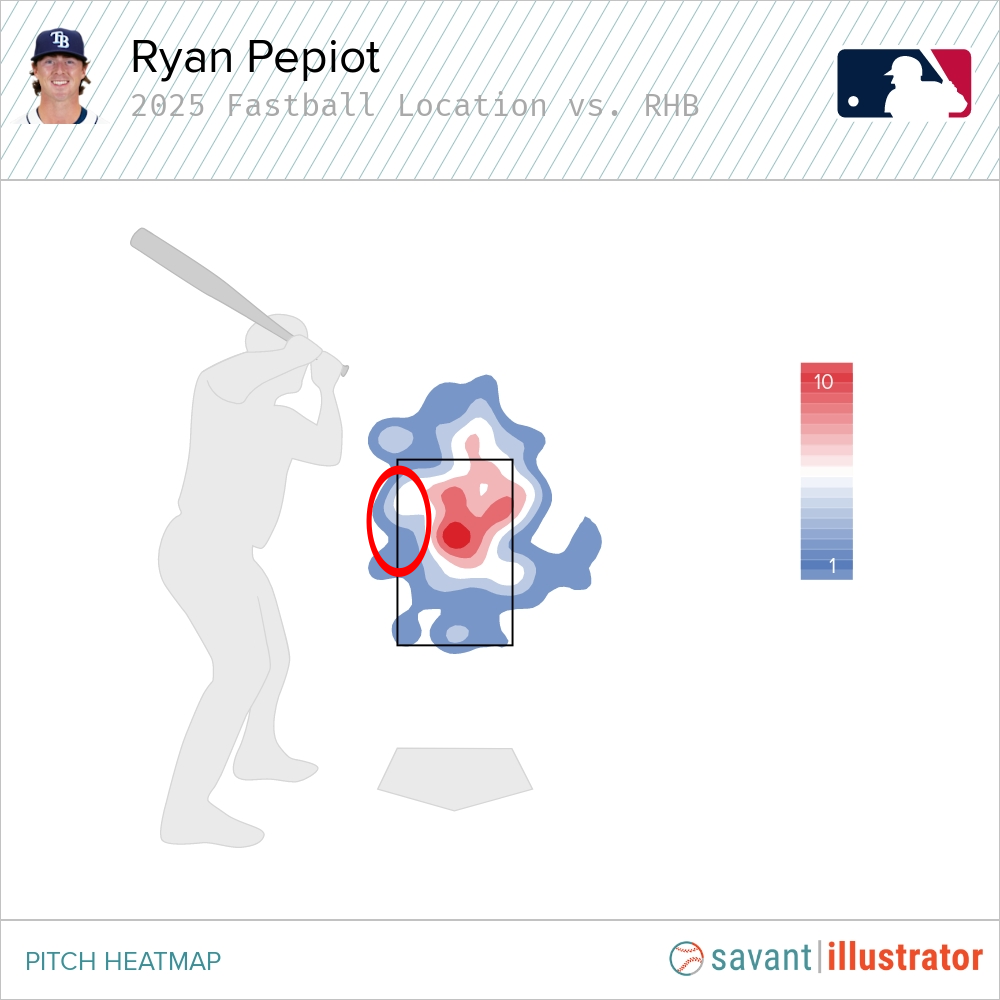
If this is who Pepiot is now, he needs fastball variability. A sinker would provide that and alleviate problems from the fastball, which could turn the fastball back to a whiff pitch, all while he is still focused on suppressing contact.
It’s reasonable to be cautious about Pepiot right now, but the excitement from past performances and the current indicators are promising enough to believe that more success is achievable.
