





Every major leaguer follows their own path, and Sean Burke has had an interesting road to reach this point. The White Sox have pushed him hard every step of the way. It didn’t matter how much he struggled; it was going to be trial by fire at each level of their minor league system. I’ve stated previously that I put exceptionally little stock in MILB statistics for pitching prospects, save for eye-catching outlier numbers, both good and bad. Despite the struggles, Burke had none of those. No, even a 6.27 ERA across 30 starts averaging 4 innings per outing during his time with Chicago’s AAA affiliate in Charlotte is not enough to get me to write a pitcher off. It wasn’t enough to dissuade the White Sox either, who had him start Opening Day in 2025 after an unconvincing 2024.
It went better than expected. He spent most of 2025 in the majors, save a few weeks late in August when he was optioned before being called back up. Across 22 starts and 6 follower outings, he pitched to league-average results with kind of ugly underlying numbers. There were things to like about his arsenal and how he used it, but I’m not sure there were many people that were all in on a Burke breakout this season. Such is the way of pitching development; he made adjustments and got better. Let’s break down why it’s working.
Elevator Shaft
Burke’s 4-seam is a solid foundation for his arsenal, coming in with good velocity and well-above-average vertical movement, even for his release height. He also cuts it substantially, giving it a straighter-than-expected look for his arm angle. I promise that’s a good thing even if you might raise your hackles at the words “straight fastball” given the term’s historical usage.
Burke’s curve stands out more for its fit into his mix than its individual stuff quality. This isn’t to say it’s bad, though; it’s not. Thrown with average velocity, good depth, and a shape that hovers between 12-6 and 11-5, it’s a great pairing with his 4-seam. More on that later.
While he doesn’t kill as much positive IVB as some other pitchers do on their gyro sliders, Burke’s high release point helps to add depth to this pitch as it steepens its VAA. It’s also worth noting that a lot of pitchers who throw 4-seamers with as much IVB as Burke gets on his fastball have the same thing happen with their gyro sliders. They struggle to create that depth with low IVB numbers. This is why it’s also important to look at IVB separation, and the 14.6” of it Burke gets between his 4-seam and slider is just a hair more than average for pitchers with similar arm slots.
As is to be expected from a pitcher with a straight, rising 4-seamer, Burke’s sinker lacks traditional shape, as it actually rises more than it runs. Its movement separation from his 4-seam shows up far more on the horizontal axis than vertical, and it may never be a groundball machine, but it has a place in his arsenal. Again, more on that later.
Cutters are generally more context-dependent, so individual stuff grading for them is kind of pointless without it. Burke’s has enough separation from his 4-seam without blending with his slider. Similar to his sinker and slider, it doesn’t have a ton of depth compared to average, but the higher release and movement of his 4-seam helps it work. It’s a new addition to his arsenal this year, and a welcome one.
Burke’s changeup is a distant sixth pitch after last season seemed to kill his faith in it. It got obliterated when he left it in the zone, and it burned him more than it was worth. This is unfortunate because I like the pitch’s potential if he can get a handle on it. It has good enough shape and theoretical deception, but he just isn’t using it right now.
As you may have gathered from this section’s title, content, and the table, Burke uses a tried-and-true arsenal archetype. Outside of his sinker, his pitches are a pretty pure north-south mix. The 4-seam, cutter, slider, and curve all average less than 6” of horizontal movement. While it takes away some of the advantages of an arsenal with wider east-west movement, everything being so stacked can add to every pitch’s deception. They come out of his hand with a very narrow range of horizontal release angles, keeping them looking the same for longer. This concept applies to pitchers like Cease, Glasnow, and probably most famously to Kershaw.

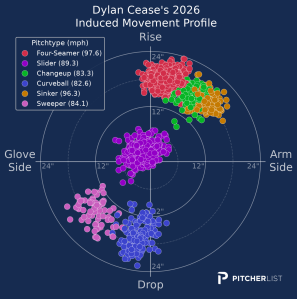
Adding to this is the phenomenal spin mirror between his 4-seam and curveball. Just 11 minutes off from a perfect opposite in spin direction, 3.7 percentage point difference in active spin%, and similar total spin rates, it’s one of the best I’ve seen. These pitches spin about as inversely as is possible, meaning they look identical out of his hand. Even though his curve has a bit of a hump in its flight path, with how he’s using his pitches, they frequently just look like sailed fastballs that wind up bending back down into the zone.
Allow me to speculate for a minute here; I think his delivery helps to mask his pitches too. He’s got a tight arm action with a lot of scap retraction, leading to the ball remaining hidden behind his body for a long time, especially for lefties. This can make it more difficult for hitters to pick up the ball out of the hand as they’ve had less time to follow it directly. This is another thing he does that kind of reminds me of Cease, though I think Burke does it better.
High Stakes
With the last section fresh in our memories, let’s talk about how he’s using that to his advantage. Burke’s command isn’t elite, but it’s getting the job done for him this year, and like everything else with him, it starts with the 4-seam.
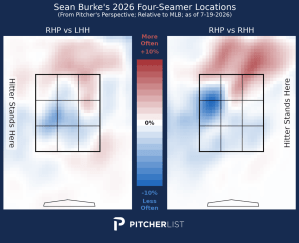
While it’s far from an extreme heatmap, barely registering more than the lightest shades of red, it does indicate that Burke has shown above-average feel for locating his fastball above the zone. This is further reflected in its phenomenal 42.4% chase rate. That ranks fourth-best among all starters with at least 100 4-seamers thrown. This is also elevated by how he’s using his breaking balls.
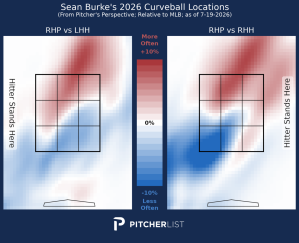
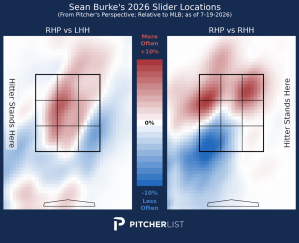
In a normally inadvisable move, Burke is throwing his breaking balls high in the zone fairly regularly, far more often than the league average rate. He’s doing it often enough that I have to assume it’s an intentional strategy. To his credit, as odd as it is, it’s been working. What these two pitches lack in exceptional chase rate, they make up for in called strikes and contact suppression.
There’s certainly some risk involved in this; the higher a breaking ball is, the easier it is for the hitter to get the bat under it. Despite this, Burke has largely avoided getting burned. I’m not sure how long that will last, and I think ultimately I would prefer he shift to more normal breaking ball locations, but he should keep this going for as long as it’s working if it’s what is comfortable for him.
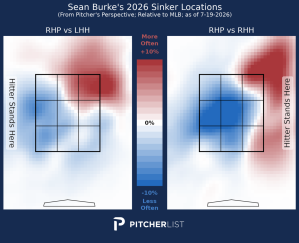
Adding to the list of pitches he throws high more often than average, Burke uses his sinker in a way that seems to be angling toward the best possible tunnel with his 4-seam. He consistently lands this pitch high and off the arm-side, and he gets chases with it. The strategy is sound… but I’m not sure his sinker is the right fit for this. While it works within his arsenal as a pitch that looks identical to the 4-seam out of his hand only to become the only pitch he has that bends significantly to the arm-side, it does not have the stuff quality to be a weak-contact/groundball getter in its current usage.
The problem is that he’s throwing high sinkers with mediocre shape, and the ones that are in the zone are hittable. On top of this, only using his sinker on the arm-side crushes some of its called strike potential. Even with what seems to be good execution of his game plan, the results on this pitch this season aren’t far off from a league-average 4-seamer, except with no whiffs because it’s a sinker. It’s just not what you want.
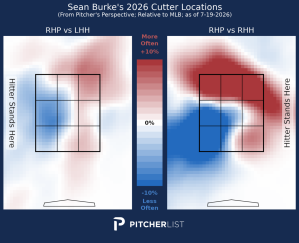
You can ignore the “vs RHH” section; that’s an 18-pitch sample, not enough to be useful on this chart. The map vs lefties is pretty interesting though. He seems to have little interest in trying to jam lefties inside with this pitch, the way most righties would use a cutter. No, he’s been enjoying attacking the arm side, away from them for called strikes, and above the zone for chases to cause whiffs/bad contact. And man, is it ever working.
Cutters so often take the brunt of the damage for a pitcher as complementary pitches meant to boost everything else; it’s really nice to be talking about one that’s used well in its own right. It’s limited usage, I know. 122 pitches isn’t the biggest sample, but it’s working so well, and the logic behind it makes sense too! It fits neatly into the vertical stack of pitches he has without blending with the slider or 4-seam.
More to Offer
While it seems like the month-long stretch from mid-June to mid-July where he was averaging 96 mph with his fastball might have been a mirage, it’s interesting to note how much his velocity fluctuates during games. He tends to build up over his outings, with his lowest average velo coming in the first inning. He also saves his best velocity for the bigger moments when the adrenaline gets going; the 12 hardest pitches he’s thrown this season all came in two-strike counts. His average fastball velocity rises almost a full tick in those situations. I’m not advocating for him to throw this hard all the time; I’m not even sure it’s feasible if it’s a mental thing for him, it’s just interesting.
No, velocity quirks aside, when I say Burke has more in the tank, I mean he has room to grow because what he’s doing right now can be built upon and modified into something better. It’s a lot to ask from a pitcher to develop and modify how they command their breaking balls. I hope that his aptitude for dropping them into the top of the zone can translate into landing them below the zone, where they’d play best. I do have faith it can happen for his slider; he was starting to show some feel for that last year before transitioning to his new strategy.
He already has all the stuff he needs. His up-down arsenal is difficult to hit against, especially for lefties, even without a changeup. And it’s not like he’s running reverse splits; he’s pitching better against righties than lefties right now, as expected. It would be great if he could develop a changeup or modify his sinker, but it’s not a necessity or even a priority right now. If I could make one adjustment, I’d like to see more cutters and fewer sinkers. The way he’s using them, I think he’d benefit from this, even if the cutter saw some diminishing returns with increased workload. While I would eventually like to see his slider, curve, and especially the sinker make their way lower on the pitch plots, I’m excited to see how long he can keep his current plan working. It’s a fun one to watch.
Feature image by Michael Packard (@CollectingPack on Twitter) | Photo by Rich Graessle /Icon Sportswire
