





The Los Angeles Dodgers signed Tanner Scott to a four-year, $72 million deal to be their closer ahead of the 2025 season. A year later, they paid Edwin Díaz $69 million to avoid that same fate.
Scott’s debut season in Dodger Blue was something between unfortunate and untenable. His ERA was nearly three full runs worse than 2024, without the peripherals that made us bullish on Devin Williams‘ path back to prominence. Runaway home run rates ruined his season, but decreased strikeouts and walks suggested that finding the strike zone offered little solace. At the intersection of opportunity and ineffectiveness, Scott’s struggles in the zone helped blow more saves than anyone in the sport.
By October, an ill-timed abscess surgery may have saved Dave Roberts from himself. 2026, though, has been much kinder to Scott, and in the wake of Díaz’s elbow injury, he is headlining one of baseball’s best bullpens. Much of that resurgence can be tied to the success of his slider.
Scott’s “New” Slider
Scott isn’t surprising batters with a new offering or tunneling better than ever before. His pitches don’t have nicknames or top leaderboards.
Stuff models like Scott, sure. But they’ve always liked him just fine, and the improvements year-over-year aren’t staggering. Rather, it’s his new slider’s ability to unlock parts of the plate that is driving these positive downstream effects.
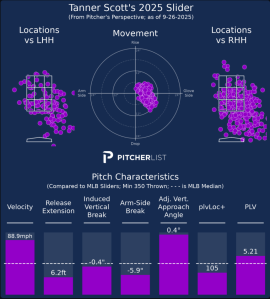
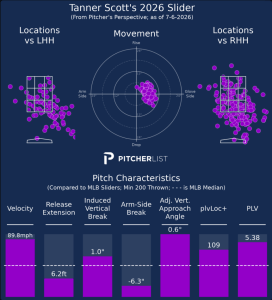
Scott’s slider has added slightly more glove-side movement while trading an extra tick of velocity for significantly less drop. I can’t speak to that movement shift being a consequence of increased velocity or vice versa, but it feels intentional. It’s far more cutter-y than years past, which is reflected in its usage. Scott is zoning it more, returning strikes at a 72.6% clip, and using it more than his fastball for the first time since 2023.
As a two-pitch pitcher, giving his heater more of a break could help it play up. PLV and Stuff+ both like it, and at 96 mph with elite HAVAA, it’s designed to miss bats, especially up in the zone. Last season, Scott’s four-seamer had an average whiff rate, even after an 8.1% jump in pitches up in the zone. A year and a double-digit increase in hiLoc% later, and it’s generating chases and whiffs at significantly higher rates.
Still, Scott’s fastball is nearly identical to last season. Yet, he’s locating both pitches better, which might be a result of throwing a harder, tighter breaking ball. His release points overlap more this season—a difference that might not matter for tunneling but does make for more repeatable mechanics.
We can also appreciate the damage Scott’s new slider has helped mitigate. There’s some batted-ball noise to deal with, but his breaker is both an out pitch and a path to soft contact, whereas his fastball is still searching for 2024’s damage suppression. Taking away some vertical movement has led to a marked increase in fly balls and pop-ups, and while the average exit velocity has stayed consistent, batters haven’t yet squared it up in the air. He’s yet to allow a barrel on it, and despite a career-high launch angle, none have left the yard.
Scott is running hot with good fortune and under-the-hood improvement, earning his luck by making hitters uncomfortable. With better command and less drastic break, Scott has unlocked the outer two-thirds of the plate to right-handed hitters. A season ago, those righties took his slider to the opposite field on 9.8% of batted-ball events. That number has jumped to 45.5% in 2026.
Slide Away
The biggest difference between Scott’s breaking ball locations is his willingness to wean off the backfoot slider.
To some extent, it will always be there as an opposite-handed offering with good glove-side movement. But if he’s throwing fewer of them, those sliders have to go somewhere, and right now, they’re landing in competitive locations on the arm-side part of the plate.
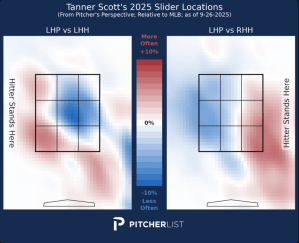
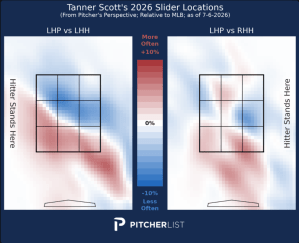
In not chasing whiffs, Scott is finding the zone more and wasting fewer pitches. Despite a slight increase in middle-middle pitches, his mistake rate on sliders has been (nearly) halved, and the strikes haven’t been punished.
PLV agrees. Quality stuff is its own form of damage suppression, making it more profitable to throw elite pitches in the zone. Scott’s slider is firmly in that bucket, and his newfound precision is being rewarded by his willingness to challenge guys.
Scott has seen a 4.8% increase in quality pitch rate with a 4.2% decrease in bad pitches (by PLV). Trading one for the other has raised his Q-BP% to the 91st percentile, the closest he has come to his 2024 dominance.
The opposite is true for his four-seamer, raising the possibility that something other than the fastball is responsible for its performance.
Unsurprisingly, throwing more “good” pitches in the zone has been beneficial. From a plate discipline standpoint, Scott has hit the trifecta: more chases, more in-zone whiffs, and more called strikes. Once again, this is largely driven by his slider.
Unlike last season, when Scott’s shrinking walk rate turned into an influx of damage, a continued increase in strikes has predictably bred success. Operating with the best K-BB% of his career, there’s an argument to be made that Los Angeles has the best version of Scott in its bullpen.
Relievers Are Weird
For all the predictive power in K-BB%, the natural skepticism for Scott’s season lies in the volatile life of a reliever.
There is little use in projecting the next half-season of any reliever, much less one pingponging between the ire and good graces of the Dodger faithful. And while Scott is earning better luck (well deserved after giving up a homer on a third of his fly balls), he is still outperforming his expected statistics by at least 20 points.
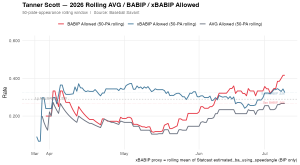
Furthermore, Scott may be walking a similar tightrope to his closing companion, Díaz. The latter needs his fastball to play like an 80-grade pitch to be successful. Scott, in a career-long battle with his command, has already seen how quickly things can unravel. He’s made tangible, and presumably intentional, changes to his slider to fend off that regression. What happens if he gives back some of those gains?
One area where this fault line might tremor is the long ball. We can be confident that his National League-leading HR/FB% isn’t real. But at 18.2% this year (45th percentile), he’s still doubling the marks from his best seasons. In 2024, his Pull Air% fell to 5.8%, easily within the top decile of pitchers. When his home runs skyrocketed last season, hitters were pulling the ball in the air at a 20.5% rate, the complete opposite side of the spectrum.
Scott has only given up four home runs this season (none on his slider), but opponents are still pulling the ball in the air 18.8% of the time. It’s worth attributing some of that fortune to the contact quality of his slider—soft fly balls are good news—but only with so much certainty. Again, relievers are weird.
Scott is currently getting outsized results from a minor stuff change. He’s throwing a slider that moves differently than before, throwing it to new spots more often, and reaping the benefits. For now, it’s an approach that puts him back among the pantheon of elite relievers, and a top option for October. How long that lasts could be the defining factor of Los Angeles’s playoff pitching staff.
Photo by David Dennis | Adapted by Parker McDonald (@CarbonFoxGFX on Twitter/X)
