





The Texas Rangers are right on schedule. They just aren’t going anywhere fast.
Texas entered Wednesday at 60-60, trailing the Houston Astros by a half-game that feels much larger. They began the year with a coin-flip chance at playoff contention. In the middle of August, those odds have held firm. But the Rangers stood pat at the deadline after shopping Jacob deGrom and other hefty contracts.
The Rangers are spiritual sellers, despite their inevitable trek toward 81 wins. They’re generating just a little too much WAR to fall out of things, thanks to the resurgence of Joc Pederson and the pesky breakout of Ezequiel Duran.
Duran, in his fifth big-league season, leads the team with 3.5 fWAR, putting the prefix in superutility and giving Texas innings at every non-catcher spot on the field. He’s been superb, and as the Rangers turn part of their attention to 2027, he’s making his case as a cornerstone.
However, Duran doesn’t check all the boxes we expect from an emerging star. I’m not quite sure what to expect from Duran in the long term, so I’d like to walk through my thought process in hopes of making a reasonable projection.
Duran Looks Like a New Man
Simply put, few players are experiencing a year-over-year improvement as great as Duran. His wRC+ has improved by 60 points, from 57 to 117. His 3.5 fWAR is 3.5 more than last season’s 90 replacement-level games. He has blossomed into an elite defender, changed his strikeout and walk rates for the better, and improved his expected metrics across the board.
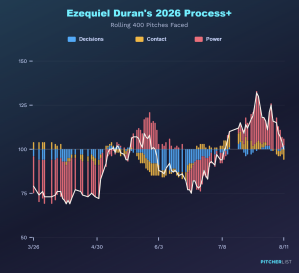
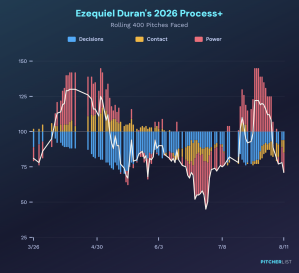
His summer-long hot streak is captured well by Process+, and he certainly looks like he’s playing the best ball of his career. However, Duran’s production has been steadier than his process-based path to getting there. A June slump (75 wRC+) stunted his progress, but he’s posted wRC+ marks between 122 and 140 in every other month this season.
My first instinct was to do a sanity check on his batted-ball luck. Running a .330 BABIP caught my eye, especially compared to a .298 xBABIP. But neither Duran’s norms nor skill set suggest he’s getting very lucky, as he owns a career .325 BABIP and boasts 89th-percentile sprint speed. He’s the type of profile that’s supposed to run hot on flares, burners, and infield singles, and his BABIP has always exceeded its expected counterpart thanks to his speed, the steadiest part of his game.
I’m more intrigued by the sudden influx of power; he’s hit 13 home runs through 111 games this season after being shut out last season. Yet, he’s not outperforming his xSLG by some crazy margin (per our model), and finding extra bases with his legs has generally had a similar impact to his BABIP. Still, Duran is slugging over 150 points better than last year. That has to come from somewhere, and it isn’t necessarily all in his bat speed. While that has improved from 71.5 mph to 72.7, helping boost his average exit velocity by 5.3 mph, his bat acceleration—the ability to swing harder across a shorter distance—shows more improvement.
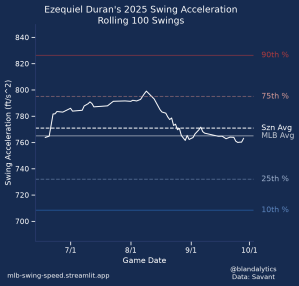
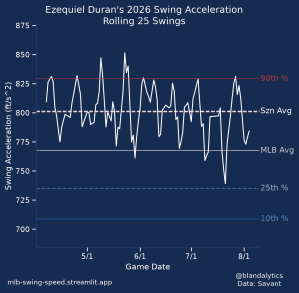
Duran’s bat accelerated at about 770 ft/s^2 last year, hovering around league average. That mark is over 800 ft/s^2 in 2026, thrusting him to the 75th percentile and allowing him to better retain his potency with a shorter swing. Anecdotally, this should help buy him a couple of milliseconds of breathing room while also helping his power play up.
One area where this is likely showing up is in his batted-ball distribution. Duran is hitting the same amount of line drives as last year, but he’s popping up far less and trading those outs for grounders (where his speed wins) and fly balls (explaining some of the power surge).
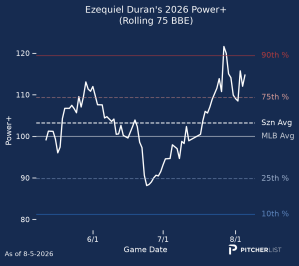
Seeing the ball better is nice, and actualizing his better plate discipline will yield better results. But the last time Duran looked like a legitimate power threat, in 2023, he was pulling far more of his fly balls, hitting it harder in the air, and touching higher-end exit velocities. If he’s getting luckier anywhere, it might be in the 20.3% HR/FB rate, which is magnitudes greater than the past two seasons and in line with 2023, despite an unoptimized spray angle.
There’s a chance that Duran’s power is less sustainable than the Texas faithful would like, and Baseball Prospectus’s suite of deserved stats seems to agree. His DRC+ (Deserved runs created plus) of 93 throws cold water on Duran’s hot summer—although it remains a significant jump from 65 last season. Duran’s DRC+ in 2023 was identical to this year, so BP didn’t believe the first rendition of this breakout, either. Even if these power gains are more emblematic of a hot streak than a true redefinition, Duran has left a lesser version of himself in the dust.
See Ball, Hit Ball
I find it helpful to think of baseball through the lens of pie charts, heatmaps, and normal distributions. A hitter chasing down a batting title is probably having a right-tailed outcome for his true talent, with hits taking up a larger piece of his hypothetical plate-appearance pie chart. Likewise, he’s probably getting the barrel to the ball just a little more than last year, and getting a little luckier, and making slightly better swing decisions. We don’t need Andrew Friedman to tell us that you’re more likely to get a hit in a 2-0 count than 0-2, and that swinging at strikes is better than swinging at balls.
Subsequently, variance can often be reflected in the nudging of these pie charts. And this year, Duran is putting himself in much more lucrative spots by overhauling his plate discipline, especially in the zone.
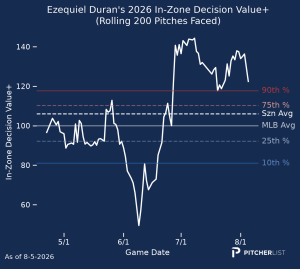
I don’t know how this happened. But if it comes out later this year that Duran got new contacts, I wouldn’t be surprised. This stark of an in-season change, without a real fluctuation in playing time, is absurd.
Given Duran’s speed and flashes of power, the Rangers should want him to put the ball in play more often. While he’s swinging at more strikes, he’s completing the trifecta by laying off the bad stuff and not sacrificing walks. As such, Duran’s 60 points of OBP improvement is far less surprising than it might seem.
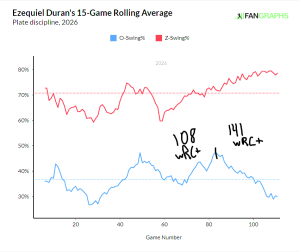
For the first time in his career, Duran’s Z-O-Swing%, a helpful proxy for plate discipline, has cleared 30%. It has improved significantly from last year’s mark of 25.7%, and it’s his best since—you guessed it—2023. Every hitter is better with an advantage, but this seems especially true for Duran. His Process+ in hitter-friendly counts has improved dramatically throughout this season, a development driven solely by his power. He’s getting to more advantageous counts, swinging at the strikes pitchers are forced to give him, and taking full advantage with some rediscovered pop.
In pitcher-friendly counts, we see that he’s more prone to bad decisions, at times trading contact for the chance to do damage. Like the rest of the world, it’s a lot less pretty than when he’s dictating the terms of engagement.
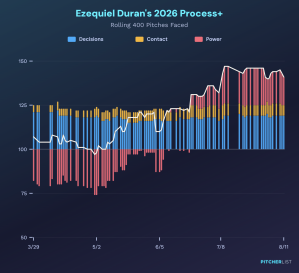
So, we know that Duran is human and playing better in accordance with his environment. If he’s not getting to those advantageous counts more often, though, it doesn’t really matter how well his bat plays in them.
Duran isn’t really owning the first pitch of the at-bat; his F-Str% is in the 94th percentile, he hits the first pitch into play at an average rate, and he’s happy to take a fair amount of called strike ones. But by limiting his putaway rate and making better swing decisions in the middle of his plate appearances, he’s shifting the odds in his favor.
Once again, Duran is thriving, looking like a totally different player than last year’s lost season and setting a new personal best. He’s getting on base 6.1% more often than last year. When the difference between the top and bottom of the (qualified) OBP leaderboard is just 18.4%, that change is massive.
On balance, neither Duran’s contact nor power strays that far from average. In any given season, either trait could dip below the median. Despite lacking truly exceptional plate discipline—his chase, walk, and strikeout rates are all below average—he has done enough to move the needle on his reality as a pro.
Projecting What’s Next
I’m fairly comfortable saying that this version of Duran is the best we’ve seen, regardless of whether the power numbers are a little fake or the looming threat of recency bias quickly erases the work of his mid-summer swing.
However, there’s a good chance that this is peak Duran, rather than a launching point for true stardom. There’s not a ton to suggest that Duran is a true-talent 117 wRC+ bat. His Process+ is still within spitting distance of league average, and his DRC+ remains unimpressive. Pitchers haven’t had a chance to adjust to his new approach, and his exit velocities don’t lend themselves to exceptional damage or homer rates. The physical tools are fine, but not special, either. Thus, believing that Duran’s bat is as good as it currently looks is an assertion that his plate-discipline gains are sustainable, and that he can continue toeing the line of chasing somewhat frequently without giving back either of his strikeout or walk wins. Doing so with 49th-percentile Z-contact feels ambitious.
Yet, Duran’s ability to flip the script on his decisions makes me optimistic that the trough of 2024 and 2025 isn’t coming. This is a different player than the one who popped in 2023, one who is more likely to find himself ahead in the count and more ready to do damage in those spots. He’s regained the swing acceleration from that season and paired it with better intangibles at the plate. The next hurdle, if not sustaining this streak, will be re-optimizing his batted-ball spray. That, too, comes with questions, especially if a change in approach mitigates opportunities for his speed to pick up extra bases.
That speed also factors into how we should project Duran’s WAR moving forward. Balancing regression and his current skill jump makes a 100-110 wRC+ feel reasonable. Attached to what looks like elite defense at shortstop, along with the versatility to play trustworthy defense across the diamond and the speed to add value as a baserunner, the Rangers aren’t relying solely on his bat to make an impact.
Duran will likely end the year north of 4.0 fWAR. I wouldn’t project him for that in 2027, but he’s flashed enough to get starter-level playing time and has the tools necessary to make good on most of his 2026 improvements. If he settles into a 2.5-3.0 WAR player, Texas has a first-division regular on its hands, and one they trust to play everywhere. That’s a win for the Rangers, even if Duran heeds the call back toward league average.
