





Hello and welcome back to using PLA to evaluate pitchers! This series uses PLA, along with other run expectancy metrics, to break down results and better understand the process behind them.
This week, I will be taking a look at a few starting pitchers bound to be key to their team battling for a final Wild Card spot. For some more details on PLA and what goes into PLV scores, be sure to check out Nick Pollack and Kyle Bland’s breakdown here.
Michael Soroka
Prior to a couple of IL stints during the summer, Michael Soroka has made 18 starts for the Diamondbacks in 2026, pitching to above-average results in a high-offense NL West. Soroka projects to return from the IL this week against Kansas City and could be key to the Diamondbacks sneaking into the playoffs.
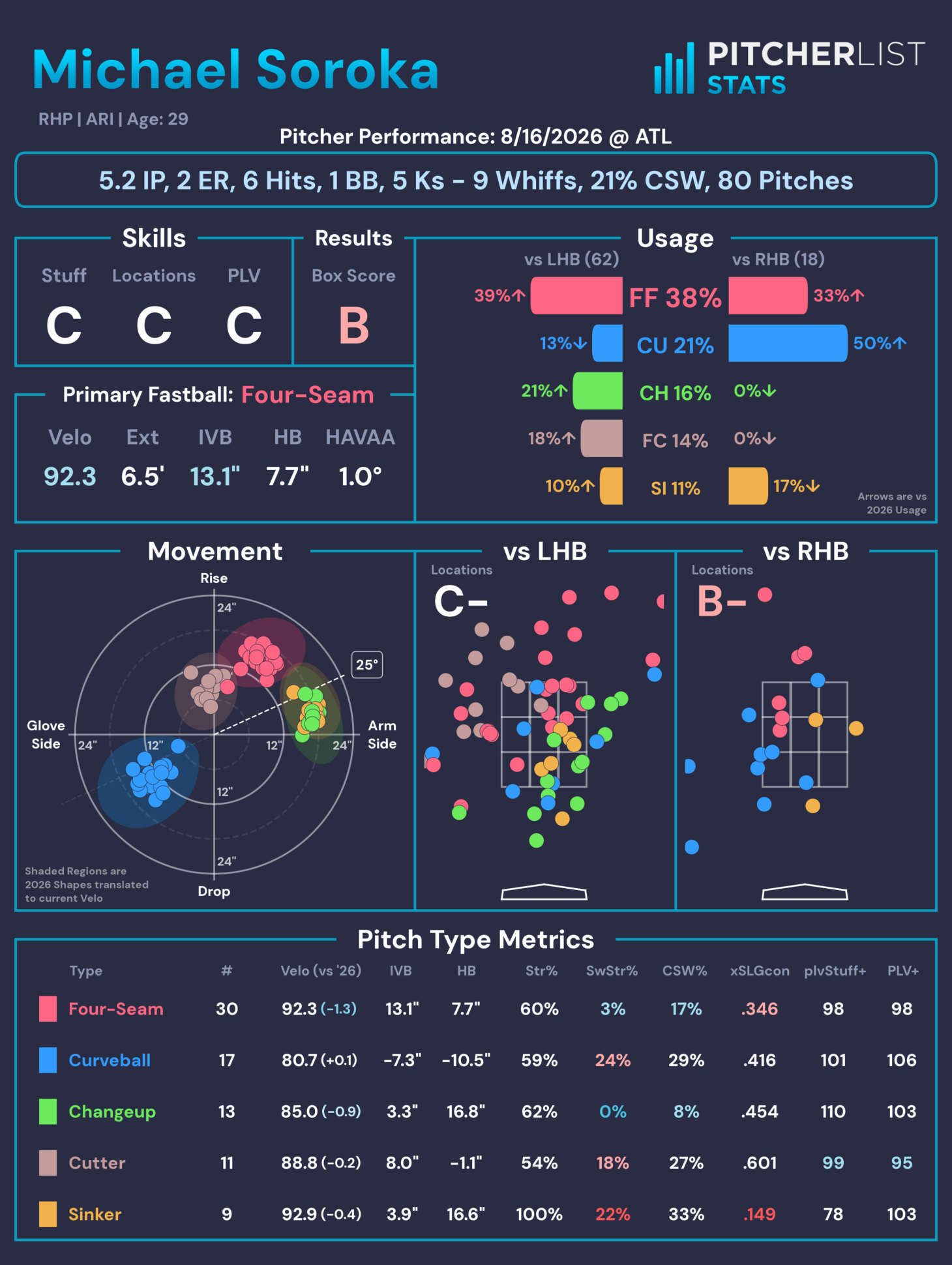
In his second-to-most-recent start, Soroka used a five-pitch mix led by a strong curveball and solid execution across the board to limit a lively Braves lineup to two runs in 5.2 innings. Despite averaging ~92 mph on his four-seam, Soroka’s trio of fastballs and solid changeup gives him a complete arsenal to complement his unique breaking ball.
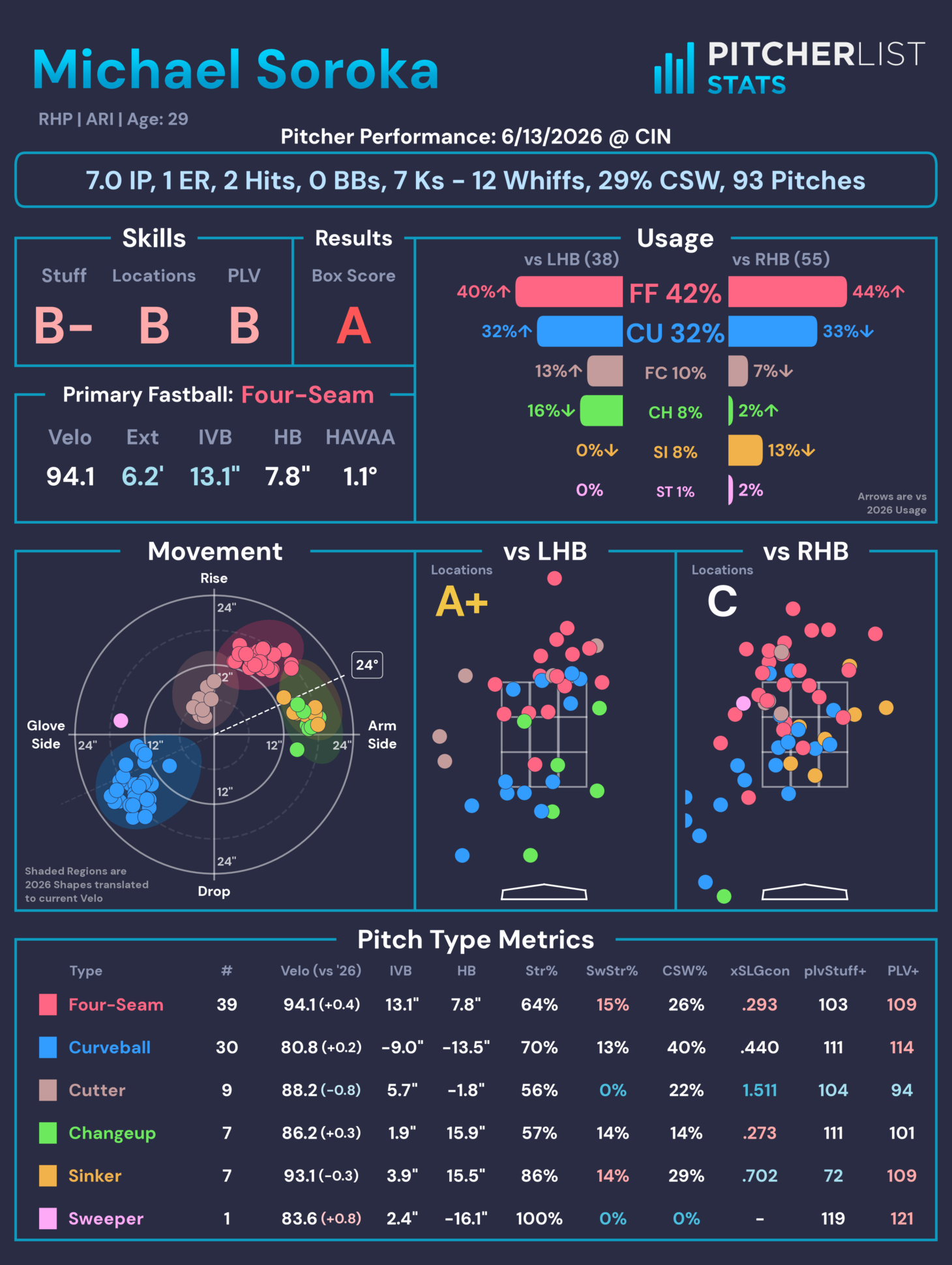
Prior to his first injury, one of Soroka’s best starts saw him go seven innings without a walk and just two hits in the hitter-friendly Great American Ball Park. His primary fastball, sitting 94, proved to be the difference maker in this outing, consistently executing at the top of the zone while his two-plane curveball worked at the bottom (and top on occasion!).
At his best, Soroka’s four-seam/curveball separation and pristine command do enough to generate excellent PLV scores. Having a deeper arsenal has allowed him to work through lineups without his best stuff, leading to an excellent 2.95 FIP and solid 3.44 PLA while averaging over 5 innings/start.
To topple the Padres for that last NL wild card spot, look for Soroka to return from injury with his June stuff and give a fairly shallow Diamondbacks rotation the last bump it needs to support a strong lineup and bullpen. While Soroka’s been limited from working deep into games after a few years of injury, he has the upside of one of the more efficient starters in baseball.
Joey Cantillo
Joey Cantillo has quietly been one of the Guardians’ most consistent starters, pitching every fifth day behind the surging Gavin Williams and Parker Messick in an underrated Guardians rotation. After an impressive 2025 breakout season, where Cantillo worked in a hybrid starting/relief role, Cantillo has settled into the Guardians’ rotation in 2026 despite averaging less than 5.0 IP/start.
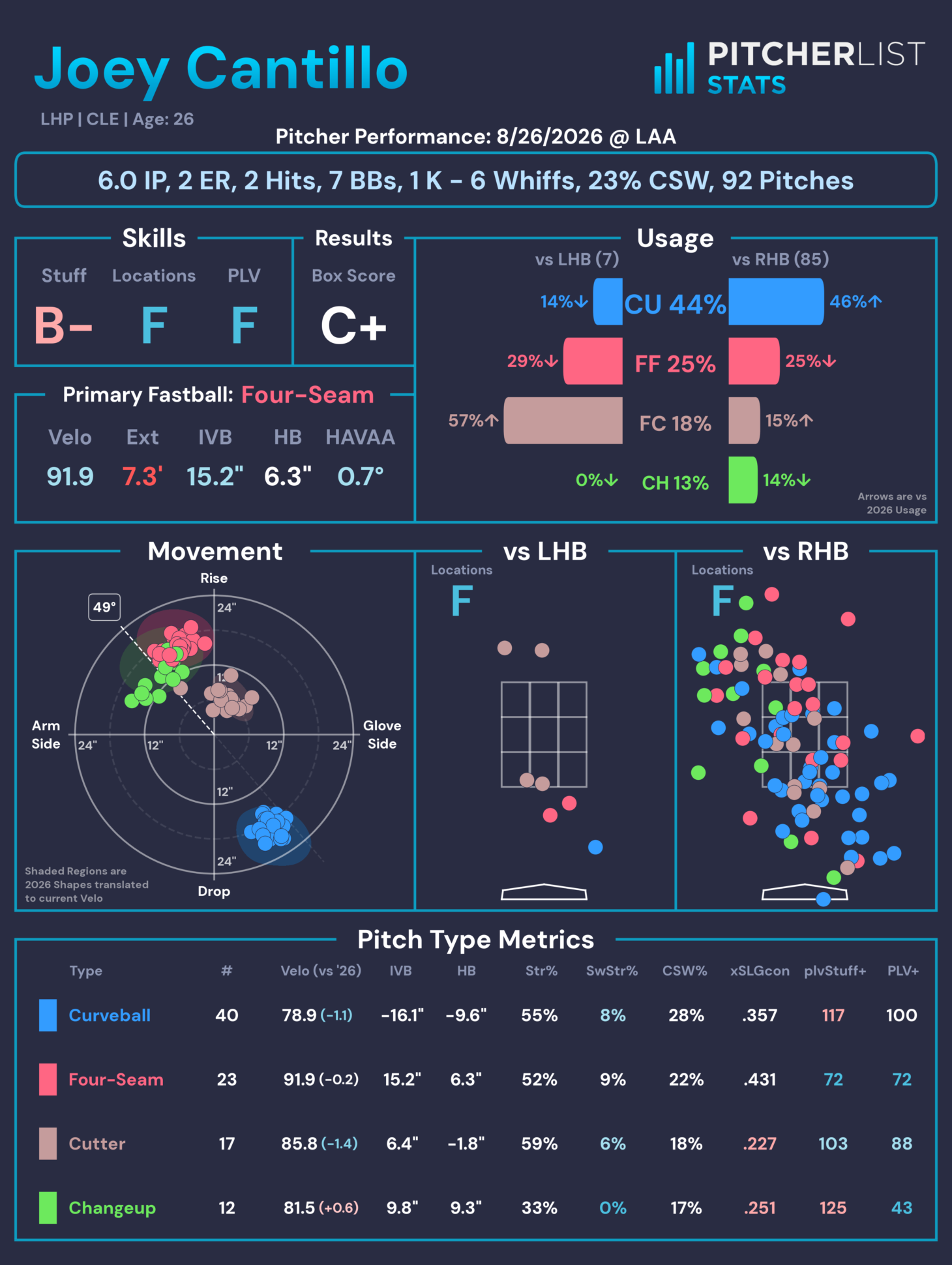
In his second-to-most-recent start, Cantillo’s strong curveball led the way while he struggled with command, walking seven batters to just one strikeout. This has been a recurring problem late in the season for Cantillo, walking at least two batters in five of his last six outings. Without consistent execution, his poor four-seam becomes all the more hittable.
Still, Cantillo’s nasty changeup and decent enough cutter gave enough different looks to limit the damage and give Cantillo a quality start. Even with such poor command, Cantillo’s elite extension helps his four-seam play up and create more deception in his changeup, while his curveball remains his go-to.
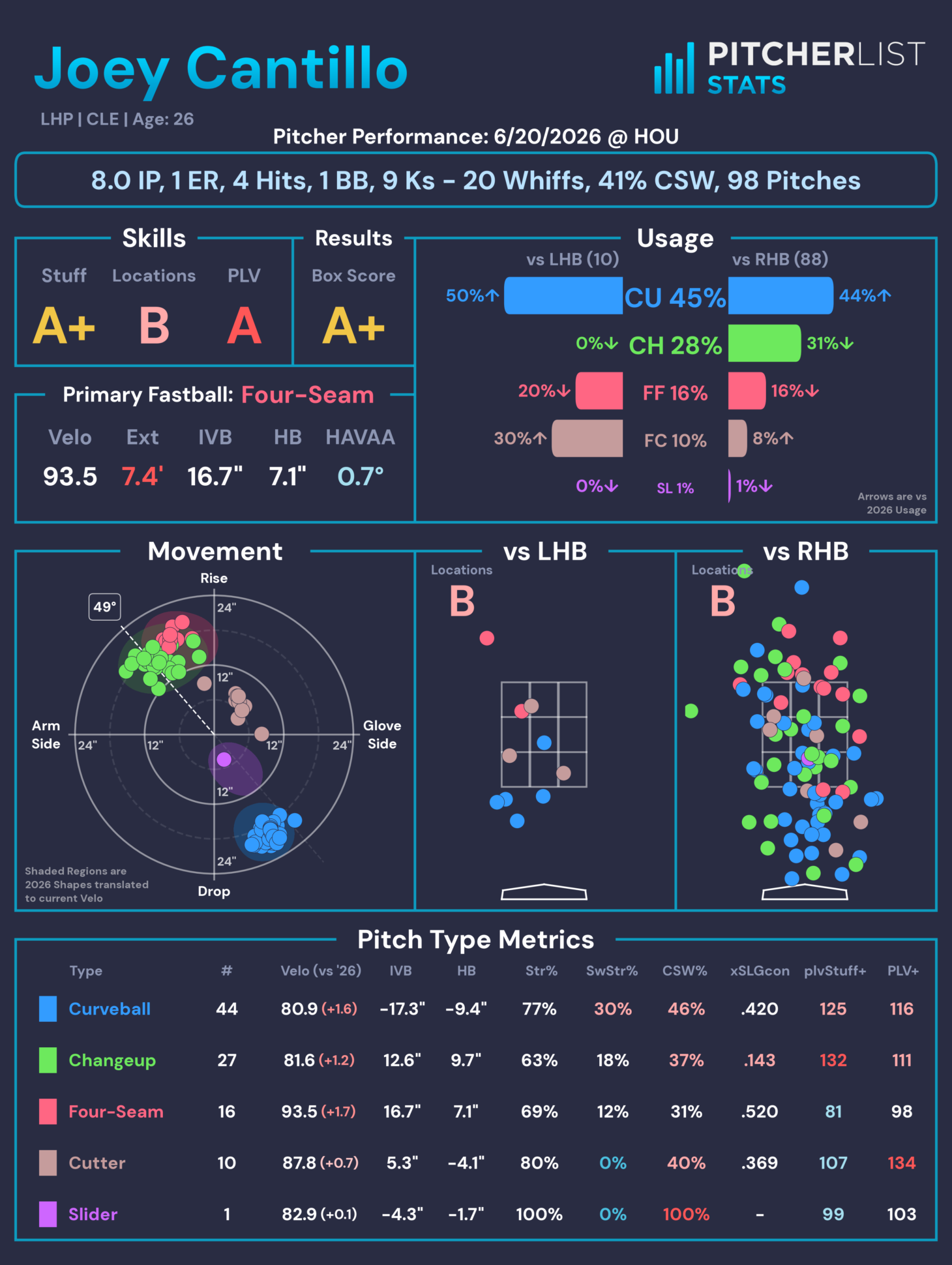
In his best start, Cantillo dominated the Astros in Houston, as his elite curveball and evil changeup created a nightmare for righty hitters. With nearly seven and a half feet of extension, Cantillo’s four-seam and cutter were also solid offerings on the night.
Overall, Cantillo’s 3.63 PLA is mediocre and reflects his decent stuff paired with inconsistent command. Starters with a primary curveball have historically struggled with consistency, and while having a strong changeup helps, Cantillo will struggle against elite lineups without a decent enough fastball. Look for Cantillo to finish the season strong and help the Guardians sneak into the playoffs.
Kumar Rocker
Kumar Rocker has had a strange 2026, working either as a brief starter or following an opener throughout the season in the back of the Rangers’ rotation. After struggling mightily in 2025, Rocker’s settled into some more consistency, but still remains below average in terms of run prevention.
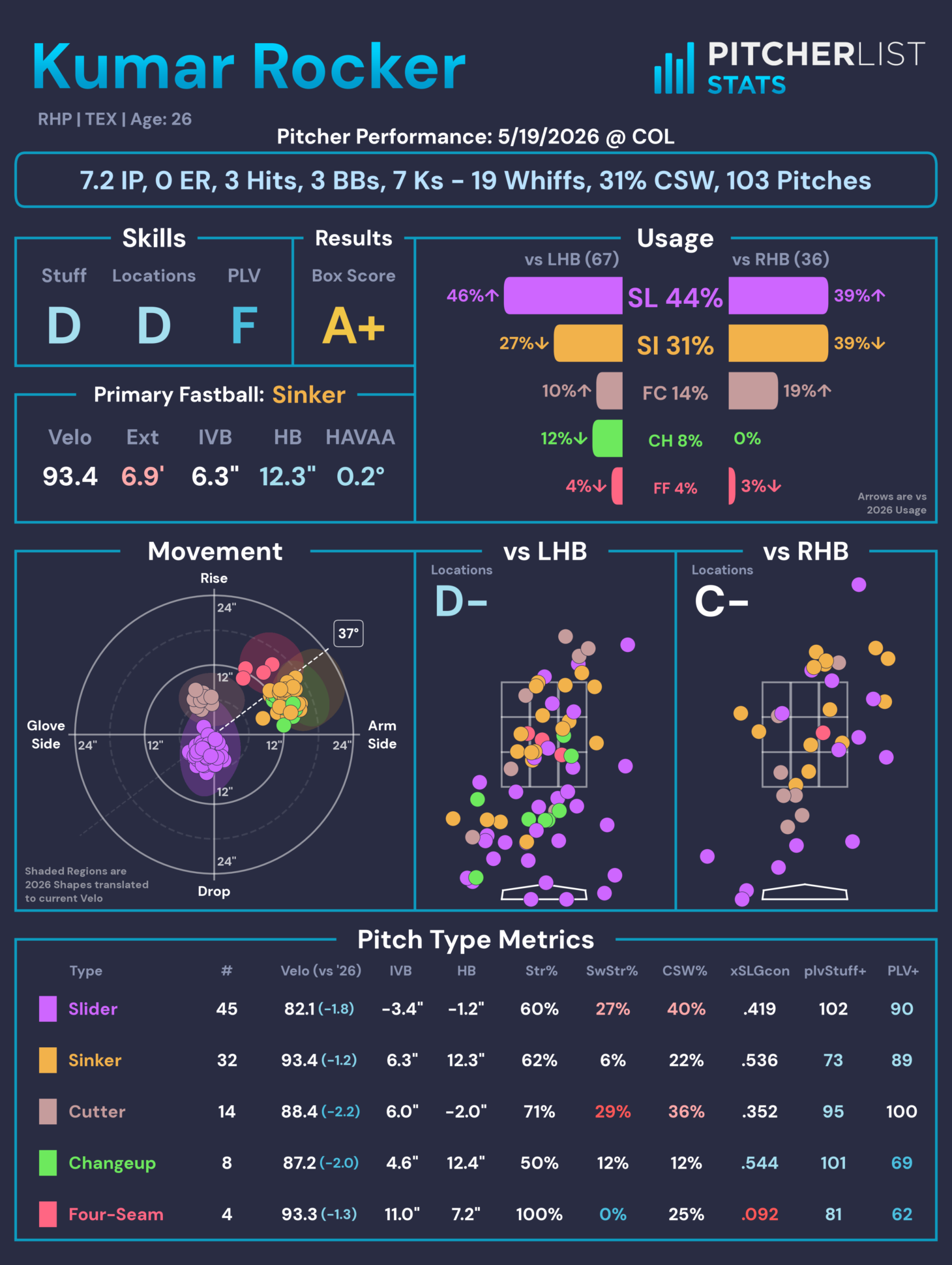
Somewhat shockingly, Rocker’s best outing of the season came in Colorado following an opener. Despite his stuff being nerfed by the high altitude, Rocker took some velocity off to consistently locate his “death-ball” slider below the zone and fill up the zone with his sinker-cutter pairing. This slider is perpetually key to his success; its unique shape helps his underwhelming fastball shapes play up in-zone while getting chases with the death ball.
On the season, Rocker’s been consistently decent at just about everything, but hasn’t necessarily stood out at anything in particular. As reflected by his poor 4.15 PLA, Rocker’s best pitch has thrived out of zone, generating a 62% strike rate despite being in-zone just 36% of the time. This, combined with its low spin and unique shape, hurt its PLV grade.
A four-seam/cutter/sinker trio of fastballs, like Soroka, allows Rocker to function otherwise, although their shapes (mostly cutter/four-seam – sinker usually isn’t that bad! just thrown too much) leave much to desire. To provide valuable in the playoffs, Rocker would likely switch to more of a relief role and hopefully add a couple ticks of velocity. His upside remains very intriguing, although the role in which Rocker will succeed in remains to be seen.
