





Hello and welcome to week six of using PLA to evaluate pitchers! This series uses PLA, along with other run expectancy metrics, to break down results and better understand the process behind them.
This week, I will be taking a look at three more veteran starters off to strong starts in 2026. For some more details on PLA and what goes into PLV scores, be sure to check out Nick Pollack and Kyle Bland’s breakdown here.
Mitch Keller
Mitch Keller has been great so far in 2026, pitching to a career-best 2.87 ERA through his first eight starts while averaging ~6 IP/start. Keller, a mainstay of the Pirates’ rotation throughout the 2020’s, has flashed his best command yet while his stuff remains solid.
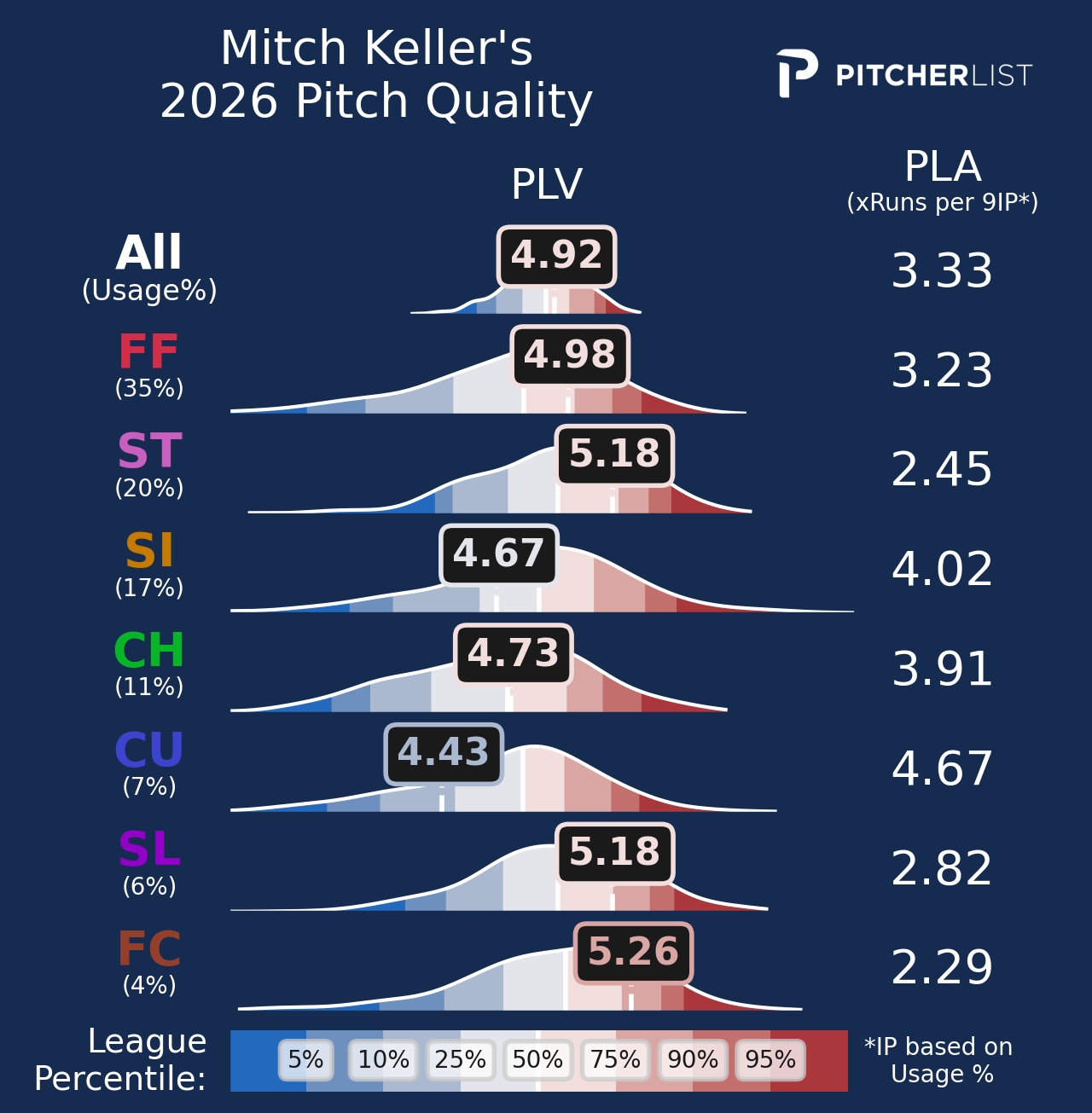
Keller, a former top prospect before settling into a mid-rotation role for the Pirates, has since lost some velocity and refined his pitch mix. Sitting mid-to-low 90s on a four-seam and sinker, Keller now owns a seven-pitch arsenal and functions more as a finesse pitcher, limiting hard contact while maintaining an above-average walk rate.
Against righties, Keller goes almost exclusively four-seam/sinker/sweeper and has pitched to a comically good .123 AVG/.123 SLG against. Lefties, however, have a .257 AVG/.381 SLG, striking out less and generating more hard contact.
Keller’s PLA of 3.33 is firmly above average, but his individual pitches have some varying grades. His slider/sweeper/cutter all boast high grades thanks to their solid velocity and movement, while being thrown on the corners pretty frequently. His curveball has a far lower grade, likely due to its 32.7% zone rate, yet it runs a strong 24.5% called-strike rate and above-average movement.
Keller’s success has come down to his fastballs, with his four-seam especially performing great. However, his .158 BA/.228 SLG allowed on the pitch are far better than its .290 xBA/.472 xSLG. In addition, a 4.4% home run to fly ball rate and .246 BABIP are both easily career bests and likely warning signs of regression. Keller will look to keep mixing pitches and avoid the long ball in his next start at home against the Rockies.
Ranger Suarez
Ranger Suarez has had a strong start to his Red Sox career, pitching to a 2.77 ERA through his first seven starts and first of five seasons in the American League. A new coaching staff has helped Suarez refine his pitch shapes while retaining low walk and home run rates.
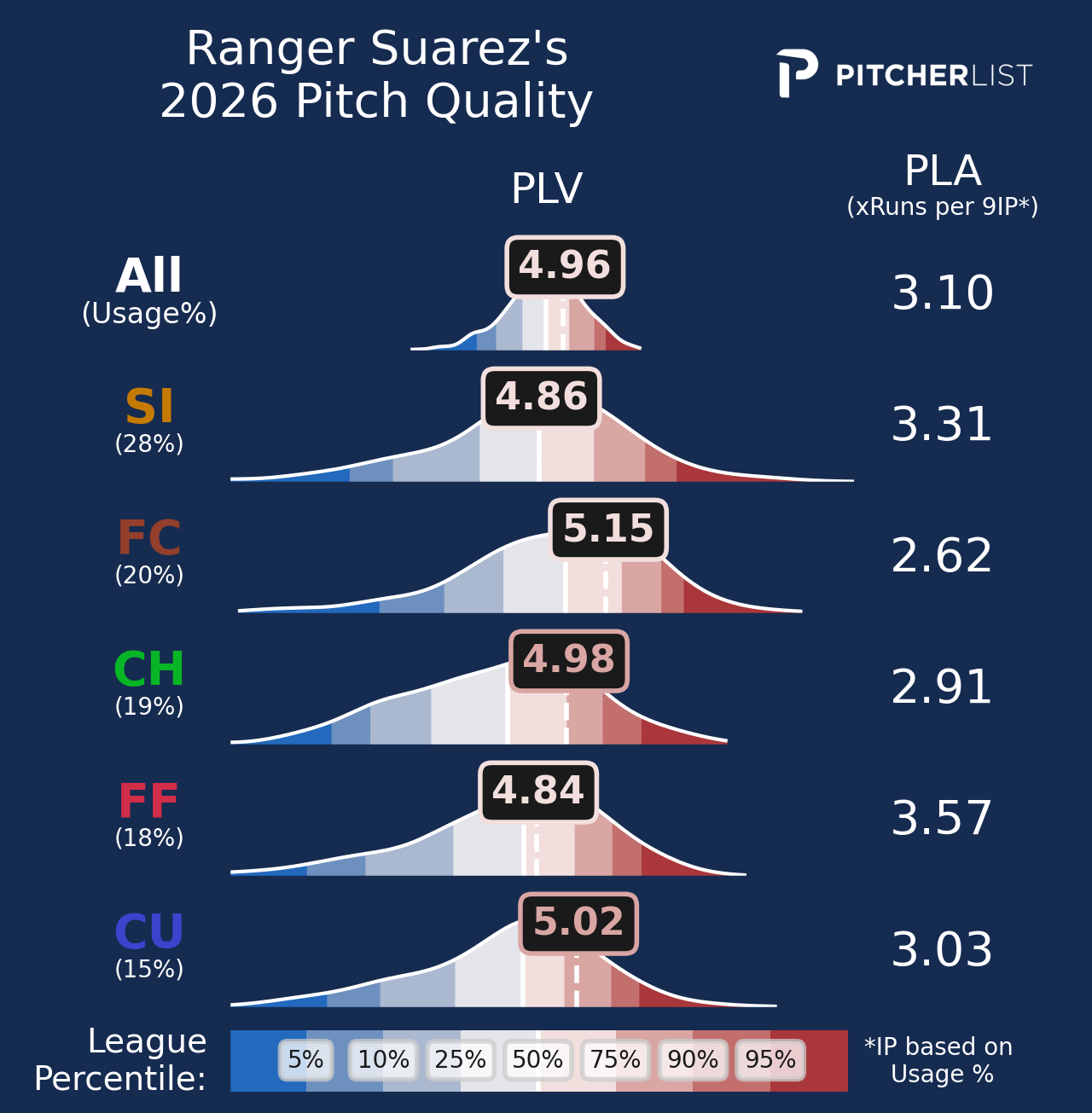
With five pitches boasting above-average PLV grades, here are some changes to his pitch shapes that have helped these scores:
- CH – -1 iVB and 2 mph harder – more fastball separation
- FF – -1.5 horizontal and +2 iVB – less swing-and-miss but elite 27.2% called strike rate
- CU – -1.5 iVB and 1.5 mph harder – in zone far less but still running high strike rate
These changes have helped Suarez thrive despite a career-low 36.2% ground-ball rate and his lowest strikeout rate (21.6%) since 2021. However, there are some concerns with his career-low BABIP (.233) and his lowest HR/FB rate since 2021 (7.9%).
This likely contributes to his SIERA (3.94) and xFIP (3.64) being a bit higher than his 2.77 ERA/3.10 PLA, but still fall above-average. Look for Suarez to keep dealing and continue limiting hard contact in his next start against the Phillies, his former team, in Boston.
Michael Wacha
Michael Wacha has also excelled thus far in 2026, further adapting his arsenal to account for lower velocity while retaining his elite changeup.
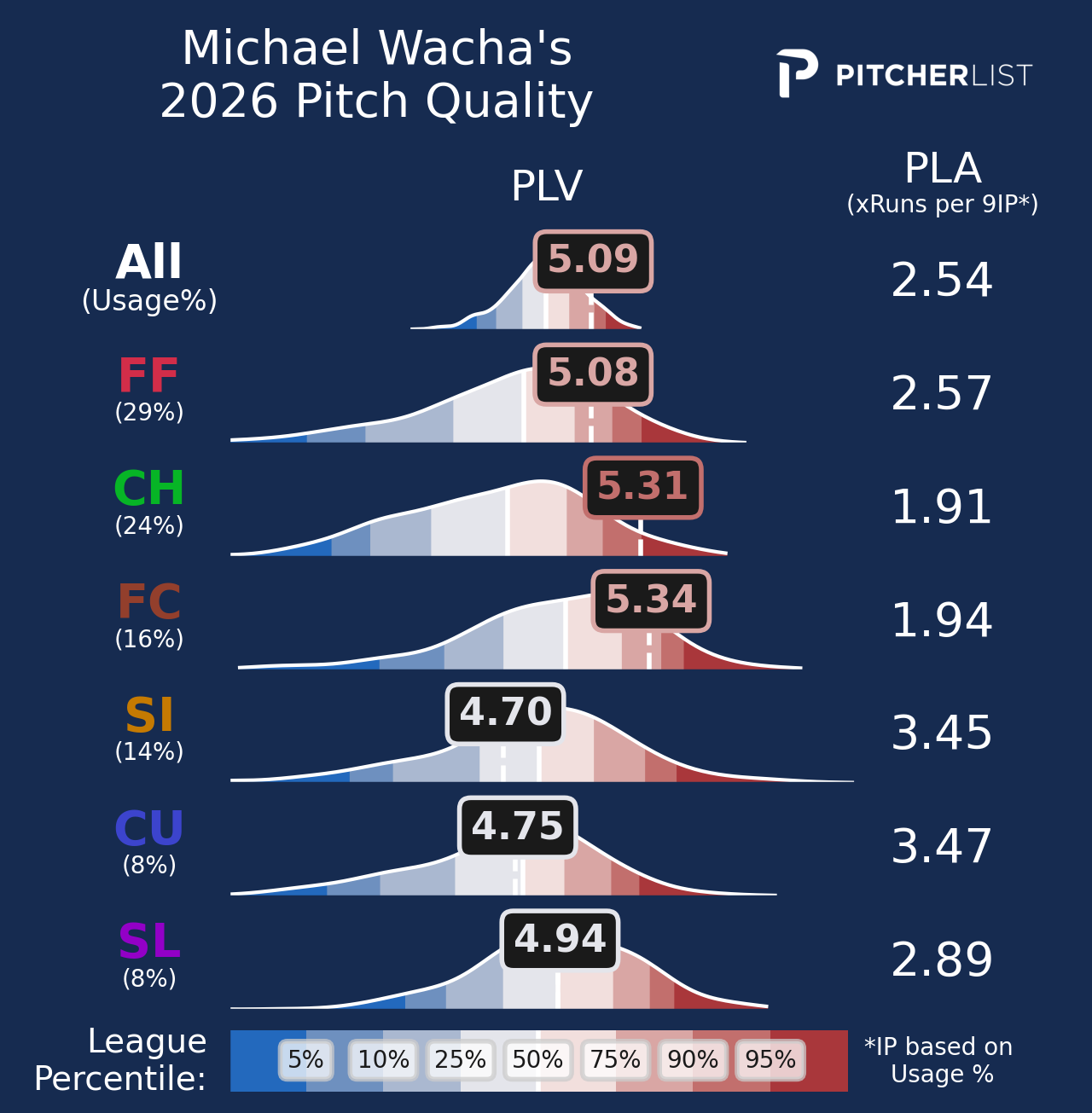
However, this changeup is a little different from years past. It has nearly three inches more induced vertical break than in 2025, where it also had around 2.5 more inches of iVB compared to 2024. This shape is a little more in line with his early 2020s changeup, yet it is roughly six miles per hour slower and has actually induced great results.
With changeups, it’s normal to want big movement separation if the velocity difference from a primary fastball is minor. However, with Wacha’s velocity falling, having a fastball and changeup with almost similar movement is great, given such a steep velocity difference.
Wacha’s cutter and sinker have also been huge to his success, keeping results against righties above-average, while lefties are neutralized by his changeup. This has all culminated in a very strong 2.95 PLA, reflecting his elite stuff and command despite slower velocity overall.
Wacha’s 4.43 xFIP/4.35 SIERA reflect a strange career trend, as Wacha has sustained a HR/FB% around eight percent throughout his time with the Royals, well below the league average. This is likely in part due to Kauffman Stadium’s huge dimensions, which have been changed somewhat in 2026. Still, Wacha has quietly been one of the game’s more effective starters in the 2020s, and will look to sustain his success in his next start, on the road against his former Cardinals.
