Hello and welcome to Pitcher List’s latest series: Using PLA to Evaluate Pitchers! Every week, I will examine various pitchers and break them down using PLA. There will be various themes and topics each week, which will range from topics such as waiver wire picks, to buy or sell, to awards races, to lefties/righties only, etc. I hope to mix it up as much as possible to keep you all on your toes.
Now, you might be asking, what is PLA?
PLA is an ERA estimator that was created in tandem with Pitch Level Value, which we refer to as PLV. PLV is essentially an all-encompassing stat that measures individual pitches and rates them on a 0-10 scale. The elements that factor into PLV include velocity, movement, release point, location, count, and handedness of the batter. We have an excellent primer on this by the one and only Nick Pollack that you can find right here! PLA takes this 0-10 score and translates it to an estimated ERA, which makes it easier to understand and more useful for those looking for help with their fantasy teams.
It’s important to note that PLA isn’t necessarily a catch-all estimator, just as xERA, FIP, SIERA, and pCRA aren’t either. These stats ultimately still measure outcomes, which are largely dependent on how a player is executing that day. ERA estimators are not crystal balls; however, they can provide some insight if taken with a grain of salt. For the purpose of this series, we are going to use PLA as the main factor to evaluate pitchers (hence the series title), but again, no stat is perfect, especially in the complex world of pitching.
Also, stay tuned for other PLV evaluation article series, such as one that will look at individual pitches and another that will use Process+ to evaluate hitters!
Today, we will be looking at the top five pitchers in wins for this season. It’s not really anybody’s favorite stat, especially not mine, but it’s interesting to see whether these pitchers are doing it out of their own merits or just by luck.
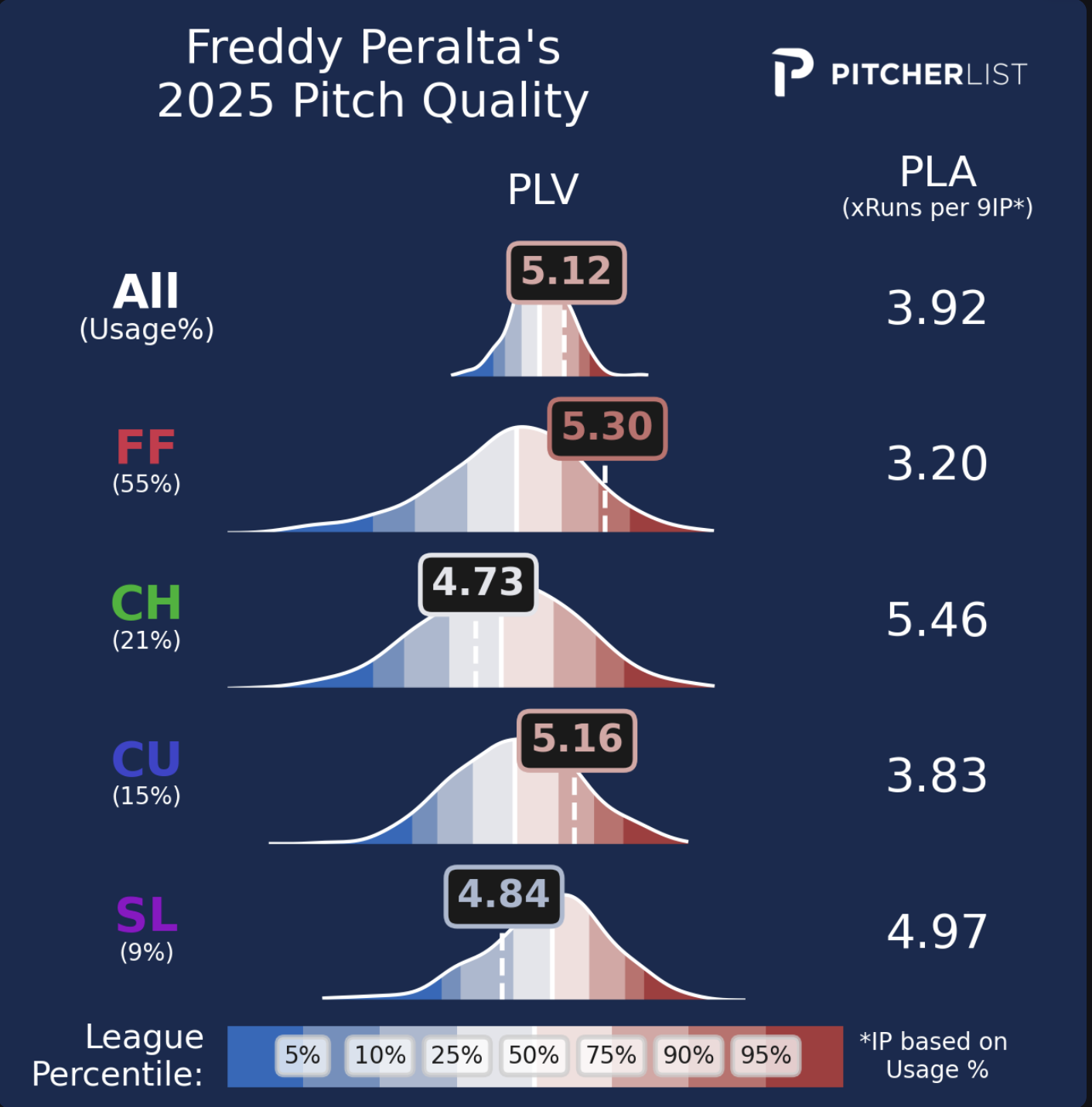
Freddy Peralta – 3.92 PLA.
The biggest winner this season is the Brewers’ Freddy Peralta, which makes sense, as he is the workhorse ace for the team that just can’t stop winning. Beyond that though, he’s had some ridiculously good results, with a career-best ERA.
Peralta has excellent stuff; there’s little question about that. His four-seam fastball, which he throws 55% of the time, does the job incredibly well. It has solid velocity, extension, decent vertical movement, and comes in at a very flat attack angle. It’s a funky pitch, and that earns it good results.
Peralta rounds out his arsenal with a changeup that doesn’t grade out the best, a solid curveball, and a slider that is below-average per PLV. The interesting thing about Peralta is that he’s basically shelved that slider after it was his main secondary for a while. Unfortunately, the pitch has lost a bit of movement which has led to PLV grading it worse, and as we have seen, Peralta and his pitching coaches believe that it should no longer be one of the main pieces to the puzzle that is his arsenal.
The key for Peralta to succeed is mastering the location. He throws plenty of non-competitive pitches, which leads to walks, wild pitches advancing runners, and shorter outings when he’s inefficient.
Garrett Crochet – 3.47 PLA
What a season Garrett Crochet is having.
I definitely expected him to be in the running for Cy Young and to be a top 5 pitcher… But he still feels better than we thought? And he doesn’t even have his signature 7 feet of extension on a consistent basis.
Crochet, like some of the other pitchers we are talking about, uses a four-seamer as his main pitch. We all know it’s an excellent offering that gets tons of swings-and-misses, even with the dropoff in extension. Interestingly, he has used it less in some starts this year, including in his seven-inning masterclass against the Yankees. Still, PLV grades it as above-average, which is what you need from the foundation of your arsenal.
The second most used pitch by Crochet is the cutter, which is also his highest-graded pitch. It gets tons of strikes and works well against lefties and righties. It’s the year of the cutter, and Crochet is one of the guys leading the charge, as this pitch is what really brought him to relevance and made him one of the most sought-after starters in the offseason last year. He additionally has a sinker as his third fastball, which gets a lot of strikes as well, especially against lefties.
In terms of the slower stuff, Crochet throws a big sweeper that grades out well, getting tons of whiffs, and a changeup, which, of course, every lefty starter needs, even if his is below average.
Crochet is an elite pitcher, and while PLA doesn’t like his arsenal as much as some other estimators, it still paints the picture of a great arm who is key to a lot of wins for a contending squad.

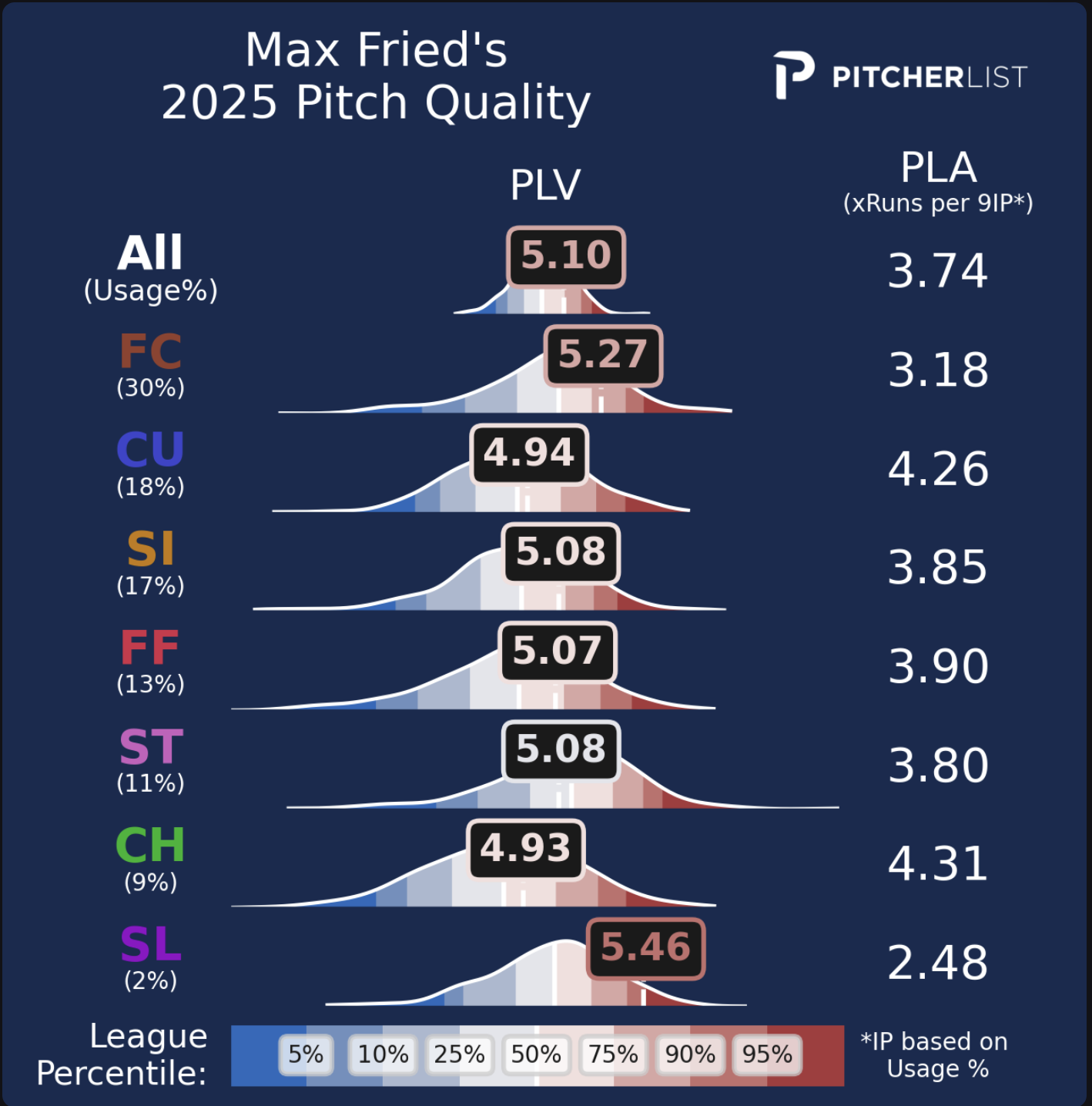
Max Fried – 3.74 PLA
It’s been a rough second half for Max Fried, who looked like the Cy Young frontrunner for a while before falling off a bit. Last time, we said that Fried likely isn’t going to be the sub-2 ERA guy for most of the year, but I think very few thought he’d stumble out of ace territory late in the summer.
Fried relies on a deep arsenal to get efficient outs. His cutter is his most-used pitch, and this is the first year that’s the case. It gets a ton of strikes, especially against righties, which he primarily deploys it against. He also has a sinker and a four-seamer, which grade out as above-average, while the cutter is more in that near-elite territory.
In terms of the slower stuff, Fried’s main breaker is a curveball which he throws 18% of the time. It’s a slow hook, which is reflected in the below-average PLV grade. Fried gets it low 64% of the time, which is solid, but still could be higher if he wanted to get even more swings-and-misses/poor contact on the pitch. The sweeper and the classic lefty changeup round out the arsenal, and both hover around average in PLV grades.
Is Fried the pitcher who had the ridiculously low ERA to start the season? Probably not. Is he the disaster he’s been since early July? Also, probably not. PLA shows that Fried is a solid pitcher but isn’t necessarily an elite option, which feels like the case as of now.
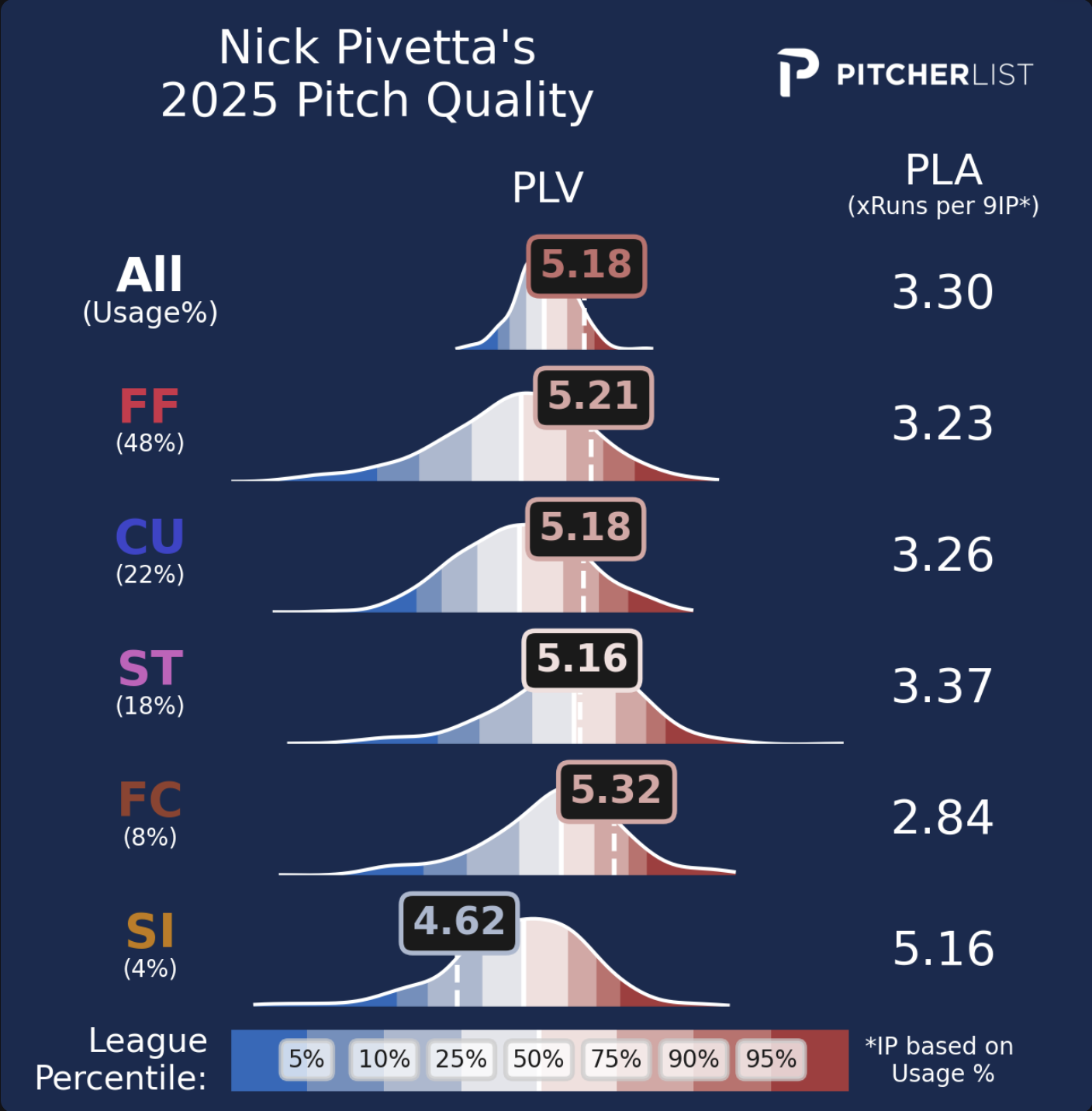
Nick Pivetta – 3.30 PLA
What a career year for Nick Pivetta, who moved from a hitter’s paradise in Fenway to one of the best parks for pitchers in Petco.
We’ve spoken about him at length in this series, largely because his PLA has remained near the top of the leaderboard as he’s continued to look like an ace in the more traditional stats.
Pivetta’s main pitch is his four-seam fastball, which succeeds due to extreme vertical movement. Think Justin Verlander, steep attack angle sure but the iVB has made it so hitters don’t know where to attack and frequently swing under the ball. Combine this with solid velocity, nearly elite extension and an ability to throw it at the top of the zone, and this pitch is getting strikes galore.
Most of Pivetta’s other pitches thrown are one of two breakers: the sweeper and the curveball. Both have pretty good PLV grades and both get plenty of strikes. The curveball is mostly used against lefties, and the sweeper against righties. Pivetta, like a lot of new-age pitchers also has two other fastballs, a sinker and cutter. Both grade out well, especially the sinker, though it’s rarely used.
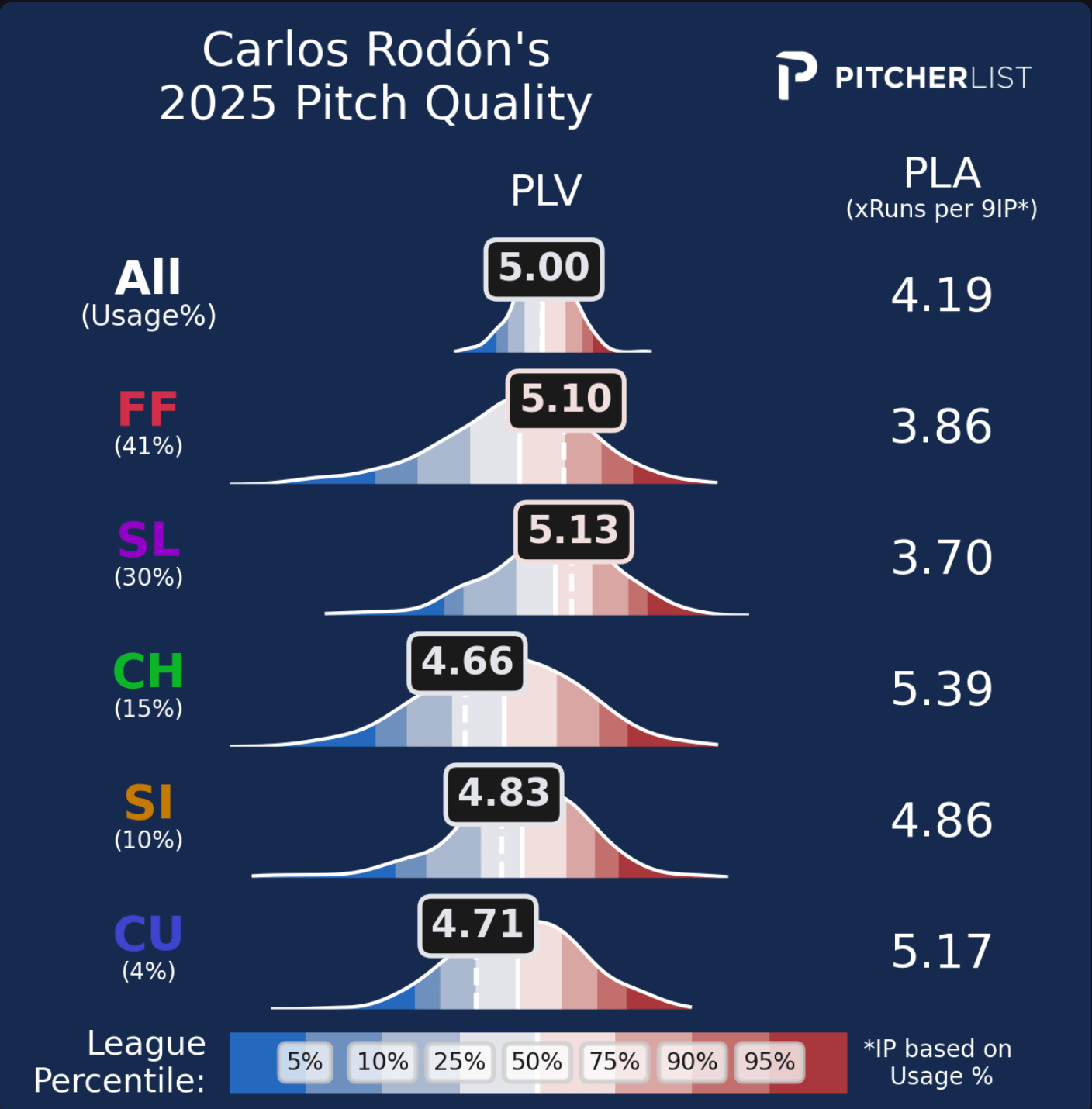
Carlos Rodón – 4.19 PLA
| ERA | xERA | FIP | xFIP | SIERA | PLA |
|---|---|---|---|---|---|
| 3.24 | 3.00 | 3.86 | 3.90 | 3.77 | 4.19 |
Another Yankee in the top 5 in wins, Carlos Rodón has had a great season this year. He may not be pitching at the level he did in 2021 and 2022, but he’s been pitching like a top-of-the-rotation arm for sure.
The foundation of Rodon’s arsenal, like always, has been the fastball/slider combination. Rodon throws the four-seamer over 40% of the time, and while it’s lost a bit of velocity compared to last year, it’s still been a solid pitch. The slider has to be his best pitch, with an excellent CSW% and the best PLV of any pitch he throws.
Rounding out Rodon’s arsenal are a changeup (classic lefty pitch), sinker, and curveball. None of these grade out particularly well, which has brought Rodon’s PLV down. The sinker is an interesting pitch though, as he uses it against lefties and gets a ton of swings and misses with it, at least compared to most other sinkers.
Rodon’s four-seamer/slider combination has brought him to glory again this year, even if PLV says that his command might not make it seem sustainable.