





Summer is waning, and the pennant races have begun in earnest. Before we look too far ahead to postseason baseball, let’s look back on August and some of the hitters who made the best swing decisions in the season’s dog days.
To analyze swing decisions, we’ll be using one of our very own metrics here at Pitcher List: PLV’s Decision Value. If you’re unfamiliar, PLV considers every single pitch’s placement, movement, and other metrics, and assigns it an overall grade. We can then use those grades to determine whether a hitter is making good swing choices and attacking pitches that he can turn into offensive production. We can also break this down further by looking at pitches both in (zDV) and out (oDV) of the strike zone. For a more in-depth explainer, check out the intro to this piece.
Like many metrics, Decision Value is graded on a scale where 100 represents the league average. Every 15 points above or below 100 is one standard deviation.
You can support Pitcher List and get access to full leaderboards for Decision Value and other PLV statistics by joining PL Pro.
Jonathan India, Kansas City Royals — 128 Decision Value
India’s first season as a Royal hasn’t been all sunshine and rainbows. He’s slashing .232/.324/.342 with eight home runs. Despite reaching double-digit stolen bases in three of his previous four seasons, he has yet to swipe even one successfully and has been caught four times. Despite the poor production at the plate, he’s added some value by manning three different positions regularly. He’s started at least 20 games at second, third, and left field.
On the swing decision front, India’s 128 Decision Value was the second-highest mark in the majors during August. His success last month was a nice return to the elite company of swing decision makers after a mid-season lull.
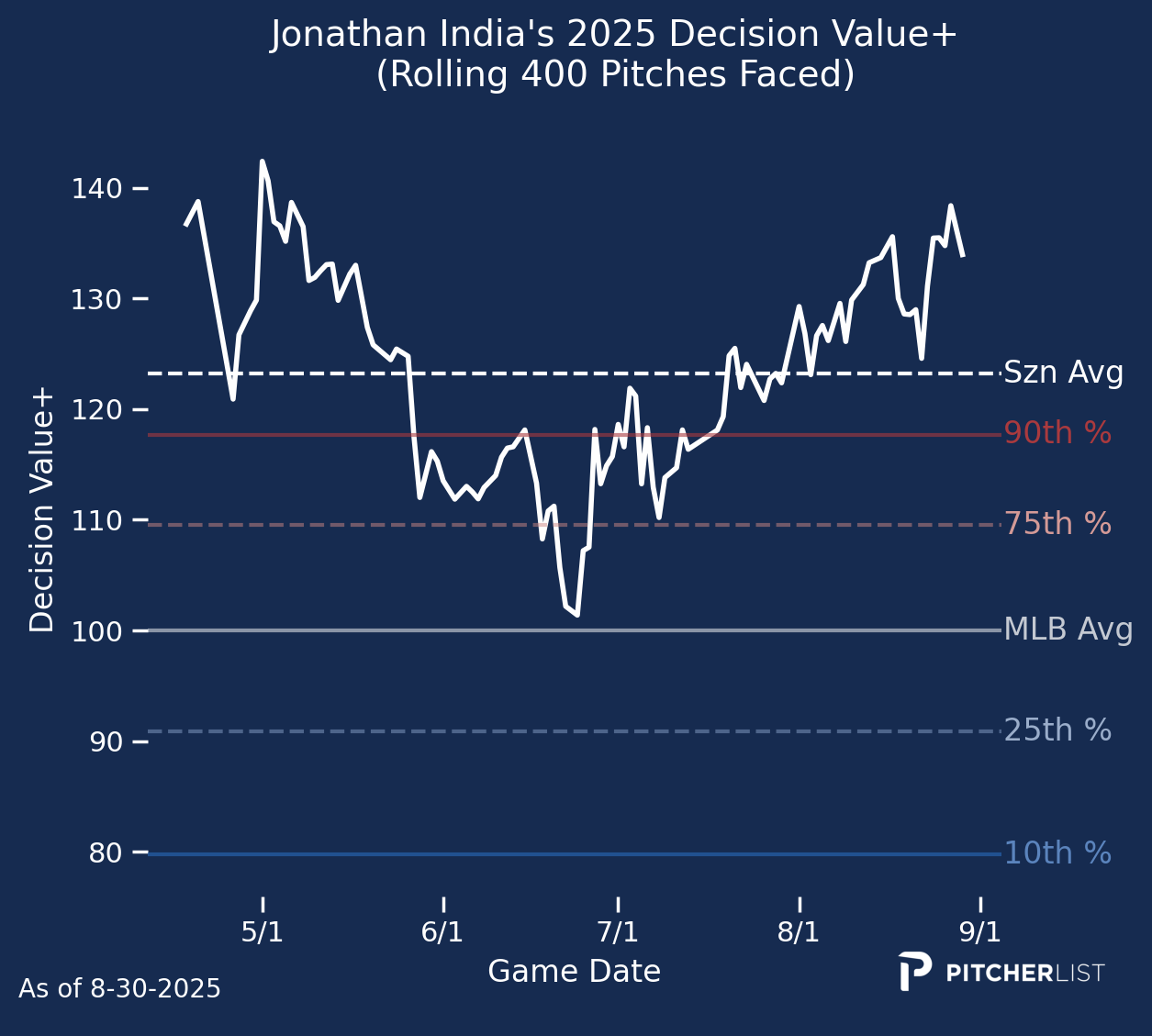
India’s always been a rather patient hitter. He’s only swung at 40.1% of the pitches he’s seen this year, good for the 6th percentile of qualified hitters. While that less-than-aggressive approach has paid off in years past, it’s not helping him much this season. Opposing pitchers are going at him more often than they ever have. With a 51.6% zone rate, India sees more pitches in the strike zone than almost any other hitter in the sport, and since he doesn’t swing at them, it’s led to a massive 22.1% called strike rate, nearly six full percentage points above the league-average mark.
Of course, India doesn’t just watch strikes go by. He passes on plenty of pitches out of the zone too, and that’s what PLV loves about him. India sports a 130 oDV on the season, the fourth-best mark in the league. On the other hand, his 89 zDV leaves a lot to be desired.
William Contreras, Milwaukee Brewers — 124 Decision Value
The Brewers have been unstoppable in the second half as they’ve marched their way to the best record in baseball, and while they’ve been clicking on all cylinders, one of the biggest factors in their surge has been Contreras’ bounce back. Milwaukee’s 27-year-old backstop had an uncharacteristically average first half, posting a 100 wRC+ with notably zapped power. Since the All-Star break, Contreras is looking a whole lot like his typical self, posting a second-half slash line of .290/.364/.534 with 11 home runs, good for a 149 wRC+.
Contreras has routinely been near the top of the Decision Value leaderboards throughout his career, but his 2025 season has been especially impressive. Here’s a look at a rolling graph of his swing choices, which showcases his season average sitting comfortably above the 90th percentile.
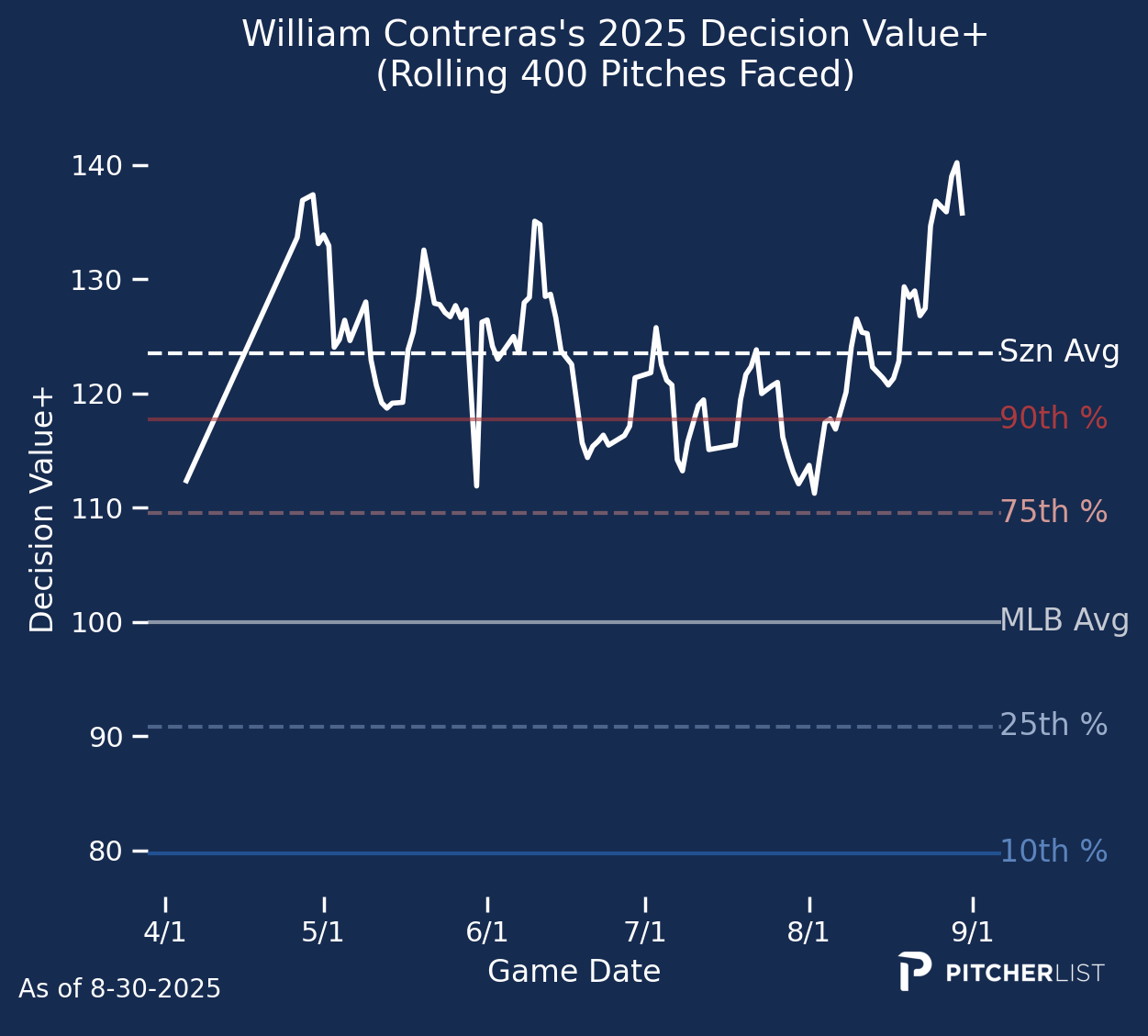
Contreras’ 124 Decision Value in August has certainly played a role in his resurgence at the plate, but given his long-standing consistency among the Decision Value elite, it’s not the main culprit. All season long, we’ve heard about how the younger Contreras brother has been playing through a fractured middle finger. Perhaps that’s finally healed, or he’s been able to find a way to adjust his grip or swing to accommodate the nagging injury. Either way, the results speak for themselves.
Brandon Nimmo, New York Mets — 123 Decision Value
Nimmo is a long-time plate discipline guru. If you flip through the yearly results on his Savant page, you’ll find that his chase and walk rates have almost exclusively been 75th percentile or above during the entirety of his 10-year big-league career. Now he’s getting his swing decisions into that same territory.
While his plate discipline reputation may give you the impression that Nimmo is incredibly passive in his approach, that’s actually not the case — at least not anymore. Nimmo’s been slowly upping his aggression at the dish throughout his career. The earliest data we have is from 2018, Nimmo’s third season as a big leaguer, when he swung at just 39.4% of the pitches he saw. That number has climbed nearly every year since to his current clip of 46.8%, just a hair below league average.
The most impressive part of Nimmo’s swing profile is that despite being more aggressive, he’s still done a phenomenal job at limiting his strikeouts and taking his walks. Those rates have understandably declined, but not to the degree you’d expect considering the increase in swing rate.
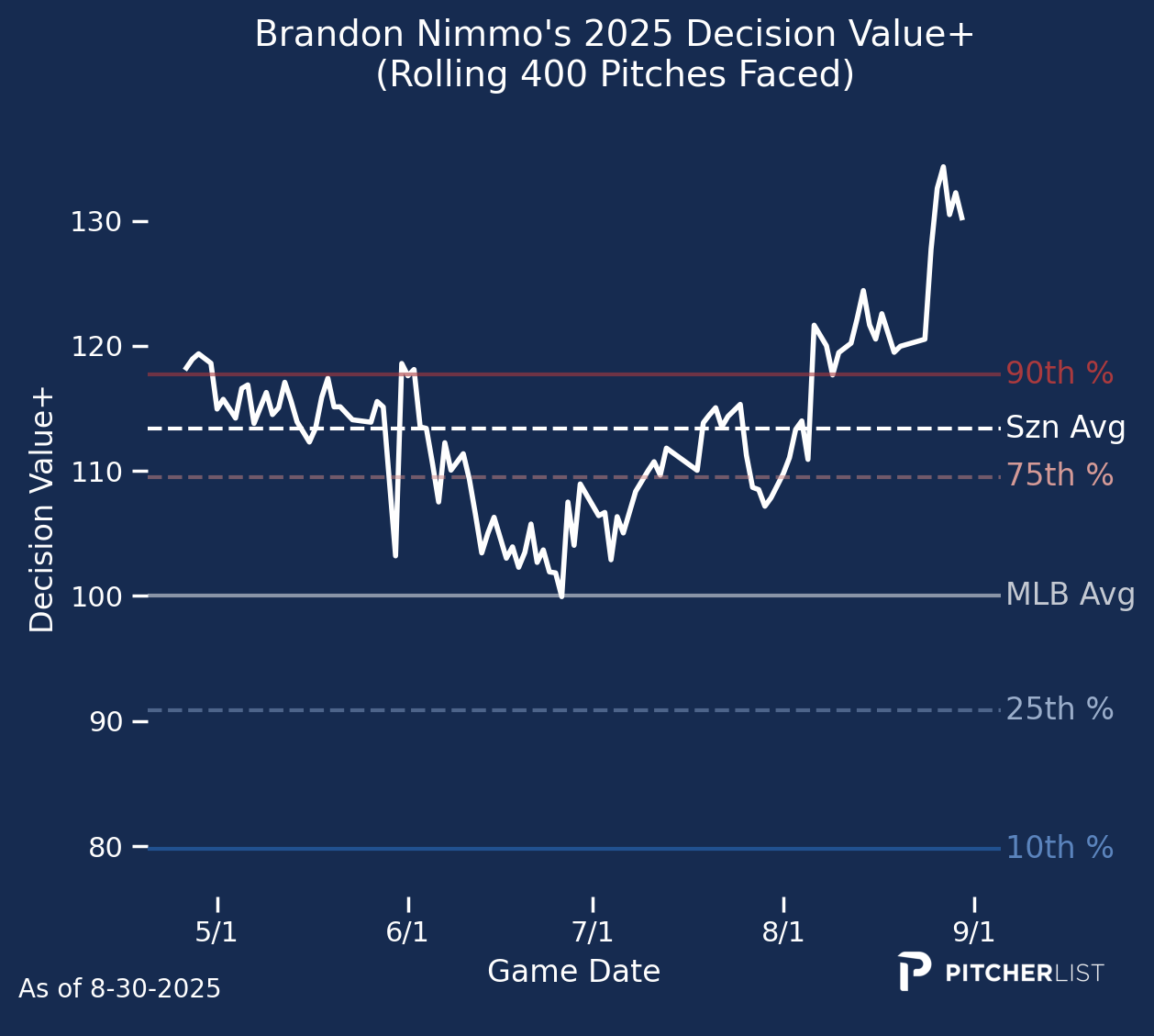
Nimmo’s excellent August wasn’t limited to just avoiding pitches out of the zone (121 oDV). He also made good swing choices on strikes, too (102 zDV). It’s not a coincidence that Nimmo slashed .289/.377/.457 in August. His .833 OPS and 136 wRC+ represent the second-best month of his 2025 season.
Taylor Ward, Los Angeles Angels — 121 Decision Value
It’s been a career-best season for the Angels’ left fielder. Ward just recently eclipsed 30 homers for the first time in his big-league tenure, and his .227/.320/.474 slash line comes out to a 116 wRC+.
Ward’s offensive onslaught has been accompanied by an approach change: he’s significantly more passive than in years past. He’s dropped his swing rate nearly six full percentage points to 37.3%, the third-lowest mark in baseball.
With great patience comes a great chase rate. Ward has chased pitches out of the zone at just a 20.8% clip, falling in the 90th percentile of qualified hitters. PLV absolutely adores that approach and grades Ward with a 127 oDV, a mark nearly two full standard deviations above average. On the flip side, Ward’s lack of aggression means he watches plenty of strikes go by. His 23.2% called strike rate is the sixth highest in baseball, leading to a poor 74 zDV.
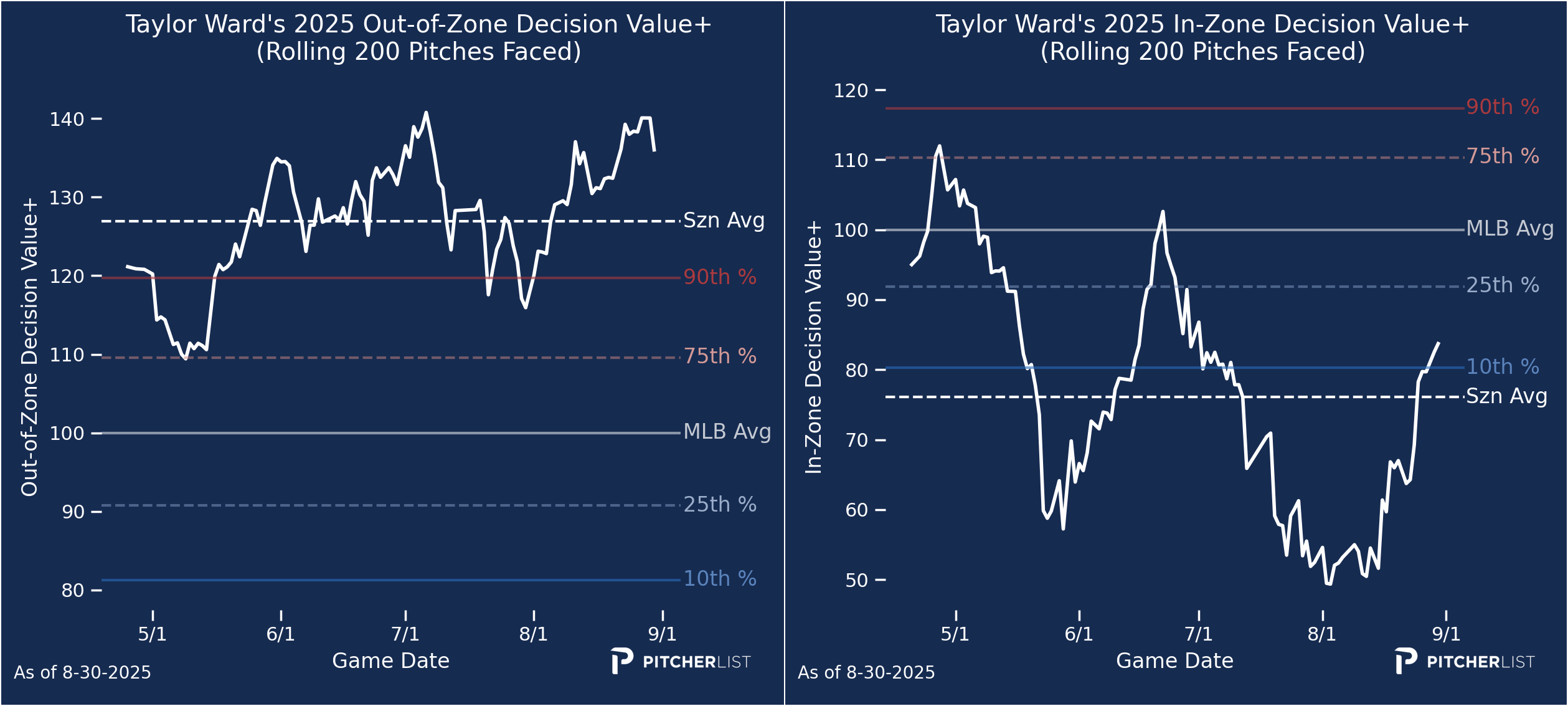
When Ward does swing, he’s doing plenty of damage. His 13.8% barrel rate is a career best, and when you combine that with a 17.4% Pull AIR% – the highest Ward’s posted since 2019 – you get 30-homer pop. He’s one of just 12 batters to reach that threshold so far this season, and he’s probably gotten there more quietly than anyone else.
Seiya Suzuki, Chicago Cubs — 120 Decision Value
It’s been an up-and-down season for Suzuki, both in actual production on the field and in his Decision Value. He was one of the noted All-Star snubs after posting an .867 OPS with 25 homers and 77 RBI in the first half, but he’s seen that production plummet since the Mid-Summer Classic. He’s slashed a measly .199/.331/.277 in the second half.
Somewhat surprisingly, that drop in production didn’t go hand-in-hand with a drop in Decision Value. It’s actually the opposite. While slumping hard, Suzuki was actually making the best swing choices of his season.
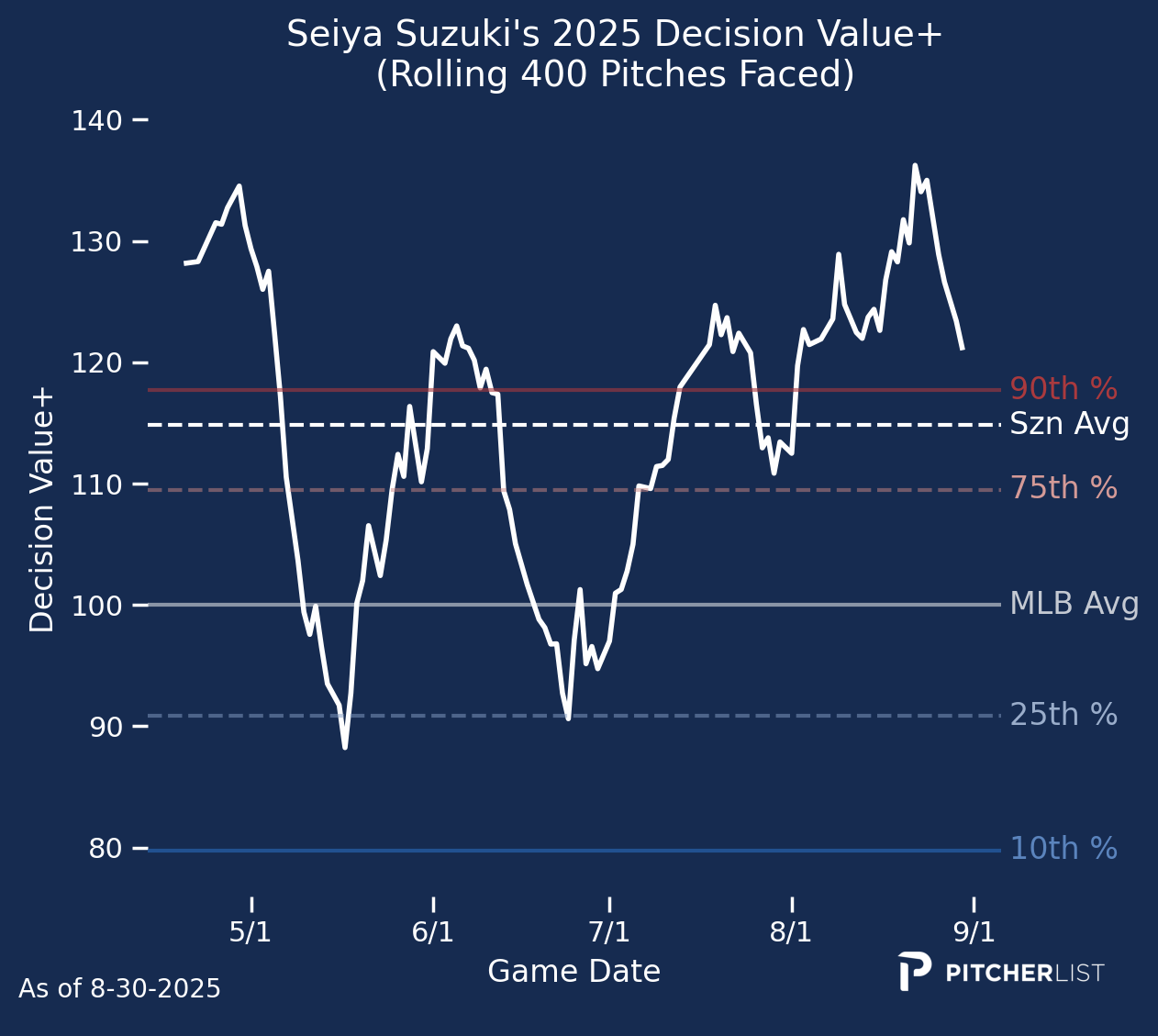
Plenty of what we just discussed with Taylor Ward is also true of Suzuki, just to a lesser degree. Suzuki is also a patient bat – his 40.6% swing rate is 7th percentile – so while he doesn’t offer at bad pitches often, he also lets plenty of pitches he could drive go by. Those two things create an uneven PLV Decision Value profile in which he struggles in the zone (70 zDV) while succeeding out of it (125 oDV).
I think all of Suzuki, the Cubs, and his fantasy managers would happily trade some of his gains in Decision Value for a return to his first-half production. He’ll likely snap out of his skid sooner rather than later, but at the very least, his downturn is certainly not due to him making poor choices at the plate.
Adapted by Kurt Wasemiller (@kurt_player02 on Instagram & Threads, @kuwasemiller.bksy.social on BlueSky)
