





It’s been an interesting year for Angels rookie Walbert Ureña. After coming into this season ranked outside the top 10 prospects on his own team, he has suddenly become a guy who will likely get some attention on the lower end of the AL Rookie of the Year ballots. He has done this with a statistical profile that has led most watchers to wait for the other shoe to drop. His K-BB% is just 9.6%, ranked 88th out of the 108 pitchers with at least 100 innings pitched this year. And yet, one of the best predictors of success seems to have missed something in Ureña, who also has the 15th-best ERA among those 108 pitchers. Let’s figure out how he’s doing it.
The Arsenal
Ureña has a unique pitch mix, and while he uses his changeup most, we’ll start with his primary fastball as it’s the pitch he leads with that sets everything else up. Perhaps even more importantly than the extreme velocity, his sinker is a bowling ball of a pitch in a variety of ways. For one, it has exceptional depth for his release height and arm angle. Ureña’s natural bias leads him to release the ball with an unusually low spin direction for his slot, which compounds with the seam-shifted wake to create a pitch that just never stops falling on its way to the plate. It is nearly impossible to get under due to the steep angle it creates. His oddly high release for a six-foot-tall pitcher adds to the list of things that hitters wouldn’t expect from this pitch.
One complication pitchers with sinkers like Walbert’s tend to run into is that they rarely have changeups that have significant movement differential from their sinkers. Due to these sinkers being largely exclusive to supinators, they’re mostly going to be finding their success with changeups that are getting seam-shifted wake as well. There’s only so much you can do in that regard; more than an hour’s worth of difference between spin and movement direction isn’t common. You can try to find a way to move the initial spin direction down, but oftentimes it doesn’t make much difference.
Back to our focus, here is Walbert, with changeup movement that is nearly identical to his sinker. This is not entirely a bad thing; it leads to these two pitches looking like copies of each other out of his hand with highly similar spin direction, active spin rates, and release path angles. It does, however, mean that he’s relying on the velocity difference and placement to get the job done beyond that. This is frequently more than enough, and as we’ll get into later, it has been for Ureña.
Ureña’s 4-seam suffers in its shape for the same reasons his sinker thrives. The lower spin direction and active spin percentage lead to a 4-seam that has relatively awful movement. In the context of his arsenal, it can work because it looks just like his sinker and changeup out of the hand and has some decent movement separation from those two. It surely doesn’t hurt that he works 95-101, of course.
Walbert’s breaking ball is a depthy power sweeper that lacks the horizontal movement the name implies. Don’t get me wrong: a high-80s breaking ball with negative IVB and more than a half foot of horizontal movement is still a great pitch; I just think sweeper is a bit of a misnomer in this case. But that’s a pedantic concern; what matters is that it’s effective.
“Wild” Walbert
There’s not much dancing around it; a 12.8% BB% raises eyebrows and drums up questions about how likely his future is as a starter. Walk rate isn’t usually a great indicator of overall pitch control outside of the extremes. Even then, Ureña’s command is probably a bit better than what you envision upon seeing his walk rate. It’s not great, but like most pitchers, it varies by pitch. For example:
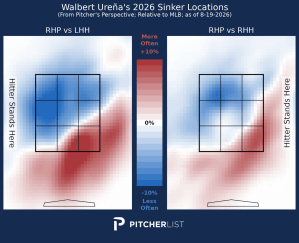
Well, that doesn’t look like bad command. On the contrary, that’s a pretty good map for a sinker like his, buried down in the zone and off of it low and to the arm-side. While it may not help him rack up called strikes by dropping it in spots where the movement helps the pitch just catch the zone, it is taking full advantage of the pitch’s downward angle by forcing swings. At least in theory. Ureña’s overall low zone rate and high walk rate have led hitters to let him come to them and see if he’ll throw strikes. Due to how hitters are approaching him, this pitch has a below-average called strike rate and a just slightly above-average chase rate, despite how well he’s spotting it.
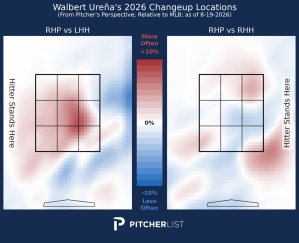
The deficiencies there are made up for by how this approach bites hitters against his changeup. He zones this pitch nearly as often as his sinker, which leaves it at a far higher-than-average rate for a changeup. This leads to a ton of called strikes on top of the whiffs this pitch gets, leading to a 93rd percentile CSW%. He zones it too often to register above-average rates of pitches in ideal out-of-zone spots, but I assure you it’s getting there too, even if the heatmap makes it seem like it’s not. Furthermore, while the heatmap accurately displays a higher-than-average rate of pitches down the middle, especially against lefties, I promise that’s not as bad as it looks. More on that later.
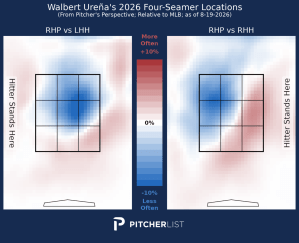
Ureña’s ability to command his 4-seam is not great, though I can’t tell exactly how good or bad it is because his plan with it is indecipherable. He throws it away from lefties, but I’m not sure there are any discernible strategies beyond that. It misses in every direction, and it finds itself pretty much anywhere in the zone. Funnily enough, it doesn’t wind up down the middle that often. I’m not sure I’ve ever written about a fastball that was thrown like this; I’m really not sure what to make of it. It clearly isn’t ideal, but I can’t tell how much room for improvement there is because it doesn’t show any real trends.
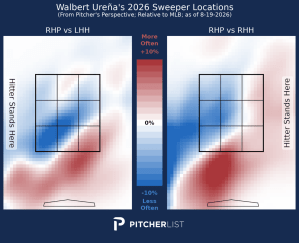
His sweeper is a bit easier to understand. He’s capable of zoning it, and he also does a good job of keeping it low. He does a decent job of hitting his spots below the zone and landing it back door against lefties. In a continuing trend, the way hitters react to Walbert’s pitching and scouting report leads to kind of wonky stats. Despite very low swing and chase rates, this pitch runs almost exactly league-average called and swinging strike numbers, just a hair above in both.
Ureña’s reputation as a pitcher who doesn’t throw many strikes leads to a strange hitter approach profile in which he walks a lot of hitters despite getting a perfectly normal amount of chases on the whole, indicative of at least some command to throw the ball in enticing locations outside of the zone. It’s also possible it’s more related to his stuff, and the locations are happenstance, but I think his sinker and changeup are earning their chases at least.
Ground Game
Now that we’ve covered what he’s doing on the mound, let’s try to draw the connecting line between that and the sub-3 ERA he sports. I mentioned earlier that Ureña’s sinker is a bowling ball, and that his changeup has been performing well. Ironically, his sinker actually has the worst batted ball stats of all of his pitches, perhaps because hitters are trying to stay ready for it. This leaves them open to everything else, however.
Yeah, some of those numbers are absurd. Hunter Brown is the only starter with a 4-seamer with a lower xwOBAcon against. Not bad for a pitch with an “awful shape”, huh? The shape is still bad, but hitters just cannot find a way to put good wood on it. I think the abnormal shape combined with how it plays off of his sinker and changeup are driving most of that.
Unlike his silver-medaling 4-seam, his changeup boasts the very best xwOBAcon among its pitch type. I think this is the culmination of how it plays with his fastballs. With hitters geared up for high-90s velocity, this pitch coming out looking the same leads to some awkward-looking swings, regardless of whether it has the same movement as his already steep sinker.
Even with his primary fastball that’s theoretically supposed to be the bad batted ball pitch putting up just slightly better than league-average numbers, Walbert ranks as the league’s very best contact manager among the aforementioned 108 pitchers with 100 innings this year. I’m not sure it’s even up for debate.
This doesn’t even fully reflect his dominance. The second-best xwOBAcon is 13 points worse. Same with the ICR% and SweetSpot%, second-best are 1.4 and 2.8 percentage points higher. When hitters have gotten the best of him, it has been with walks and papercuts. They have not managed to hit the ball in a threatening manner against him this year, even when he’s struggling.
The Outlook
So now that we’ve covered how he pitches and how hitters have fared against it, what does the future hold for Ureña? It’s not a particularly common statistical profile. Actually, it’s pretty much one of one. He’s a premier bad contact inducer who can get some strikeouts, but also isn’t zoning the ball consistently enough to force hitters to swing at his stuff. The high walk rate not being supported by a high strikeout rate is concerning, of course. K-BB% is arguably the best metric for predicting success. It’s not perfect, of course; it does ignore what Ureña has been doing better than anybody, but it’s cause for worry.
I am not entirely convinced hitters will continue to struggle so much against his 4-seam, but I am similarly unconvinced that his sinker will continue to only turn in average results. In fact, those trends have already started to take shape.
This is much more in line with what I would expect, though the 4-seam still returning better-than-average contact metrics is a pleasant surprise. The changeup continues to be arguably the single best contact-managing pitch in the game this year. How long will that hold? It’s impossible to say for sure, but I love what Walbert offers on the mound. His unique mix of pitches combines depth and deception and is so much fun to watch and analyze.
He needs to throw more strikes; I think even the staunchest Walbert believers would agree. With how his arsenal is built, it could only do him good to throw more pitches (especially sinkers) in the zone to force hitters to swing at all of his pitches more frequently. It would help him work deeper into games as well. For a guy who induces as much bad contact as he does, he doesn’t work particularly efficiently. His 4.05 pitches/PA is tied for 10th-most among starters.
He needs hitters swinging at his stuff; that is where he shines. I do not ordinarily begrudge walks, but he pushes the line of how many I can accept given he does not rack up strikeouts along with them. I’m not even going to try to project specific pitch location command; that’s the step after the one he needs to take. I don’t want to be presumptuous given he already needs to work on his ability to locate the pitches he already knows how to throw, but I wouldn’t mind seeing him develop another pitch to throw to lefties. While his changeup is phenomenal, it is also the only pitch he has that is tailored to beating them. A cutter or curveball could go a long way toward helping him in platoon matchups.
It’s hard to fully commit to believing in his statistical profile because there’s no one else quite like him who has seen this kind of success. His closest contemporary this year in terms of strikeouts, walks, and quality of contact is Roupp, who has somewhat worse quality of contact with a lower walk rate, but an ERA that is nearly a run and a half higher than Ureña’s. I dug back through the Statcast era year by year to try to find even a single season that was comparable to what Walbert has done this year. This proved to be a fruitless endeavor, as his contact suppression is pushing unprecedented levels.
I want to believe in Ureña; it’s just hard to have faith in something that hasn’t been done before. Currently, Walbert inspires just as much trepidation as confidence for me. I believe in his potential if he can realize it, but that’s projection. The good news is that he has plenty of time to figure it out. He’ll be 22 all through this season; he’s one of the youngest players in the majors right now. Fuentes and Kade are the only active major league pitchers younger than he is. For right now, we can enjoy what he’s doing and hope he can build on it as he goes.
