





As much as I would like to forget middle school, there’s a memory that sticks out from seventh-grade math when we were introduced to histograms. We surveyed our classmates on a topic of our choosing, and I remember being disappointed when I was alone in the 140+ games watched bucket of my project.
I can’t blame them. Even baseball’s biggest fans have things to do, and when the baseball isn’t particularly good, it’s easy for an everyday commitment to turn into a chore. So we collectively pick our spots on convenience and attraction—Shohei Ohtani is coming to town, a rivalry series awaits, the game is on national television. There are infinite reasons to tune in on any given day, but if you miss four plate appearances from your favorite hitter, you can set your clock to their spot in tomorrow’s lineup. This sport is freeing in its regularity.
However, nothing puts butts in seats quite like the buzz of a young starting pitcher. The potential for acehood mirrors that of a summer blockbuster, namely the urgency not to miss the hottest show in town. In West Sacramento, that’s Athletics starter Gage Jump. After a rocky debut, he’s allowed just one run in his last 13.1 innings, and he’s flashing the kind of stuff that’s worth getting excited about.
Jumping on the Bandwagon
Jump is largely projected to be a mid-rotation starter on the back of an excellent fastball. It sits at 96 mph and flirts with triple digits, with promising peripherals to boot.
Unsurprisingly, PLV loves this offering (5.39, 98th percentile). Even as a control-over-command guy, Jump’s location has netted strong returns. His 104 plvLoc+ and 110 Location+ are boosted by an absurdly high 59.4% zone rate, and the meat left on the bone has me excited. For one, Jump’s shape improved with his promotion, gaining two inches of induced vertical break. He’s already getting plenty of swings above the zone, but he has yet to target the letters regularly against lefties.
He’s currently keeping the fastball low and away to lefties, presumably to set up the breaking balls. But given his willingness to place sliders in the zone, his fastball is begging for more arm-side elevation.
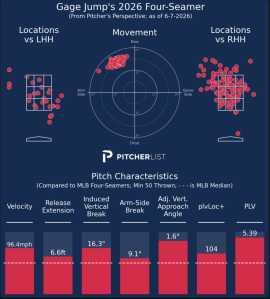
We know this shape can get swings and misses, and after posting a 31% whiff rate on it at AAA, there’s little reason to doubt that the Ks are coming. I’m happy to bank on more balls up in the zone keeping the swing rate high and the whiffs following suit. He’s not going to post a 17.8% strikeout rate forever.
For now, Jump is keeping fastballs in the zone and avoiding hard contact. Hitters are fouling off and popping up his fastball far more frequently than league average while earning a measly .228 xwoBACON. Thrown nearly half the time, Jump has no problem challenging batters with the pitch that gave him helium.
Bear With the Breakers
Of course, no 23-year-old is a finished product. Not with a pair of secondaries that aren’t being thrown for strikes and no obvious out pitch to opposite-handed hitters. Jump’s secondary offerings will make or break his profile, but the early returns are promising.
His slider is his primary breaking ball and checks off an important box: a platoon-neutral secondary that can consistently earn strikes.
Like the heater, it is not getting as many whiffs as its chase race would suggest, but it is avoiding barrels despite the zone rate, sporting a .224 xwoBACON. The whiff rate is high enough for the called strikes to generate a strong CSW% (31.3%, 62nd percentile), partly because of how well it tunnels with the high fastballs he’s throwing to righties.
Jump’s slider gives him a second 60-grade pitch, which might be enough to cash in on that mid-rotation projection. Two plus pitches without a runaway walk problem is a path to success, and throwing the two a combined three-quarters of the time sets him up for success. However, it’s the unrefined breaking balls that have caught my eye.
Neither his sweeper nor curveball is as effective or reliable as his slider, but their presence is meaningful. Having three distinct breaking balls (that are actually getting into game action) is emblematic of Jump’s feel for spin. He lacks elite spin rates across the board, but he has shown the ability to deploy breakers with varying levels of rotation.
This is increasingly important in the current era of player development, where breakouts are often forged in pitching labs. Jump’s sweeper might not have an ideal shape today. But tomorrow? A track record of adding passable breaking balls makes improvement accessible. Doing so with above-average velocity (all of his breaking balls hover around the 75th percentile) makes Jump a consistent candidate for pitch-design progress.
In the meantime, Jump’s sweeper doesn’t need outlier movement to get lefties to swing and miss. An MLB-ready out pitch, it has found incredible success through three starts. It is missing bats in the zone, getting swings outside of it, and making guys look like this:
Athletics fans can also hold out hope that the curve will come around. So far, it’s been uncompetitive, earning a PLV Bad Pitch rate on 14 of 23 pitches. He’s spiking it almost as often as it lands in the zone, rendering it temporarily useless.
I’m not too concerned. Jump hasn’t commanded it perfectly in the minors, but he zoned it much more often in AAA. Whether that’s early-start nerves or a hesitance to challenge big leaguers isn’t immediately clear, but with traits that pop on stuff models (129 Stuff+), it seems like a matter of time before it is adding to his arsenal. The curve should also play better with an uptick in high fastballs. If he can find free real estate early in counts while returning the chase routes he had in Sin City, he’d check off another box: an out pitch to righties.
It goes without saying that none of these improvements is guaranteed. He’s getting a little lucky on sliders over the heart of the plate, the sweeper’s shape has been inconsistent, and the curve might get punished in Sacramento’s launching pad. But Jump’s proximity to these gains is tantalizing, and he has the physical traits and track record to be bullish.
Changing Trajectory
Perhaps the biggest step Jump can take this season is revamping his changeup. Right now, it’s just as uncompetitive as his curveball, with less clear a path to relevance. Neither its shape nor feel is particularly impressive, and its location is routinely too far from the zone to be taken seriously.
Simply put, it’s a bad pitch, and it limits his effectiveness against right-handed hitters. Throwing it just 5% of the time at AAA this season suggests it wasn’t a focal point of his development, either.
To Jump’s credit, he’s throwing it more in the bigs; maybe the Athletics are forcing the issue out of necessity. What gives me the most hope here is the uniqueness of the movement profile.
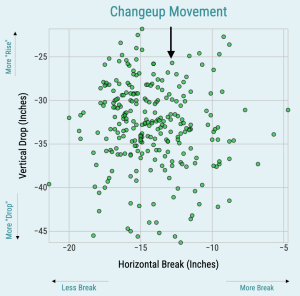
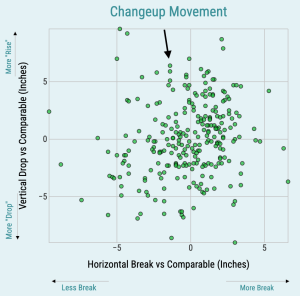
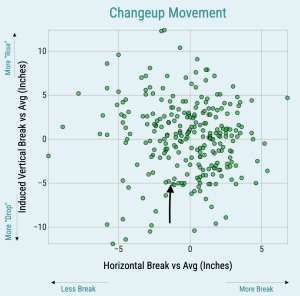
via Baseball Savant
It’s not good by many traditional movement metrics, as it’s more fastball-like than we’ve come to like our offspeed pitches. But it is weird, and that gives him a chance if he can command it significantly better. By our plvStuff+, the offering earned grades of 107, 114, and 126, respectively, in his first three starts. We’re a ways away from Jump featuring this pitch, but as a change-of-pace offering to righties timing up the fastball or waiting for a slider in the zone, it has potential. It’s the final box to check to complete his arsenal, and while it’s the biggest ask, I can’t quite rule it out.
Moving forward, it’s worth watching how Jump navigates the zone with his fastball and whether more optimal locations have downstream effects on his work-in-progress secondaries. With a high-upside fastball and a slider/sweeper combination capable of getting outs, rounding out Jump’s arsenal could make the Athletics must-see TV once every five days.
