





Andrew Abbott is one of the few pitchers who still has the ability to cause baseball’s nerds and traditionalists to turn on each other and start smear campaigns attacking the way the other side sees the game. A season ago, he had a 2.87 ERA across 29 starts for a Cincinnati team that stole the final NL wild card spot in the final weekend of September, but one didn’t have to look far to see the red flags.
His four-seamer, which he threw nearly half the time, had an average velocity a hair under 93 MPH. He didn’t miss many bats; he had a below-average strikeout rate and was a fly-ball pitcher with one of the league’s most homer-friendly venues as his home stadium. Only four qualified starters in baseball outperformed their FIP more than him. His xFIP was north of 4.00. Projection systems were skeptical of a repeat. At one point, the social media beef between Reds fans and Derek Carty, owner of The Bat and The Bat X projections over at Fangraphs (which unforgivingly forecasted a mid-4s ERA for Abbott in 2026), regarding Abbott got so ugly that it seemed capable of starting a war.
Through 16 starts so far, it may seem as though the nerds have won this battle. Abbott’s ERA is up nearly a full run (3.83), a lot closer to what the peripherals suggested last year. Yet, those same peripherals have gotten worse too. His xERA, FIP, and xFIP are all in the 4.80s. He’s striking out less than 20% of batters and walking more than 10%. He’s allowing more hard contact, his PLV is down, and despite all that, his ERA is still under 4. This year, he’s still in the top 10 of the FIP-minus-ERA leaderboard. He’s doing it again! For however long it continues, those nerds will keep scratching their heads.
Enter miss distance and swing timing, courtesy of Statcast.
The next phase of Baseball Savant’s bat tracking rollout debuted earlier in June, and most of the initial marketing that MLB did surrounding the release was all about Mason Miller. Miller’s slider misses bats by an average of 10.8″, the highest in the league for a single pitch this year, which makes sense. Hitters are so preoccupied with his triple-digit fastball that the slider naturally induces some of the ugliest swings you’ll see. If the best reliever in the world owns the pitch that misses bats by the largest distance in the game, surely a similarly nasty pitcher is right behind him?
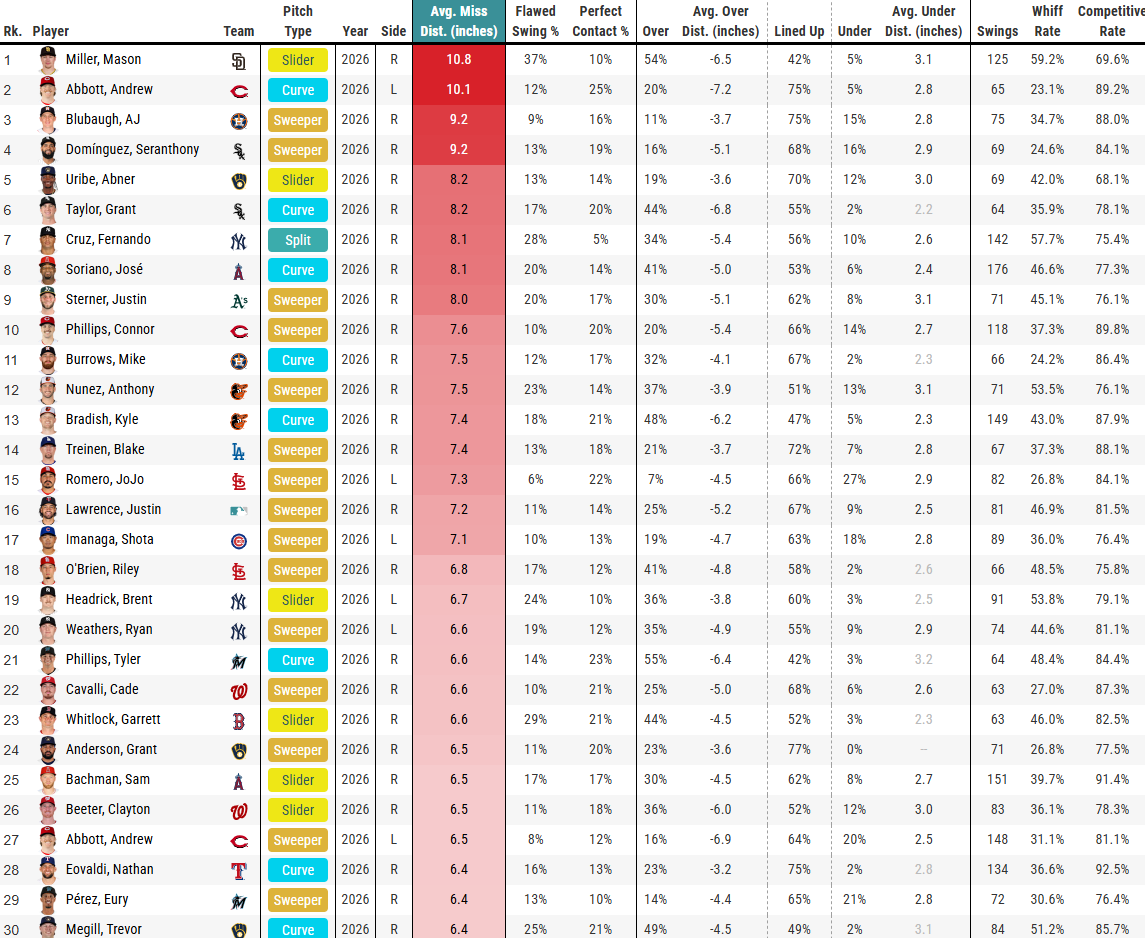
MLB Miss Distance Leaders by Pitch Type, 2026
Nope.
Abbott’s curveball is the only pitch in the game besides Miller’s slider with an average miss distance greater than 10″. Not only that, but he’s on this leaderboard twice. His sweeper is inside the top 30 in terms of average miss distance, making him the only MLB arm with two such pitches. His swing-and-miss rates on both the sweeper and curve aren’t terrible, but they aren’t great either. Were these numbers the missing piece of evidence in the case of how he’s been able to outrun his peripherals for so long?
The great thing about all this new data is MLB didn’t just give us miss distance and call it a day. On each swing, they break the position of the bat down into three dimensions: timing (early, on time, or late, in milliseconds), horizontal (tied up, centered, or flailed, in inches from the barrel), and vertical (over, lined up, or under, in inches from the barrel). That last one tells us the most about Abbott. With both the curveball and the sweeper, it isn’t that batters are swinging over top of them every single time. When they are, though, they look foolish.
Among all player-and-pitch-type combos in the league that elicit swings over top of the ball at a non-negligible frequency, Abbott’s breaking balls are at the top of the league in terms of how much batters are over top by when they swing. The sweeper is his go-to secondary against lefties, who have seen either a fastball or a sweeper a combined 93% of the time from Abbott this season. The curveball plays more of a tertiary role with a 17% usage rate against righties this season, behind the fastball and changeup. His two glove-side weapons are both miss distance outliers.
Even though the curveball is the true unicorn, I want to start with the sweeper because it’s easier to explain: Pitch models actually like it. Virtually every public-facing stuff model on the internet would tell you the sweeper is his best pitch, and the results this season back that up. It has some standout traits, with an average spin rate over 2,800 RPM and an average induced vertical break below the 0″ line, but what really sets it apart is its release characteristics. Abbott’s arm angle when he throws his sweeper is around 52°, 3rd-highest among everyone who has thrown at least 50 of them this season. It’s just not an easy pitch to throw from an over-the-top arm slot, but Abbott manages to generate above-average cut all the same. Hitters don’t often see stuff that moves like this from his release point.
It’s a nasty offering in itself, but that alone probably doesn’t explain why hitters are missing it this badly. Eno Sarris of The Athletic recently theorized that the best use of miss distance is to evaluate pitchers’ ability to sequence, tunnel, and cause hitters to guess wrong. Using that school of thought, Abbott is doing a wonderful job causing lefty hitters confusion as to what’s coming at them, primarily because his fastball and sweeper tunnel quite well.
Even though they end up on opposite corners of pitch movement plots, Abbott’s fastball and sweeper appear similar out of his hand thanks in large part to his over-the-top release. As the video below demonstrates, it isn’t until well into each pitch’s flight time that the horizontal action on the sweeper becomes decipherable. Abbott’s average vertical release angle on his sweeper is steeper than 90% of sweepers in baseball (min. 50 thrown) on account of his high arm angle. At the league level, fastballs and off-speed pitches usually have the steepest release angles, but Abbott’s sweeper gives the initial impression that it’s a fastball for a few extra milliseconds thanks to its initial trajectory out of his hand.
Naturally, when lefty hitters see a sweeper while assuming a fastball was coming, they miss by a lot due to the eventual divergence between their movement profiles as they approach the plate. The curveball, though, the pitch that misses bats by a larger distance than anything in baseball outside of Mason Miller’s slider, is a different story. Its release angles are considerably less similar to the fastball, thereby making it easier to identify early in its flight path. Stuff models aren’t as fond of it, so we can’t conclusively say that it’s a premier pitch on its own. What gives?
My best guess is that it’s a count-based usage skill. To lefties, Abbott’s approach is quite simple: Fastball nearly half the time and sweeper nearly half the time, with a negligible amount of curveballs and changeups. There’s more to unpack for righties. He throws the fastball about half the time and a changeup about a quarter of the time. The curveball is next as his primary breaking pitch to opposite-handers, but the sweeper (11%) cannot completely be discounted either. A right-handed batter can expect a good amount of fastballs regardless, but after that, it gets confusing.
Breaking things down by count allows us to see the specifics of Abbott’s righty approach. Even though the curveball is his primary breaking ball against righties, he rarely uses it in two-strike scenarios. He’ll throw a get-me-over curve from time to time and occasionally turn to it when he falls behind, but in swing-and-miss spots, he relies more on the sweeper and changeup. In fact, the sweeper is his most-used pitch behind the fastball in two-strike counts against righties this year despite the 11% overall usage rate.
Most of these patterns have been consistent for his whole career. I think this is because, especially lately, he trusts himself to throw the curveball for strikes, so when he needs to get control of the count, it becomes his main secondary (my favorite oxymoron in baseball). When he’s in the driver’s seat, though, he’d rather keep throwing fastballs or something soft out of the zone.
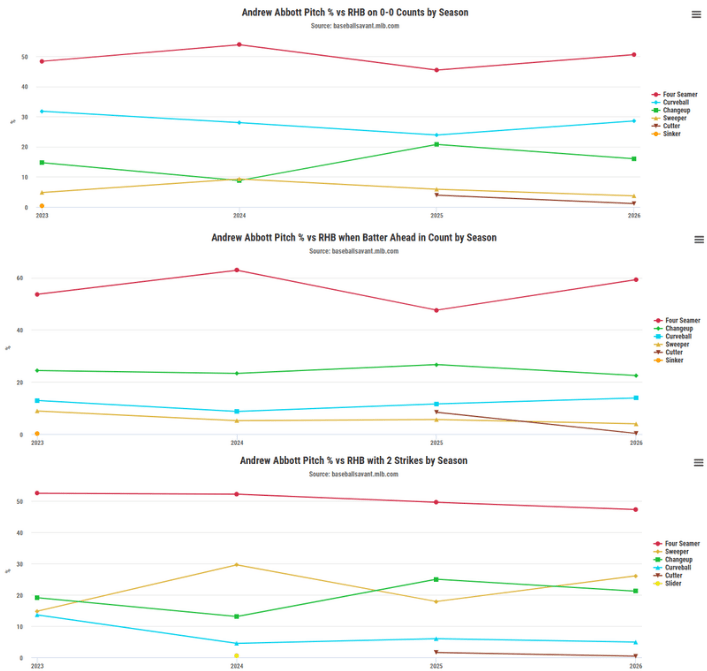
Andrew Abbott Usage vs RHB by Count (Statcast)
In more concise terms, the first pitch of an at-bat, as well as times when a hitter is ahead, are situations where Abbott is most likely going to throw a fastball, and the same is true for most pitchers in the league. Those are also the same spots where he’s likeliest to turn to his curveball, hence the outsized miss distance. It’s not an out pitch, but he deliberately uses it when hitters can most confidently sit on a fastball before proceeding with a fastball/sweeper/changeup mix with two strikes.
This is how you succeed at making sure the hitter doesn’t often know what’s coming. Not every starter in baseball has the capacity to throw multiple breaking balls to opposite-handed hitters, but Abbott has done it his whole career. Not only that, but when he’s at his best, he has pitch selection down to a science.
This may seem like a lot of fodder over a pitcher with below-average stuff and an 11% walk rate, but even though the results haven’t been as good this year, he continues to outpace his ERA estimators more than anyone else in the game, and miss distance is showing us how he’s getting there. His naysayers were ready to declare victory over the hapless traditionalists and Reds diehards after his miserable April, but he’s turned a corner since the season’s first month. A curveball with 10″ miss distance doesn’t change the fact that he has a 5.52 FIP against righties, but it’s nonetheless remarkable that he has that in his back pocket without a 102-MPH fastball that hitters have to respect or a large collection of nasty pitches in general.
Between the deception caused by his crossfire delivery, a fastball/sweeper tunnel, and a two-breaking-ball approach to righties, there’s a lot that separates Andrew Abbott from the conventional starting pitcher. Pitchers who can outrun ERA-related regression for this long are usually met with their share of skeptics, but the longer Abbott keeps this up, the more I’ll start to believe this might just be who he is.
All stats entering June 25, 2026.
