





Andrew Painter, the former top prospect for the Phillies, struggled in his first taste of the show, pitching to a 7.06 ERA, which is notably worse than his still-poor 5.52 FIP, 5.09 xERA, and 4.62 SIERA. His last four starts have all resulted in four earned runs or more, including six over just two innings against the Marlins on 6/17. Painter looks like a pitcher you win in spite of, rather than because of, and due to that, he was optioned to AAA Lehigh Valley after that dreadful Marlins outing.
Painter features a six-pitch mix, relying primarily on his four-seam fastball and slider, and will supplement these two offerings with a splitter and curveball against lefties and sinker and sweeper against righties.
He has a natural cut to his four-seam fastball with average ride, and his sinker is a dead zone offering – lacking the drop or run to induce soft contact. Due to his natural cut, his slider has a bit more break than the average righty, but also less drop in part because he throws it 1.5 mph harder than the average righty. The sweeper, splitter, and curveball have less movement than the average righty and are about average in terms of velocity.
The main issue for Painter is that his most-used pitch isn’t going to miss bats or induce weak contact, an issue that’s even more prominent against lefties, where his usage is significantly higher. Across the board, his fastball is underperforming in key metrics: xwOBA, swinging-strike rate, called-strike rate, and CSW
Even though his wOBA is higher than his xwOBA, potentially pointing to some positive regression, the xwOBA allowed on his fastball is in line with Shohei Ohtani’s 2026 mark as of writing. This is exacerbated when considering that it’s his primary weapon in all but two of the twelve count situations:
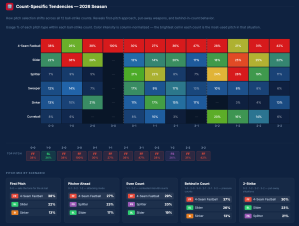
However, there is a solution, and the secondary pitches are the key to unlocking some of his potential.
Approach Adjustments
Slider: The Putaway Pitch
Painter has the elite putaway pitch for righties in his slider, which has a ridiculous 44% whiff rate against righties and misses bats both inside (78th percentile) and outside (82nd percentile Chase Contact) the zone. Against lefties, it’s still above average at missing bats with a 33.3% whiff rate and a minuscule 20% O-Contact rate.
One of Painter’s core issues, however, is that he’s not getting righties to expand the zone on his slider, with a chase rate of just 31.6% against righties (SP league average: 32.8%) while zoning the pitch only 29.6% of the time. Against lefties, he’s zoning his slider 52.2% of the time and getting a called strike 24.3% of the time (SP League Average on Sliders: 13.7%). The locations (pitcher’s POV) support this, as the LHH heatmaps are inside the zone, while the RHH primarily resides just off the plate.
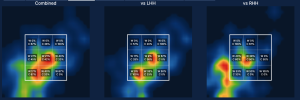
The usage chart in the first section highlights that the most common counts Painter uses his slider are when he’s down 1-0 (36%) or 2-0 (29%). Hitters are far less likely to expand the zone when they have that count leverage; he’s using his putaway pitch as a pitch to steal strikes with. The counts with the next highest slider usage are 1-2 or 2-2 counts (25%), which have a higher probability of a hitter looking to extend the zone, but the 18% usage in 0-2 counts needs to rise.
Getting to the Slider
Now we’ve established a way for Painter to put away hitters, but he needs to get to these favorable counts without relying so heavily on his four-seamer. That’s where his sweeper comes into play against righties, as he zones the pitch at a high rate (47.5%, SP League Average: 41.1%). Those early count sliders to righties can be replaced by his sweeper, and he can keep his out pitch in his back pocket. The heatmaps below highlight that Painter locates the pitch well:
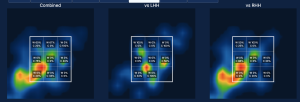
The issue right now with the plan is that everything is gloveside. For his four-seamers’ faults, Painter locates them gloveside, and while there are improvements that can be made (it’s all middle-in to LHH, and leaks over the middle to RHH as well), this is the right idea, as his natural cut will be more successful on this side of the plate.
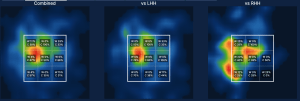
All three pitches discussed either break gloveside (Slider, Sweeper), or he locates gloveside. Hitters, especially righties, can cut the plate in half. That’s where his sinker and splitter come into play. Both pitches break armside, and while the sinker has below-average movement, it’s still a better option armside than his four-seamer. Should Painter be throwing his sinker as frequently to right-handed hitters as he currently is (20+%)? Probably not, but it is a tool in his toolbox that sets, and while the location to righties could be better as it’s all middle-in, it could be worse (middle middle, middle away in the sweet spot, etc). While the usage against lefties (2%) is too negligible to put weight into the locations, some more diversification with the sinker armside – especially into the upper third of the zone – would be beneficial to both righties and lefties, and would help set up his splitter.
The Splitter: Unlocking it all
The splitter/sinker usage is inverted, in that the splitter is reserved primarily for left-handed hitters, while Painter reserves the sinker for right-handed hitters, as mentioned above. That is something that immediately should be adjusted, as Painter’s splitter is his best option for missing bats in the zone (66.7% Zone Contact, 93rd percentile). With the splitter breaking further down from the sinker, and in the opposite direction of his slider, it’s a great bridge pitch for Painter’s arsenal.
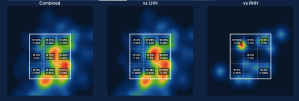
While Painter is susceptible to leaving the splitter too far up, he’s consistently locating the pitch armside. This gives Painter a tunnel between the sinker/splitter armside, and then he can play his slider and sweeper off of that gloveside. Of all of Painter’s pitches, the splitter has the second-lowest xwOBA (.245), behind only his curveball (.214 xwOBA), which is reserved primarily for 2-strike counts (0-2, 1-2, 2-2).
The splitter, having so much success missing bats in the zone, allows Painter to reserve his slider as that wipeout offering, while also setting up the sweeper and sinker for success. Right now, it’s a one-handed weapon, and extending that usage to righties is a simple adjustment that can lead to improved success for his other offerings.
Final Thoughts
The road back to the show for Andrew Painter starts with arguably the easiest adjustment: a usage tweak. Turn the fastball from the primary pitch to the occasional weapon to keep hitters honest and set up your other offerings. Dial back the four-seamer and sinkers to right-handed hitters, dial back the four-seamer to lefties, use the sinker a bit more up and away to play off the splitter, use the sweeper and splitter to get ahead of hitters, and put them away with the slider. Is he going to live up to the hype he had? I don’t think he will with this arsenal, but there’s a productive pitcher that can give the Phillies quality innings. He’s more talented than he’s shown this year, and hopefully we’ll see him pitch in the Show again soon.
