





As a member of the Baseball Writers Association of America since 2013, I’ve gotten to vote for the Hall of Fame for the past three years. It’s an honor, a privilege, and a responsibility I take earnestly, enthusiastically, and thoughtfully — no matter what anyone thinks of my ballots. I certainly see results every election that make me scratch my head, too, so I get it. But in general and throughout history since 1936, the BBWAA has done a sound job collectively of electing the right players for Cooperstown. For anyone who thinks there are too many players in the Hall, or that it’s watered down, it’s mostly not the fault of the writers. If anything, they’ve been glacially conservative, sometimes comically so. For more details, read “The Politics of Glory” by Bill James, or Jay Jaffe’s “Cooperstown Casebook.” Or, just review the election results.
It’s a flawed system, and I can agree with the point of view that says writers shouldn’t be voting on things like this at all, that they shouldn’t be “making” the news. And it is a shame, probably, that someone like Vin Scully never got to vote for the Hall of Fame, just because he was a team broadcaster and not a writer. But I also see conflicts and potential blind spots there, too, even with someone of his high quality.
And if you just had players and managers vote, it would be so much worse. There’s a historical record of it already.
It’s a little daunting to explain my process and philosophy. I watched all of these players perform, as a writer since 1998 and baseball enthusiast for 20 years before that. I compare a lot of statistics. I refer to FanGraphs WAR because it does a decent job of taking career snapshots. I read a lot of what other people write, and not only professionals. Fans. I respect ballplayers’ opinions and account for them, even if I disagree. I try to put things in context. I definitely try to be fair.
I don’t automatically disqualify a player for being linked to performance-enhancing drugs. Maybe I should. After all, they broke the rules. But I do disqualify individuals for being credibly accused of domestic violence. There’s a character clause in the voting guidelines that all players are subject to. It most certainly was not put there back in the day because of domestic violence, but it gives me a way to avoid voting for a person who should not be thrown a big party for being a great baseball player.
With that, and knowing that Carlos Beltrán and Andruw Jones were elected Tuesday night, here are the 10 players I voted for, along with my reasoning. In addition, I included reasons for voting no for seven others on the ballot. There were 27 players total. We can vote for up to 10 (which is not enough — there should be no limit).
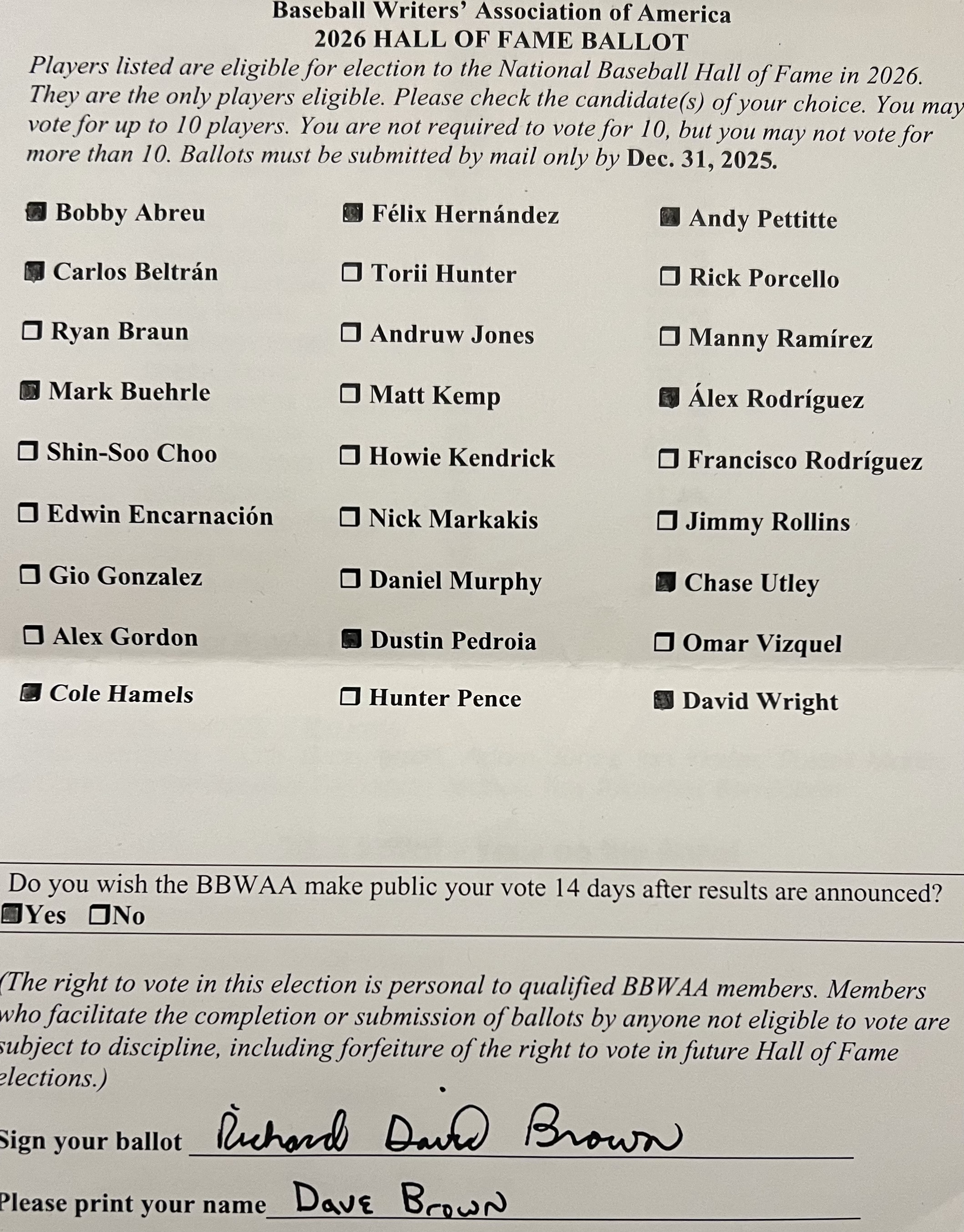
Yes
His 67.4 fWAR ranks 28th all-time among outfielders and is better than 48 outfielders already in the Hall of Fame. Jaffe’s JAWS system ranks Beltrán the No. 9 center fielder ever. JAWS emphasizes an individual’s peak seasons and compares them to those already in the Hall of Fame.
Beltrán won AL Rookie of the Year, made nine All-Star teams, received MVP votes seven times, won three Gold Gloves and two Silver Sluggers. He is 59th all-time in times on base, 25th in extra-base hits, 53rd in runs scored, 34th in total bases, 41st in RBIs, 92nd in walks and 162nd in stolen bases.
His role in the Houston Astros‘ sign-stealing scandal that used high-tech surveillance equipment and trash cans no doubt has cost him votes and delayed his induction. Voters have been left to conclude if the good outweighs the cheating, if Beltrán is worthy of forgiveness, or some combination.
He’s one of the 10 or 15 best position players of all time, registering better fWAR than Mickey Mantle, Rickey Henderson and Mike Schmidt, to name a few. Rodríguez hit 696 home runs (fifth all-time) and ranks in the top 10 in runs scored, total bases and RBIs. He also admitted to using performance-enhancing drugs (after repeatedly denying it). As with Beltrán, voters have been left to put A-Rod’s transgressions into perspective.
3. Chase Utley
JAWS ranks Utley as the 12th-best second baseman ever. Utley’s fWAR ranks higher than that of Ryne Sandberg and 11 other second basemen already in the Hall of Fame. A six-time All-Star who got MVP votes five times, only seven second basemen have more home runs, and only 17 have more RBIs than Utley.
He never won a Gold Glove, but that was a mistake by voters at the time, and a lot of Utley’s HOF case rests on his defense. Since Utley’s first season (2003), only one second baseman (Mark Ellis) has more total runs saved. Utley actually ranks 11th among all players at every position in TRS since ’03.
Since integration in 1947, Utley ranks as the ninth-best offensive second baseman and the 13th-best defensive second baseman at FanGraphs. Of the nine Hall of Fame second basemen with better offensive numbers than Utley, only two (Rogers Hornsby and Charlie Gehringer) have better numbers on defense. Of the 11 players in the Hall of Fame with better numbers on defense, only Hornsby was a better hitter.
The best case against him: Utley’s career was relatively short. He ranks 35th all-time in plate appearances among second basemen, and only six Hall of Famers at second base have fewer PAs. It’s true that there are better second basemen out there, not in Cooperstown, who should be. But Lou Whitaker and Bobby Grich aren’t on any ballots.
Utley this time gained about 20% on his 2025 vote total.
4. Bobby Abreu
Abreu’s record is much closer to that of an average Hall of Fame outfielder than a fringe one. Would rank 37th in fWAR among AL and NL outfielders already in the HOF, right between Dave Winfield and Andre Dawson, and better than 34 (or so) Hall of Fame outfielders. Criticized for being a stat compiler and for playing below-average defense, Abreu’s offensive peak is substantial, and his defensive peak, while shorter, was stronger than his reputation suggests.
Abreu had seven individual seasons (all consecutive) with an fWAR of 5.2 or higher. He also had three fWAR seasons of 6.3 or higher, though none of this properly reflected in MVP voting. Voters might have held his lack of home-run power against him, with Abreu hitting 30-plus homers only twice in his career. Abreu’s offensive pop came with doubles, and while he only led the league in one season, his 574 career doubles rank 25th all-time. He also ranks 20th all-time in walks, 25th in doubles, 61st in extra-base hits, 74th in stolen bases, 82nd in runs scored, 83rd in on-base percentage and 88th in total bases. Yeah, he was a compiler of great stats, which happens to be a great way to help teams win ballgames.
He won a Gold Glove and was a plus fielder in multiple seasons, perhaps six or seven, though he had several poor seasons defensively, too. He’s 28th all-time in outfield assists. He could run and had a great arm in his prime. He made only two All-Star teams, but the competition was stiff in his time. The voters missed frequently on Abreu (and continue to), no matter the platform.
Injuries shortened Pedroia’s career, as they did with Sandy Koufax, Kirby Puckett and other Hall of Fame players. Only two second basemen in the Hall had fewer career plate appearances than Pedroia (and one was Jackie Robinson, whom you can’t really count because of time lost to the color barrier and military service).
Pedroia ranks 28th in fWAR among second basemen and 20th in JAWS at his position. That’s certainly pushing the envelope, given that there are 21 second basemen in Cooperstown. Pedroia doesn’t have the counting stats that most others do. Only four HOF second basemen have worse fWAR.If he’s ever inducted, Pedroia would rank near the low end of all second basemen.
If the objective were to rank the best second basemen ever, the shortness of Pedroia’s career would push him down the list. But it shouldn’t keep him out of Cooperstown entirely. When he was healthy, Pedroia had several great individual seasons — one 7.9 fWAR (2011), another 6.3 (2008), three that were 4.3 or better, and four that were in the 3’s. Not many second basemen can say that historically. He won AL Rookie of the Year in 2007, AL MVP in ’11 and finished in the top three in voting twice more. He won four Gold Gloves, which is backed up with the available stats. He was, at times, clearly one of the best players in the league, regardless of position on both sides of the ball.
6. David Wright
Wright had a similar career to Pedroia, playing great while healthy until a spinal injury ended things. He played not even 80 games total after his age-31 season in 2014. Wright, like Pedroia at second, would be among the lower end of the third basemen in Cooperstown, with only four players at that position with fewer fWAR. JAWS ranks him 27th at third base, with 19 players at third in the Hall of Fame.
Wright made seven All-Star teams, won two Gold Gloves and two Silver Sluggers. He received MVP votes six times and finished in the top 10 four times, though never higher than fourth. His wRC+, a comprehensive measure of offensive production at FanGraphs, ranks 14th all-time among qualified third basemen (just ahead of George Brett and Wade Boggs). It would rank seventh among all third basemen in Cooperstown. His slugging percentage among third basemen ranks 17th all-time. Wright’s win probability added ranks just ahead of recent inductee Scott Rolen.
He had five individual plus seasons on defense with runs saved, but Wright’s overall defense would rank in the lower half of those in Cooperstown.
Threw only 2,729⅔ career innings and didn’t have much of a career after age 30, but analysts need to adjust how they grade starting pitchers when it comes to the Hall of Fame, because the position is lagging way behind others on the diamond. How the game is played has evolved. Managers just don’t ask starting pitchers to do what they used to. We shouldn’t judge pitchers like Hernández against outdated standards. Contemporary pitchers can still be great, the results just won’t look like they did 25 years ago.
Hernández ranks 69th all-time among pitchers in fWAR (between Hall of Famers Koufax and Ted Lyons), but he compares more favorably to his contemporaries. He was No. 1 in fWAR (50.1) from 2006-15, his first 10 full seasons — better in that span than Justin Verlander, CC Sabathia and Zack Greinke.
He won a Cy Young (2010), was a two-time ERA champ, a six-time All-Star, and once led the league with five shutouts (2012). King Felix had a great peak. I should have voted for Hernández a year ago, but he continues to make strides in the public balloting, so I’m not the only one who sees their error.
8-10. Andy Pettitte, Mark Buehrle, and Cole Hamels
We are finding in modern baseball that there is value, and even greatness, in being a very good pitcher over a period. Pettitte, Buehrle and Hamels didn’t have huge strikeout numbers, and they didn’t win ERA titles or Cy Young Awards, but each was among the best pitchers of their era for more than a decade. Each helped their respective teams win a championship (Pettitte’s New York Yankees won four times). Each had multiple individual moments of greatness, whether it’s having a big performance in the World Series, or throwing a no-hitter or a perfect game, Pettitte, Buehrle and Hamels demonstrated they were great. We just need to know where to look to prove it.
Pettitte ranks 34th all-time in fWAR among pitchers, better than Tom Glavine, Jim Bunning, Roy Halladay, Bob Feller, Juan Marichal and Don Drysdale, and at least three dozen other Hall of Famers from the AL-NL. He’s about the 66th percentile for fWAR among Hall of Fame pitchers. Pettitte’s peak wasn’t as high, with JAWS ranking him as the 82nd-best pitcher ever, which is still better than nearly 20 pitchers already in the Hall of Fame. The fWAR and JAWS lists do not account for Pettitte’s success in the postseason, where his teams went 23-9 in his 44 career starts. He has an AL Championship Series MVP to his credit.
Buerhle and Hamels are less clear-cut. Buehrle finished with 52.3 fWAR and Hamels 51.6, which puts them about 33rd percentile among starting pitchers in Cooperstown. Buehrle pitched a no-hitter and a perfect game, and helped the White Sox win the World Series in 2005. One of the best fielding pitchers of his era, Buehrle won four Gold Gloves. He was a five-time All-Star, with nobody pitching more innings from 2000-15.
Hamels pitched a no-hitter and pitched another 100 innings in the postseason, helping the Phillies win in 2008, when he was named World Series MVP.
No
Andruw Jones: Arrested for domestic violence committed against his wife in 2012, he hasn’t gotten my vote for the past three years. He otherwise might have, based on his career accomplishments (mostly on defense). Jones, along with Beltrán, was elected on Tuesday.
Manny Ramirez: One of the five or 10 best hitters ever, but he also was arrested for domestic violence against his wife, so he hasn’t gotten my vote. He will fall off the BBWAA ballot after this year, having come up well short of induction for the 10th straight year — presumably because of his PED violations. He might get in someday (in a decade or two?) if he can find a friendly oversight committee.
Ryan Braun: He has solid hitting credentials, along with a tale of injuries that shortened (and/or blunted) his career, similar to Pedroia and Wright. He was the NL Rookie of the Year, the NL MVP, a six-time All-Star, and a five-time Silver Slugger (which is really hard to do). He just didn’t perform well enough for long enough (43.4 fWAR). Being a PED guy doesn’t automatically disqualify a player for me, but the way Braun handled it was about the worst one could do. Some people deserve the benefit of the doubt, and then there’s Braun. After getting less than 5% of the vote, he has fallen off the ballot.
Jimmy Rollins: He doesn’t miss by a lot, but he still falls on the outside. He won an MVP and four Gold Gloves (his defense was terrific), but his hitting was just too ordinary overall. His JAWS ranks 34th among shortstops, so his peak was too short in length and height.
Omar Vizquel: I won’t vote for him because of credible domestic violence allegations, plus additional abuse accusations of a bat boy in the minor leagues when Vizquel was the manager. I likely wouldn’t vote for him anyway. In his prime, Mike Hargrove called him the best defensive shortstop he’d ever seen, but the metrics we have say that’s an overstatement. Vizquel certainly wasn’t better than Ozzie Smith. He probably was closer to the 10th-best defensive shortstop than the first. Good for him.
Francisco Rodríguez: He’s sixth all-time in saves, so he’s probably being overlooked by voters based on the totals that have come in. He also has a domestic violence history, so that’s a no from me.
Torii Hunter: A nine-time Gold Glove winner, Hunter at his peak was a spectacular defensive center fielder who frequently made highlight-reel plays. But he also had several seasons where the available stats didn’t back up the Gold Glove hardware. His hitting, about 10% above league average, just wasn’t robust enough.
None of the other 10 candidates, who were first-year players on the ballot, deserve a vote — other than for sentimentality.
