





Prior to their game on July 25, the New York Yankees acquired Ryan McMahon from the Colorado Rockies in exchange for prospects Griffin Herring and Josh Grosz. This trade followed endless buzz in the trade market, linking the Yankees to various third basemen to replace Oswald Peraza’s lackluster offense.
In addition to acquiring Amed Rosario, who could share time at third with McMahon against lefties, the Yankees traded from one of their biggest strengths in the minors—pitching depth. Both Herring and Grosz were drafted in the last two years out of the mid-to-lower rounds, yet have already shown promise in the lower levels of the minors.
As the Rockies are clearly sellers, they had reason to shed the ~$36 million owed to McMahon through 2027 despite extending him just a few years ago. It also allowed them to acquire some long-term prospective talent, as neither Herring nor Grosz is projected to debut in the Majors until 2027.
McMahon is also far from a given for the Yankees, as his poor numbers on the road have raised skepticism about his offensive potential in Yankee Stadium. Still, it’s worth going into how each player’s potential can play out at either Yankee Stadium or Coors Field, and seeing how McMahon’s stats could look down the stretch in 2025.
Yankees get:
Ryan McMahon
After signing a 6-year, $70 million extension with the Rockies in 2022, McMahon has played four full seasons, averaging a 95 OPS+ and elite defense. While playing 3B, McMahon has had a Fielding Run Value of at least 6 each year since 2021, when he started playing third full-time. McMahon is assumed to replace Oswald Peraza at third base nearly full-time—if his OPS+ were to remain fairly unchanged, it would be a 70-point increase from the light-hitting Peraza without losing much of Peraza’s strong defense.
However, this assumes McMahon is able to sustain his Coors-boosted offense at normal altitude, which has already shown to be a problem in 2025.
While his batted ball tendencies have been less drastic, McMahon’s results on the road have been abysmal compared to his numbers at Coors. While stark, these changes are par for the course when it comes to lefty sluggers in Coors.
Look at Carlos González in his 2010 MVP finalist season—1.161 OPS at home, .775 OPS on the road. Charlie Blackmon’s 2017 all-star season—1.239 OPS at home, .784 OPS on the road. While McMahon isn’t exactly the hitter these guys were, it’s nothing new to see stark home/road splits for a Rockies slugger.
Does this mean Gonzalez or Blackmon would’ve been mediocre players outside of Coors? Not even a little. In 2016, Blackmon had a .939 OPS at home and .926 OPS on the road. In 2013, Gonzalez had a .930 OPS at home and .987 on the road.
This is to say that home/road splits, as a Rockie, are not good predictors of future success. Hitting at high altitude requires certain approach changes to account for less “magnus force“—for example, McMahon hit an infield fly 7% of the time on the road compared to 2% of the time at home. This likely derives from the induced vertical break being far less variable in Coors and thus making McMahon less likely to pop up a fastball with high backspin.
Among many other park factors in Coors, such as its huge outfield and higher carry on fly balls, McMahon’s swing and approach are formulated with these things in mind. Now, going from playing at high altitude half the time to less than 1% of the time, McMahon will likely change parts of his swing and approach to account for a new hitting environment.
To say exactly how McMahon will adjust is impossible. Still, some changes he’s made to his approach overall are well-suited for Yankee Stadium – a career-high 93.9 mph average exit velocity, 18.7% pulled fly-ball rate, and 12.9% barrel rate are all good indicators for success. In the meantime, look for McMahon to continue playing sharp defense while hopefully adding some power to the bottom of the Yankees’ lineup.
Rockies get:
Griffin Herring
Data via Fangraphs
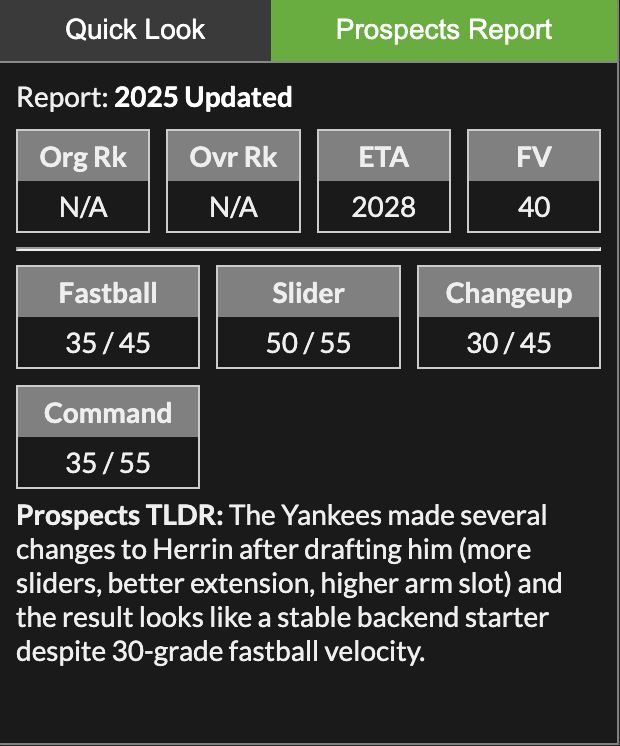
Despite being drafted just a year ago, Herring quickly made a name for himself as a breakout pitching prospect in the Yankees’ farm system. Through 16 starts split between low A and A+ ball, Herring has posted a 1.71 ERA/2.91 FIP with an 18.4 K-BB%.
Herring sits 89-92 with a two-seam as well as a slider/changeup/four-seam, with his slider likely being his best offering. Herring has excelled at preventing home runs while generating elite whiff rates, although hard-hit and walk rates have been below average.
For now, Herring’s low velocity, along with a limited arsenal, has kept him from skyrocketing through the Yankees’ system. Now faced with developing in Coors, Herring will likely have to add some velo and improve his command over the next few years to make an impact in Colorado.
Josh Grosz
Data via Fangraphs
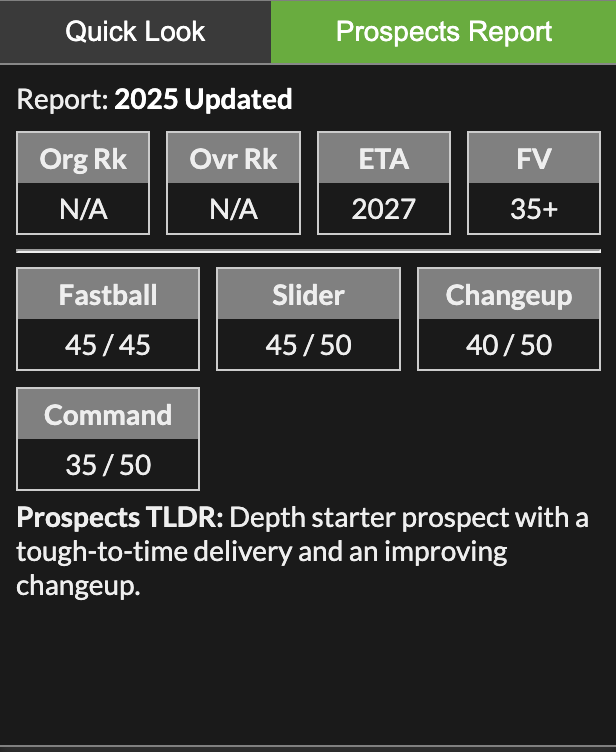
Grosz, drafted a year earlier than Herring, is more of a depth piece for the Rockies than Herring. Grosz sits 92-95 with his four-seam with a plus slider and developing changeup, and has a 4.14 ERA/3.37 FIP over 16 outings in A+.
Grosz will likely require a more developed arsenal with improved command to succeed in the Majors. Still, he’s a long-term project that could be key, along with Herring, to get their pitching in shape for an eventual rebuild.
