





Another year, another enigmatic season for Bryce Miller. Yet again, we go from start to start, never exactly sure what to expect from him. After a miserable 2025 season, he started the year on the IL with an oblique strain that kept him off the field until mid-May. He came back with his hair on fire, putting up nonstop lights-out performances. It took nearly two months for his first start with more than three runs allowed. And then, just as quickly as the breakout started, it was gone. He’s been cold for a month now, leaving us all with questions. Was it for real? Is this slump something to worry about? And why is he throwing his pitches like that? There’s a lot to get into; let’s establish the basics first and go over what he’s working with.
The Pieces
Miller throws seven pitches, each with merit and potential. I’ll keep this short and focus on the most relevant information about each pitch so both of us aren’t here forever.
Miller’s bread and butter is his 4-seam fastball. This is an excellent pitch with good velocity and elite vertical movement from a lower-than-average release. His high arm slot makes this a bit more expected, but he drops down in his delivery to create a flat VAA that helps it generate whiffs. One added note is that he’s cutting this pitch a bit more this season, as he did in 2024. It’s not a huge difference, but it does create a slightly more unique look for this pitch. Reducing horizontal movement in a way that pushes it further from what’s expected from his release makes it theoretically harder for hitters to get the barrel on it.
Miller doesn’t sell his arm action very well on his splitter, but it’s never made a difference; the pitch is potentially too nasty to really fail. With 14” of IVB separation and 11.2 mph of velocity separation from his fastball, if hitters think fastball for even a millisecond out of his hand, it’s too late for them to do anything with this pitch.
Miller’s most used breaking ball is a tight gyro slider in the mid-high 80s. It’s not the most interesting pitch of all time, but it’s good by virtue of being a hard gyro slider with solid depth.
The first of Miller’s platoon-specific pitches is a slurvy sweeper with a lot of depth and substantial velocity for how it moves. He’s gained a lot of confidence in this pitch this season and is using it to great effect; more on that later.
Miller throws a cutter with a somewhat abnormal shape. Its IVB is about what I would expect given where his fastball and slider sit, but it gets just as much horizontal movement as his slider, which is a bit strange. Cutters are already difficult to break down in this way, but this one especially is going to be a difficult eval. For organizational purposes, I’ll end this part of its breakdown with: “This could work”.
After it got knocked around last season, Miller has almost completely abandoned his sinker this year. The cost of his unique 4-seam is that his sinker has a bad shape that only works in the context of his arsenal, severely lacking in the depth normally expected from a sinker to induce groundballs. It mostly relies on movement separation from the 4-seam to do its job. It did so in 2024, but not so much last year. Again, we’ll get to that soon.
Last up, inexplicably (kind of explicably) is a 60-grade curveball. This pitch rules. Thrown with power, depth, and a tight 12-6 shape, this pitch has the potential to be one of his best; it’s just hiding on the bottom shelf, hidden behind the rest of his pitches. There’s a reason for this, but it’s probably not the one you’d be expecting.
The Current Methods
He’s got a strong, deep arsenal of mostly good-great pitches. On top of that, he was pitching ridiculously well to start the year. So what’s changed? I’ll save you wondering now; he’s not doing much substantially different than he was earlier in the year. His pitch usage is fluctuating within “normal” parameters, for him at least.
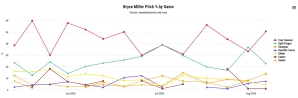
His fastballs are drifting lower in the zone than normal, which is probably part of why the whiff rate has plummeted in the last five starts, but it’s a symptom of a larger change. He’s using his pitches kind of oddly this year, and even after finishing looking into it, I’m not entirely sure what to make of it. It’s definitely not traditional optimization; that much I’m confident in. Even with the support of strong underlying numbers this season, I never fully believed in his hot start because of this. It’s difficult to accept unique game plans until we see them work long-term. Let’s start by looking at how he’s using his pitches individually. As it has for Miller since his debut, everything revolves around his 4-seam, so that’s where we’re starting.
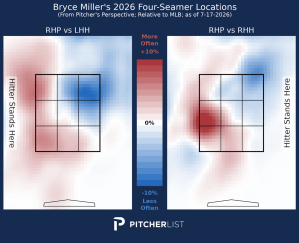
Why? Why is this what we’re doing? After having a breakout campaign in 2024, he regressed heavily in 2025, largely due to a complete reversal in fortune on his 4-seam. Some of this, I think, can be explained by the following:
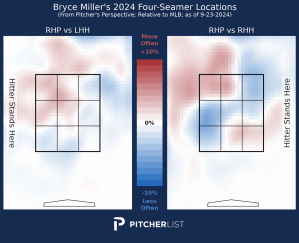
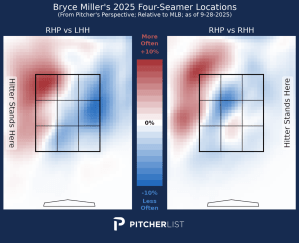
What was a pretty normal 4-seam location heatmap with faint red above the top of the zone where you want a 4-seam like his to be moved into pelting the high glove-side corner at will. He’s clearly got a talent for throwing it there, and that location can work to set up his other pitches, but using a primary fastball that you regularly throw in excess of 45% of the time in this way makes you predictable. He’s not even switching it up based on the batter’s handedness to throw high and away to theoretically reduce barrels; it’s always to the same corner.
One thing that surprised me while researching this was that his number of 4-seamers in the shadow and chase zones directly above the plate but out of the zone have remained remarkably similar year to year, making up around 13% of his 4-seams; they just gravitated toward the glove side. It’s actually gone up in 2-strike counts, and that hasn’t changed in the last month. It’s the fastballs located elsewhere that have started to give him some trouble. It was working until a month ago, though. There’s been no stuff loss; all of his pitches have remained within their normal bands of velocity and movement. We’ll have to come back to this in the big picture strategy section.
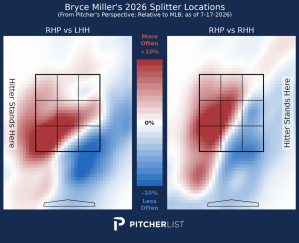
Next pitch’s evaluation is nice and easy; the splitter is not causing him problems. Even if he doesn’t drop it below the zone quite as often as I’d like, it hasn’t gotten him into trouble even when he’s missed higher with it. He just pounds the glove side to tunnel it with the 4-seam as best he can, and is more than happy to leave it in the zone because nobody seems to be able to do anything with it even when they get the bat on it. His forcing the issue by being aggressive with this pitch allows it to post elite strike and swinging strike rates at the cost of raw whiff rate looking average.
Judging his slider requires a bit of nuance. He has good feel for hitting the glove side, as well as throwing it low, but he doesn’t always push far enough in those directions, leaving it stranded deeper in the zone in those sections. While those aren’t terrible spots for a gyro slider, the rate at which he does this has allowed for hitters to put a beating on this pitch. He likes to use this pitch against lefties, but the issue is that when you aren’t properly burying gyro sliders in platoon matchups and getting those backfoot spots, they suddenly become a problem.
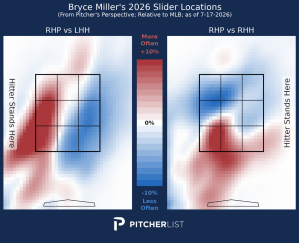
You can see the potential. He’s hitting the right spot at an above-average rate. Unfortunately, the red blotch extends well into the strike zone around waist height, which is not where you want any pitches to be.
His sweeper is an interesting, albeit quick study because he uses it like a finishing move. It’s his “Get over here!” Against right-handed hitters. 55% of all of his sweepers have come in 2-strike counts, returning a 43.2% chase rate in those situations. It is not difficult to see why.
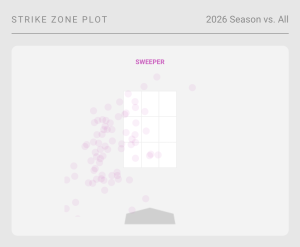
When I made that reference in the last paragraph, I meant it. It’s like he’s actually forcing righties to send their bats flailing across the zone to a pitch that’s out of reach. Very fun to see a pitch that has mediocre strike-based stats be so effective.
I’m going to cheat a bit and skip ahead to his curve because he uses it the same way, except against lefties. We’ll loop back to the cutter and sinker after this, but the usage on these two pitches is too similar to not do them together. It’s actually more extreme in this case. 58.2% of his curves come in 2-strike counts. While it’s been less effective than his sweeper in this role, generating fewer whiffs, it’s still doing the job well enough. It’s a small sample, though I think these results track with how he’s been throwing it. His command of this pitch is just average compared to his sweeper, which he has an exceptional knack for spotting, ideally. Worth noting is that it used to be better, but has regressed since 2024, starting last year. He no longer seems interested in trying to zone this pitch, and it didn’t get him that many called strikes when he was trying that previously.
Alright, less fun now. His cutter is going to give me a headache if I stare at the numbers too long. I had to remind myself that there’s a lot of small sample noise here. Even the faster-stabilizing metrics aren’t at enough of a sample to really take seriously, but we’re going to look at the numbers for a second because they’re weird. Just please take these with the entire salt shaker rather than just a few grains.
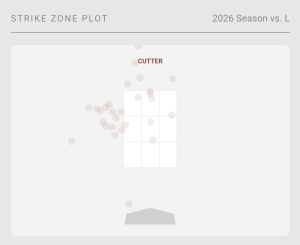
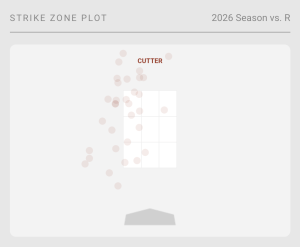
We see what’s happening here, right? The small sample is killing the batted ball results because he’s given up three homers out of just 63 pitches. This actually includes both of the last two cutters he’s thrown at the time of writing. One of them wasn’t even in the zone. To counteract the slack we’d cut him for that, the other two he’s allowed were down the middle. Regardless, he’s generally locating this pitch well; he’s just had the misfortune of exceptional batter performance against the small number of mistakes he’s made. I think even in the tiny sample, the chase and swinging strike rates stand out and are at least somewhat indicative of how he’s been spotting this pitch. I can’t even ask him to get it further to the glove side against righties because he’s already doing that at an exceptionally high rate, just shy of 70%.
Lastly, there is his sinker. There’s nothing to go on here. There’s no clear trend of what he’s trying to do as there is with the cutter. He’s zoning it a lot; that’s about it. It leans to the arm side but not by as much as most sinkers do. It’s catching more of the middle thirds of the zone both horizontally and vertically than I’d like. I think trying to speculate further on whether there’s a strategy in the midst of a small scattered sample is pointless. 56 pitches with no obvious trends in results or execution doesn’t leave me with much to say; but I tried.
Untying the Gordian Knot
We’ve talked about the plethora of tools at his disposal, and how he’s using them. Now comes the hard part: How do these pieces fit together? What’s out of place, and what should stay locked in? It’s funny to say it after I stated earlier that I hadn’t bought into what he’s been doing this year, but I think he actually just suffered a bit of misfortune and regression to the mean over the last month rather than hitters actually fully adjusting to his game plan. It’s difficult to do so when he changes it every game, as you might recall from his game-by-game pitch percentage chart from earlier. This effect is dampened slightly by the consistency with which he sticks to his planned pitch execution, though.
Miller is known to be a nerd about pitching, and it shows in his relentless tinkering. It also shines through in all the high-quality pitches he’s developed and found uses for. The usage change from game to game is one thing, but we also see significant modifications year to year. Since his second season, he’s thrown 40-45% 4-seamers, and everything else has seen variation. He’s increased splitter usage each year. He was using his sinker regularly for two years and notably quite well early on, and now it’s nearly shelved. The curveball went from an afterthought to a legitimate secondary to a strikeout hunter only. It goes on like this.
It’s hard to get a read on what works for him because he doesn’t usually do the same things for very long. Similar 4-seam execution that saw this pitch tagged last season has led to success this year. This has been the number one cause for his turnaround. When something remains the same but sees different results, we check its context. In digging for it, I found what I believe is the answer for his fastball’s performance this year.
Remember when Yoshinobu Yamamoto came to MLB and refused to throw his 4-seam high? More than just about anyone else, he’d throw it in the lower half of the zone to tunnel it with splitters low and out of the zone. Bryce is doing a modified version of that. He’s throwing his 4-seam lower and using his knack for hitting the glove side still, but he’s shifted his two main secondary pitches over there now to get them to play better together. On top of that, the cutter and sweeper increasing in usage lines up with this scheme. The splitter especially, given its usage rate, is why I think it’s been working.
Despite his prosperity with this new roadmap this season, his fastball is returning a strange pitch profile, in which hitters are swinging at it constantly. Where Yamamoto was getting takes on fastballs down the middle, Miller is getting swing after swing against it. This has always been true for him, though. I think some of it is related to reputation and scouting as much as it is the active locations he’s throwing them. When a hitter faces Bryce Miller, the number one thing in their mind is that they have to be ready for the fastball because he’s going to attack with it.
His fastball can survive in the zone; even this year, its 19.1% zone whiff rate is still above average despite being the first time Miller’s dipped below 20% in this metric. Out of the zone, his whiff rate has fallen significantly since 2024, and I think this is an effect of the glove-side approach he’s taken. However, I’m not convinced it matters that much, as the result of the lower whiff rate here is primarily just foul balls and bad contact. His PAR% with the 4-seam has actually increased this year.
Despite the new locations, his fastball is also garnering substantially better results on contact than it did in his 2024 breakout campaign. This is almost certainly due to the context he’s throwing it in with his other pitches, as well as higher pitches technically being easier to get the bat under. But when you cut your barrel rate on your primary fastball to just over a third of what it was during your best season, you must be doing something right. The hard-hit rate has also dropped from that season. Perhaps most impressively, the stats on contact have improved despite a more normal popup rate, dropping from 19.2% to 15.1%. It hasn’t mattered that the pull rate has increased, because over the course of the season, batters aren’t hitting it well enough for the direction to matter much.
We don’t have to dive as deep into the other pitches because most of what he does rides on the fastball. The successes of his secondaries can be explained by going back to what he’s doing with them individually and comparing it to the heater and seeing that pretty much everything but the sinker (and the curve a little bit) has been tailored to play off his primary pitch. The only one that’s really struggled with enough sample to say it could be doing better is the slider, and we already went over how he just needs to make sure he’s burying it down and to the glove side further. If it comes at the expense of hitters watching a few more of them pass by for balls, so be it. It’s not like walks have been an issue for him this year anyway.
I said earlier that he’s been on a rough stretch for a month now. That’s around the point that it starts to feel like a trend. Somehow, that trend wound up being bad sequencing and luck. Against what we’ll call modern conventional wisdom, everything points to his new weird strategy being something that actually works for him. I went into this expecting to talk about his potential to improve and what he could be doing differently, but I’m not sure I can advocate against something that seems to be working objectively better than anything he’s tried previously.
Miller has a 4-seam that was practically (probably literally) designed in a lab to generate whiffs at the cost of loud contact when it does get hit. Despite this, he’s using it like it’s a cutter. He has found a way to go against the grain and find a happy medium of performance that still allows him to get strikeouts, while also reducing the danger presented by the balls put in play against it. Furthermore, condensing his pitches to one side and getting them all to work with each other has led to literally every one of his seven different pitches improving in chase rate this season.
He’s found his strikeouts again. He’s cut his walk rate down to just 4.9%. His overall xwOBAcon is down 90 points, and his xwOBA is down more than 100. It’s obscene. He has somehow improved every facet of his game even though his two primary pitches are not being thrown in the theoretical ideal locations, and that is being done on purpose. Even coming to an understanding of why and how it’s working, it feels like it’s defying logic. Despite that, there’s something comforting in a pitcher finding success with unconventional means. It suggests to me that if this strategy were eventually to start to fail him due to hitters’ adjustments, he could always try what everyone else is doing. What a novel concept.
