





Cade Cavalli’s career in amateur and professional baseball has been filled with adversity. As a college freshman in 2019, he missed most of the season due to a stress reaction in his right arm, and his excellent sophomore season in 2020 came to an abrupt end when the remainder of the season was cancelled due to the pandemic. Drafted 22nd overall in the 2020 draft by the Washington Nationals largely due to his upside and physical tools, Cavalli made his Major League debut in 2022, starting one game before experiencing shoulder inflammation. Shortly thereafter, Cavalli experienced a UCL tear, which required Tommy John surgery, causing him to miss the entirety of the 2023 season and a majority of the 2024 season.
While the road back to the Majors after experiencing these injuries in succession is certainly a long one, Cavalli has overcome these obstacles and made his return to the Major League level this month, and has done nothing but impress on the mound. Over his first three starts, Cavalli has produced a 2.20 ERA, 2.90 FIP, and 14.5% K-BB, providing optimism that he can be an important piece of the Washington Nationals‘ starting rotation moving forward. This article will take a closer look at Cavalli’s return, examine the changes he has made to his arsenal since 2022, and attempt to prognosticate Cavalli’s level of production moving forward.
As mentioned earlier, this season has been Cavalli’s first full season at the professional level since 2022, due to missing nearly the entirety of the past two seasons due to his UCL injury. In 17 starts at the Minor League level this season, Cavalli produced a 24.7% strikeout rate, 9.4% walk rate, 56.9% ground ball rate, and a 3.97 xFIP over 74.0 innings pitched, which was good enough to earn a promotion to the Major League level on August 5th. Cavalli has continued to combine an above-average K-BB% with an above-average ground ball rate at the Major League level, producing a 20.3% strikeout rate, 5.8% walk rate, 52.9% ground ball rate, and a 3.53 xFIP over his first 16.1 innings pitched at the Major League level this season.
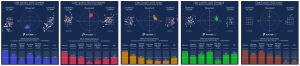
As shown by the tables above, Cavalli’s pitch arsenal consists of five pitches: a knuckle-curve, a four-seam fastball, a sinker, a changeup, and a cutter. Against right-handed hitters, Cavalli predominantly uses the knuckle-curve, four-seamer, and sinker, while increasing the usage of his changeup against left-handed hitters (4.9% usage vs. RHH, 25.4% usage vs. LHH). While three starts at the Major League level is perhaps too small a sample size for platoon splits to be very reliable, Cavalli is currently performing better against left-handed hitters, producing a 24.2% K-BB and 2.90 xFIP against left-handed hitters while producing a 5.6% K-BB and 4.72 xFIP against right-handed hitters.
While on-field results can take a larger sample size of pitches to become reliable, pitch quality models, which evaluate pitches solely based on their velocity, movement, and spin characteristics, become reliable in small sample sizes and can be useful tools to evaluate the effectiveness of Cavalli’s arsenal so far this season. As shown by the table above, pitch quality models such as Stuff+, StuffBot, and aStuff+, each grade Cavalli’s arsenal as above-average, with a 106 Stuff+, 56 StuffBot, and a 102 aStuff+. aStuff+ and StuffBot believe that the sinker is the best pitch in Cavalli’s arsenal (with StuffBot grading the pitch as one and a half standard deviations above league-average), while FanGraphs’ Stuff+ is a believer in Cavalli’s curveball, awarding the pitch a 119 Stuff+, nearly two standard deviations above league-average.
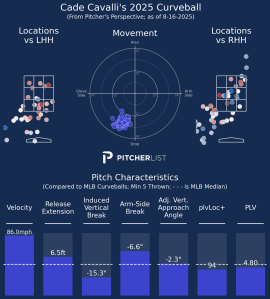
Cavalli’s on-field results align with FanGraphs’ Stuff+’s assessment of his curveball, which, in my opinion, is the best pitch in his arsenal. Averaging ~13 inches of drop and ~6 inches of glove-side movement at 85.9 MPH, the pitch possesses well above-average velocity for a curveball (with league-average being around 80 MPH), and is a versatile weapon that Cavalli can use for both called strikes and whiffs as evident by the 39.3% CSW the offering has produced so far this season. Combining the pitch’s excellent movement profile with a tendency to locate the offering low in the zone has allowed for the curveball to be an ideal ground ball inducer as well, with opposing hitters producing a -6.6 degree launch angle and 70% ground ball rate against the offering over his first three Major League starts. Given the pitch’s versatility and reliability, the curveball should continue to serve as the headlining offering in Cavalli’s pitch arsenal moving forward.
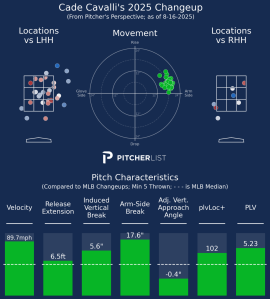
Another pitch that has been a notable piece of Cavalli’s arsenal throughout his professional career has been his changeup. Averaging ~7 inches of induced vertical break and ~17 inches of arm-side run at 89.7 MPH, the changeup has been effective at generating swing-and-miss with a 39.1% whiff rate so far this season. Changeups are generally more effective against opposite-handed hitters as the pitch’s movement “fades” away from the hitter’s swing path, inducing swing-and-miss, and possessing an above-average changeup provides Cavalli with an effective offering to utilize against left-handed hitters. Combined with his above-average curveball, which is also a platoon-neutral offering due to the pitch’s downward movement, Cavalli has two pitches in his arsenal that he can use to effectively attack left-handed hitters, explaining why he has experienced more success against left-handed hitters so far in 2025.
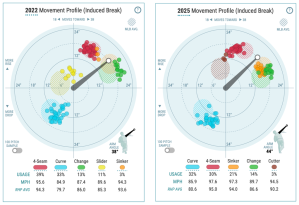
While Cavalli’s curveball and changeup have been the headline pitches in his arsenal, Cavalli has made a couple of notable adjustments to his pitch mix since 2022 that can help explain his improved results in 2025. As shown by the movement plots above, one notable adjustment that Cavalli has made is that he revamped the shape of his sinker. Back in 2022, the sinker closely mirrored his four-seam fastball, carrying a more traditional two-seam profile, while in 2025, Cavalli has added more drop to the offering, likely by tweaking his grip to take advantage of seam-shifted wake. Cavalli leans towards supination bias, due to his ability to throw a breaking ball at high velocity and the 85% spin efficiency on his four-seamer, making him an ideal candidate to tap into seam effects. While seam orientation data isn’t publicly available, the large axis differential on the sinker indicated that Cavalli is accessing seam-shifted wake to generate more drop than expected on the offering, which should allow the pitch to generate more ground balls over a larger sample size, particularly to right-handed hitters.
Another notable adjustment to Cavalli’s arsenal has been that he has increased his arm angle from 38 degrees in 2022 to 44 degrees so far in 2025. This post-injury increase in arm angle is reminiscent of how Max Meyer increased his arm angle after returning from injury in 2024, which I wrote about earlier this season. While it is difficult to determine from this chair the reasoning as to why Cavalli has increased his arm angle, this increase has allowed for Cavalli to generate more cut on his four-seam fastball, as the pitch is generating ~2 more inches of cut in 2025 than it did pre-injury in 2022, which will likely provide hitters with a more deceptive look at the plate.
It is also noteworthy that Cavalli has seen an increase in velocity on all of his pitches relative to the velocity he displayed during the 2022 season. At the Minor League level this season, scouting reports indicated that Cavalli sat at 95 MPH with his four-seamer, while the pitch is currently averaging 97.6 MPH over his first three starts at the Major League level. This spike is likely fueled by adrenaline, and it wouldn’t be surprising if his velocity (and with it, his pitch quality grades) regresses slightly over the final month of the season.
The third notable adjustment that Cavalli has made to his pitch arsenal is that he has removed his slider from his pitch mix altogether. Cavalli threw the slider 11 times during his one start during the 2022 season, and the pitch was poorly received by pitch quality models, with Stuff+ awarding the pitch an 84, and StuffBot grading the offering as a 39, both well below league-average. While it makes sense for Cavalli to scrap this offering in favor of his curveball due to the superior quality of the curveball, I wonder if Cavalli’s arsenal would stand to benefit from adding an additional secondary offering to utilize against right-handed hitters. Perhaps revamping the shape of his cutter to generate more drop and get to about 6 inches of induced vertical break at ~91 MPH would provide him with an additional versatile weapon that he could use to generate swing-and-miss against right-handed hitters, and an additional fastball to utilize inside to left-handed hitters.
Overall, Cade Cavalli has been very impressive in his first three starts at the Major League level since returning from injury, and with the Washington Nationals at a crossroads as an organization, he should get plenty of opportunities to remain in the starting rotation for the foreseeable future. OOPSY has Cavalli projected for a 21% strikeout rate, 9% walk rate, and 4.13 ERA over the remainder of the season, which I believe is a fair projection for Cavalli considering his limited track record at the Major League level. While durability will remain a question given his injury history, Cavalli’s 2025 resurgence offers a glimpse at the upside the Nationals have long envisioned and is a testament to the perseverance he has displayed throughout his career. With a couple of notable adjustments to his pitch arsenal, Cavalli projects to have a solidified role in the Nationals’ starting rotation for the foreseeable future.
Statistics as of the end of play on August 19th, 2025.
Photo courtesy of Icon Sportswire | Adapted by Aaron Polcare (@abeardoesart on Bluesky and X)
