





This article was almost written two months ago, when Houston Astros outfielder Cam Smith burst out of the gate with newfound bat speed and an exciting hot streak.
Instead, I opted to write about Mason Montgomery, and before I could return to Houston’s rising star, his flame was extinguished. Smith’s .609 OPS in May gave pause to optimism and ensured any climb back to league average would take a while. His spring included two 15-game stretches with wRC+ marks of 12 and 2, respectively. Things got ugly, but as they often do in the sport, they eventually returned to normal.
Smith hasn’t gone scorched-earth in June — he’s yet to post an above-average month by wRC+. His path back to acceptable, though, is ripe with signals that more could be coming as he taps into his physical tools.
Smith’s Gifts Raise His Floor
Smith is already exceeding some of the expectations from his prospect profile. Once an average third baseman, he’s taken a liking to right field and put himself in contention for a Gold Glove. Posting 6 Outs Above Average (95th percentile), his instincts have played up in his new home.
If pairing that with 83rd-percentile arm strength isn’t enough to prop up his athletism, pivot to sprint speed. His 29.3 feet/second mark is similarly elite; 95th percentile to be exact. Even at 6’3″, 224, Smith is a twitchy athlete with an impressive capacity for power.
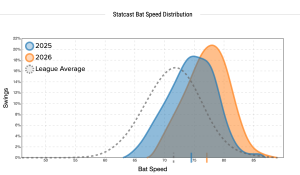
Throughout his early-season struggles, Smith’s elite bat speed has remained consistent. Another proxy for athleticism, Smith’s bat speed has begun to actualize the raw power laden in his profile. His 114.7-mph max exit velocity is elite, and he’s barreling up 11.6% of his batted balls while working through significant launch angle concerns. His eight home runs aren’t overwhelming, but he’s now just one behind last year’s total in 60% of the plate appearances.
In short, Smith’s defense and base running make him a functional Major Leaguer. He looks like an average starter with an 87 wRC+. What might happen if he gets to 110 wRC+? 115?
The proximity to a 3+ WAR season is enticing, and while there’s a long road to a consistent offensive breakout, we know the raw power is in there somewhere. Now, it’s a matter of Smith’s contact and plate discipline getting him across the finish line.
Swinging, Missing, and Surging
Striking out over a quarter of the time and pacing for one per game isn’t ideal, but Smith can take solace in the root of his issues. He’s not lost in the tunnels of opposing arsenals, and he’s running an average walk rate. This is simply a bat-to-ball issue, albeit a significant one.
The contact rates are meager and not limited to offerings outside the zone. He’s straddling the 80% Z-Con% shelf, and as long as he can stay above that line, I’m comfortable calling his whiffs more of an obstacle than an albatross. Those season-long rates are all in the bottom quartile of contact rates, but the shape of his season tells a more encouraging story.
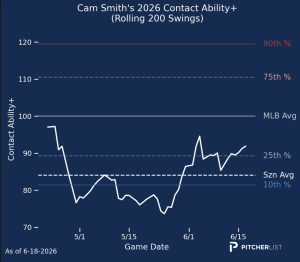
Smith spent the second half of May scraping the bottom of our graphics. Since then, his pitch-level contact has caught up with the rest of the league, or at least a standard deviation of the MLB average. It’s pointed in the right direction, and the Houston faithful should be emboldened by its intertwinement with his plate discipline.
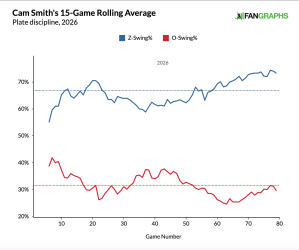
Every part of his non-power profile is ascending quickly. After taking his lumps in one of baseball’s deepest slumps, Smith is making tangible improvements in plate discipline and parlaying that into more favorable swings. This is most evident in his strike zone judgment. Across every pitch group, Smith has identified hittable pitches at a much better rate than he did at the beginning of the year. It’s understandably easier to hit (and do damage on) pitches within the zone, and despite the whiffs and strikeouts, he’s running a 61st-percentile O-Swing%. With two strikes, his chase rate is even more impressive (20.9%, 85th percentile).
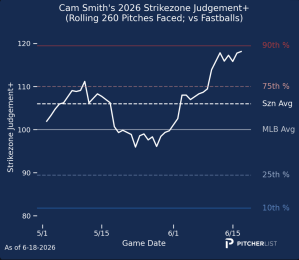
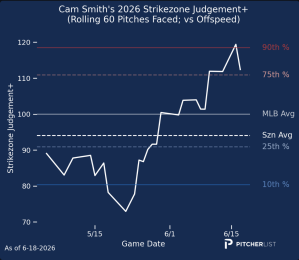
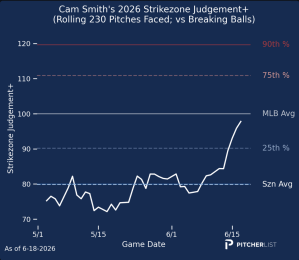
In limiting the ugliest portion of his swings, Smith is mitigating the holes in his contact profile. Unsurprisingly, the quality of his batted balls has improved with his decision value, particularly as he is seeing soft stuff better. Smith’s woes are worst against off-speed pitches. But laying off changeups is more productive than swinging over them, making his spits all the more important.
Although his contact issues here make even league-average production a pipe dream, the rest of his skill set could help fend off this weakness.
Smith Is Making Adjustments
It would be ambitious to expect Smith to overhaul his bat-to-ball skills or become a force against off-speed pitches. Instead, his path to production is a matter of optimizing what’s left of his game: maximizing his plate discipline, doing damage on the occasional contact, and optimizing his spray and launch angles.
2026 has been kind to his intangibles, and from afar, it very much looks like a top-100 prospect developing as he should. Regrouping after extended struggles is a skill in itself, and for an Astros team in desperate need of young talent, Smith’s steps are a player development victory. Plenty of hitters have made a living checking the power and plate discipline boxes! Furthermore, the current state of his power is at least partly an indictment of the meat he is leaving on the bones of his spray direction. There’s more work to be done, which means said development is attainable.
Smith is an obvious candidate to get more out of his exit velocities by pulling more fly balls. At 13.2%, his Pull Air% ranks in the bottom decile for the second year in a row, which falls in line with the rest of his batted ball data. Nearly half of Smith’s batted balls are grounders (81st percentile), and he struggles to turn his promising exit velocities into productive line drives. Similarly, his hardest-hit balls are often on the ground, and his exit velocity on fly balls is underwhelmingly average.
Likewise, Smith is shooting balls the opposite way at a 91st-percentile rate and pulling his batted balls just 34.2% of the time — even less than last season.
This is frequently indicative of a broken swing. However, Smith’s swing design isn’t damning.
There are 215 qualifiers in Baseball Savant’s swing path leaderboard. Smith ranks 79th in swing tilt (34°), 84th in attack angle (11°), and 68th in attack direction (4° pull-side). None of that screams ill-fated fundamentals, although just 45.1% of his swings registered in the ideal attack angle (5-20°) ranks 166th.
Smith’s swing data may subsequently offer both good and bad news. While his swing isn’t a lost cause, it may be an indictment of the timing aspects of these numbers. Savant’s miss data can help us visualize this.
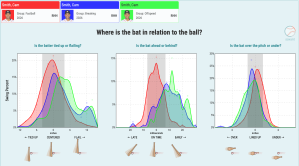
Smith is very early on non-fastballs, which lends itself to weaker contact. And when he’s getting fastballs to drive, Smith is largely late and lined up, limiting the opportunities to pull fly balls. In essence, when he’s pulling the ball, he’s doing so on his lesser swings and wasting his best batted ball events.
June has helped change Smith’s fortunes. It hasn’t manifested in the box score just yet, but Smith’s gains in plate discipline are playing out in the quality of his swings.
Clearly, the off-speed stuff is still a work in progress. But Smith’s June has shown remarkable strides, both in pulling the ball more and looking more comfortable against fastballs and breaking balls.
Halfway through his second season, Smith is rounding into the complete player his flashes have projected. He’ll continue toeing the line of uncomfortable contact rates, but by controlling the zone and getting more out of his contact, Smith is approaching the kind of profile that begets a power surge. With elite defense and base running already locked in, Houston has a chance to take victory formation on the Kyle Tucker deal by the end of the summer.
Photo by Joe Robbins, David J. Phillip | Adapted by Parker McDonald (@CarbonFoxGFX on Twitter/X)
