





Colton Cowser’s emergence as a notable presence in the Orioles lineup was one of many positive developments that Baltimore experienced during their 91-71 season last year. Finishing as the runner-up for the American League Rookie of the Year in 2024, Cowser displayed improved power production, allowing him to generate a 119 wRC+ despite his swing-and-miss tendencies, which, when combined with his above-average defense, allowed him to generate 3.8 fWAR last season. Along with the rest of the Orioles lineup, Cowser has underwhelmed relative to expectations this season, generating an 86 wRC+ over 342 plate appearances in 2025. This decline has left many observers wondering what has changed with Cowser’s approach at the plate and whether he will be able to reclaim his prior levels of offensive production moving forward. This article will take a look at the changes in Cowser’s approach from last season, identify some reasons for optimism regarding his offensive potential, and attempt to prognosticate Cowser’s future production as an impact corner outfielder for the Baltimore Orioles.
As mentioned earlier, Cowser had an impressive 2024 campaign, producing a 119 wRC+ over 561 plate appearances last season. This level of offensive production was greater than many had projected from Cowser prior to the season, with improved batted ball quality from 2023 to 2024 largely contributing to his increase in power output. This observation is backed up by his scouting report on FanGraphs, which noted that “Cowser showed up to 2024 spring training having added a grade of power to his game”, and by his bat tracking data, as his average bat speed increased from 70.8 MPH in 2023 to 73.8 MPH in 2024. Swing-and-miss has always been a concern with Cowser’s profile, as he was awarded a 40/40 hit tool grade by FanGraphs; however, the increased power output allowed him to still generate above-average levels of offensive production despite running a 30.7% strikeout rate.
This season, Cowser’s offensive production has seemingly evaporated, currently producing an 86 wRC+ over 342 plate appearances in 2025. Cowser’s strikeout rate has increased to 35.4%, while his walk rate has also decreased from 9.3% in 2024 to 7.0% in 2025. While he is perhaps running into a smidge of bad “batted ball luck” with a .269 BABIP and .291 wOBA / .302 xwOBA, Cowser has also experienced a slight decline in power output this season, with his ISO declining from .204 in 2024 to .196 in 2025, and his SLG declining from .447 to .397. While perhaps some positive regression on his balls in play would give his offensive production a slight boost, Cowser’s combination of getting on-base less and hitting for less power has contributed to his decline in offensive output this season.
While the in-game results have been underwhelming for Cowser this season, there is some optimism in his bat tracking data that he will be able to hit for more power in-game in the future. The table above depicts Cowser’s bat tracking metrics from the 2024 and 2025 seasons. Cowser has maintained the same above-average bat speed this season as he did in 2024, and his combination of possessing above-average bat speed with a steep swing (as evidenced by his above-average swing path tilt and attack angle) is a characteristic that is shared by some of the best hitters in Major League Baseball. Swinging the bat fast and on an upwards plane is conducive to hitting the ball hard in the air, which, granted they are able to make contact, is the most valuable outcome a hitter can produce at the Major League level.
Bat speed is strongly correlated with swing length, as longer swings have more time to accelerate to the point of contact where bat speed is measured by Statcast. Since longer swings allow more time to generate bat speed, Cowser’s measured average bat speed value may mask a slight decline in his true bat speed, given that his bat speed has remained relatively constant while his swing length has increased from 6.9 feet in 2024 to 7.3 feet in 2025. This increase in swing length is driven by an increase in his intercept point this season, as he is making contact more “out in front”, closer to the pitcher. Cowser has likely made this adjustment in an attempt to pull the ball in the air more frequently, as this type of contact occurs with a more “out in front” contact point, and he has achieved this objective this season, with his pull rate increasing from 34.8% in 2024 to 40.3% in 2025, and his pull air rate increasing from 13.6% in 2024 to 15.2% in 2025. Overall, while still possessing an above-average swing, Cowser has experienced a slight decrease in his “true” bat speed this season, and his year-to-year swing change speaks to the importance of using each of the bat tracking metrics in tandem to better understand the inputs into a player’s offensive production, given the variables’ tendency to correlate with each other.
Cowser’s batted ball profile has also remained relatively consistent year-to-year. As shown by the table above, Cowser’s barrel rate, EV50, and EV90 have all remained the same from 2024, and each metric is at a level that is above-average for the Major League level. As a prospect, Cowser was graded as a 60/60 raw power, and I believe that his continued display of an above-average batted ball profile confirms this observation. Given that his under-the-hood metrics indicate a sustained ability to hit for power, it appears that an increased strikeout rate and perhaps a change in his approach at the plate have been the main culprits for Cowser’s decline in offensive production this season.
The table above displays Cowser’s performance against different pitch groups (fastballs, breaking balls, off-speed) during the 2024 and 2025 seasons. Cowser has consistently performed well against fastballs, currently producing a .361 wOBA, .378 xwOBA, and 22.6% whiff rate against these pitches so far this season. Most of Cowser’s home runs are against fastballs, with 12 of Cowser’s 16 home runs this season occurring against either four-seamers, sinkers, or cutters.
The primary weakness in Cowser’s offensive profile has been his performance against secondary pitches, particularly breaking balls (sliders and curveballs). As shown by the table above, Cowser has generated a >40% whiff rate against these pitches in each of the past two seasons, with his whiff rate against breaking balls increasing from 40.8% in 2024 to 47.6% in 2025. In addition, Cowser is making less productive contact against these pitches when he doesn’t swing-and-miss, with a .216 wOBA and .238 xwOBA against breaking balls this season. Opposing pitchers have taken note of Cowser’s increasing weakness against this subset of pitches, with their breaking ball usage rate against Cowser increasing from 28.5% in 2024 to 29.6% in 2025.
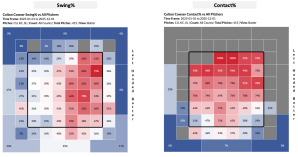
The heat maps above depict Cowser’s swing and contact tendencies against breaking balls during the 2025 season. As shown by the heat map on the left, Cowser has been very passive regarding swinging at breaking balls located on the outer-third of the plate, mostly swinging at breaking balls that are located on the inner-third. While Cowser has likely adopted this approach because he believes that most of his damage against these pitches occur when they are located on the inner-third, taking too many pitches in the strike zone can allow the pitcher to easily get ahead in the count, placing the hitter in a more defensive count state where they are more likely to swing-and-miss at pitches out of the zone. As shown by the contact rate heat map, Cowser has experienced difficulty making contact with breaking balls located underneath the strike zone, leaving Cowser vulnerable when pitchers attempt to induce a swing out of the zone in two-strike counts.
This trend of taking breaking balls located on the outer-third of the plate reflects a larger trend in Cowser’s offensive approach, where he has been swinging at pitches located in the zone less often. As shown by the table above, while Cowser’s chase rate has remained relatively steady at 23.9% in 2025 compared to 25.0% in 2024, his zone-swing rate has declined from 64.0% in 2024 to 59.9% in 2025. This increased passivity against pitches located in the strike zone has led to Cowser facing more pitches in counts where he is “behind”, causing a decline in his walk rate despite a better chase rate, and contributing to an increase in his strikeout and whiff rates since he is facing more pitches in unfavorable count states.
Evaluating a player’s swing decision ability can be particularly complex, since very few hitters generate positive run values on their swings; however, hitters must also avoid being too passive at the plate, as they can run into too many unfavorable count states, which appears to be Cowser’s current predicament. This appears to be a trait that has followed Cowser around throughout his professional career, as Eric Logenhagen wrote in his FanGraphs scouting report, “the gap between Cowser’s overall chase rate in 2023 (way better than league average, minors included) and his two-strike chase rate (substantially worse than average) is indicative of a very selective approach, and perhaps also of predetermined takes early in the count”. From this chair, it appears that a combination of swinging more frequently at pitches within the strike zone, particularly against breaking balls, is the blueprint for Cowser to reclaim the level of offensive production last season. Perhaps taking more swings against breaking balls against a Trajekt would allow Cowser to improve his in-game production, and the increased aggression against pitches in the strike zone would make it more difficult for opposing pitchers to get ahead in the count when facing Cowser.
Overall, I am still rather bullish on Cowser’s long-term potential, and I still believe that he will play an integral role in the Baltimore Orioles lineup in the near future. While his “true” bat speed may have slightly declined, his batted ball profile is still intact from 2024, and his ability to play multiple outfield positions adds some versatility value to his profile as well. Improving his production against secondary pitches and becoming more aggressive against pitches in the strike zone appear to be imperative to improving his level of offensive production in 2026. With a lineup still full of promising young homegrown players, the Baltimore Orioles stand poised to rebound from their disappointing 2025 season with a few roster adjustments this offseason, and with a few tweaks to his offensive approach, Colton Cowser projects to once again be an impactful presence in the Orioles’ lineup next season.
Statistics as of the end of play on September 23rd, 2025.
Photos by Icon Sports Wire and MLB.com | Graphic by Carlos Leano
