






It’s September! There are no Halloween decorations up in my neighborhood yet, but the mornings are chilly, and the scent of pumpkin spice wafts from the coffee shop around the corner. This is the final regular season week for standard public leagues, and private leagues, or any league with playoffs longer than three weeks are already in their postseasons. Context really matters now. Make sure you know your tie-breaker system. Check ahead for handedness matchups to know if your platoon guys are likely to start. Starting pitchers are only as good as their next matchup or two. And schedules are more variable this time of year, so it can be difficult to trust a Sunday start. If a player isn’t a lock to be on your squad next season, they’re droppable for help now. Flags fly forever.
Fallers
Andrew Vaughn, First Base, Milwaukee Brewers – 33% Rostered
Vaughn was featured here way back in week 16, just after he started his new life as a Brewer. The former first-rounder has had a much better go of it in Milwaukee than he ever did in Chicago. He’s slashed .285/.353/.485 with 9 homers and a whopping 40 RBI in just 188 plate appearances as a Brewer. However, after posting an OPS over 1.100 in July, he fell back to earth with a .695 mark in August, and has hit just .188/.259/.208 over the last couple of weeks.
Vaughn did have a “lucky” BABIP of .340 in July and an “unlucky” one of .264 in August (MLB average is .292), but that doesn’t come anywhere close to accounting for a 400+ point OPS swing. We need some charts for this.
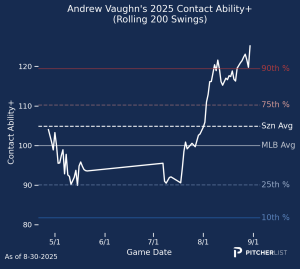
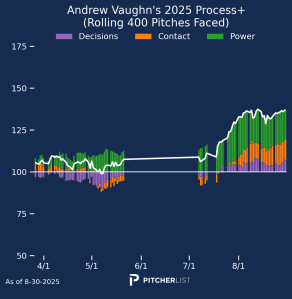
That process chart is a thing of beauty, isn’t it? It’s shocking how much better Vaughn has been in Milwaukee, shocking. Well, not that shocking. His huge power production somewhat obscures the rest of his great work, which is why I pulled the contact chart, too. Vaughn is still making good contact and even trending upward despite already being well above average.
His underlying metrics are still strong as well. He’s still in the top quartile in exit velocity and both hard hit and barrel rates. His chase rate could be a bit better, and he could draw more walks, but his K rate is still under 20% and I expect him to finish the season strong. His roster percentage has dropped in the last week, though, and since we are so late in the season, I have to think he was dropped by competitive teams. I think that will prove to be a mistake, and if Vaughn is available in your league, stop dallying, go get him.
Miguel Andujar, Third Base and Outfield, Cincinnati Reds – 17% Rostered
Miguel is hitting just fine, but he’s fallen back in the short side of a platoon. He’s started just one of the Red’s last 6 games against right-handed starters. He has still batted cleanup against lefties, but just does not have enough at-bats to help. He’s droppable in all but the deepest leagues; we’re talking abyssal depth here. Also, this is a freebie, doesn’t count, just looking for out for my readers. You’re welcome.
Kody Clemens, First, Second, Third and Outfield, Minnesota Twins – 2% Rostered
Clemens had a very useful July, posting a .250/.286/.519 line with 3 homers and 12 RBI over just 56 plate appearances. He followed that up with a poor showing in August, slashing .185/.242/.293 with two homers and 9 RBI over 100 plate appearances. He did have some poor batted ball luck in August, with a .224 BABIP after a .270 mark in July, which can explain some of that slump.
Clemens strikes out a bit more than your average MLB regular, but his 23% K rate is nothing egregious and not a rate where prolonged slumps are expected. Also, his process and contact charts both look fine.
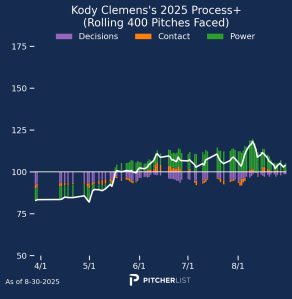
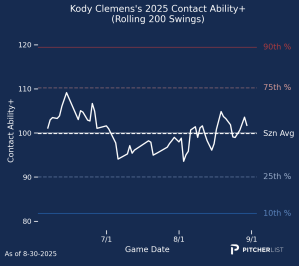
See? His contact chart looks a little stronger in August than it did in July, so what gives? Clemens has had difficulty hitting four-seamers this season. Just under 35% of the pitches Clemens saw in 2024 were four-seam fastballs, and he batted .317 with a .707 slugging percentage against that particular offering. This year, nearly 44% of the pitches Clemens has seen have been four seamers, and he’s batting just .150 with a .307 slugging percentage against them.
Struggling against four seamers is a big deal, obviously, since it’s the most commonly thrown pitch in Major League Baseball. If he struggled against righties with big sliders, you can work around that, but everyone throws a four-seam fastball. It’s a shame, really. Clemens has very good power metrics, including a 50% hard hit rate and an average exit velocity at nearly 92 MPH, but his inability to hit the fastball has been exploitable. If I can spot it, MLB teams can too.
Adrian Houser, Starting Pitcher, Tampa Bay Rays – 21% Rostered
Houser is the anti-Vaughn. He was much more effective as a member of the White Sox than he has been since he was dealt to the Rays. Houser recorded a 2.10 ERA and 1.22 WHIP with a 47:22 K:BB ratio over 68 innings for the Pale Hose, but has pitched to a 4.85 ERA and 1.61 WHIP as a Ray. We can’t even blame the tiny minor league stadium the Rays are using this season, as Houser has pitched on the road in 4 out of his 5 starts for the Rays.
Some of Houser’s recent struggles can be chalked up simply to regression to the mean. He carries a career ERA of 4.03. He had a FIP of 3.33, more than a full run higher than his ERA while with the Sox this season. His FIP with the Rays is 4.78, nearly identical to his ERA. His biggest issue is his inability to strike out batters. Houser averages just over 6 Ks per nine innings, one of the lowest rates in the Majors. So he needs to get outs on balls in play.
Houser mostly relies on his sinker as his primary pitch, and while he has produced a nice ground ball rate, MLB hitters are batting .291 against the pitch, while only whiffing 10.5% of the time. Even worse, they are making hard contact against that sinker over 50% of the time. It simply isn’t a good enough pitch for Houser to be successful throwing it 46% of the time. He faces Seattle at home today, and I want no piece of that.
Risers
Luis Matos, Outfield, San Francisco Giants – 10% Rostered
Matos has been up and down with the Giants this season. He appeared in at least 10 games for the big club in April, May and July, but batted under .160 in each of those three months. However, he has been scorching hot since his most recent promotion back on August 21st, slashing .432/.450/.811 with 3 homers and two stolen bases in just 40 plate appearances.
Matos is just 23 years old and has a very strong 15% K rate as a major leaguer, so if the power and speed are legitimate, we could have a good player on our hands here. And his minor league track record, 67 dingers and 82 stolen bases over 200o plate appearances, suggests it is. A full MLB season would include somewhere around 600 plate appearances, so that would project Matos as a 20/25 type of player if his production translated from AAA to MLB. Let’s get the usual charts out.
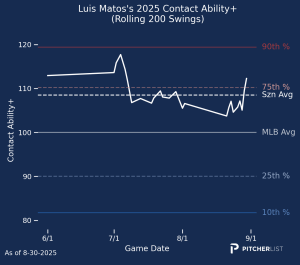
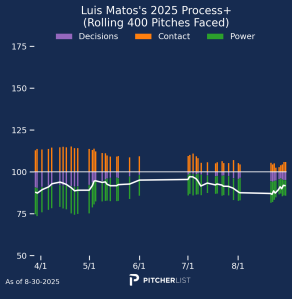
The process chart covers a much longer time frame. While it is angling upwards at the far right, it’s less dramatic than I was hoping, and his decision value is still lacking. His contact chart, which focuses on his recent play a bit more, has a much more dramatic upswing over the past couple of weeks. He’s also benefitted from an unsustainable .424 BABIP in August, but suffered through BABIPs of .147, .095, and .172 in the three months mentioned above when he batted below .150.
I think the evidence is clear. Matos was cursed. Maybe hexed. Possibly by some sort of witch doctor. I’m a fantasy baseball analyst, not an expert in the occult. But Matos has also very clearly expunged whatever supernatural force was causing nearly every ball he hit to careen directly into a waiting glove. He’s been playing every day, has overall strong plate discipline (his chase rate is a little high) and looks to be tapping into more of his power and speed lately. I think Matos could be helpful for the stretch run and is on my early list of players to target in 2026.
Jeremiah Jackson, Short Stop and Outfield, Baltimore Orioles – 14% Rostered
Jackson made his debut for the Orioles following the trade deadline. The 25-year-old rookie earned the promotion after slashing .313/.343/.537 with 15 homers and 11 steals in 360 plate appearances split between AA and AAA. He’s been impressive so far, slashing .337/.356/.520 with three dingers, 14 runs scored, and 15 driven in over his first 101 plate appearances in the Majors.
He’s posted a good average exit velocity at 90.8 MPH, a moderately above average barrel rate of 9.6% and a very strong hard hit rate just under 50%. However, his chase rate is off-putting at over 36%, and his whiff rate is pretty high at 27%. His overall K rate, at just under 25% isn’t very good, but won’t send me running. I do wish he walked more than 3% of the time, but he drew only 15 free passes in 360 minor league plate appearances, so I don’t see that improving any time soon.
Jackson also has a .412 BABIP so far in his major league career, which isn’t quite Luis Matos‘ level of luck, but it won’t last and with Jackson’s strikeout rate, I would expect a batting average more in the .250-270 range. He could hit for some power, as he launched 11 dingers in 172 plate appearances at AAA Norfolk this year and 110 dingers over 2400 plate appearances in his minor league career. He also stole 84 bases, but is 0-2 in the Majors.
Jackson definitely looks like he could help teams right now, but overall, I’m less excited about Jackson than I am about Matos. Both are swinging hot bats right now, but I like what I see in Matos’ plate discipline metrics more for long-term success. Jackson, however, offers more eligibility since he can slot in at short or middle infield.
Blaze Alexander, Second Base, Third Base, Short Stop, Arizona Diamondbacks – 18% Rostered
Blaze struggled to a .553 OPS with a couple steals and 4 RBI in July, but was red hot in August, slashing .255/.361/.520 with 7 homers and 15 RBI over 119 plate appearances. His underlying metrics support the power surge, as Blaze sports an exit velocity over 91 MPH, a 13% barrel rate and a 46% hard hit rate. His on-base skills are different from what we tend to see her,e too.
Blaze has a very good chase rate of just 23%, and a decent walk rate at 8.3%. But he has a terrible whiff rate at 33% and an overall K rate of 32%, and anything over 30% spooks me. He benefitted from a .328 BABIP in August, which is high, but nothing like what we saw from Matos and Jackson. Blaze did manage to bat over .270 through 526 minor league games with a K rate over 30% but I would still expect an average closer to .250 in the Majors.
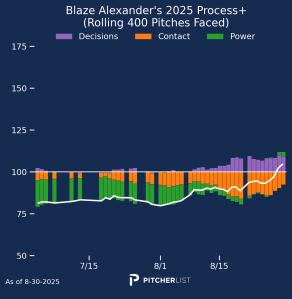
His process chart looks great, though. His contact rate isn’t great, we know that, but it is trending in the right direction. His decision value is where he’s made his largest improvement, so let’s pull up that one by itself.
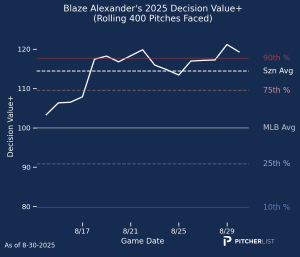
Blaze drew 12 walks over 119 plate appearances in August compared to just 3 walks in 57 plate appearances in July. Combine that with his excellent chase rate, and we have a player with a great batting eye. So we have good power metrics, a good eye and a bad whiff rate. If Blaze can cut down on those whiffs, we could have a legitimate breakout on our hands. I love the eligibility, and he’s mostly batted in the middle of the lineup, behind Ketel Marte and Corbin Carroll. I like him for the remainder of the season, and he’s on the target list for 2026. Let’s Blaze one together!
Thanks as always for reading, and good luck out there, Deep Leaguers!
