





There are not many bad things to say about Jacob DeGrom. One of the most dominant pitchers of this generation is having his healthiest season since 2020, and it’s the first time he’s eclipsed 100 innings pitched since 2019.
The season-long stats are incredible and expected: a 2.76 ERA, 0.93 WHIP, 27.3% strikeout rate, and 5.5% walk rate are ace quality. Everything under the hood backs it up, too. However, we haven’t seen this much DeGrom in a long time, which means most batters are getting more looks at him than they ever have. Only 19 of the 163 batters who faced DeGrom this year saw him in his last full season. The two hitters who have faced the most pitches from DeGrom this year, Lawrence Butler and Jackson Holliday, had less than a year of professional experience combined in 2019 (Holliday was just 15 years old).
This means that DeGrom has to adjust to a larger workload. While he dominated the first half of the season, his July and August have been a prolonged struggle by his standards.
A 4+ ERA across eight starts? Is he ever going to be okay? A full season does mean that cold stretches will happen, but it’s been an unusual struggle for DeGrom. He’s striking out four percent more hitters but giving up nearly twice as many home runs. Among pitchers with at least 40 innings since July 1st, his 10 home runs conceded are tied for the 7th most in baseball.
One graph shows pretty clearly that there’s one issue plaguing DeGrom:
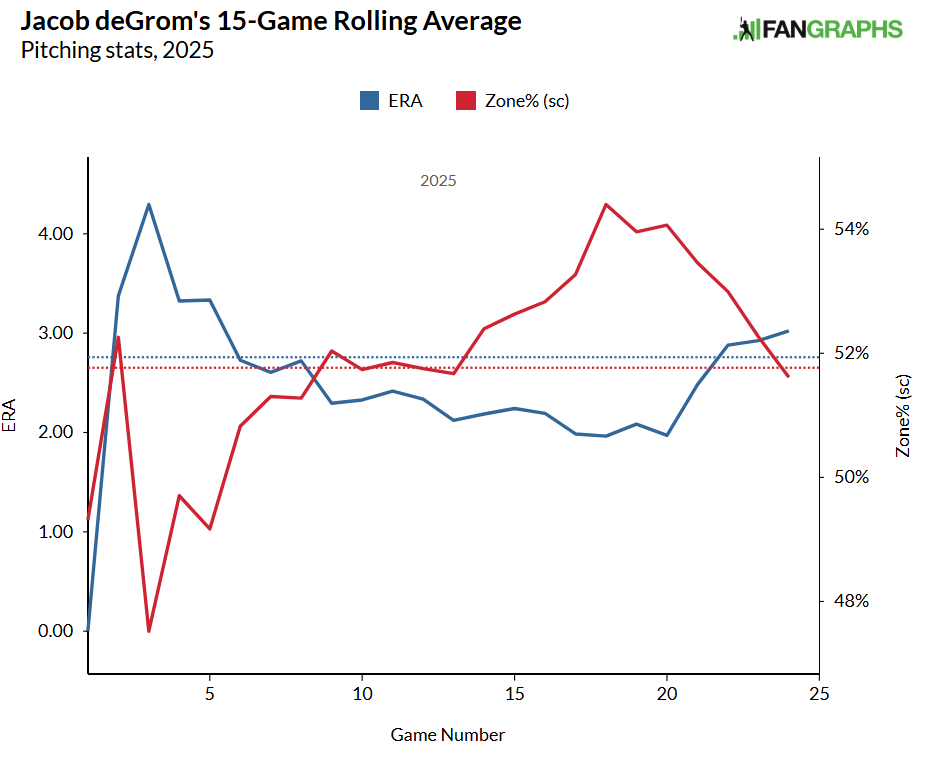
DeGrom stopped filling up the zone, with an almost 1:1 reaction in his ERA. Despite a drop in pitches in the zone, DeGrom’s walk rate hasn’t wavered (it’s up 0.1%).
That’s not a control problem, but rather a command problem. Usually, the control vs. command difference is defined as control being the ability to throw strikes and command being the ability to hit specific spots. Seeing DeGrom’s decrease in zone rate, it would be easy to say that he’s lost control as he’s thrown more innings. Again, this is Jacob DeGrom we’re talking about, and he transcends most normal things about being a pitcher.
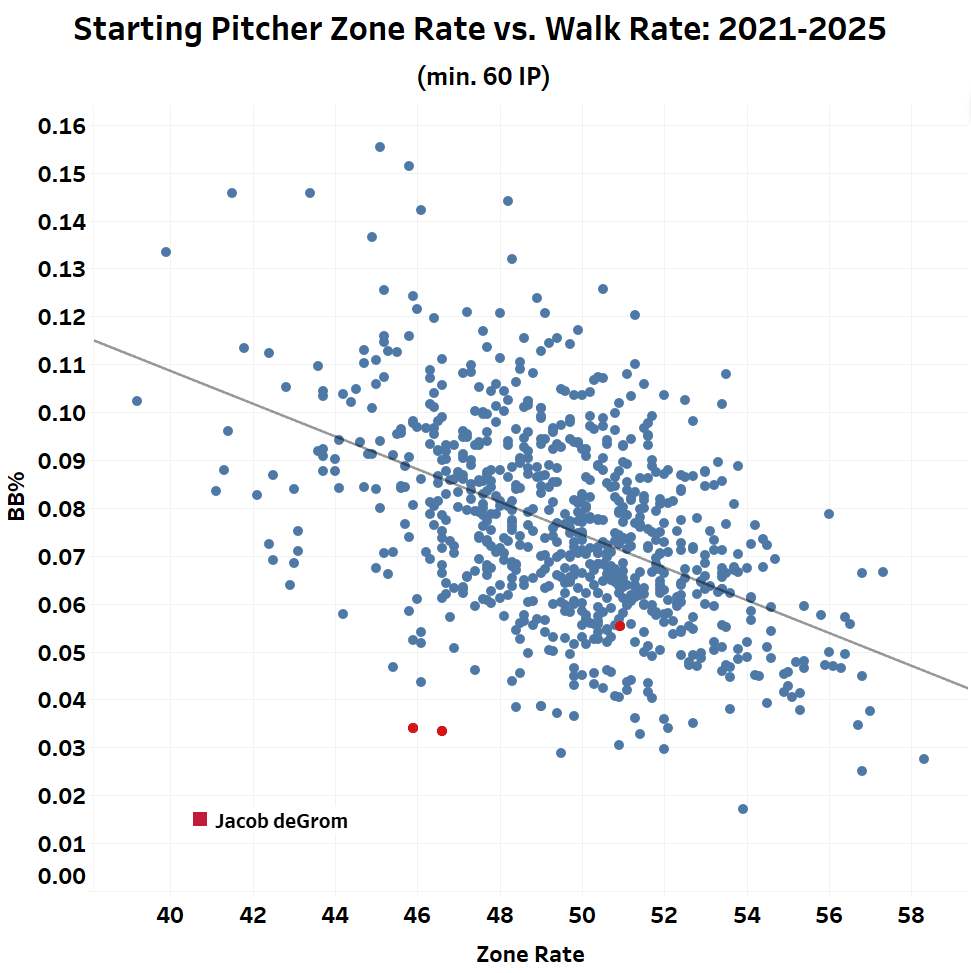
Overall, there’s a strong correlation between zone rate and walk rate, which is a fundamental part of baseball. When you’re DeGrom or another filthy pitcher, you can throw outside the zone more frequently, with batters flailing at unhittable stuff. The two lowest DeGrom dots are his 2021 and 2022, when he had an awe-inducing 40+% strikeout rate and sub-4% walk rate. The middle dot is 2025.
While his zone rate has decreased over the last eight starts, he has seen a modest bump in strikeouts. There are two main issues plaguing DeGrom that contribute to his late-season slowdown, and he’s trying to mitigate the problem rather than solve it.
Losing the Slider
DeGrom’s slider is his best pitch, even if it’s down slightly in velocity from his peak. It comes in at over 90mph, with five inches of horizontal break and zero inches of iVB. It’s been a reverse-platoon pitch, surprisingly devastating left-handed hitters while only being average against righties.
DeGrom throws the slider more in the zone against lefties and gets more chases at the same time. He locates the slider consistently below the zone vs. lefties, while working off the plate and gloveside vs. righties.
He’s lost a touch of feel for the pitch over the last two months, not showcasing the pristine command it had earlier in the year. Against lefties, this isn’t as much of an issue since it’s still over the plate.
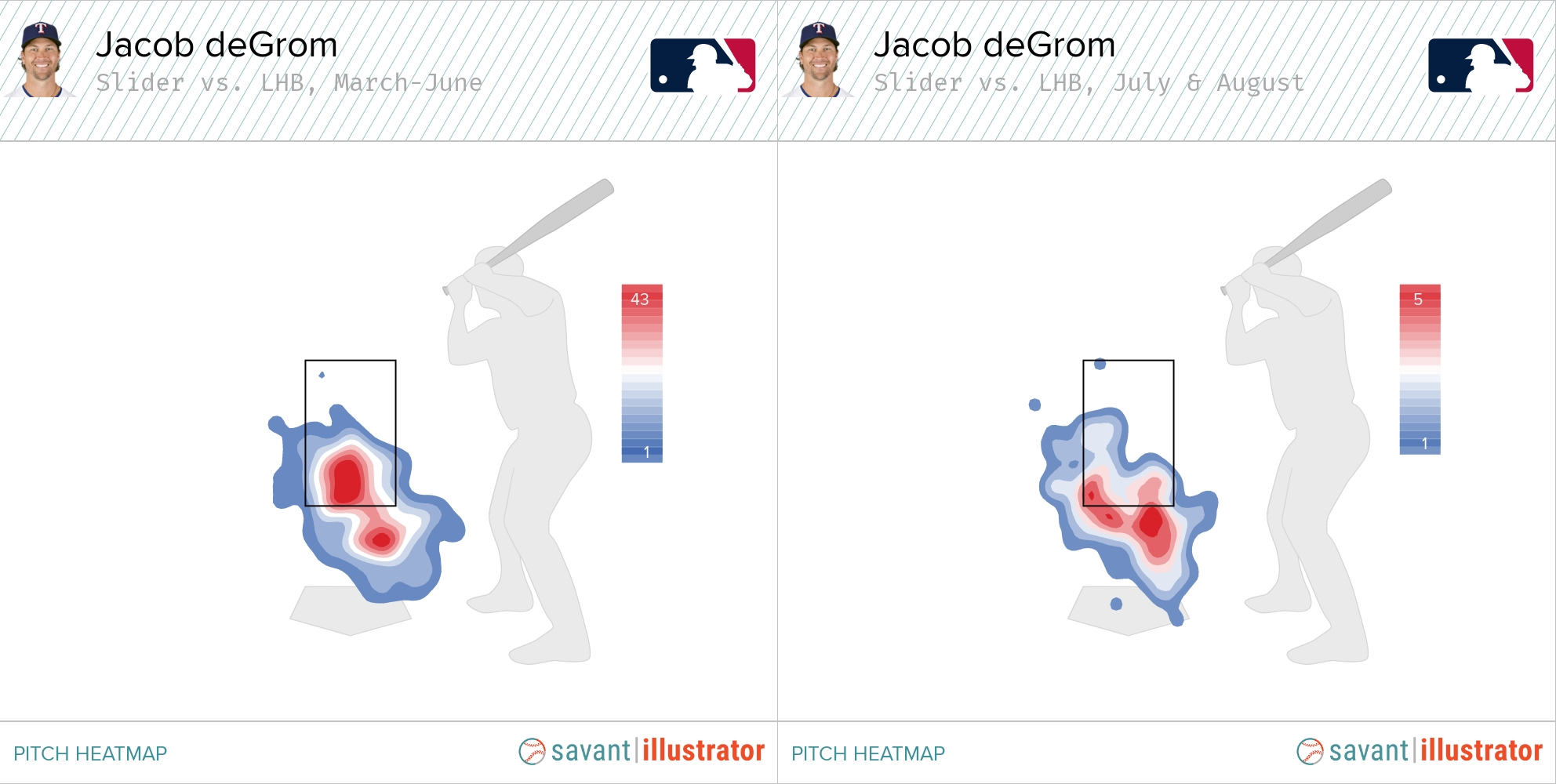
Rather than having a consistent location to throw in the zone and having a chase spot, they’ve melded together right at the bottom area of the zone. Lefties are now whiffing less and hitting the ball hard more consistently against the slider. Because the pitch is still filthy, it isn’t a devastating change: hitters are only hitting .231 with a .301 wOBA, not great, but not devastating.
Against righties, it has been a much larger struggle.
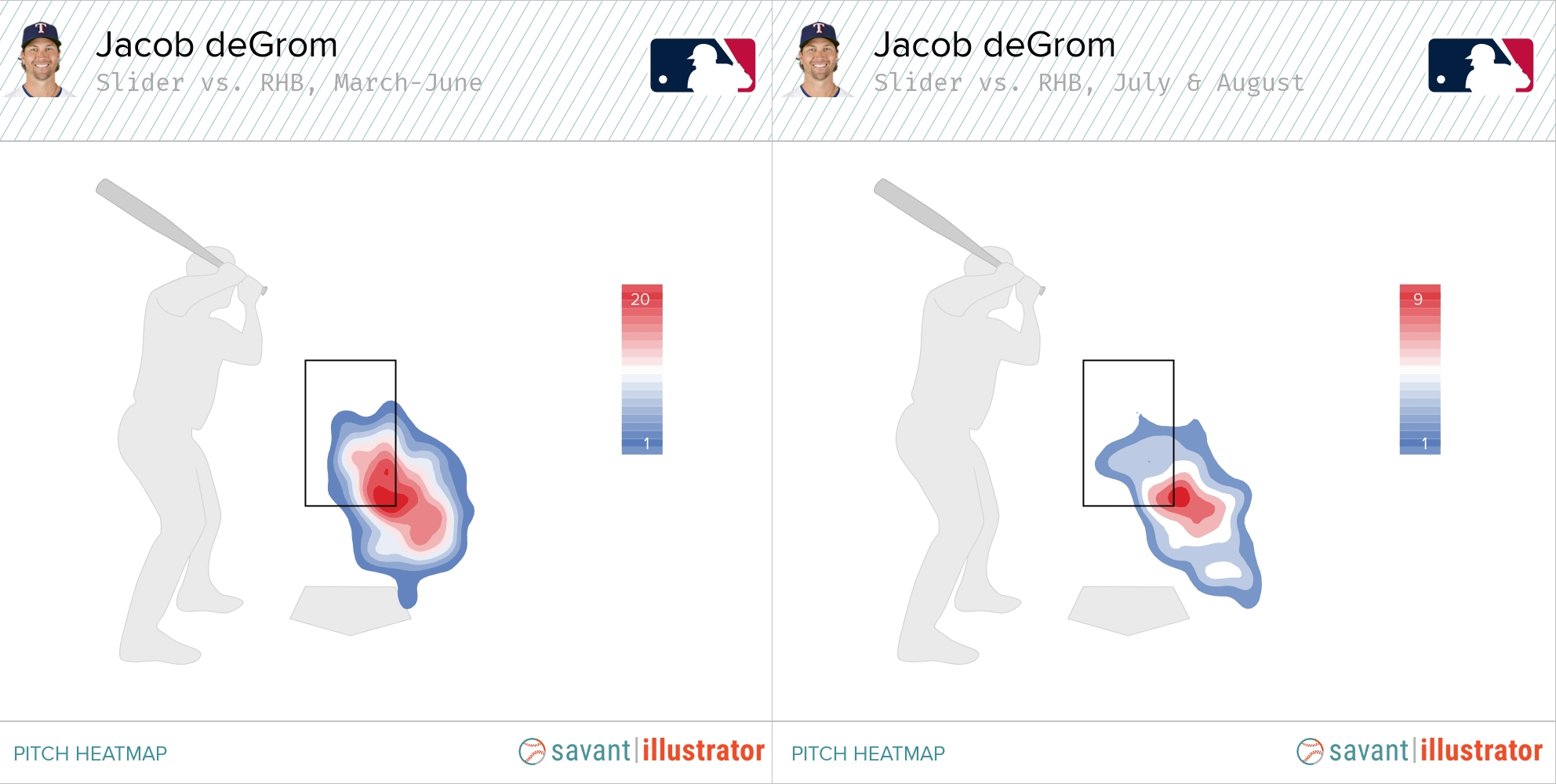
He only has one location against righties, and it’s now leaking more down-and-away, where hitters aren’t as enticed by it.
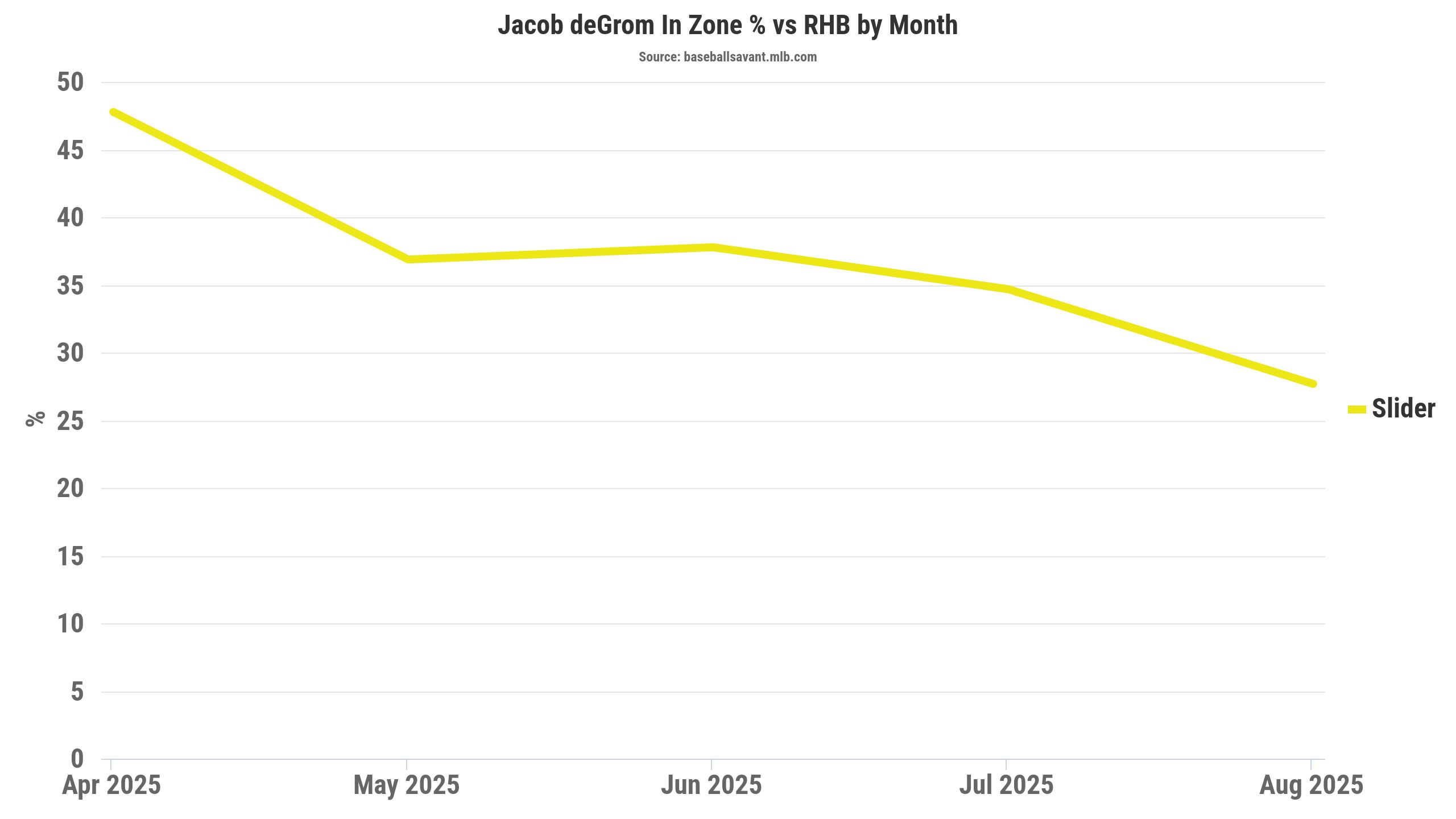
While the swing rate has remained throughout the season, the whiff rate has cratered in August.
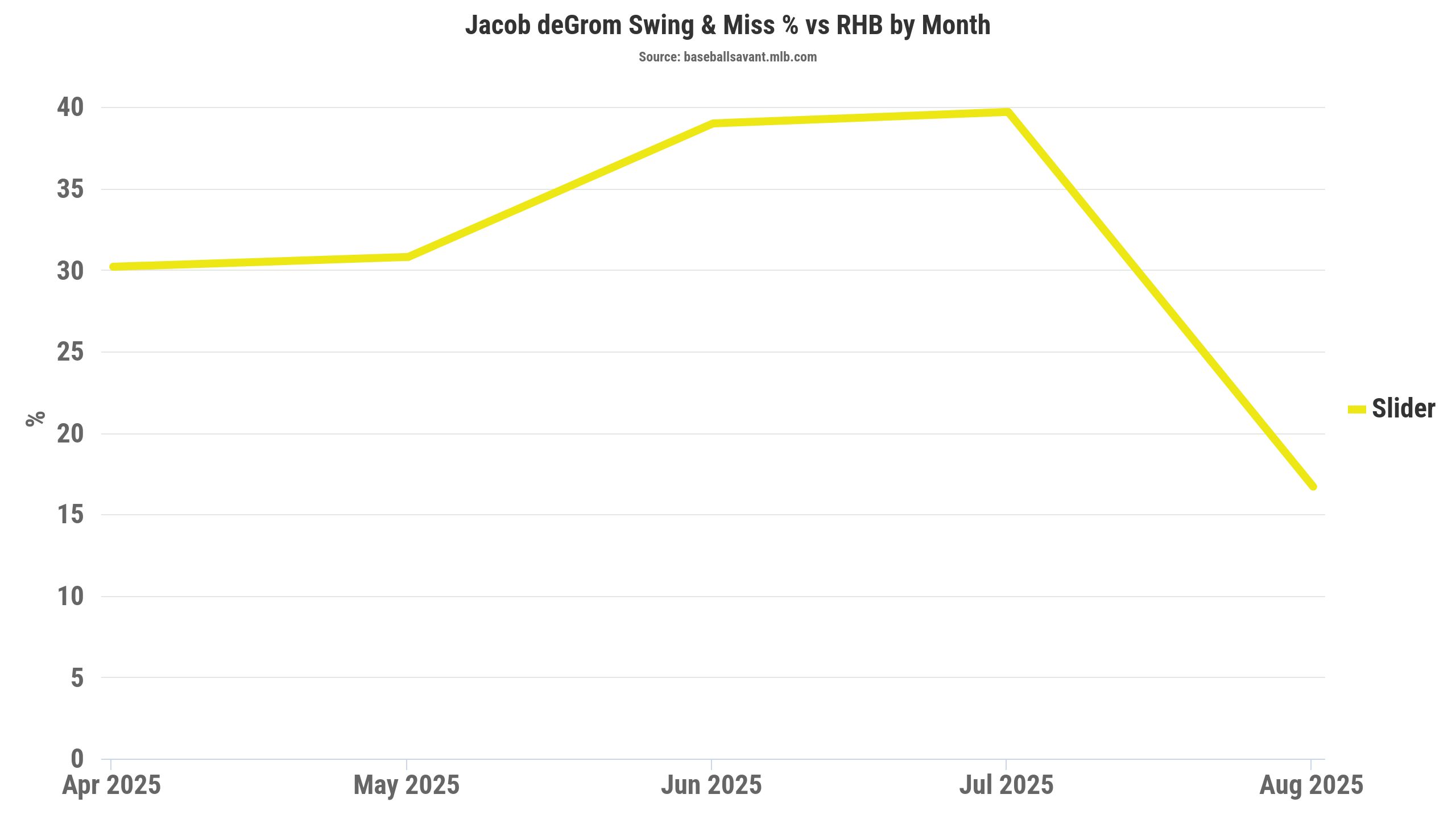
That doesn’t work. The shortcomings of the slider have come mainly early in the count, making DeGrom rely on other stuff when he doesn’t want to. His slider’s zone rate has maintained in the 20% range in two-strike counts, where he can hunt those chase swings. Early in the count (0-0, 1-0, 0-1, & 1-1), his slider dropped from around a 70% zone rate in the first three months to 50% in the last two. In his three August starts, his slider zone rate early in counts is a horrendous 46.2%.
Compensating With The Fastball
With the slider’s location evaporating, DeGrom is turning to the fastball to throw strikes to make up for the whiff deficiency he’s facing. The problem with that, however, is that he can’t be as picky with the fastball location.
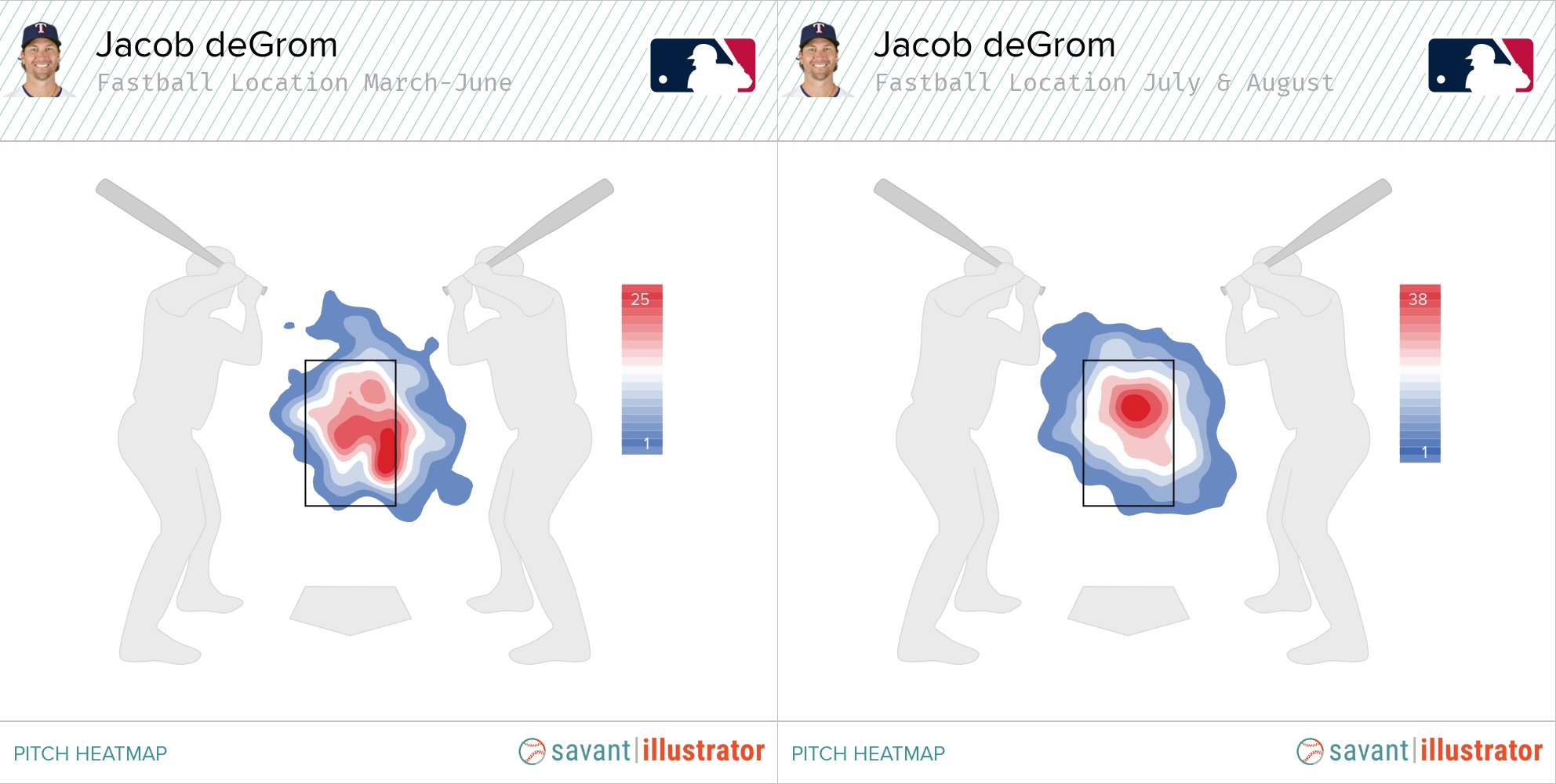
Despite a fastball perfectly suited to throw up in the zone, DeGrom’s season-long 43.5% HiLoc% is in the 18th percentile. He’s previously thrived on throwing down-and-gloveside early in the count before elevating in two-strike counts. Over the last two months, the fastball has coalesced in the heart of the zone, with less variable location. The Location+ of the pitch has fallen from 112 to 102 in that timeframe, with four of his six sub-100 Location+ games all season coming in the last six starts.
The zone rate hasn’t changed across the season, but the fastball has yielded its highest xSLG in July and August (.497 vs. .381 earlier in the year). It’s still getting similar whiff rates, too, but he’s throwing more center-cut pitches that hitters are just ready to unload on. He’s given up ten home runs since July, with none of these locations suggesting they were a fluke.
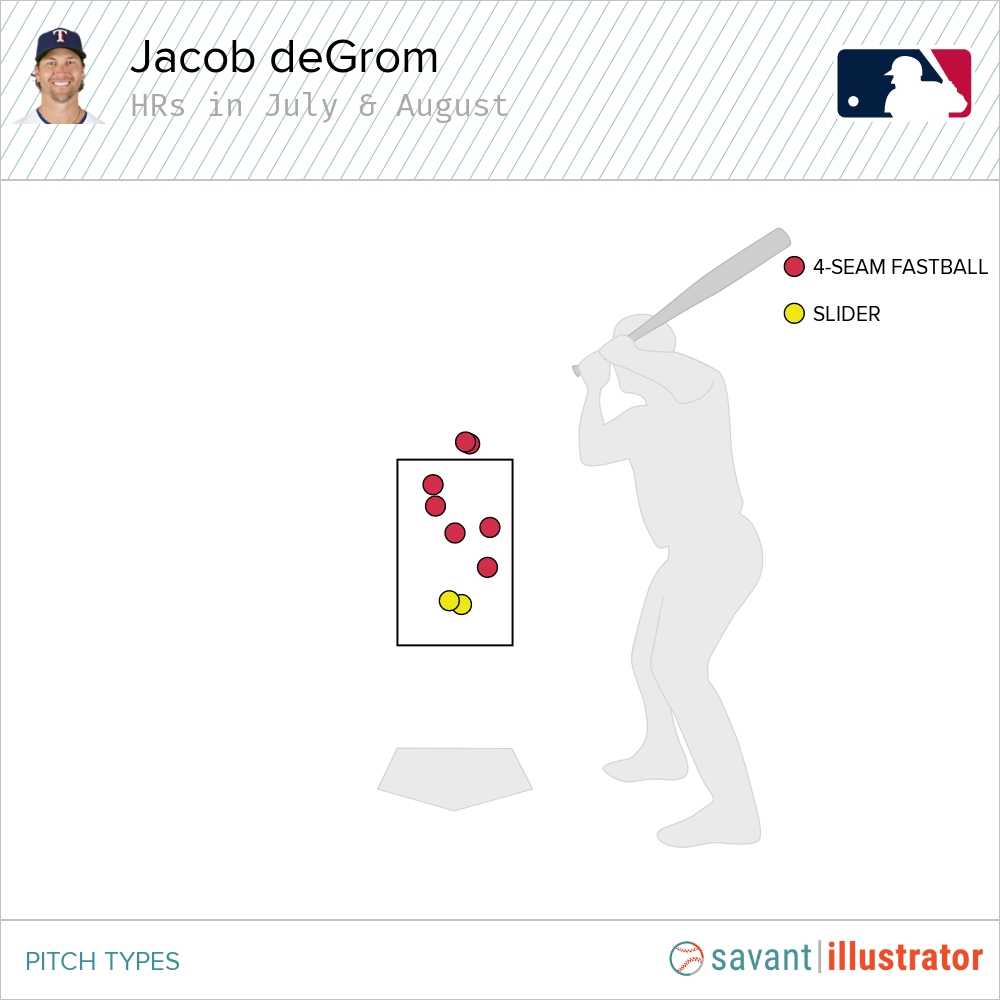
These home runs on fastballs haven’t come in overly hitter’s counts either: of the eight home runs on fastballs, just one was in a hitter’s count. This damage has primarily come from lefties, with nine of ten home runs coming against them. Despite giving up significantly more home runs to lefties, his performance has actually been better against them (.285 wOBA vs. .311).
DeGrom is currently operating like an unpolished strikeout arm. More middle-up fastballs and sliders out of the zone create more strikeouts as he can overpower clueless hitters, but enough over the plate leads to more home runs.
His Other Offerings to Lefties
DeGrom has certainly realized that lefties are his bigger issue, and it is impressive how he’s limited a true breakdown against them by playing around with his secondaries. He has a changeup and curveball, which are almost entirely thrown to left-handed hitters. He throws his changeup almost 20% of the time and the curveball eight percent of the time. The changeup has picked up more of the slack than the curveball, which runs into similar issues as the slider.
The curveball is exclusively an early in the count pitch. Across the whole season, 91.7% of curveballs have been early in the count. Most of these come against the first time through the order, preventing hitters from locking in against his other pitches. However, like his other breaking pitch, it’s dealing with a strike deficiency problem.
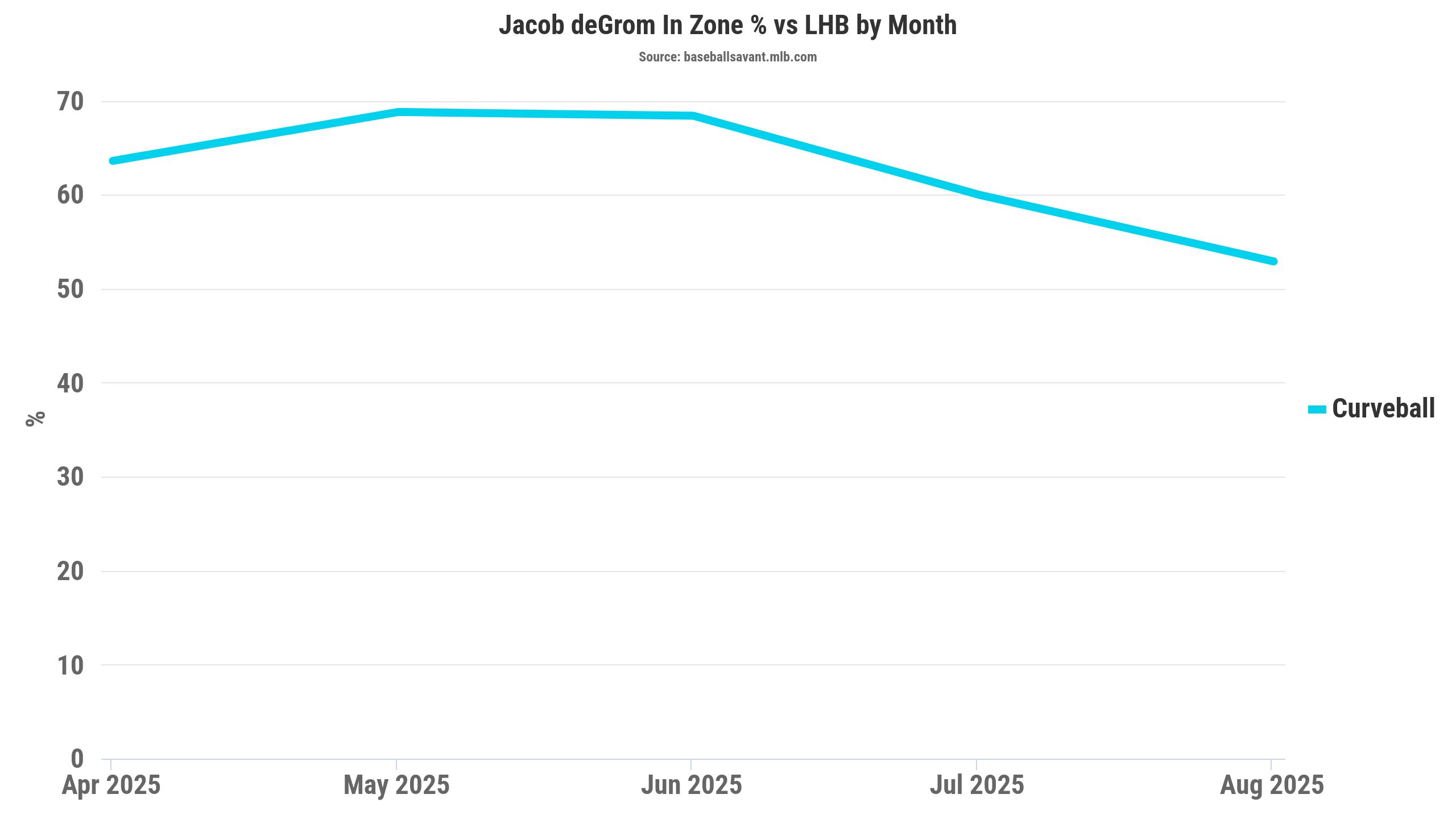
The curveball’s zone rate is down 15% from earlier in the year, with only half of his pitches finding the zone in August. When he’s throwing a curveball to freeze a hitter, it’s almost a free opportunity to get ahead in the count. Instead, DeGrom is finding himself climbing uphill more often, which runs up pitch counts and gets him out of the game quicker.
He doesn’t have to worry about batted balls, as there have only been 12 batted balls on 84 curveballs thrown. Only four batted balls have gone for hits, all singles.
On the other hand, the changeup is what matters in neutralizing lefties at the moment. Since the slider command is lost, DeGrom turned to the changeup to save the day.
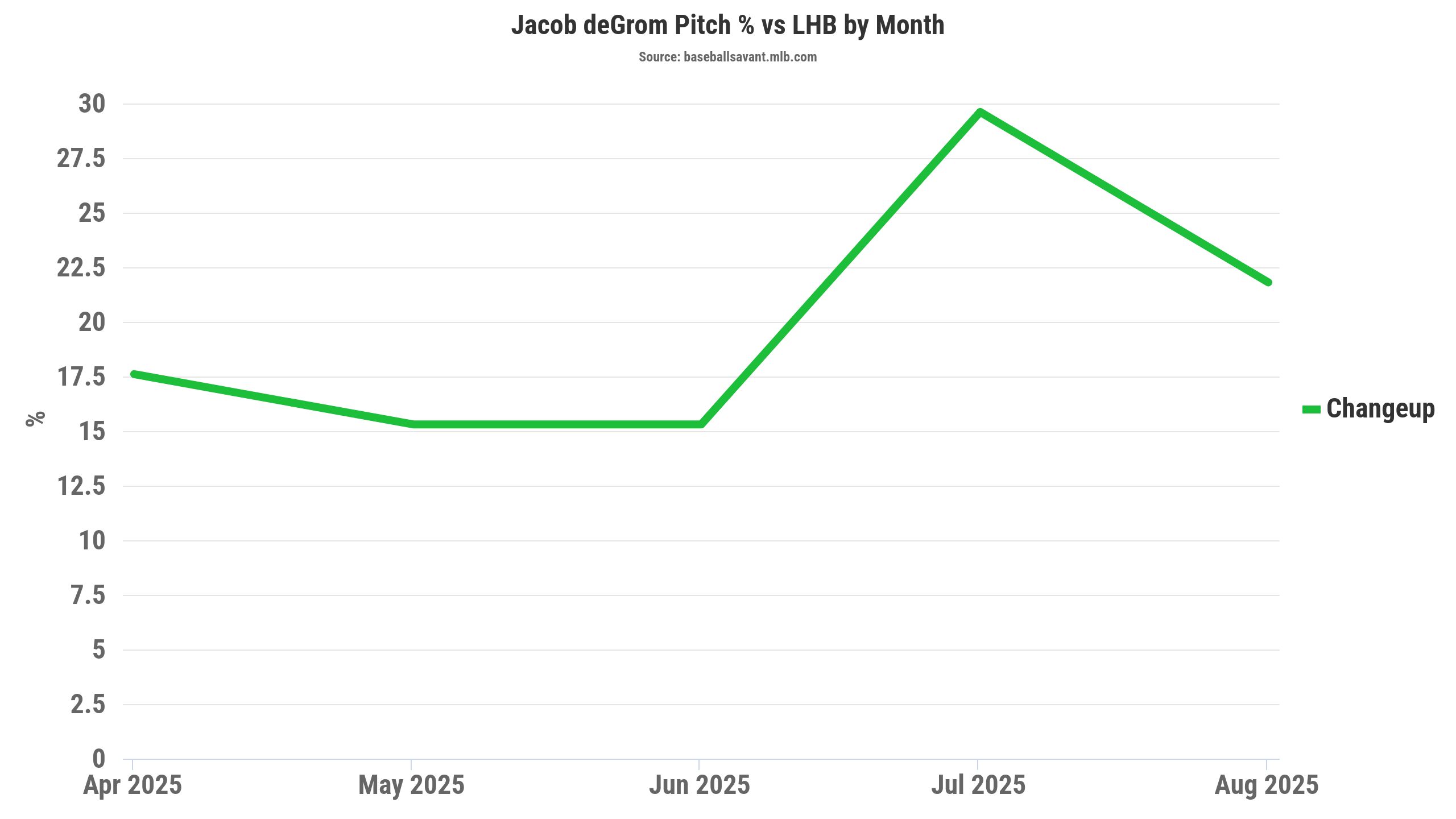
With increased usage, DeGrom also has steadily taken the pitch out of the zone. Since his slider and fastball are significantly better stuff-wise, they still operate as pitches in the zone. The changeup isn’t as devastating, and DeGrom is using it as a chase pitch. It’s working, as the changeup has a near-40% whiff rate (80th percentile) and a 33.6% chase rate (51st percentile).
These whiffs are now coming in better counts, which actually put away hitters when the slider is not. The changeup is thrown 25% of the time in two-strike counts in August, up from 11% in July and 8% in the earlier months. Lefties are also only hitting .083 on the pitch too.
The Health Concerns and What’s Next
DeGrom went from the classic version of himself to a pitcher who was scrambling to find solutions. Even though he’s maintained strong strikeout and walk numbers, his command has significantly affected his ERA and batted ball results.
His most recent start was skipped due to shoulder fatigue, but he’s all set to start going forward. The fatigue could be contributing to why he’s lost his touch, since the overall 2025 workload is far greater than in previous years. When he comes back, how the slider fares defines his outlook for the stretch run of 2025. If he’s actively getting strikes with it, he can utilize the fastball where he wants and avoid the longball problems. If not, the changeup will need to hold strong against lefties, and he’ll need to continue to manage against righties. He’s one of the greats for a reason; it’s just whether he can regain his Hall of Fame-worthy command.
