






Eddie Rosario is one of the best bad ball hitters in all of baseball. Over his years with the Twins, it’s become his signature move — while the rest of the Twins lineup has become known for drawing out ABs, taking walks, and forcing a pitcher to work for his outs, Rosario swings freely and makes enough contact for it to work out for him. At times, it has made Rosario look silly or prone to long slumps. At other times, Rosario does things like this:
Just a bit outside. 😏#MNTwins pic.twitter.com/sphILFH5sn
— Minnesota Twins (@Twins) August 4, 2020
or this:
🗣 EDDIE
🗣 EDDIE#MNTwins pic.twitter.com/ajFZ0Q1lze— Bally Sports North (@BallySportsNOR) August 1, 2020
This plate approach can make Rosario fun to watch, but he’s infuriating to have on a team. Part of every manager just knows that if Rosario ever loses bat speed, pitchers would be able to take advantage and render him useless. Fortunately, Rosario is changing.
Rosario’s New Approach
In the offseason this year, Rosario repeatedly committed to taking more pitches this year. In an interview Rosario gave, he told reporters that “I love being aggressive, but I want to help the team.” Aaron Gleeman of The Athletic also reported Rosario saying, “That’s one of the goals this season. Just to be more selective with pitches. When I swing at good pitches, my numbers are there. So I’m just going to concentrate on that and try to keep getting better.”
Fortunately, Eddie has made good on his word. Nearly every single plate discipline metric of his is dramatically improved his year, with Eddie going from one of the worst in baseball in many plate discipline statistics to above average.
| Season | K% | BB% | 1st Pitch Swing % | Chase % |
|---|---|---|---|---|
| 2018 | 17.60 | 5.10 | 61.50 | 41.60 |
| 2019 | 14.60 | 3.70 | 59.50 | 43.00 |
| 2020 | 10.70 | 12.50 | 51.80 | 34.60
|
These numbers are amazing! Rosario has decreased his strikeouts, over tripled his walk rate, and significantly decreased other swing rates. Everything we can see here points towards a rousing success for Rosario as far as his offseason changes go. In the past, when Rosario has approached the plate in a patient way, it has led to great success for him.
One statistic, which I originally heard reported by Justin Morneau and later saw repeated by Aaron Gleeman, does a great job of encapsulating that: “In the months when Rosario swung at more than 40 percent of pitches outside the strike zone, his OPS was .713. When he swung at fewer than 40 percent of out-of-zone pitches, his OPS rises to .838. And when Rosario swung at fewer than 35 percent of out-of-zone pitches — just six months across five seasons — his OPS jumped to .918.” So far this season, Rosario’s chase rate is at 34.6%. That would put him in the same bucket of plate discipline as when he has put up a .918 OPS in the past. For a player whose wRC+ in 2019 was only 103 with an OPS of exactly.800, that’s a significant jump.
Rosario’s Failures
Unfortunately for Rosario, that change hasn’t yet quite worked out how he wanted it to. For the most part, his numbers up to this point of the year have been downright hard to look at. Rosario’s slash line stands at .208/.300/.415, resulting in a .715 OPS that’s over 200 points lower than we had hoped for.
Those numbers do take a while to stabilize, so it’s not necessarily helpful to look at them and come to any significant conclusions yet. Rosario does have a .182 BABIP, and his ISO is right near his career norm. What is concerning is how much difficulty Rosario is having hitting the ball hard, which we can see from his Baseball Savant page.
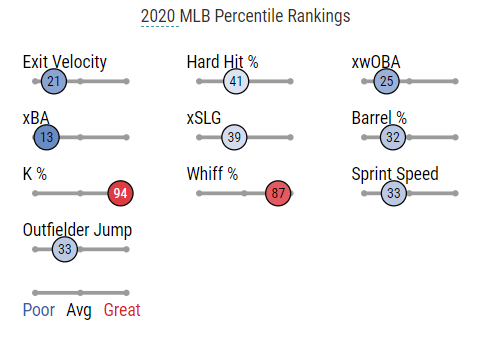
Rosario has never had difficulty in the past with these numbers. He’s never been an outlier, like his teammate Miguel Sano, but in 2019 he had a solidly above average 89.2 mph average exit velocity. Thus far this year, that number is 84.7. That number can be misleading on occasion (especially when comparing players) but it does show that on average Rosario isn’t driving the ball as well this year.
Fortunately, average exit velocity isn’t the only statistic we have to measure Rosario with. In fact, nearly every metric that measures Rosario’s quality of contact is down precipitously. Rosario’s sweet spot %? The metric dropped from a healthy 33.4% to an abysmal 20.9%. His xWOBACon fell from .388 to.235. And his hard hit% crashed by a full 10%.
Clearly, something isn’t working out for Rosario, as these results are utterly perplexing. He finally did what all analysis had hoped he would do, and yet, instead of having something to show for it, he’s produced his worst season to this point in his career. Ultimately, Rosario’s struggles may have come down to some of us confusing correlation and causation. It’s possible that Rosario didn’t succeed in past seasons because he was swinging outside the zone less often but instead, he swung outside the zone less often because he was hot and playing well with the pitches within the strike zone.
A Closer Look
In June 2018, Eddie Rosario was on fire. That month he slashed .330/.395/.689 and hit nine home runs. Everything that pitchers were throwing, Eddie was hitting — and demolishing. It’s also when he featured a chase rate of 31.1%, the lowest its been in his career. Most exciting to me, however, was his spectacularly low 10.5% whiff rate.
Rosario’s approach that month hadn’t changed; he was simply hitting more pitches early, before he had a chance to fall behind in the count and before pitchers could force him to change. That slash line is amazing, and the OBP is excellent, but its propped up by his .330 average. He walked slightly more than normal for him that month, but it was still below MLB’s average walk rate. Under the hood, there were no significant changes either: Rosario still swung well over half the time, closer to his career norms than his numbers in 2020.
As some look at Rosario’s chase rates this far into 2020 and think that he’s repeating that month in 2018, I’d like to caution you from believing that. This is a whole new Rosario.
This Rosario has a swing rate against fastballs and sinkers has never been lower than it has this season. Meanwhile, he’s swinging more than ever at sliders and curveballs. This isn’t a good thing. After all, the slider is the toughest commonly thrown pitch to hit and a high swing rate on curveballs for a batter who struggles with plate discipline doesn’t seem like a recipe for success, either.
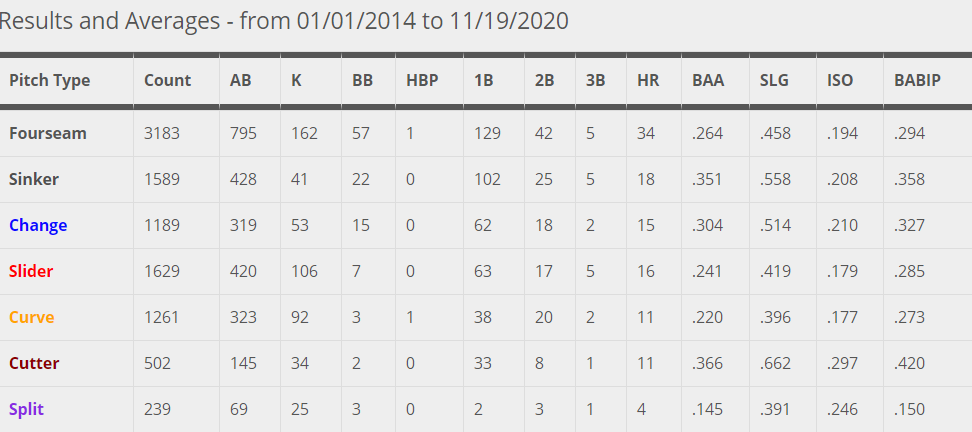
Indeed, Rosario has been significantly worse against breaking balls in his career, which we can see in this graphic from Brooks Baseball. If this is how Rosario’s plate approach is going to change, I don’t want it. Allowing Eddie to jump on an early fastball was never the problem — he performs well against four-seamers and excellently against sinkers and cutters. Instead, Rosario needed to learn to take more curveballs and sliders, pitches pitchers struggle to place in the zone, and which Rosario struggles to hit.
This year he hasn’t improved his plate approach. He’s simply taken a concerted effort to become less aggressive. When pitchers are able to sneak an early fastball by him and force him to swing at sliders and curveballs that they’ve completely fooled him on, they’ve won the first part of the plate appearance and gained a huge advantage.
It’s painful for me, a lover of walks, to say this, but Eddie Rosario needs to revert back to his old self. He doesn’t need to do so completely: keeping his chase% down seems like it doesn’t really have downside, but by and large, his changes this season have been harmful rather than helpful.
It’s not all bad, however. In the last few days, we’ve seen some of the potential of what Rosario could become. Rosario hit three home runs in a series this week against the Brewers. Twice, he did so while leading in the count, a time where we saw the potential upside that his new plate approach could lead to. If he can take balls early, he’ll force pitchers to throw the fastballs in the zone that he hits so well.
The other ball he hit out, however, was on a 0-0 count. Adrian Houser left a ball hanging in the zone and Rosario crushed it over the center-field wall for a grand slam. This is the kind of Rosario I want to see, a Rosario that is willing to take breaking balls early but swing at the balls he can mash. Eddie doesn’t need to lead the league in walks. That’s not his game and it’s not a strong suit for him. All Rosario needs to do is get ahead in the count more often so that he can better dictate the pitches thrown.
Overall, Rosario is a tough player to project into the future. If he continues to be passive early in counts, it’s likely he could continue to struggle. If he reverts back to 2019 Rosario, he’ll be okay, but nothing special. If, however, he manages to find the magic middle ground, he could reach the next step. I hope he can do so.
Photo by Larry Radloff/Icon Sportswire
